A post-processed higher-order multiscale method for nondivergence-form elliptic equations
Pith reviewed 2026-05-10 10:06 UTC · model grok-4.3
The pith
A post-processing strategy enables higher-order convergence rates in multiscale approximations of nondivergence-form elliptic equations with heterogeneous coefficients.
A machine-rendered reading of the paper's core claim, the machinery that carries it, and where it could break.
Core claim
The central claim is that a multiscale method based on localized orthogonal decomposition, equipped with a stabilized formulation for the gradient and a post-processing step, delivers higher-order convergence for nondivergence elliptic problems despite the low regularity of the load functional, under the assumption of a generalized Cordes condition.
What carries the argument
The post-processing strategy applied to the localized orthogonal decomposition approximation, enabled by the stabilized symmetric formulation for the gradient in the nondivergence-form variational setting.
Load-bearing premise
The generalized Cordes condition must hold to ensure that a renormalized version of the nondivergence-form operator is sufficiently close to the Laplacian.
What would settle it
Numerical experiments on a problem where the generalized Cordes condition is not satisfied would fail to show the higher-order convergence rates promised by the post-processing.
Figures


read the original abstract
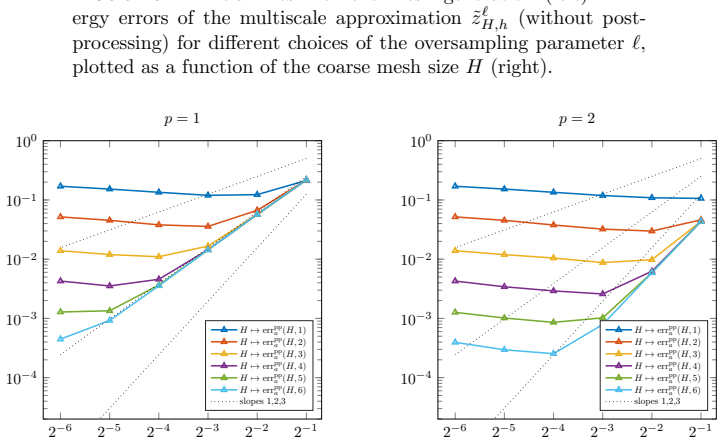
We study the finite element approximation of linear second-order elliptic partial differential equations in nondivergence form with highly heterogeneous diffusion and drift coefficients. A generalized Cordes condition is imposed to guarantee that a suitably renormalized version of the nondivergence-form differential operator is near the Laplacian. Based on a stabilized symmetric formulation for the gradient that enables the use of $H^1$-conforming approximation spaces, we construct a multiscale method following the methodology of the localized orthogonal decomposition with coarse basis functions tailored to the heterogeneous coefficients. We employ a novel post-processing strategy to obtain higher-order convergence rates, overcoming previous limitations imposed by the low regularity of the load functional. Numerical experiments demonstrate the performance of the method.
Editorial analysis
A structured set of objections, weighed in public.
Referee Report
Summary. The paper develops a multiscale finite element method for linear second-order elliptic PDEs in nondivergence form with highly heterogeneous diffusion and drift coefficients. A generalized Cordes condition is imposed to renormalize the operator so that it is close to the Laplacian. The method uses a stabilized symmetric formulation allowing H^1-conforming spaces, constructs an LOD multiscale scheme with coefficient-adapted coarse basis functions, and applies a novel post-processing step to recover higher-order convergence rates that overcome limitations from low-regularity loads. Numerical experiments illustrate the approach.
Significance. If the renormalization yields uniform constants independent of heterogeneity and the post-processing error analysis is complete, the work would advance multiscale approximation for nondivergence-form problems, which lack standard variational structure. The post-processing idea to bypass load-regularity barriers and the numerical demonstration of performance are concrete strengths.
major comments (1)
- [Section introducing the generalized Cordes condition and the renormalized operator] The generalized Cordes condition is invoked to guarantee that the renormalized nondivergence operator remains close to the Laplacian, enabling standard LOD and stabilized H^1 estimates. However, the manuscript does not appear to establish that the renormalization factor and its bounds remain uniform with respect to the scale of coefficient oscillations. Without such uniformity, the coercivity constant, localization error, and post-processing correction term acquire hidden dependence on the heterogeneity, which would undermine the claimed higher-order rates.
minor comments (1)
- [Abstract] The abstract states that the post-processing overcomes limitations from low load regularity, but the precise convergence rates (e.g., O(H^2) or better) and the regularity assumptions on the load are not quantified there.
Simulated Author's Rebuttal
We thank the referee for the careful reading of the manuscript and the constructive comment regarding the uniformity of the renormalization constants. We address this point below and will incorporate a clarification in the revised version.
read point-by-point responses
-
Referee: [Section introducing the generalized Cordes condition and the renormalized operator] The generalized Cordes condition is invoked to guarantee that the renormalized nondivergence operator remains close to the Laplacian, enabling standard LOD and stabilized H^1 estimates. However, the manuscript does not appear to establish that the renormalization factor and its bounds remain uniform with respect to the scale of coefficient oscillations. Without such uniformity, the coercivity constant, localization error, and post-processing correction term acquire hidden dependence on the heterogeneity, which would undermine the claimed higher-order rates.
Authors: We appreciate the referee's observation on this key technical point. The generalized Cordes condition (Assumption 2.1) is stated with parameters α and β that are independent of the oscillation scale by construction, as they are required to hold uniformly for the given heterogeneous coefficients. The renormalization factor λ is defined pointwise from the coefficients in a manner that inherits this uniformity, yielding a coercivity constant γ for the renormalized operator that depends only on α, β and the dimension (see the estimates following (2.4)). Consequently, the LOD basis construction, localization error bounds, and post-processing correction inherit the same independence from the small-scale oscillations. Nevertheless, we acknowledge that an explicit statement or auxiliary lemma confirming this independence is not present in the current draft. We will therefore add a short lemma in Section 2 (immediately after the definition of the renormalized operator) that derives the uniform bounds on γ and the deviation from the Laplacian directly from the scale-independent Cordes parameters. This addition will make the uniformity explicit and ensure the higher-order rates are rigorously free of hidden heterogeneity dependence, while leaving the main theorems and numerical results unchanged. revision: yes
Circularity Check
No circularity: extends LOD with independent post-processing under external Cordes assumption
full rationale
The derivation imposes the generalized Cordes condition as an external hypothesis to renormalize the nondivergence operator near the Laplacian, then applies established localized orthogonal decomposition (LOD) techniques plus a novel post-processing step for higher-order rates. No step reduces a claimed prediction or uniqueness result to a fit on the same data, a self-citation chain, or a self-definitional ansatz. The post-processing is described as overcoming low load regularity independently rather than being constructed from the multiscale basis itself. This is the common honest case of a self-contained extension of prior methods.
Axiom & Free-Parameter Ledger
axioms (1)
- domain assumption Generalized Cordes condition on the coefficients
Reference graph
Works this paper leans on
-
[1]
S. Armstrong, B. Fehrman, and J. Lin. Green function and invariant measure estimates for nondivergence form elliptic homogenization, 2022. arXiv:2211.13279
-
[2]
R. Altmann, P. Henning, and D. Peterseim. Numerical homogenization beyond scale separation. Acta Numerica , 30:1–86, 2021
work page 2021
- [3]
-
[4]
N. T. Bishop. The P oincar\'e inequality for a vector field with zero tangential or normal component on the boundary. Quaestiones Math. , 11(2):195--199, 1988
work page 1988
- [5]
-
[6]
F. Camilli and C. Marchi. Rates of convergence in periodic homogenization of fully nonlinear uniformly elliptic PDE s. Nonlinearity , 22(6):1481--1498, 2009
work page 2009
-
[7]
H. O. Cordes. \" U ber die erste R andwertaufgabe bei quasilinearen D ifferentialgleichungen zweiter O rdnung in mehr als zwei V ariablen. Math. Ann. , 131:278--312, 1956
work page 1956
-
[8]
Y. Capdeboscq, T. Sprekeler, and E. S\" u li. Finite element approximation of elliptic homogenization problems in nondivergence-form. ESAIM Math. Model. Numer. Anal. , 54(4):1221--1257, 2020
work page 2020
-
[9]
Z. Dong, M. Hauck, and R. Maier. An improved high-order method for elliptic multiscale problems. SIAM J. Numer. Anal. , 61(4):1918–1937, 2023
work page 1918
-
[10]
D.A. Di Pietro and A. Ern. Mathematical Aspects of Discontinuous Galerkin Methods . Math \'e matiques et Applications. Springer Berlin Heidelberg, 2011
work page 2011
-
[11]
A. Ern and J.-L. Guermond. Theory and Practice of Finite Elements , volume 159 of Applied Mathematical Sciences . Springer New York, 2004
work page 2004
- [12]
-
[13]
B. D. Froese and A. M. Oberman. Numerical averaging of non-divergence structure elliptic operators. Commun. Math. Sci. , 7(4):785--804, 2009
work page 2009
-
[14]
C. Finlay and A. M. Oberman. Approximate homogenization of convex nonlinear elliptic PDE s. Commun. Math. Sci. , 16(7):1895--1906, 2018
work page 1906
-
[15]
C. Finlay and A. M. Oberman. Approximate homogenization of fully nonlinear elliptic PDE s: estimates and numerical results for P ucci type equations. J. Sci. Comput. , 77(2):936--949, 2018
work page 2018
- [16]
- [17]
-
[18]
D. Gallistl, T. Sprekeler, and E. S\" u li. Mixed F inite E lement A pproximation of P eriodic H amilton-- J acobi-- B ellman P roblems W ith A pplication to N umerical H omogenization. Multiscale Model. Simul. , 19(2):1041--1065, 2021
work page 2021
-
[19]
X. Guo, T. Sprekeler, and H. V. Tran. Characterizations of diffusion matrices in homogenization of elliptic equations in nondivergence-form. Calc. Var. Partial Differential Equations , 64(1), 2025. Paper No. 1
work page 2025
- [20]
- [21]
- [22]
-
[23]
X. Guo, H. V. Tran, and Y. Yu. Remarks on optimal rates of convergence in periodic homogenization of linear elliptic equations in non-divergence form. Partial Differ. Equ. Appl. , 1(4), 2020. Paper No. 15
work page 2020
-
[24]
F. Hellman, P. Henning, and A. M lqvist. Multiscale mixed finite elements. Discrete Contin. Dyn. Syst. Ser. S , 9(5):1269--1298, 2016
work page 2016
-
[25]
M. Hauck and A. Lozinski. A high-order localized orthogonal decomposition method for heterogeneous S tokes problems, 2025. arXiv:2511.22684
-
[26]
M. Hauck and A. Lozinski. A localized orthogonal decomposition method for heterogeneous S tokes problems. SIAM J. Numer. Anal. , 63(4):1617--1641, 2025
work page 2025
- [27]
-
[28]
P. Henning, H. Li, and T. Sprekeler. Stable localized orthogonal decomposition in R aviart- T homas spaces. IMA J. Numer. Anal. , in press, 2026
work page 2026
-
[29]
F. Hellman and A. M lqvist. Contrast independent localization of multiscale problems. Multiscale Model. Simul. , 15:1325--1355, 2017
work page 2017
-
[30]
F. Hellman and A. M lqvist. Numerical homogenization of elliptic PDE s with similar coefficients. Multiscale Model. Simul. , 17(2):650--674, 2019
work page 2019
- [31]
-
[32]
M. Hauck and D. Peterseim. Multi-resolution localized orthogonal decomposition for helmholtz problems. Multiscale Model. Sim. , 20(2):657–684, 2022
work page 2022
-
[33]
M. Hauck and D. Peterseim. Super-localization of elliptic multiscale problems. Math. Comp. , 92(341):981–1003, 2022
work page 2022
-
[34]
B. Kalyanaraman, F. Krumbiegel, R. Maier, and S. Wang. Optimal higher-order convergence rates for parabolic multiscale problems, 2025. arXiv:2510.09514
work page internal anchor Pith review arXiv 2025
-
[35]
R. C. Kirby and L. Mitchell. Code generation for generally mapped finite elements. ACM Trans. Math. Software , 45(4):Art. 41, 23, 2019
work page 2019
-
[36]
E. L. Kawecki and T. Sprekeler. Discontinuous G alerkin and C^0 - IP finite element approximation of periodic H amilton- J acobi- B ellman- I saacs problems with application to numerical homogenization. ESAIM Math. Model. Numer. Anal. , 56(2):679--704, 2022
work page 2022
-
[37]
R. Maier. A high-order approach to elliptic multiscale problems with general unstructured coefficients. SIAM J. Numer. Anal. , 59(2):1067–1089, 2021
work page 2021
-
[38]
A. M lqvist and D. Peterseim. Localization of elliptic multiscale problems. Math. Comp. , 83(290):2583--2603, 2014
work page 2014
-
[39]
A. Målqvist and D. Peterseim. Numerical Homogenization by Localized Orthogonal Decomposition . Society for Industrial and Applied Mathematics, 2020
work page 2020
-
[40]
J. Qian, T. Sprekeler, H. V. Tran, and Y. Yu. Optimal R ate of C onvergence in P eriodic H omogenization of V iscous H amilton- J acobi E quations. Multiscale Model. Simul. , 22(4):1558--1584, 2024
work page 2024
- [41]
- [42]
-
[43]
I. Smears and E. S\" u li. Discontinuous G alerkin finite element approximation of nondivergence form elliptic equations with C ord\`es coefficients. SIAM J. Numer. Anal. , 51(4):2088--2106, 2013
work page 2088
-
[44]
I. Smears and E. S\"uli. Discontinuous G alerkin finite element approximation of H amilton- J acobi- B ellman equations with C ordes coefficients. SIAM J. Numer. Anal. , 52(2):993--1016, 2014
work page 2014
-
[45]
T. Sprekeler, E. S\"uli, and Z. Zhang. Finite element approximation of stationary F okker- P lanck- K olmogorov equations with application to periodic numerical homogenization. SIAM J. Numer. Anal. , 63(3):1315--1343, 2025
work page 2025
-
[46]
T. Sprekeler and H. V. Tran. Optimal convergence rates for elliptic homogenization problems in nondivergence-form: analysis and numerical illustrations. Multiscale Model. Simul. , 19(3):1453--1473, 2021
work page 2021
-
[47]
T. Sprekeler, H. Wu, and Z. Zhang. Numerical approximation of effective diffusivities in homogenization of nondivergence-form equations with large drift by a L agrangian method, 2025. arXiv:2506.14073
-
[48]
G. Talenti. Sopra una classe di equazioni ellittiche a coefficienti misurabili. Ann. Mat. Pura Appl. (4) , 69:285--304, 1965
work page 1965
discussion (0)
Sign in with ORCID, Apple, or X to comment. Anyone can read and Pith papers without signing in.