Direct and Ambient Backscatter Communications with a Dual-Function Radar Transmitter
Pith reviewed 2026-05-10 10:01 UTC · model grok-4.3
The pith
A radar transmitter can send its message while enabling a tag to communicate via environmental clutter reflections.
A machine-rendered reading of the paper's core claim, the machinery that carries it, and where it could break.
Core claim
By embedding the source message in repeated coded radar pulses, the transmitter simultaneously enables direct communication to a reader and ambient backscatter communication from a tag that exploits clutter as carrier; the induced subspace structure supports joint or disjoint decoding without pilots, while pilot-aided variants allow non-iterative or iterative recovery, all under codebook conditions that ensure noiseless identifiability of messages and channels.
What carries the argument
Subspace structure induced in the received signal by the repeated coded radar pulses, which separates the combined source and tag contributions for joint or disjoint message and channel recovery.
If this is right
- Joint decoding recovers source and tag messages along with all channel vectors simultaneously from the subspace structure.
- Disjoint decoding first isolates the tag codeword and then estimates the source codeword and channels.
- Pilot-aided operation yields both a non-iterative decoder that uses pilot-derived channel estimates and an iterative decoder that alternates estimation and detection.
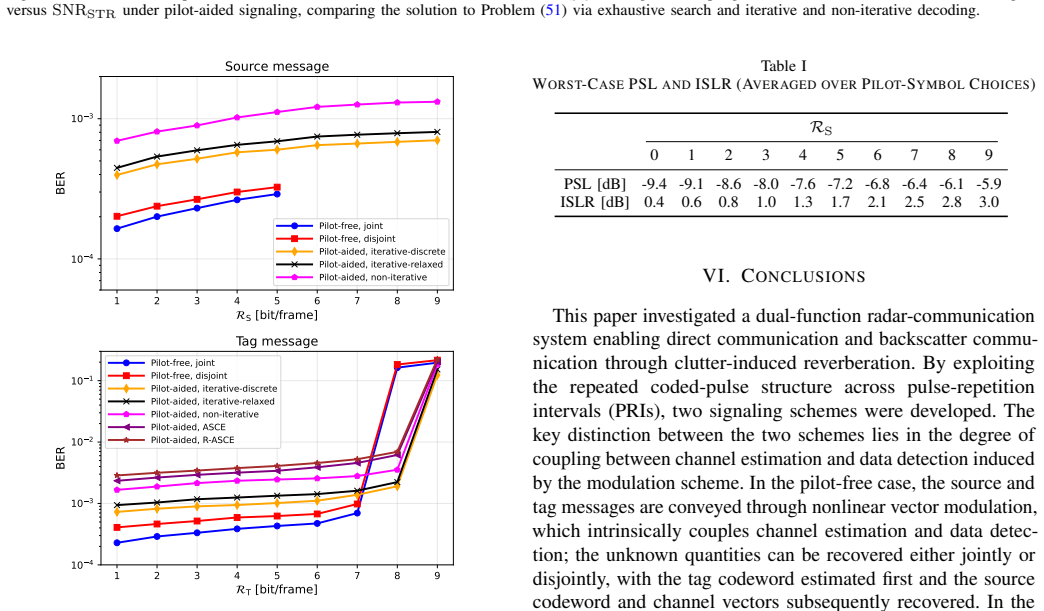
- Source and tag error probabilities together with channel-estimation accuracy quantify the performance of each scheme.
- Explicit tradeoffs between pilot-free and pilot-aided operation appear once codebook size, frame length, and SNR are fixed.
Where Pith is reading between the lines
- The same waveform structure could support multiple tags if additional codebook orthogonality conditions are imposed.
- In environments where clutter statistics are known, the subspace dimension might be used to adapt codebook sizes dynamically.
- Extending the identifiability conditions to include Doppler or moving tags would require only modest changes to the current subspace argument.
Load-bearing premise
The clutter must supply a sufficiently structured and stable ambient carrier whose reflections match the assumed model, without extra interference or mismatches that would break the subspace separation.
What would settle it
Generate a noiseless received-signal realization using the stated codebooks and known clutter response; run the proposed joint or disjoint decoder and verify whether it recovers the exact source and tag codewords together with the channel vectors.
Figures


read the original abstract
This work considers a system where a dual-function radar transmitter (source) performs direct communication with a reader while simultaneously enabling ambient backscatter communication from a tag. The source embeds its message into a coded pulse repeatedly transmitted over a frame, whereas the tag exploits the resulting environmental reverberation (clutter) as an ambient carrier to convey its own message. By leveraging the structure induced by the radar waveforms, we develop two signaling schemes. In the pilot-free scheme, the source and tag messages are conveyed through nonlinear vector modulation; the induced subspace structure enables both joint decoding, where all unknown quantities are simultaneously estimated, and disjoint decoding, where the tag codeword is recovered first, followed by the estimation of the source codeword and the channel vectors. In the pilot-aided scheme, pilot symbols and linearly modulated data symbols are embedded within each frame, enabling both non-iterative decoding based on pilot-derived channel estimates and iterative decoding via alternating channel estimation and data detection. We establish sufficient conditions on the source and tag codebooks that guarantee noiseless identifiability of the involved messages and channels. Finally, performance is evaluated in terms of source/tag error probabilities and channel-estimation accuracy, and the resulting system-level tradeoffs are discussed.
Editorial analysis
A structured set of objections, weighed in public.
Referee Report
Summary. The manuscript considers a dual-function radar transmitter that embeds its message in coded pulses while enabling ambient backscatter from a tag that uses environmental clutter as carrier. It develops a pilot-free nonlinear vector modulation scheme supporting joint or disjoint decoding via induced subspace structure, and a pilot-aided scheme with linear modulation for non-iterative or iterative decoding. Sufficient conditions on source and tag codebooks are established to guarantee noiseless identifiability of messages and channels. Performance is assessed through source/tag error probabilities and channel estimation accuracy, with discussion of system tradeoffs.
Significance. If the identifiability results hold, the work provides a theoretically grounded approach to integrating radar waveforms with direct and ambient backscatter communications, exploiting clutter structure for pilot-free operation in one scheme. The subspace-based decoding and codebook conditions offer concrete design guidelines for ISAC systems, and the joint/disjoint and iterative options highlight practical flexibility. Strengths include the focus on noiseless identifiability derived from waveform structure and the explicit sufficient conditions rather than empirical fitting.
major comments (2)
- [§2] §2 (system model): The treatment of clutter as a fixed unknown deterministic vector is load-bearing for the subspace structure in both schemes; the paper should state the precise conditions (e.g., stationarity over the frame) under which this holds, as any time variation would invalidate the identifiability claims in Theorems 1 and 2.
- [§4] §4 (identifiability analysis): The sufficient conditions on the source and tag codebooks guarantee noiseless recovery only under the exact model with no additional interference; a brief sensitivity analysis or counter-example showing breakdown under mild mismatch would clarify the robustness of the central claim.
minor comments (2)
- [§5] §5 (numerical results): The error probability and estimation accuracy plots would be clearer with explicit mention of the codebook constructions (e.g., random or structured) and frame length used in the simulations.
- Notation: The distinction between joint and disjoint decoding subspaces is introduced without a compact summary table; adding one would aid readability.
Simulated Author's Rebuttal
We thank the referee for the positive assessment and constructive comments, which help improve the clarity of the manuscript. We address each major comment below.
read point-by-point responses
-
Referee: [§2] §2 (system model): The treatment of clutter as a fixed unknown deterministic vector is load-bearing for the subspace structure in both schemes; the paper should state the precise conditions (e.g., stationarity over the frame) under which this holds, as any time variation would invalidate the identifiability claims in Theorems 1 and 2.
Authors: We agree that the fixed clutter vector assumption is essential to the subspace structure underlying both signaling schemes and the identifiability results. In the revised manuscript, we will explicitly state in Section 2 that the clutter is modeled as a deterministic vector constant over the frame duration (i.e., stationary over the observation interval). We will also note that time variation in the clutter would invalidate the current subspace-based identifiability claims in Theorems 1 and 2, thereby clarifying the model assumptions without changing the technical contributions. revision: yes
-
Referee: [§4] §4 (identifiability analysis): The sufficient conditions on the source and tag codebooks guarantee noiseless recovery only under the exact model with no additional interference; a brief sensitivity analysis or counter-example showing breakdown under mild mismatch would clarify the robustness of the central claim.
Authors: The theorems establish sufficient conditions for noiseless identifiability strictly under the exact system model, which is the conventional approach for deriving such guarantees. While a comprehensive sensitivity analysis lies outside the paper's scope, we will add a concise discussion in Section 4 acknowledging the model assumptions and observing that mismatches (e.g., unmodeled interference) would degrade performance, consistent with the error-rate simulations already presented. This provides the requested clarification on robustness without requiring new derivations. revision: partial
Axiom & Free-Parameter Ledger
axioms (2)
- domain assumption Radar waveforms induce a usable subspace structure in the received signals for decoding.
- domain assumption Sufficient conditions on source and tag codebooks guarantee noiseless identifiability.
Reference graph
Works this paper leans on
-
[1]
Mazar,Radio spectrum Management: Policies, regulations and techniques
H. Mazar,Radio spectrum Management: Policies, regulations and techniques. USA: John Wiley & Sons, 2016
work page 2016
-
[2]
6G internet of things: A comprehensive survey,
D. C. Nguyenet al., “6G internet of things: A comprehensive survey,” IEEE Internet of Things Journal, vol. 9, no. 1, pp. 359–383, Jan. 2022
work page 2022
-
[3]
Ambient backscatter communications: A con- temporary survey,
N. Van Huynhet al., “Ambient backscatter communications: A con- temporary survey,”IEEE Communications Surveys & Tutorials, vol. 20, no. 4, pp. 2889–2922, Fourthquarter 2018
work page 2018
-
[4]
B. Gu, D. Li, H. Ding, G. Wang, and C. Tellambura, “Breaking the interference and fading gridlock in backscatter communications: State-of- the-art, design challenges, and future directions,”IEEE Communications Surveys & Tutorials, vol. 27, no. 2, pp. 870–911, Apr. 2025
work page 2025
-
[5]
Communication by means of reflected power,
H. Stockman, “Communication by means of reflected power,”Proceed- ings of the IRE, vol. 36, no. 10, pp. 1196–1204, Oct. 1948
work page 1948
-
[6]
Ambient backscatter: Wireless communication out of thin air,
V . Liuet al., “Ambient backscatter: Wireless communication out of thin air,” inProc. of ACM SIGCOMM, Hong Kong, China, Aug. 2013, p. 39–50
work page 2013
-
[7]
R. Duanet al., “Ambient backscatter communications for future ultra- low-power machine type communications: Challenges, solutions, oppor- tunities, and future research trends,”IEEE Communications Magazine, vol. 58, no. 2, pp. 42–47, Feb. 2020
work page 2020
-
[8]
Zero-energy devices em- powered 6G networks: Opportunities, key technologies, and challenges,
S. Naser, L. Bariah, S. Muhaidat, and E. Basar, “Zero-energy devices em- powered 6G networks: Opportunities, key technologies, and challenges,” IEEE Internet of Things Magazine, vol. 6, no. 3, pp. 44–50, Sep. 2023
work page 2023
-
[9]
Symbiotic radio: A new communication paradigm for passive internet of things,
R. Long, Y .-C. Liang, H. Guo, G. Yang, and R. Zhang, “Symbiotic radio: A new communication paradigm for passive internet of things,”IEEE Internet of Things Journal, vol. 7, no. 2, pp. 1350–1363, Feb. 2020
work page 2020
-
[10]
Symbiotic radio: Cognitive backscattering communications for future wireless networks,
Y .-C. Liang, Q. Zhang, E. G. Larsson, and G. Y . Li, “Symbiotic radio: Cognitive backscattering communications for future wireless networks,” IEEE Transactions on Cognitive Communications and Networking, vol. 6, no. 4, pp. 1242–1255, Dec. 2020
work page 2020
-
[11]
H. Xu, M. Mo, Z. Chen, and J. Wang, “Cognitive backscatter commu- nication: Symbiotic radio systems assisted by reconfigurable intelligent surface,”IEEE Internet of Things Magazine, vol. 8, no. 2, pp. 62–68, Mar. 2025
work page 2025
-
[12]
Signal detection in ambient backscatter systems: Fundamentals, methods, and trends,
S. Zargari, A. Hakimi, F. Rezaei, C. Tellambura, and A. Maaref, “Signal detection in ambient backscatter systems: Fundamentals, methods, and trends,”IEEE Access, vol. 11, pp. 140 287–140 324, 2023
work page 2023
-
[13]
Coding techniques for backscatter communications—a contemporary survey,
F. Rezaei, D. Galappaththige, C. Tellambura, and S. Herath, “Coding techniques for backscatter communications—a contemporary survey,” IEEE Communications Surveys & Tutorials, vol. 25, no. 2, pp. 1020– 1058, Secondquarter 2023
work page 2023
-
[14]
Radio resource management in joint radar and communication: A comprehensive survey,
N. C. Luong, X. Lu, D. T. Hoang, D. Niyato, and D. I. Kim, “Radio resource management in joint radar and communication: A comprehensive survey,”IEEE Communications Surveys & Tutorials, vol. 23, no. 2, pp. 780–814, 2021
work page 2021
-
[15]
Integrated sensing and communications over the years: An evolution perspective,
D. Zhanget al., “Integrated sensing and communications over the years: An evolution perspective,”IEEE Communications Surveys & Tutorials, pp. 1–1, 2026
work page 2026
-
[16]
Performance trade-off of integrated sensing and communications for multi-user backscatter systems,
Y . Tian, D. Wang, C. Huang, and W. Zhang, “Performance trade-off of integrated sensing and communications for multi-user backscatter systems,”IEEE Transactions on Wireless Communications, vol. 23, no. 11, pp. 17 310–17 323, Nov. 2024
work page 2024
-
[17]
Multichan- nel radar backscatter communication and localization,
I. Cnaan-On, S. J. Thomas, M. S. Reynolds, and J. L. Krolik, “Multichan- nel radar backscatter communication and localization,” in2014 IEEE International Conference on Acoustics, Speech and Signal Processing (ICASSP), May 2014, pp. 76–80
work page 2014
-
[18]
Multi- channel backscatter communication and ranging for distributed sensing with an FMCW radar,
I. Cnaan-On, S. J. Thomas, J. L. Krolik, and M. S. Reynolds, “Multi- channel backscatter communication and ranging for distributed sensing with an FMCW radar,”IEEE Transactions on Microwave Theory and Techniques, vol. 63, no. 7, pp. 2375–2383, Jul. 2015
work page 2015
-
[19]
D. Maet al., “Integrated sensing, identification, and backscatter commu- nication system utilizing inverse scattering approach,”IEEE Transactions on Antennas and Propagation, vol. 73, no. 8, pp. 5877–5889, Aug. 2025
work page 2025
-
[20]
Transmit power- efficient beamforming design for integrated sensing and backscatter communication,
S. Zargari, D. Galappaththige, and C. Tellambura, “Transmit power- efficient beamforming design for integrated sensing and backscatter communication,”IEEE Open Journal of the Communications Society, vol. 6, pp. 775–792, 2025
work page 2025
-
[21]
Integrated sensing and backscatter communication for target identification and parameter estimation,
S. Li, J. Chen, J. Ge, and Y .-C. Liang, “Integrated sensing and backscatter communication for target identification and parameter estimation,”IEEE Transactions on Wireless Communications, vol. 25, pp. 6695–6710, 2026
work page 2026
-
[22]
Backscatter communication assisted by reconfigurable intelligent surfaces,
Y .-C. Lianget al., “Backscatter communication assisted by reconfigurable intelligent surfaces,”Proceedings of the IEEE, vol. 110, no. 9, pp. 1339– 1357, Sep. 2022
work page 2022
-
[23]
Integrated sensing and communication for RIS-assisted backscatter systems,
X. Wang, Z. Fei, and Q. Wu, “Integrated sensing and communication for RIS-assisted backscatter systems,”IEEE Internet of Things Journal, vol. 10, no. 15, pp. 13 716–13 726, Aug. 2023
work page 2023
-
[24]
S. Han, J. Wang, C. Li, and E. Hossain, “Principles, applications, and challenges of reconfigurable intelligent surface-enabled backscatter communication: A comprehensive survey and outlook,”IEEE Communi- cations Surveys & Tutorials, vol. 27, no. 5, pp. 2937–2972, Oct. 2025
work page 2025
-
[25]
ISAC STAR-RIS transceivers with space-time coded pulsed signals,
H. Taremizadeh, E. Grossi, L. Venturino, and M. Lops, “ISAC STAR-RIS transceivers with space-time coded pulsed signals,”IEEE Open Journal of the Communications Society, vol. 6, pp. 9569–9586, 2025
work page 2025
-
[26]
M. I. Skolnik,Introduction to radar systems, 3rd ed. New York, NY , USA: McGraw-Hill Higher Education, 2001
work page 2001
-
[27]
N. Levanon and E. Mozeson,Radar Signals. Hoboken, NY , USA: Wiley, 2004
work page 2004
-
[28]
Radar- enabled backscatter communication,
J. Johnston, L. Venturino, E. Grossi, M. Lops, and X. Wang, “Radar- enabled backscatter communication,” in2022 Asilomar Conference on Signals, Systems, and Computers, Pacific Grove, CA, USA, Oct. 2022
work page 2022
-
[29]
Joint data and channel estimation in radar-enabled backscatter communications,
L. Venturino, E. Grossi, J. Johnston, M. Lops, and X. Wang, “Joint data and channel estimation in radar-enabled backscatter communications,” in2023 IEEE International Workshop on Technologies for Defense and Security (TechDefense), Nov. 2023, pp. 368–372
work page 2023
-
[30]
Radar- enabled ambient backscatter communications,
L. Venturino, E. Grossi, M. Lops, J. Johnston, and X. Wang, “Radar- enabled ambient backscatter communications,”IEEE Transactions on Wireless Communications, vol. 22, no. 12, pp. 8666–8680, Dec. 2023
work page 2023
-
[31]
Pilot- assisted ambient backscatter communications exploiting radar clutter,
L. Venturino, E. Grossi, J. Johnston, M. Lops, and X. Wang, “Pilot- assisted ambient backscatter communications exploiting radar clutter,” in 2024 IEEE Radar Conference (RadarConf24), May 2024, pp. 1–6
work page 2024
-
[32]
Semi- blind multi-tag ambient backscatter communications using radar signals,
L. Venturino, E. Grossi, J. Johnston, M. Lops, and X. Wang, “Semi- blind multi-tag ambient backscatter communications using radar signals,” IEEE Transactions on Wireless Communications, vol. 23, no. 12, pp. 19 870–19 884, Dec. 2024
work page 2024
-
[33]
Radar-enabled integrated sensing and backscatter communication systems,
S. Zeng, X. Kuai, and Y .-C. Liang, “Radar-enabled integrated sensing and backscatter communication systems,” inICC 2025 - IEEE International Conference on Communications, Jun. 2025, pp. 4050–4055
work page 2025
-
[34]
Embedding information into radar emissions via waveform implementation,
S. D. Blunt, M. R. Cook, and J. Stiles, “Embedding information into radar emissions via waveform implementation,” in2010 International Waveform Diversity and Design Conference, Aug. 2010, pp. 195–199
work page 2010
-
[35]
Code shift keying based joint radar and communications for emcon applications,
T. W. Tedesso and R. Romero, “Code shift keying based joint radar and communications for emcon applications,”Digital Signal Processing, vol. 80, pp. 48–56, 2018
work page 2018
-
[36]
Dual-function radar communication systems: A solution to the spectrum congestion problem,
A. Hassanien, M. G. Amin, E. Aboutanios, and B. Himed, “Dual-function radar communication systems: A solution to the spectrum congestion problem,”IEEE Signal Processing Magazine, vol. 36, no. 5, pp. 115–126, Sep. 2019
work page 2019
-
[37]
Ambient backscatter communication systems: Detection and performance analysis,
G. Wang, F. Gao, R. Fan, and C. Tellambura, “Ambient backscatter communication systems: Detection and performance analysis,”IEEE Transactions on Communications, vol. 64, no. 11, pp. 4836–4846, Nov. 2016
work page 2016
-
[38]
J. Proakis and M. Salehi,Digital Communications, 5th ed. New York, NY , USA: McGraw-Hill Higher Education, 2014
work page 2014
-
[39]
A fast iterative shrinkage-thresholding algorithm for linear inverse problems,
A. Beck and M. Teboulle, “A fast iterative shrinkage-thresholding algorithm for linear inverse problems,”SIAM Journal on Imaging Sciences, vol. 2, no. 1, pp. 183–202, 2009
work page 2009
-
[40]
Square-root lasso: pivotal recovery of sparse signals via conic programming,
A. Belloni, V . Chernozhukov, and L. Wang, “Square-root lasso: pivotal recovery of sparse signals via conic programming,”Biometrika, vol. 98, no. 4, pp. 791–806, 2011
work page 2011
-
[41]
D. P. Bertsekas, “Nonlinear programming,”Journal of the Operational Research Society, vol. 48, no. 3, pp. 334–334, 1997
work page 1997
-
[42]
Generalized radar clutter model,
D. Shnidman, “Generalized radar clutter model,”IEEE Transactions on Aerospace and Electronic Systems, vol. 35, no. 3, pp. 857–865, Jul. 1999
work page 1999
-
[43]
Optimal binary sequences for spread spectrum multiplexing,
R. Gold, “Optimal binary sequences for spread spectrum multiplexing,” IEEE Transactions on Information Theory, vol. 13, no. 4, pp. 619–621, Oct. 1967
work page 1967
-
[44]
S. W. Golomb and G. Gong,Signal Design for Good Correlation: For Wireless Communication, Cryptography, and Radar. Cambridge, U.K.: Cambridge University Press, 2005
work page 2005
discussion (0)
Sign in with ORCID, Apple, or X to comment. Anyone can read and Pith papers without signing in.