Radiation-driven stellar winds at the fast-slow transition: new hydrodynamic solutions
Pith reviewed 2026-05-10 08:24 UTC · model grok-4.3
The pith
New stable wind solutions fill the elusive gap between fast and δ-slow radiation-driven regimes, showing velocity kinks and distinct H I, He I, Si IV line profiles.
A machine-rendered reading of the paper's core claim, the machinery that carries it, and where it could break.
Core claim
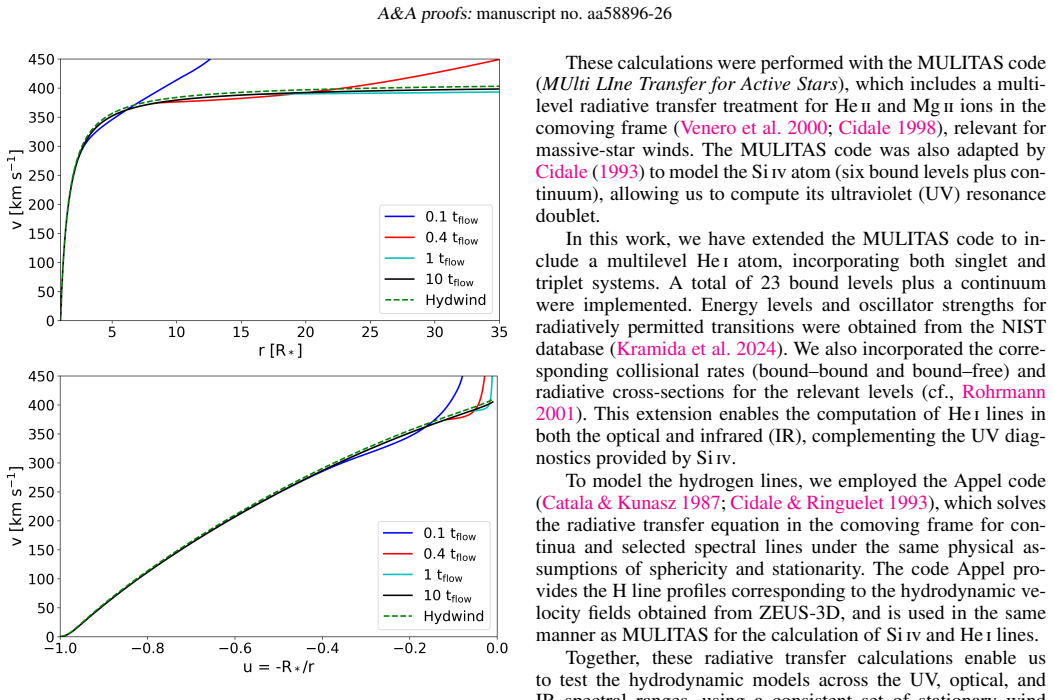
We found new stationary solutions in the gap region, alongside their corresponding line profiles, for a typical B supergiant star model. In this model, the new solutions are stable, and some of them present a kink in the velocity profile at a fixed distance from the star, depending on the δ value.
Load-bearing premise
That the modified CAK theory parameters can be chosen such that time-dependent hydrodynamics in ZEUS-3D yields stable stationary solutions in the gap region where previous methods failed, and that ionization perturbations can trigger transitions between regimes.
Figures


read the original abstract
Radiation-driven winds of massive stars can be described within the modified CAK theory, which parametrises the radiation force through three key quantities: $\alpha$, $\delta$, and $k$. Different combinations of these parameters, together with rotation, result in three types of stationary solutions, namely fast (or classical), $\delta$-slow, and $\Omega$-slow solutions. The primary objective of this work is to model radiation-driven winds inside the gap region between the fast and $\delta$-slow regimes, where stationary solutions have proven elusive. In addition, we compute synthetic line profiles of H I, He I, and Si IV to illustrate the morphology of different wind regimes. We employ the time-dependent hydrodynamic code ZEUS-3D, capable of obtaining stationary solutions by progressing through an initial solution. Then we compute the line profiles solving the transfer equation for an expanding atmosphere, assuming spherical symmetry in the comoving frame, under non-local thermodynamic equilibrium (NLTE) conditions. We found new stationary solutions in the gap region, alongside their corresponding line profiles, for a typical B supergiant star model. In this model, the new solutions are stable, and some of them present a kink in the velocity profile at a fixed distance from the star, depending on the $\delta$ value. Perturbations in the wind ionisation may trigger transitions between different hydrodynamic regimes and offer a plausible explanation for structured and variable winds. A systematic investigation of these effects will be the subject of future work. Furthermore, we investigate the resulting line profiles from different hydrodynamic solutions and compare them with those predicted by a velocity profile given by a $\beta$-law using the same global wind parameters.
Editorial analysis
A structured set of objections, weighed in public.
Circularity Check
Numerical integration yields emergent stationary solutions with no circular reduction
full rationale
The paper obtains new stationary wind solutions inside the fast–δ-slow gap by evolving the time-dependent hydrodynamic equations (continuity and momentum with modified CAK force) in ZEUS-3D from chosen initial conditions until a time-independent state appears. The final (ρ, v) profiles are therefore determined by the dynamics of the PDE system rather than being predefined by the input parameters α, δ, k or by any fitted quantity. Synthetic line profiles are computed afterward from the resulting velocity law and compared to a β-law; this is a post-processing diagnostic, not a prediction that loops back to the inputs. No load-bearing step invokes a self-citation whose validity depends on the present result, nor is any ansatz or uniqueness theorem smuggled in to force the outcome. The derivation chain is therefore self-contained as a numerical experiment.
Axiom & Free-Parameter Ledger
free parameters (1)
- α, δ, k
axioms (1)
- domain assumption The time-dependent code ZEUS-3D can obtain stationary solutions by evolving from an initial state in the gap region.
Reference graph
Works this paper leans on
-
[1]
Abbott, D. C. 1982, ApJ, 259, 282
work page 1982
-
[2]
Araya, I., Curé, M., ud-Doula, A., Santillán, A., & Cidale, L. 2018, MNRAS, 477, 755
work page 2018
- [3]
-
[4]
Cassinelli, J. P., Waldron, W. L., Sanders, W. T., et al. 1981, ApJ, 250, 677
work page 1981
- [5]
- [6]
-
[7]
Cidale, L. S. 1993, PhD thesis, National University of La Plata, Argentina
work page 1993
-
[8]
Cidale, L. S. 1998, ApJ, 502, 824
work page 1998
-
[9]
Cidale, L. S., Haucke, M., Arias, M. L., et al. 2023, A&A, 677, A176
work page 2023
-
[10]
Cidale, L. S. & Ringuelet, A. E. 1993, ApJ, 411, 874
work page 1993
-
[11]
Clarke, D. A. 1996, ApJ, 457, 291
work page 1996
-
[12]
Clarke, D. A. 2010, ApJS, 187, 119 Curé, M. 2004, ApJ, 614, 929 Curé, M. & Araya, I. 2023, Galaxies, 11, 68 Curé, M., Cidale, L., & Granada, A. 2011, ApJ, 737, 18 de Burgos, A., Keszthelyi, Z., Simón-Díaz, S., & Urbaneja, M. A. 2024, A&A, 687, L16
work page 2010
- [13]
-
[14]
Friend, D. B. & Abbott, D. C. 1986, ApJ, 311, 701
work page 1986
-
[15]
Fujita, A., Martin, C. L., Mac Low, M.-M., & Abel, T. 2003, ApJ, 599, 50
work page 2003
-
[16]
Gayley, K. G. 1995, ApJ, 454, 410
work page 1995
-
[17]
Haucke, M., Cidale, L. S., Venero, R. O. J., et al. 2018, A&A, 614, A91
work page 2018
- [18]
- [19]
- [20]
-
[21]
Kaper, L., Henrichs, H. F., Nichols, J. S., & Telting, J. H. 1999, A&A, 344, 231
work page 1999
-
[22]
Kramida, A., Ralchenko, Y ., Reader, J., & Team, N. A. 2024, NIST Atomic Spec- tra Database (ver. 5.11),https://physics.nist.gov/asd, national Insti- tute of Standards and Technology, Gaithersburg, MD Krtiˇcka, J. & Kubát, J. 2016, Advances in Space Research, 58, 710
work page 2024
-
[23]
Kudritzki, R. P. 2002, ApJ, 577, 389
work page 2002
-
[24]
Kurucz, R. L. 1979, ApJS, 40, 1
work page 1979
-
[25]
Lamers, H. J. G. L. M., Snow, T. P., & Lindholm, D. M. 1995, ApJ, 455, 269
work page 1995
- [26]
- [27]
- [28]
-
[29]
Pauldrach, A., Puls, J., & Kudritzki, R. P. 1986, A&A, 164, 86
work page 1986
- [30]
-
[31]
2001, PhD thesis, National University of La Plata, Argentina Rubio-Díez, M
Rohrmann, R. 2001, PhD thesis, National University of La Plata, Argentina Rubio-Díez, M. M., Sundqvist, J. O., Najarro, F., et al. 2022, A&A, 658, A61
work page 2001
-
[32]
Stone, J. M., Mihalas, D., & Norman, M. L. 1992, ApJS, 80, 819
work page 1992
-
[33]
Stone, J. M. & Norman, M. L. 1992, ApJS, 80, 753
work page 1992
-
[34]
2000, in Astronomical Society of the Pacific Conference Series, V ol
Venero, R., Cidale, L., & Ringuelet, A. 2000, in Astronomical Society of the Pacific Conference Series, V ol. 214, IAU Colloq. 175: The Be Phenomenon in Early-Type Stars, ed. M. A. Smith, H. F. Henrichs, & J. Fabregat, 607
work page 2000
-
[35]
Venero, R. O. J., Curé, M., Cidale, L. S., & Araya, I. 2016, ApJ, 822, 28
work page 2016
-
[36]
Venero, R. O. J., Curé, M., Puls, J., et al. 2024, MNRAS, 527, 93 Article number, page 9 of 10 A&A proofs:manuscript no. aa58896-26 Appendix A: Terminal velocity and mass-loss rates for the T19 model (Ω =0.2) Table A.1: Stellar wind parameters for the solutions found in the fast andδ-slow regimes, and in the gap region for the T19 model withΩ =0.2, comput...
work page 2024
discussion (0)
Sign in with ORCID, Apple, or X to comment. Anyone can read and Pith papers without signing in.