Puzzle Pieces, Bi-accessibility, and Connectivity of the Julia Set for Generalized Blaschke Products
Pith reviewed 2026-05-10 06:47 UTC · model grok-4.3
The pith
Bi-accessible repelling cycles on Julia sets provide a complete characterization of their connectivity for a family of generalized Blaschke products.
A machine-rendered reading of the paper's core claim, the machinery that carries it, and where it could break.
Core claim
For parameters inside Arnold tongues of the family, adjacent ones possess bi-accessible repelling cycles identified combinatorially via puzzle pieces; these cycles exclude multiply connected Fatou components whenever Herman rings are absent, yielding a complete characterization of Julia set connectivity for each member of the parametric family.
What carries the argument
Combinatorial study of puzzle pieces to prove existence of bi-accessible repelling cycles, which then rule out multiply connected Fatou components absent Herman rings.
Load-bearing premise
The argument assumes that Herman rings are absent to use bi-accessible repelling cycles to exclude multiply connected Fatou components.
What would settle it
A counterexample would be a parameter in the family with a multiply connected Fatou component that is not a Herman ring, even though bi-accessible repelling cycles are present.
Figures






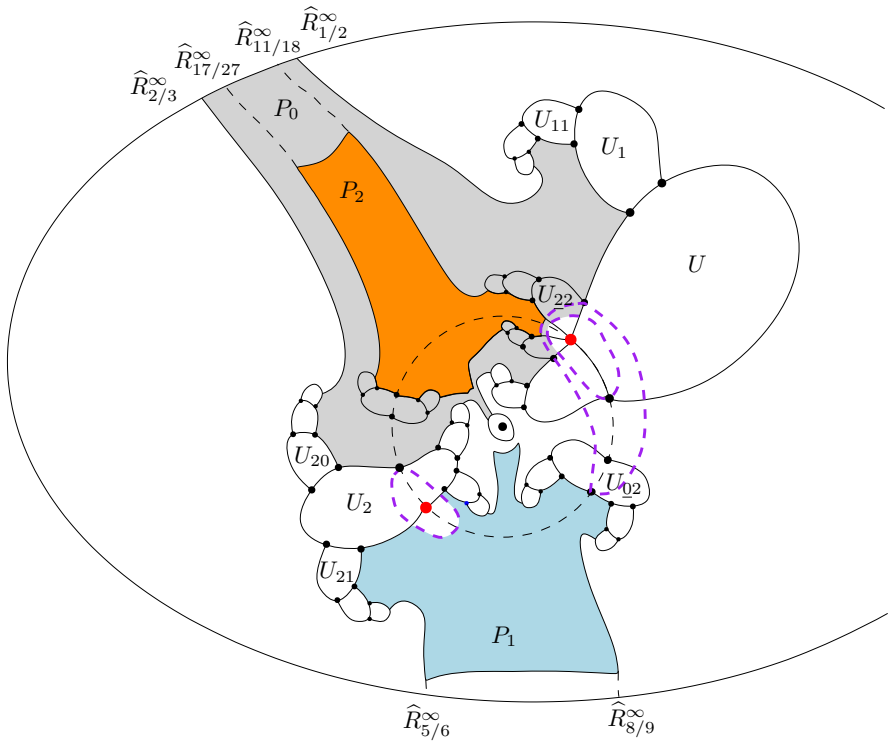


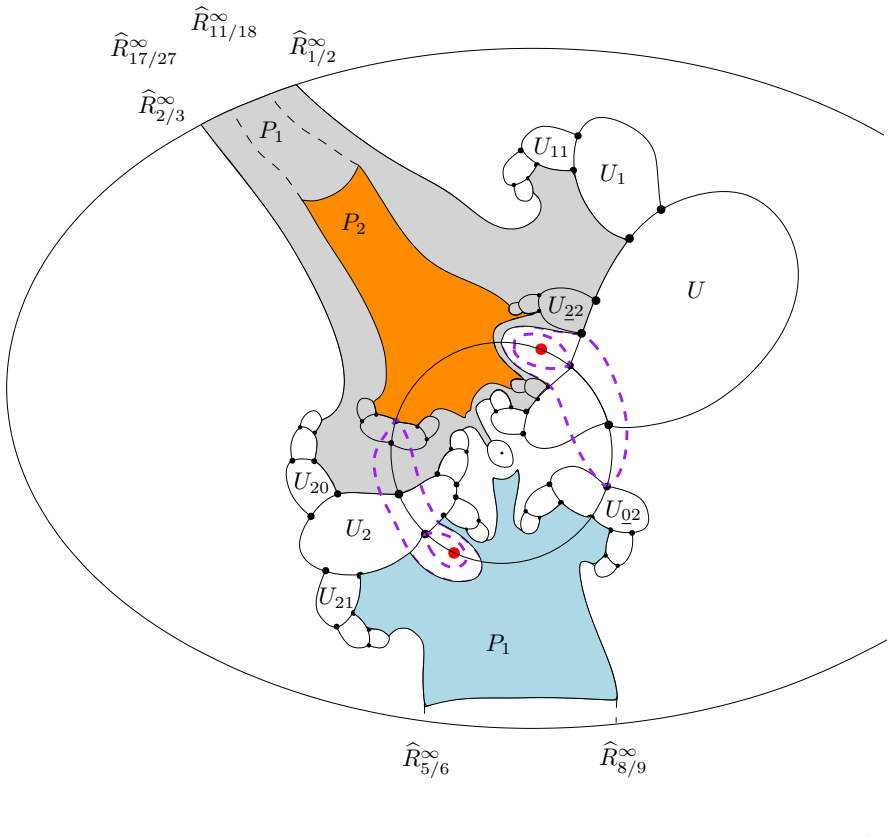


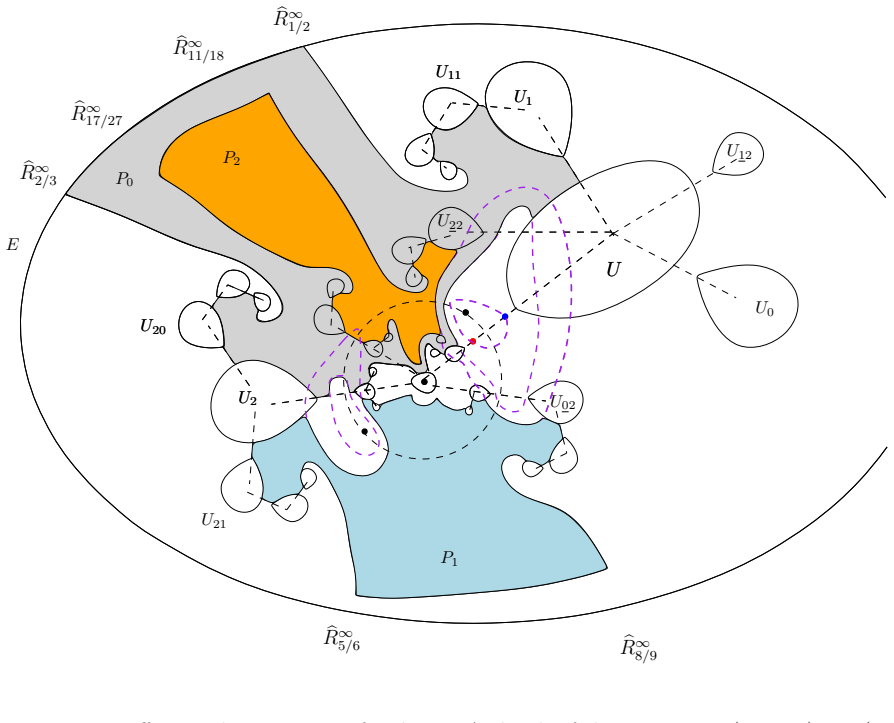

read the original abstract
We study the dynamics of a parametric family of rational functions of odd degree, where each function is a generalized Blaschke product that maps the unit circle onto itself. The action of the Blaschke product restricted to the unit circle defines a circle map, and the parameter space of the family exhibits Arnold tongues. As the parameter varies over an Arnold tongue, the action of the circle map changes from a diffeomorphism to a non-injective endomorphisms. Using a combinatorial study of puzzle pieces, we show that for adjacent parameters inside the Arnold tongues, there exist bi-accessible repelling cycles. This topological feature enables us to exclude the presence of multiply connected Fatou components whenever Herman rings are absent. As a result, we obtain a complete characterization of the connectivity of the Julia set for each member of the parametric family.
Editorial analysis
A structured set of objections, weighed in public.
Referee Report
Summary. The manuscript studies a parametric family of odd-degree rational maps that are generalized Blaschke products preserving the unit circle. The induced circle maps exhibit Arnold tongues in parameter space, within which the map transitions from a diffeomorphism to a non-injective endomorphism. A combinatorial analysis of puzzle pieces is used to prove the existence of bi-accessible repelling cycles for adjacent parameters inside these tongues. This bi-accessibility is then invoked to exclude multiply connected Fatou components (hence to determine Julia-set connectivity) whenever Herman rings are absent, yielding what is presented as a complete characterization of connectivity for every member of the family.
Significance. If the result holds after addressing the conditional gap, the work would furnish a precise connectivity classification for Julia sets in this circle-preserving rational family, extending combinatorial techniques from complex dynamics to parameter regions with Arnold tongues. The explicit construction of bi-accessible cycles via puzzle-piece combinatorics is a concrete methodological contribution that strengthens the topological arguments.
major comments (1)
- [Abstract] Abstract: The central claim states that the bi-accessibility result 'enables us to exclude the presence of multiply connected Fatou components whenever Herman rings are absent. As a result, we obtain a complete characterization of the connectivity of the Julia set for each member of the parametric family.' No argument is supplied showing that Herman rings are absent for all parameters in the family, nor is there a case distinction or separate analysis for parameters where such rings could exist. Because Herman rings are themselves multiply connected Fatou components whose presence would alter the connectivity conclusions drawn from bi-accessibility alone, this unaddressed condition renders the 'complete characterization' claim unsupported as stated.
Simulated Author's Rebuttal
We thank the referee for the careful reading and constructive comments. We address the major comment below.
read point-by-point responses
-
Referee: [Abstract] Abstract: The central claim states that the bi-accessibility result 'enables us to exclude the presence of multiply connected Fatou components whenever Herman rings are absent. As a result, we obtain a complete characterization of the connectivity of the Julia set for each member of the parametric family.' No argument is supplied showing that Herman rings are absent for all parameters in the family, nor is there a case distinction or separate analysis for parameters where such rings could exist. Because Herman rings are themselves multiply connected Fatou components whose presence would alter the connectivity conclusions drawn from bi-accessibility alone, this unaddressed condition renders the 'complete characterization' claim unsupported as stated.
Authors: We agree that the abstract's phrasing of a 'complete characterization' risks implying an unconditional classification for every parameter. The manuscript does condition the exclusion of multiply connected Fatou components on the absence of Herman rings, but to eliminate ambiguity we will revise the abstract to state explicitly that bi-accessibility yields a characterization of Julia-set connectivity precisely in the absence of Herman rings. We will add a short remark in the introduction clarifying that our combinatorial methods do not address the (non)existence of Herman rings in this family and that determining their presence remains outside the scope of the present work. This revision directly resolves the conditional gap noted by the referee. revision: yes
Circularity Check
No circularity; derivation relies on independent combinatorial topology
full rationale
The paper establishes bi-accessible repelling cycles via combinatorial analysis of puzzle pieces for adjacent parameters in Arnold tongues, then applies this to exclude multiply connected Fatou components (conditional on absent Herman rings) and characterize Julia-set connectivity. No quoted step reduces by definition, by renaming a fitted input as a prediction, or by load-bearing self-citation whose cited result itself depends on the target claim. The arguments invoke standard tools from complex dynamics (puzzle pieces, accessibility) without smuggling ansatzes or importing uniqueness theorems from the authors' prior work as external facts. The explicit conditional on Herman rings is stated rather than elided, leaving the chain self-contained against external benchmarks.
Axiom & Free-Parameter Ledger
axioms (2)
- standard math Standard properties of Julia sets, Fatou components, and accessibility for rational maps on the Riemann sphere
- domain assumption Existence and basic properties of Arnold tongues for circle maps arising from Blaschke products
Reference graph
Works this paper leans on
-
[1]
Llu´ ıs Alsed` a, Jaume Llibre, and Michal Misiurewicz.Combinatorial dynam- ics and entropy in dimension one. Vol. 5. Singapore: World Scientific Pub- lishing Company, 2000
work page 2000
-
[2]
Alan Beardon.Iteration of Rational Functions. Vol. 132. Graduate Texts in Mathematics. New York: Springer-Verlag, 1991, pp. xvi+280
work page 1991
-
[3]
Antipode preserving cubic maps: The Fjord theorem
Araceli Bonifant, Xavier Buff, and John Milnor. “Antipode preserving cubic maps: The Fjord theorem”. In:Proceedings of the London Mathematical Society116.3 (2018), pp. 670–728
work page 2018
-
[4]
Bifurcations of circle maps: Arnol’d tongues, bistability and rotation intervals
Philip L Boyland. “Bifurcations of circle maps: Arnol’d tongues, bistability and rotation intervals”. In:Commun. Math. Phys.106.3 (1986), pp. 353– 381
work page 1986
-
[5]
Cam- bridge: Cambridge University Press, 2002
Michael Brin and Garrett Stuck.Introduction to dynamical systems. Cam- bridge: Cambridge University Press, 2002
work page 2002
-
[6]
Connectivity of the Julia set for the Chebyshev-Halley family on degreenpolynomials
B. Campos, J. Canela, and P. Vindel. “Connectivity of the Julia set for the Chebyshev-Halley family on degreenpolynomials”. In:Commun. Nonlinear Sci. Numer. Simul.82 (2020), p. 105026.doi:10.1016/j.cnsns.2019. 105026
-
[7]
Tongues in degree 4 Blaschke prod- ucts
J. Canela, N. Fagella, and A. Garijo. “Tongues in degree 4 Blaschke prod- ucts”. In:Nonlinearity29.11 (2016), p. 3464
work page 2016
-
[8]
Surgery on Herman rings of the standard Blaschke family
Haifeng Chu. “Surgery on Herman rings of the standard Blaschke family”. In:Discrete Contin. Dyn. Syst. A38.1 (2018), pp. 63–74
work page 2018
-
[9]
Edson De Faria and Welington De Melo.Mathematical tools for one-dimensional dynamics. Vol. 115. New York: Cambridge University Press, 2008
work page 2008
-
[10]
Sur la conjugaison diff´ erentiable des diff´ eomorphismes du cercle ` a des rotations
Michael Robert Herman. “Sur la conjugaison diff´ erentiable des diff´ eomorphismes du cercle ` a des rotations”. In:Publ. Math. IHES49 (1979), pp. 5–233
work page 1979
-
[11]
Ryuichi Ito. “Rotation sets are closed”. In:Math. Proc. Camb. Phil. Soc. Vol. 89. Cambridge University Press. 1981, pp. 107–111. 41
work page 1981
-
[12]
John Milnor.Dynamics in One Complex Variable. Vol. 160. Princeton: Prince- ton University Press, 2011
work page 2011
-
[13]
On the Julia set of a typical quadratic polynomial with a Siegel disk
Carsten L Petersen and Saeed Zakeri. “On the Julia set of a typical quadratic polynomial with a Siegel disk”. In:Ann. Math.(2004), pp. 1–52
work page 2004
-
[14]
On the quasiconformal surgery of rational functions
Mitsuhiro Shishikura. “On the quasiconformal surgery of rational functions”. In:Ann. Sci. ´Ecole Norm. Sup.(4)20.1 (1987), pp. 1–29
work page 1987
-
[15]
Norbert Steinmetz. “Rational iteration”. In:Rational Iteration. Berlin; New York: de Gruyter, 2011
work page 2011
-
[16]
Saeed Zakeri.Rotation sets and complex dynamics. Vol. 2214. Cham: Springer, 2018. 42
work page 2018
discussion (0)
Sign in with ORCID, Apple, or X to comment. Anyone can read and Pith papers without signing in.