Band mixing and particle-hole asymmetry in moir\'e fractional Chern insulators
Pith reviewed 2026-05-10 07:02 UTC · model grok-4.3
The pith
Remote band mixing in moiré materials destabilizes fractional Chern insulators more at filling fraction 1/3 than at 2/3 by lowering electron Wigner crystal energies.
A machine-rendered reading of the paper's core claim, the machinery that carries it, and where it could break.
Core claim
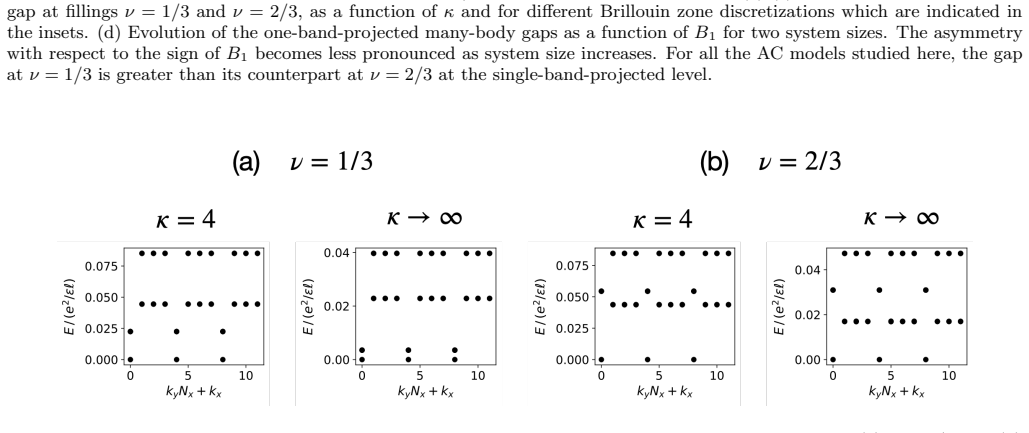
In the absence of band mixing, the leading instability at ν = 1/3 is the electron Wigner crystal, whereas at ν = 2/3 the main competing phase is the hole crystal. Remote band mixing substantially lowers the energy of the electron crystal but has only a weak effect on the hole crystal. Consequently, it destabilizes the fractional Chern insulator at ν=1/3 more strongly than at ν=2/3. This mechanism also provides an explanation for the emergence of re-entrant integer quantum anomalous Hall states in moiré MoTe2 for fillings ν>1/2.
What carries the argument
The differential energy lowering of electron versus hole Wigner crystals due to remote band mixing in effective moiré Hamiltonians.
If this is right
- The fractional Chern insulator phase is more robust at 2/3 filling than at 1/3 filling.
- Re-entrant integer quantum anomalous Hall states emerge for fillings greater than 1/2.
- The observed asymmetry between electron and hole fillings in twisted MoTe2 is accounted for by this competition.
- Similar particle-hole asymmetries are expected in other moiré systems with remote band effects.
Where Pith is reading between the lines
- Tuning the twist angle to modulate remote band mixing strength could switch between different competing phases.
- This suggests designing moiré materials with controlled band mixing to stabilize fractional states at desired fillings.
- Extensions of the model to other fractional fillings may reveal additional re-entrant behaviors.
- Compressibility or transport measurements could detect the Wigner crystal phases as a function of band mixing parameters.
Load-bearing premise
The family of models accurately approximates the continuum descriptions of real moiré materials and that numerical energy comparisons between the fractional Chern insulator and the Wigner crystal phases reliably identify the leading instabilities.
What would settle it
A calculation or measurement showing that the electron Wigner crystal energy does not drop significantly more than the hole crystal energy when remote bands are included, or the absence of re-entrant integer states when band mixing is suppressed.
Figures




read the original abstract
We investigate the effect of remote band mixing on the stability of fractional Chern insulators in a family of models that approximate continuum descriptions of moir\'e materials. Our results suggest that the experimentally observed asymmetry between filling fractions $\nu=1/3$ and $\nu=2/3$ in twisted MoTe$_2$ originates from a competition between a fractional Chern insulator, an electron Wigner crystal, and a hole Wigner crystal. In the absence of band mixing, the leading instability at $\nu = 1/3$ is the electron crystal, whereas at $\nu = 2/3$ the main competing phase is the hole crystal. Remote band mixing substantially lowers the energy of the electron crystal but has only a weak effect on the hole crystal. Consequently, it destabilizes the fractional Chern insulator at $\nu=1/3$ more strongly than at $\nu=2/3$. This mechanism also provides an explanation for the emergence of re-entrant integer quantum anomalous Hall states in moir\'e MoTe$_2$ for fillings $\nu>1/2$.
Editorial analysis
A structured set of objections, weighed in public.
Referee Report
Summary. The manuscript investigates remote band mixing effects on fractional Chern insulator (FCI) stability in a family of lattice models approximating continuum moiré systems such as twisted MoTe2. It argues that the experimentally observed asymmetry between fillings ν=1/3 and ν=2/3 arises from competition among the FCI, electron Wigner crystal (WC), and hole WC phases: without mixing the electron WC is the leading instability at ν=1/3 while the hole WC competes at ν=2/3; remote band mixing lowers the electron WC energy substantially but affects the hole WC only weakly, thereby destabilizing the FCI more strongly at ν=1/3 and also rationalizing re-entrant integer quantum anomalous Hall states for ν>1/2.
Significance. If the reported energy ordering is robust, the work supplies a concrete, band-mixing-based mechanism for the particle-hole asymmetry observed in moiré FCI experiments and underscores the necessity of multi-band treatments beyond single-band projections. The systematic use of a tunable family of models to isolate remote-band effects is a methodological strength that could be extended to other moiré platforms.
major comments (2)
- [§4] §4 (energy comparisons for WC states): the central claim that remote band mixing lowers the electron-WC energy far more than the hole-WC energy rests on direct numerical comparisons. However, WC energies in lattice models are known to be sensitive to supercell size, boundary conditions, and the precise stabilization procedure (pinning fields or projected order parameters). No finite-size scaling or convergence checks on the long-range interaction tails are reported, so the differential lowering could be an artifact of the chosen clusters rather than a continuum-limit feature.
- [§3] §3 (model construction): while the family of models is stated to approximate continuum descriptions, the precise mapping of remote-band mixing onto the interaction terms that control WC-FCI competition is not fully specified. It is therefore unclear whether the reported asymmetry survives changes in the interaction cutoff or the inclusion of higher remote bands.
minor comments (2)
- [Figures] Figure captions for the energy-vs-mixing plots should explicitly state the system sizes, boundary conditions, and any pinning strengths used for the WC states.
- [Notation] Notation for the filling fractions and band indices is occasionally ambiguous; a short table summarizing the definitions of ν, electron vs. hole sectors, and the remote-band cutoff would improve readability.
Simulated Author's Rebuttal
We thank the referee for their thorough review and constructive feedback on our manuscript. We address each major comment below and have made revisions to strengthen the presentation of our results.
read point-by-point responses
-
Referee: [§4] §4 (energy comparisons for WC states): the central claim that remote band mixing lowers the electron-WC energy far more than the hole-WC energy rests on direct numerical comparisons. However, WC energies in lattice models are known to be sensitive to supercell size, boundary conditions, and the precise stabilization procedure (pinning fields or projected order parameters). No finite-size scaling or convergence checks on the long-range interaction tails are reported, so the differential lowering could be an artifact of the chosen clusters rather than a continuum-limit feature.
Authors: We agree that finite-size effects and convergence are crucial for the reliability of our energy comparisons. In the original manuscript, we used several finite clusters with periodic boundary conditions and pinning fields to stabilize the WC states. To address the referee's concern, we have performed additional calculations on larger supercells and included a finite-size scaling analysis in the revised version. The differential energy lowering due to remote band mixing remains robust across the sizes considered, supporting our conclusion that it is not an artifact. We have also clarified the stabilization procedure in the methods section. revision: yes
-
Referee: [§3] §3 (model construction): while the family of models is stated to approximate continuum descriptions, the precise mapping of remote-band mixing onto the interaction terms that control WC-FCI competition is not fully specified. It is therefore unclear whether the reported asymmetry survives changes in the interaction cutoff or the inclusion of higher remote bands.
Authors: We thank the referee for this observation. The family of models is defined by varying the strength of remote band mixing through an additional hopping parameter that couples to higher bands, while keeping the interaction as the bare Coulomb interaction projected onto the multi-band Hilbert space. In the revised manuscript, we have expanded the model construction section to explicitly describe how remote band mixing modifies the effective interaction matrix elements relevant for WC and FCI states. We have also tested the robustness by varying the interaction cutoff (truncating the long-range part at different distances) and confirmed that the particle-hole asymmetry persists. Regarding higher remote bands, our model captures the dominant mixing effects from the nearest remote bands; including further bands would require larger Hilbert spaces but is expected to enhance rather than reverse the effect based on perturbative arguments. revision: partial
Circularity Check
No circularity; claims rest on independent numerical energy comparisons
full rationale
The paper derives its central claim—that remote band mixing destabilizes the FCI more at ν=1/3 than at ν=2/3—directly from computed energies of competing phases (FCI, electron WC, hole WC) in a family of models with and without band mixing. These are independent numerical outputs, not quantities defined in terms of the target asymmetry or fitted to it. No self-definitional steps, no predictions that reduce to fitted inputs by construction, and no load-bearing self-citations or imported uniqueness theorems appear in the derivation chain. The abstract and described results treat the models as approximations to continuum moiré systems and report differential energy shifts as computed facts, without renaming known results or smuggling ansatzes. The derivation is therefore self-contained against external benchmarks.
Axiom & Free-Parameter Ledger
Reference graph
Works this paper leans on
-
[1]
J. Cai, E. Anderson, C. Wang, X. Zhang, X. Liu, W. Holtzmann, Y. Zhang, F. Fan, T. Taniguchi, K. Watanabe, Y. Ran, T. Cao, L. Fu, D. Xiao, W. Yao, and X. Xu, Signatures of fractional quantum anomalous Hall states in twisted MoTe 2, Nature622, 63 (2023)
2023
-
[2]
Y. Zeng, Z. Xia, K. Kang, J. Zhu, P. Kn¨ uppel, C. Vaswani, K. Watanabe, T. Taniguchi, K. F. Mak, and J. Shan, Thermodynamic evidence of fractional Chern insulator in moir´ e MoTe2, Nature622, 69 (2023)
2023
-
[3]
H. Park, J. Cai, E. Anderson, Y. Zhang, J. Zhu, X. Liu, C. Wang, W. Holtzmann, C. Hu, Z. Liu, T. Taniguchi, K. Watanabe, J.-H. Chu, T. Cao, L. Fu, W. Yao, C.- Z. Chang, D. Cobden, D. Xiao, and X. Xu, Observation of fractionally quantized anomalous Hall effect, Nature 622, 74 (2023)
2023
-
[4]
F. Xu, Z. Sun, T. Jia, C. Liu, C. Xu, C. Li, Y. Gu, K. Watanabe, T. Taniguchi, B. Tong, J. Jia, Z. Shi, S. Jiang, Y. Zhang, X. Liu, and T. Li, Observation of In- teger and Fractional Quantum Anomalous Hall Effects in Twisted Bilayer MoTe2, Phys. Rev. X13, 031037 (2023)
2023
-
[5]
K. Kang, B. Shen, Y. Qiu, Y. Zeng, Z. Xia, K. Watan- abe, T. Taniguchi, J. Shan, and K. F. Mak, Evidence of the fractional quantum spin Hall effect in moir´ e MoTe2, Nature628, 522 (2024)
2024
-
[6]
Redekop, C
E. Redekop, C. Zhang, H. Park, J. Cai, E. Anderson, O. Sheekey, T. Arp, G. Babikyan, S. Salters, K. Watan- abe, T. Taniguchi, M. E. Huber, X. Xu, and A. F. Young, Direct magnetic imaging of fractional Chern insulators in twisted MoTe2, Nature635, 584 (2024)
2024
-
[7]
Z. Ji, H. Park, M. E. Barber, C. Hu, K. Watanabe, T. Taniguchi, J.-H. Chu, X. Xu, and Z.-X. Shen, Lo- cal probe of bulk and edge states in a fractional Chern insulator, Nature635, 578 (2024)
2024
-
[8]
Anderson, J
E. Anderson, J. Cai, A. P. Reddy, H. Park, W. Holtz- mann, K. Davis, T. Taniguchi, K. Watanabe, T. Smolen- ski, A. Imamo˘ glu, T. Cao, D. Xiao, L. Fu, W. Yao, and X. Xu, Trion sensing of a zero-field composite fermi liq- uid, Nature635, 590 (2024). 9
2024
-
[9]
Y. Wang, J. Choe, E. Anderson, W. Li, J. Ingham, E. A. Arsenault, Y. Li, X. Hu, T. Taniguchi, K. Watanabe, X. Roy, D. Basov, D. Xiao, R. Queiroz, J. C. Hone, X. Xu, and X.-Y. Zhu, Hidden states and dynamics of fractional fillings in twisted MoTe2 bilayers, Nature641, 1149 (2025)
2025
-
[10]
F. Xu, Z. Sun, J. Li, C. Zheng, C. Xu, J. Gao, T. Jia, K. Watanabe, T. Taniguchi, B. Tong, L. Lu, J. Jia, Z. Shi, S. Jiang, Y. Zhang, Y. Zhang, S. Lei, X. Liu, and T. Li, Signatures of unconventional superconduc- tivity near reentrant and fractional quantum anomalous Hall insulators (2025), arXiv:2504.06972 [cond-mat.mes- Hall]
work page internal anchor Pith review arXiv 2025
-
[11]
H. Park, J. Cai, E. Anderson, X.-W. Zhang, X. Liu, W. Holtzmann, W. Li, C. Wang, C. Hu, Y. Zhao, T. Taniguchi, K. Watanabe, J. Yang, D. Cobden, J.- h. Chu, N. Regnault, B. A. Bernevig, L. Fu, T. Cao, D. Xiao, and X. Xu, Ferromagnetism and topology of the higher flat band in a fractional Chern insulator, Nature Physics21, 549 (2025)
2025
-
[12]
F. Xu, X. Chang, J. Xiao, Y. Zhang, F. Liu, Z. Sun, N. Mao, N. Peshcherenko, J. Li, K. Watanabe, T. Taniguchi, B. Tong, L. Lu, J. Jia, D. Qian, Z. Shi, Y. Zhang, X. Liu, S. Jiang, and T. Li, Interplay between topology and correlations in the second moir´ e band of twisted bilayer MoTe2, Nature Physics21, 542 (2025)
2025
-
[13]
Thompson, K
E. Thompson, K. T. Chu, F. Mesple, X.-W. Zhang, C. Hu, Y. Zhao, H. Park, J. Cai, E. Anderson, K. Watan- abe, T. Taniguchi, J. Yang, J.-H. Chu, X. Xu, T. Cao, D. Xiao, and M. Yankowitz, Microscopic signatures of topology in twisted MoTe 2, Nature Physics21, 1224 (2025)
2025
-
[14]
Y. Deng, W. Holtzmann, Z. Zhu, T. Zaklama, P. Ma- jchrzak, T. Taniguchi, K. Watanabe, M. Hashimoto, D. Lu, C. Jozwiak, A. Bostwick, E. Rotenberg, L. Fu, T. P. Devereaux, X. Xu, and Z.-X. Shen, Nonmonotonic band flattening near the magic angle of twisted bilayer MoTe2, Phys. Rev. X15, 041043 (2025)
2025
-
[15]
W. Li, E. Redekop, C. Wang Beach, C. Zhang, X. Zhang, X. Liu, W. Holtzmann, C. Hu, E. Anderson, H. Park, T. Taniguchi, K. Watanabe, J.-h. Chu, L. Fu, T. Cao, D. Xiao, A. F. Young, and X. Xu, Universal magnetic phases in twisted bilayer MoTe2, Nano Letters25, 18044 (2025)
2025
-
[16]
H. Pan, S. Yang, Y. Wang, X. Cai, W. Wang, Y. Zhao, K. Watanabe, T. Taniguchi, L. Zhang, Y. Liu, B. Yang, and W. Gao, Optical signatures of− 1 3 fractional quan- tum anomalous Hall state in twisted MoTe 2, Phys. Rev. Lett.136, 056601 (2026)
2026
-
[17]
Huber, K
O. Huber, K. Kuhlbrodt, E. Anderson, W. Li, K. Watan- abe, T. Taniguchi, M. Kroner, X. Xu, A. Imamo˘ glu, and T. Smole´ nski, Optical control over topological Chern number in moir´ e materials, Nature649, 1153 (2026)
2026
-
[19]
Holtzmann, W
W. Holtzmann, W. Li, E. Anderson, J. Cai, H. Park, C. Hu, T. Taniguchi, K. Watanabe, J.-H. Chu, D. Xiao, T. Cao, and X. Xu, Optical control of integer and frac- tional Chern insulators, Nature649, 1147 (2026)
2026
-
[20]
H. Park, W. Li, C. Hu, C. Beach, M. Gon¸ calves, J. F. Mendez-Valderrama, J. Herzog-Arbeitman, T. Taniguchi, K. Watanabe, D. Cobden, L. Fu, B. A. Bernevig, N. Regnault, J.-H. Chu, D. Xiao, and X. Xu, Observation of dissipationless fractional Chern insulator, Nature Physics22, 389 (2026)
2026
-
[21]
W. Li, C. Wang Beach, C. Hu, T. Taniguchi, K. Watan- abe, J.-H. Chu, A. Imamo˘ glu, T. Cao, D. Xiao, and X. Xu, Signatures of fractional charges via anyon–trions in twisted MoTe 2, Nature651, 48 (2026)
2026
-
[22]
C. Chen, W. Holtzmann, X.-W. Zhang, E. Anderson, S. He, Y. Zhao, W. Li, J. Liu, Y. Guo, C. Jozwiak, A. Bostwick, E. Rotenberg, K. Watanabe, T. Taniguchi, T. Cao, D. Xiao, X. Xu, and Y. Chen, Visualizing elec- tronic structure of twisted bilayer MoTe 2 in devices, Communications Physics9, 62 (2026)
2026
- [23]
-
[24]
Y. Wang, G. E. Minarik, W. Li, Y. Kwan, S. Yuan, E. Anderson, C. Hu, J. Ingham, J. Choe, T. Taniguchi, K. Watanabe, X. Roy, J.-H. Chu, R. Queiroz, J. C. Hone, N. Regnault, X. Xu, and X. Zhu, Magnetic signatures of a putative fractional topological insulator in twisted MoTe2 (2026), arXiv:2601.18508 [cond-mat.str-el]
-
[25]
Z. Sun, F. Xu, J. Li, Y. Jiang, J. Gao, C. Xu, T. Jia, K. Cheng, J. Zhang, W. Tian, K. Watanabe, T. Taniguchi, J. Jia, S. Jiang, Y. Zhang, Y. Zhang, S. Lei, X. Liu, and T. Li, Twist-angle evolution from valley-polarized fractional topological phases to valley- degenerate superconductivity in twisted bilayer MoTe 2 (2026), arXiv:2603.16412 [cond-mat.mes-Hall]
-
[26]
Tang, J.-W
E. Tang, J.-W. Mei, and X.-G. Wen, High-temperature fractional quantum Hall states, Phys. Rev. Lett.106, 236802 (2011)
2011
-
[27]
K. Sun, Z. Gu, H. Katsura, and S. Das Sarma, Nearly flatbands with nontrivial topology, Phys. Rev. Lett.106, 236803 (2011)
2011
-
[28]
Neupert, L
T. Neupert, L. Santos, C. Chamon, and C. Mudry, Frac- tional quantum Hall states at zero magnetic field, Phys. Rev. Lett.106, 236804 (2011)
2011
-
[29]
D. N. Sheng, Z.-C. Gu, K. Sun, and L. Sheng, Fractional quantum Hall effect in the absence of Landau levels, Na- ture Communications2, 389 (2011)
2011
-
[30]
Regnault and B
N. Regnault and B. A. Bernevig, Fractional Chern insu- lator, Phys. Rev. X1, 021014 (2011)
2011
-
[31]
H. Li, U. Kumar, K. Sun, and S.-Z. Lin, Spontaneous fractional Chern insulators in transition metal dichalco- genide moir´ e superlattices, Phys. Rev. Res.3, L032070 (2021)
2021
-
[32]
Cr´ epel and L
V. Cr´ epel and L. Fu, Anomalous Hall metal and fractional Chern insulator in twisted transition metal dichalcogenides, Phys. Rev. B107, L201109 (2023)
2023
-
[33]
Morales-Dur´ an, J
N. Morales-Dur´ an, J. Wang, G. R. Schleder, M. Angeli, Z. Zhu, E. Kaxiras, C. Repellin, and J. Cano, Pressure- enhanced fractional Chern insulators along a magic line in moir´ e transition metal dichalcogenides, Phys. Rev. Res.5, L032022 (2023)
2023
-
[34]
A. P. Reddy, F. Alsallom, Y. Zhang, T. Devakul, and L. Fu, Fractional quantum anomalous Hall states in twisted bilayer MoTe 2 and WSe 2, Phys. Rev. B108, 085117 (2023). 10
2023
-
[35]
A. P. Reddy and L. Fu, Toward a global phase diagram of the fractional quantum anomalous Hall effect, Phys. Rev. B108, 245159 (2023)
2023
-
[36]
Wang, X.-W
C. Wang, X.-W. Zhang, X. Liu, Y. He, X. Xu, Y. Ran, T. Cao, and D. Xiao, Fractional Chern insulator in twisted bilayer MoTe 2, Phys. Rev. Lett.132, 036501 (2024)
2024
-
[37]
J. Dong, J. Wang, P. J. Ledwith, A. Vishwanath, and D. E. Parker, Composite Fermi Liquid at Zero Magnetic Field in Twisted MoTe 2, Phys. Rev. Lett.131, 136502 (2023)
2023
-
[38]
T. Wang and M. P. Zaletel, Chiral superconductivity near a fractional Chern insulator (2025), arXiv:2507.07921 [cond-mat.str-el]
-
[39]
A. M. L¨ auchli, Z. Liu, E. J. Bergholtz, and R. Moessner, Hierarchy of fractional Chern insulators and competing compressible states, Phys. Rev. Lett.111, 126802 (2013)
2013
-
[40]
Abouelkomsan, K
A. Abouelkomsan, K. Yang, and E. J. Bergholtz, Quan- tum metric induced phases in moir´ e materials, Phys. Rev. Res.5, L012015 (2023)
2023
-
[41]
J. Yu, J. Herzog-Arbeitman, M. Wang, O. Vafek, B. A. Bernevig, and N. Regnault, Fractional Chern insula- tors versus nonmagnetic states in twisted bilayer MoTe2, Phys. Rev. B109, 045147 (2024)
2024
-
[42]
Abouelkomsan, A
A. Abouelkomsan, A. P. Reddy, L. Fu, and E. J. Bergholtz, Band mixing in the quantum anomalous Hall regime of twisted semiconductor bilayers, Phys. Rev. B 109, L121107 (2024)
2024
-
[43]
C. Xu, J. Li, Y. Xu, Z. Bi, and Y. Zhang, Maximally lo- calized Wannier functions, interaction models, and frac- tional quantum anomalous Hall effect in twisted bilayer MoTe2, Proc. Natl. Acad. Sci. U.S.A.121, e2316749121 (2024)
2024
-
[44]
Spinless and spinful charge excitations in moir\'e Fractional Chern Insulators
M. Gon¸ calves, J. F. Mendez-Valderrama, J. Herzog- Arbeitman, J. Yu, X. Xu, D. Xiao, B. A. Bernevig, and N. Regnault, Spinless and spinful charge exci- tations in moir´ e fractional Chern insulators (2025), arXiv:2506.05330 [cond-mat.str-el]
work page internal anchor Pith review arXiv 2025
- [45]
- [46]
- [47]
- [48]
-
[49]
Morales-Dur´ an, N
N. Morales-Dur´ an, N. Wei, J. Shi, and A. H. MacDonald, Magic angles and fractional Chern insulators in twisted homobilayer transition metal dichalcogenides, Phys. Rev. Lett.132, 096602 (2024)
2024
-
[50]
J. Shi, N. Morales-Dur´ an, E. Khalaf, and A. H. Mac- Donald, Adiabatic approximation and Aharonov-Casher bands in twisted homobilayer transition metal dichalco- genides, Phys. Rev. B110, 035130 (2024)
2024
-
[51]
Aharonov and A
Y. Aharonov and A. Casher, Ground state of a spin- 1 2 charged particle in a two-dimensional magnetic field, Phys. Rev. A19, 2461 (1979)
1979
- [52]
-
[53]
Sodemann and A
I. Sodemann and A. H. MacDonald, Landau level mixing and the fractional quantum Hall effect, Phys. Rev. B87, 245425 (2013)
2013
-
[54]
S. H. Simon and E. H. Rezayi, Landau level mixing in the perturbative limit, Phys. Rev. B87, 155426 (2013)
2013
-
[55]
Bishara and C
W. Bishara and C. Nayak, Effect of Landau level mix- ing on the effective interaction between electrons in the fractional quantum Hall regime, Phys. Rev. B80, 121302 (2009)
2009
-
[56]
M. R. Peterson and C. Nayak, More realistic Hamiltoni- ans for the fractional quantum Hall regime in gaas and graphene, Phys. Rev. B87, 245129 (2013)
2013
-
[57]
Murthy and R
G. Murthy and R. Shankar, Hamiltonian theory of the fractional quantum Hall effect: Effect of Landau level mixing, Phys. Rev. B65, 245309 (2002)
2002
-
[58]
E. H. Rezayi, Landau level mixing and the ground state of theν= 5/2 quantum Hall effect, Phys. Rev. Lett.119, 026801 (2017)
2017
-
[59]
W´ ojs, C
A. W´ ojs, C. T˝ oke, and J. K. Jain, Landau-level mixing and the emergence of pfaffian excitations for the 5/2 frac- tional quantum Hall effect, Phys. Rev. Lett.105, 096802 (2010)
2010
-
[60]
D. Yoshioka, Effect of the Landau level mixing on the ground state of two-dimensional electrons, Jour- nal of the Physical Society of Japan53, 3740 (1984), https://doi.org/10.1143/JPSJ.53.3740
-
[61]
D. Yoshioka, Excitation energies of the fractional quan- tum Hall effect, Journal of the Physical Society of Japan 55, 885 (1986), https://doi.org/10.1143/JPSJ.55.885
-
[62]
Yoshioka, Effect of the higher Landau levels on the excitation spectrum of the ground state of 2d electrons, Surface Science170, 125 (1986)
D. Yoshioka, Effect of the higher Landau levels on the excitation spectrum of the ground state of 2d electrons, Surface Science170, 125 (1986)
1986
-
[63]
J. Zhao, Y. Zhang, and J. K. Jain, Crystallization in the fractional quantum Hall regime induced by Landau-level mixing, Phys. Rev. Lett.121, 116802 (2018)
2018
-
[64]
Papi´ c and D
Z. Papi´ c and D. A. Abanin, Topological phases in the zeroth Landau level of bilayer graphene, Phys. Rev. Lett. 112, 046602 (2014)
2014
-
[65]
N. D. Le and T. Jolicoeur, Competing laughlin state and Wigner crystal in bernal bilayer graphene, Phys. Rev. B 107, 125129 (2023)
2023
-
[66]
A. Kou, B. E. Feldman, A. J. Levin, B. I. Halperin, K. Watanabe, T. Taniguchi, and A. Yacoby, Electron- hole asymmetric integer and fractional quantum Hall ef- fect in bilayer graphene, Science345, 55 (2014)
2014
-
[67]
Maher, L
P. Maher, L. Wang, Y. Gao, C. Forsythe, T. Taniguchi, K. Watanabe, D. Abanin, Z. Papi´ c, P. Cadden-Zimansky, J. Hone, P. Kim, and C. R. Dean, Tunable fractional quantum Hall phases in bilayer graphene, Science345, 61 (2014)
2014
-
[68]
D.-K. Ki, V. I. Fal’ko, D. A. Abanin, and A. F. Mor- purgo, Observation of even denominator fractional quan- tum Hall effect in suspended bilayer graphene, Nano Let- ters14, 2135 (2014)
2014
-
[69]
Repellin, T
C. Repellin, T. Neupert, Z. Papi´ c, and N. Regnault, Single-mode approximation for fractional Chern insula- tors and the fractional quantum Hall effect on the torus, Phys. Rev. B90, 045114 (2014)
2014
-
[70]
A. H. MacDonald and D. B. Murray, Broken symmetry states for two-dimensional electrons in a strong magnetic 11 field, Phys. Rev. B32, 2291 (1985)
1985
-
[71]
Hall crystal
Z. Teˇ sanovi´ c, F. m. c. Axel, and B. I. Halperin, “Hall crystal” versus Wigner crystal, Phys. Rev. B39, 8525 (1989)
1989
-
[72]
Huang, S
Y. Huang, S. Musser, J. Zhu, Y.-Z. Chou, and S. Das Sarma, Apparent inconsistency between streda formula and Hall conductivity in reentrant integer quan- tum anomalous Hall effect in twisted MoTe 2, Phys. Rev. B112, 195136 (2025)
2025
-
[73]
Zaklama, D
T. Zaklama, D. Luo, and L. Fu, Structure factor and topological bound of twisted bilayer semiconductors at fractional fillings, Phys. Rev. B112, L041115 (2025)
2025
-
[74]
MacDonald, Influence of Landau-level mixing on the charge-density-wave state of a two-dimensional electron gas in a strong magnetic field, Physical Review B30, 4392 (1984)
A. MacDonald, Influence of Landau-level mixing on the charge-density-wave state of a two-dimensional electron gas in a strong magnetic field, Physical Review B30, 4392 (1984)
1984
-
[75]
Zhu and S
X. Zhu and S. G. Louie, Wigner crystallization in the fractional quantum Hall regime: A variational quantum monte carlo study, Phys. Rev. Lett.70, 335 (1993)
1993
-
[76]
Y. Jia, J. Yu, J. Liu, J. Herzog-Arbeitman, Z. Qi, H. Pi, N. Regnault, H. Weng, B. A. Bernevig, and Q. Wu, Moir´ e fractional Chern insulators. i. first-principles calculations and continuum models of twisted bilayer MoTe 2, Phys. Rev. B109, 205121 (2024)
2024
-
[77]
J. Zhu, Y. Huang, X. Hu, D. Xiao, and T. Cao, Crystallization in the fractional quantum Hall regime with disorder-aware neural quantum states (2026), arXiv:2604.06316 [cond-mat.str-el]
work page internal anchor Pith review Pith/arXiv arXiv 2026
-
[78]
Guerci, A
D. Guerci, A. Abouelkomsan, and L. Fu, From fraction- alization to chiral topological superconductivity in a flat Chern band, Phys. Rev. Lett.135, 186601 (2025)
2025
-
[79]
F. D. M. Haldane, Fractional quantization of the Hall ef- fect: A hierarchy of incompressible quantum fluid states, Phys. Rev. Lett.51, 605 (1983)
1983
-
[80]
X. G. Wen and A. Zee, Shift and spin vector: New topo- logical quantum numbers for the Hall fluids, Phys. Rev. Lett.69, 953 (1992)
1992
-
[81]
Thomson, Xxiv
J. Thomson, Xxiv. on the structure of the atom: an in- vestigation of the stability and periods of oscillation of a number of corpuscles arranged at equal intervals around the circumference of a circle; with application of the re- sults to the theory of atomic structure, The London, Ed- inburgh, and Dublin Philosophical Magazine and Journal of Science7, 2...
1904
discussion (0)
Sign in with ORCID, Apple, or X to comment. Anyone can read and Pith papers without signing in.