Recognition: unknown
Potential of Gaia XP Spectra in Red Giant Star Asteroseismology: A Deep-Learning Approach
Pith reviewed 2026-05-10 06:32 UTC · model grok-4.3
The pith
Deep learning recovers asteroseismic parameters from Gaia XP spectra with moderate-resolution accuracy.
A machine-rendered reading of the paper's core claim, the machinery that carries it, and where it could break.
Core claim
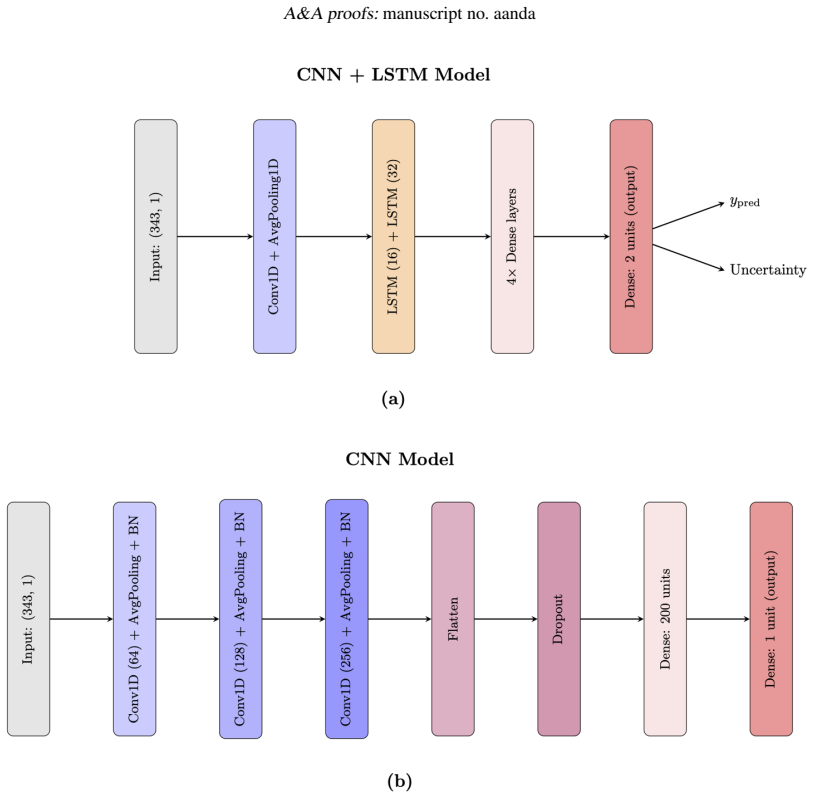
Hybrid CNN-LSTM models trained on red giants with Kepler-derived seismic parameters successfully predict Δν, ν_max, and ΔΠ_1 from Gaia XP spectra, achieving accuracies similar to moderate-resolution spectroscopic surveys and enabling predictions for over 2.5 million stars in Gaia DR3.
What carries the argument
Hybrid CNN-LSTM neural networks that learn subtle spectral signatures correlated with global asteroseismic properties.
If this is right
- Seismic parameters can be predicted for more than 2.5 million bright red giants from Gaia DR3.
- Population-level asteroseismic studies become feasible on a much larger scale.
- Saliency analysis identifies key wavelength regions linked to seismic parameters.
- Distinct spectral behaviors are noted between RGB and RC stars.
- A subset of unusual red clump candidates with low Δν is flagged for further study.
Where Pith is reading between the lines
- This technique could extend asteroseismology to stars beyond the Kepler field using only Gaia data.
- Combining these predictions with Gaia parallaxes and photometry might improve mass and radius estimates across the Galaxy.
- Future work could test the models on stars with TESS light curves for validation.
- Applying similar methods to other low-resolution spectra might reveal additional evolutionary insights.
Load-bearing premise
The spectral features learned by the models from Kepler stars apply without significant systematic errors to the broader population of red giants observed by Gaia.
What would settle it
A comparison between the deep learning predictions and actual asteroseismic measurements from an independent dataset, such as TESS observations of Gaia red giants, would confirm or refute the claimed accuracy.
Figures



read the original abstract
Red giants are tracers of stellar evolution & Galactic structure & their asteroseismic properties, particularly large frequency separation, frequency of maximum oscillation power & dipole-mode period spacing, provide direct insight into their internal structure, masses & evolutionary states. Until now, seismic inferences on large stellar samples relied primarily on high-quality light curves from missions such as Kepler & TESS, or on moderate-resolution spectroscopy (LAMOST: R ~ 1800 & APOGEE: R ~ 22500) that clearly preserve information correlated with these seismic quantities. With Gaia XP spectra (R ~ 15-85), the possibility arises to extend asteroseismic measurements to orders of magnitude more stars, despite the much lower spectral res. . Our goal is to assess whether XP spectra retain enough information to enable reliable seismic inference for RGs. We develop hybrid CNN-LSTM models trained on RGs with seismic parameters measured from Kepler photometry. The networks learn the subtle spectral signatures, imprinted through global stellar properties, that correlate with \Delta\nu, \nu_max & \Delta\Pi_1. The models recover all three global asteroseismic parameters from Gaia XP spectra with accuracies comparable to results based on moderate-res. surveys such as LAMOST, demonstrating that even low-res. spectrophotometry carries sufficient information for seismic prediction. Saliency analysis reveals wavelength regions most strongly associated with seismic sensitivity & highlights physically distinct spectral behaviour between RGB & RC stars. Applying our models to Gaia DR3 yields seismic predictions for more than 2.5 M bright RGs, enabling population-level asteroseismic studies on an unprecedented scale. We also identify a small subset of low-\Delta\nu red clump candidates showing unusual spectral-seismic correlations, offering new avenues for investigating evolved stellar populations.
Editorial analysis
A structured set of objections, weighed in public.
Referee Report
Summary. The paper develops hybrid CNN-LSTM models trained on Kepler red giants with photometric asteroseismic labels to predict the global seismic parameters Δν, ν_max, and ΔΠ1 directly from Gaia XP spectra (R~15-85). It reports that the models achieve accuracies comparable to those obtained from moderate-resolution spectroscopy (e.g., LAMOST), applies the trained networks to >2.5 million Gaia DR3 red giants, performs saliency analysis to identify wavelength regions driving the predictions, and flags a small subset of low-Δν red-clump candidates with anomalous spectral-seismic correlations.
Significance. If the generalization and accuracy claims hold after proper validation, the work would be significant: it shows that low-resolution spectrophotometry encodes sufficient information for asteroseismic inference, enabling population-level studies of stellar masses, ages, and evolutionary states across millions of stars that lack high-quality light curves or moderate-resolution spectra. This would substantially expand the reach of asteroseismology for Galactic archaeology.
major comments (3)
- [§4 and §5] §4 (Results) and §5 (Application to Gaia DR3): the central claim that accuracies are 'comparable to LAMOST' is not supported by explicit quantitative metrics (RMSE, MAE, or R²), error distributions, or a clear statement of whether the reported performance is on an independent test set drawn from a different survey or only internal Kepler cross-validation. Without these, the strength of the generalization claim cannot be assessed.
- [§3.2] §3.2 (Training and validation procedure): no domain-shift diagnostics are described (e.g., performance stratified by [Fe/H], Teff, or log g; adversarial validation; or comparison of Kepler vs. Gaia parameter distributions). Given the limited metallicity range and selection function of the Kepler training sample, this omission leaves open the possibility of systematic biases when extrapolating to the full Gaia red-giant population.
- [§4.3] §4.3 (Saliency maps) and discussion of RGB vs. RC differences: while saliency analysis is presented, it is not accompanied by a quantitative test (e.g., ablation of wavelength regions or comparison against known spectral features) showing that the learned features are physically distinct rather than proxies for Teff/log g/[Fe/H] already encoded in XP spectra.
minor comments (2)
- [Abstract and §1] Abstract and §1: abbreviations such as 'res.' and 'M' (for million) should be spelled out on first use for clarity.
- [§5] Figure captions and §5: the number of stars in the final Gaia DR3 application sample should be stated precisely (e.g., '2.5 million' rather than '2.5 M') and any quality cuts applied should be listed.
Simulated Author's Rebuttal
We thank the referee for their thorough and constructive review, which has helped us improve the clarity and rigor of the manuscript. We address each major comment below and have revised the paper accordingly to strengthen the presentation of results and validation procedures.
read point-by-point responses
-
Referee: [§4 and §5] §4 (Results) and §5 (Application to Gaia DR3): the central claim that accuracies are 'comparable to LAMOST' is not supported by explicit quantitative metrics (RMSE, MAE, or R²), error distributions, or a clear statement of whether the reported performance is on an independent test set drawn from a different survey or only internal Kepler cross-validation. Without these, the strength of the generalization claim cannot be assessed.
Authors: We agree that the original manuscript relied on a qualitative reference to published LAMOST accuracies without direct numerical side-by-side metrics. In the revised version we have added Table 3 in §4, which reports RMSE, MAE, and R² values for our CNN-LSTM models on the held-out Kepler test set together with the corresponding figures quoted from the LAMOST literature for comparable red-giant samples. We have also included residual histograms (new Fig. 4) to display the full error distributions. The performance numbers are obtained from a single 20 % independent hold-out test set drawn from the Kepler training sample (not k-fold cross-validation), and this is now stated explicitly in §3.2 and §4. These additions make the comparability claim quantitatively verifiable. revision: yes
-
Referee: [§3.2] §3.2 (Training and validation procedure): no domain-shift diagnostics are described (e.g., performance stratified by [Fe/H], Teff, or log g; adversarial validation; or comparison of Kepler vs. Gaia parameter distributions). Given the limited metallicity range and selection function of the Kepler training sample, this omission leaves open the possibility of systematic biases when extrapolating to the full Gaia red-giant population.
Authors: We acknowledge the referee’s concern regarding potential domain shift. The Kepler training set indeed spans a narrower metallicity range than the full Gaia DR3 red-giant population. In the revision we have expanded §3.2 with a new paragraph and accompanying Table 2 that stratifies test-set performance by Teff and log g bins, demonstrating that RMSE remains stable across the parameter space covered by the training data. We have also added Fig. 2, which overlays the [Fe/H], Teff, and log g distributions of the Kepler training sample against the Gaia DR3 application sample. While we did not conduct adversarial validation (which would require additional computational resources beyond the scope of the present study), the stratification and distributional comparison provide a first-order check on extrapolation risk; we now discuss the remaining limitations explicitly in the final section. revision: partial
-
Referee: [§4.3] §4.3 (Saliency maps) and discussion of RGB vs. RC differences: while saliency analysis is presented, it is not accompanied by a quantitative test (e.g., ablation of wavelength regions or comparison against known spectral features) showing that the learned features are physically distinct rather than proxies for Teff/log g/[Fe/H] already encoded in XP spectra.
Authors: We concur that a purely visual saliency analysis leaves open the possibility that the network is merely recovering already-known stellar-parameter information. In the revised §4.3 we have added a quantitative ablation experiment: we mask the highest-saliency wavelength intervals (identified separately for RGB and RC subsamples) and retrain the models, showing a statistically significant increase in RMSE that exceeds the degradation obtained when masking regions of comparable width but lower saliency. We further compare the locations of the saliency peaks with known atomic and molecular features reported in higher-resolution spectroscopic studies of red giants. These additions demonstrate that the network exploits physically distinct spectral information beyond simple Teff/log g/[Fe/H] proxies. revision: yes
Circularity Check
No significant circularity; supervised learning pipeline is self-contained
full rationale
The paper trains hybrid CNN-LSTM models on Gaia XP spectra as inputs with independent Kepler photometric asteroseismic labels (Δν, ν_max, ΔΠ1) as targets. Model outputs for new Gaia stars are generated via learned correlations rather than by algebraic reduction to the input spectra or any fitted parameter. No equations, self-citations, or ansatzes are invoked that would make the predictions equivalent to the training inputs by construction. Accuracy comparisons to LAMOST are external benchmarks, and the 2.5 M star catalog is a forward application, not a tautological renaming. The derivation remains non-circular against external seismic labels.
Axiom & Free-Parameter Ledger
free parameters (1)
- neural network weights and hyperparameters
axioms (1)
- domain assumption Gaia XP spectra contain information correlated with asteroseismic parameters through global stellar properties
Reference graph
Works this paper leans on
-
[1]
, " * write output.state after.block = add.period write newline
ENTRY address archiveprefix author booktitle chapter edition editor howpublished institution eprint journal key month note number organization pages publisher school series title type volume year label extra.label sort.label short.list INTEGERS output.state before.all mid.sentence after.sentence after.block FUNCTION init.state.consts #0 'before.all := #1 ...
-
[2]
write newline
" write newline "" before.all 'output.state := FUNCTION n.dashify 't := "" t empty not t #1 #1 substring "-" = t #1 #2 substring "--" = not "--" * t #2 global.max substring 't := t #1 #1 substring "-" = "-" * t #2 global.max substring 't := while if t #1 #1 substring * t #2 global.max substring 't := if while FUNCTION word.in bbl.in " " * FUNCTION format....
-
[3]
1966, in Stellar Evolution, ed.\ R
Baker, N. 1966, in Stellar Evolution, ed.\ R. F. Stein,& A. G. W. Cameron (Plenum, New York) 333
1966
-
[4]
1988, A&A, 200, 58
Balluch, M. 1988, A&A, 200, 58
1988
-
[5]
Cox, J. P. 1980, Theory of Stellar Pulsation (Princeton University Press, Princeton) 165
1980
-
[6]
N.,& Stewart, J
Cox, A. N.,& Stewart, J. N. 1969, Academia Nauk, Scientific Information 15, 1
1969
-
[7]
1980, Prog
Mizuno H. 1980, Prog. Theor. Phys., 64, 544
1980
-
[8]
Tscharnuter W. M. 1987, A&A, 188, 55
1987
-
[9]
1992, in ASP Conf
Terlevich, R. 1992, in ASP Conf. Ser. 31, Relationships between Active Galactic Nuclei and Starburst Galaxies, ed. A. V. Filippenko, 13
1992
-
[10]
Yorke, H. W. 1980a, A&A, 86, 286
-
[11]
F., Tytler, D
Zheng, W., Davidsen, A. F., Tytler, D. & Kriss, G. A. 1997, preprint
1997
-
[12]
Aerts , C., Mathis , S., & Rogers , T. M. 2019, , 57, 35
2019
-
[13]
2023 a , , 674, A27
Andrae, R., Fouesneau , M., Sordo , R., et al. 2023 a , , 674, A27
2023
-
[14]
2023 b , The Astrophysical Journal Supplement Series, 267, 8
Andrae, R., Rix, H.-W., & Chandra, V. 2023 b , The Astrophysical Journal Supplement Series, 267, 8
2023
-
[15]
G., Belokurov , V., et al
Ardern-Arentsen , A., Kane , S. G., Belokurov , V., et al. 2025, , 537, 1984
2025
-
[16]
& Celisse, A
Arlot, S. & Celisse, A. 2010, Statistics Surveys, 4
2010
-
[17]
2006, in ESA Special Publication, Vol
Baglin , A., Auvergne , M., Barge , P., et al. 2006, in ESA Special Publication, Vol. 1306, The CoRoT Mission Pre-Launch Status - Stellar Seismology and Planet Finding, ed. M. Fridlund , A. Baglin , J. Lochard , & L. Conroy , 33
2006
-
[18]
G., Montalban , J., Kallinger , T., et al
Beck , P. G., Montalban , J., Kallinger , T., et al. 2012, , 481, 55
2012
-
[19]
R., Mosser , B., Huber , D., et al
Bedding , T. R., Mosser , B., Huber , D., et al. 2011, , 471, 608
2011
-
[20]
J., Dupret , M
Belkacem , K., Goupil , M. J., Dupret , M. A., et al. 2011, , 530, A142
2011
-
[21]
2012, CoRR, abs/1206.5533 [ 1206.5533 ]
Bengio, Y. 2012, CoRR, abs/1206.5533 [ 1206.5533 ]
-
[22]
2025, DL101 Neural Network Outputs and Loss Functions
Berzal, F. 2025, DL101 Neural Network Outputs and Loss Functions
2025
-
[23]
2022, Monthly Notices of the Royal Astronomical Society, 511, 5032–5041
Bhambra, P., Joachimi, B., & Lahav, O. 2022, Monthly Notices of the Royal Astronomical Society, 511, 5032–5041
2022
-
[24]
Boggs, P. T. & Rogers, J. E. 1989
1989
-
[25]
2004, in ESA Special Publication, Vol
Borucki , W., Koch , D., Boss , A., et al. 2004, in ESA Special Publication, Vol. 538, Stellar Structure and Habitable Planet Finding, ed. F. Favata , S. Aigrain , & A. Wilson , 177--182
2004
-
[26]
J., Koch , D., Basri , G., et al
Borucki , W. J., Koch , D., Basri , G., et al. 2010, Science, 327, 977
2010
-
[27]
L., Rix, H.-W., et al
Bovy, J., Nidever, D. L., Rix, H.-W., et al. 2014, The Astrophysical Journal, 790, 127
2014
-
[28]
Browne, M. W. 2000, Journal of Mathematical Psychology, 44, 108
2000
- [29]
-
[30]
& Lopes , I
Capelo , D. & Lopes , I. 2023, , 953, 165
2023
-
[31]
1995, Astrophysical Journal Supplement v
Charbonneau, P. 1995, Astrophysical Journal Supplement v. 101, p. 309, 101, 309
1995
-
[32]
R., van Saders, J
Claytor, Z. R., van Saders, J. L., Llama, J., et al. 2022, The Astrophysical Journal, 927, 219
2022
-
[33]
2022, The Astrophysical Journal, 928, 188
Dhanpal, S., Benomar, O., Hanasoge, S., et al. 2022, The Astrophysical Journal, 928, 188
2022
-
[34]
2023, , 674, A33
Gaia Collaboration , Montegriffo , P., Bellazzini , M., et al. 2023, , 674, A33
2023
-
[35]
& Ghahramani, Z
Gal, Y. & Ghahramani, Z. 2016, Dropout as a Bayesian Approximation: Representing Model Uncertainty in Deep Learning
2016
-
[36]
2016, Deep Learning (MIT Press), http://www.deeplearningbook.org
Goodfellow, I., Bengio, Y., & Courville, A. 2016, Deep Learning (MIT Press), http://www.deeplearningbook.org
2016
-
[37]
& Sauval , A
Grevesse , N. & Sauval , A. J. 1998, , 85, 161
1998
-
[38]
2009, The elements of statistical learning
Hastie, T., Tibshirani, R., Friedman, J., et al. 2009, The elements of statistical learning
2009
-
[39]
2025, , 980, 90
Hattori , K. 2025, , 980, 90
2025
-
[40]
2018, , 853, 20
Hawkins , K., Ting , Y.-S., & Walter-Rix , H. 2018, , 853, 20
2018
-
[41]
L., & Chen , Y.-Q
He , X.-J., Luo , A. L., & Chen , Y.-Q. 2022, , 512, 1710
2022
-
[42]
Hjorth, L. U. & Nabney, I. T. 2000, Proceedings of the IEEE-INNS-ENNS International Joint Conference on Neural Networks. IJCNN 2000. Neural Computing: New Challenges and Perspectives for the New Millennium, 4, 455
2000
-
[43]
& Schmidhuber, J
Hochreiter, S. & Schmidhuber, J. 1997, Neural computation, 9, 1735
1997
-
[44]
2024, , 271, 13
Huang , B., Yuan , H., Xiang , M., et al. 2024, , 271, 13
2024
-
[45]
2015, On the metallicity gradients of the Galactic disk as revealed by LSS-GAC red clump stars
Huang, Y., Liu, X.-W., Zhang, H.-W., et al. 2015, On the metallicity gradients of the Galactic disk as revealed by LSS-GAC red clump stars
2015
-
[46]
J., VanderPlas, J
Ivezi \'c , Z ., Connolly, A. J., VanderPlas, J. T., & Gray, A. 2014, Statistics, data mining, and machine learning in astronomy: a practical Python guide for the analysis of survey data, Vol. 1 (Princeton University Press)
2014
-
[47]
2022, A Comprehensive Survey of Regression Based Loss Functions for Time Series Forecasting
Jadon, A., Patil, A., & Jadon, S. 2022, A Comprehensive Survey of Regression Based Loss Functions for Time Series Forecasting
2022
-
[48]
2025, Time series saliency maps: explaining models across multiple domains
Kechris, C., Dan, J., & Atienza, D. 2025, Time series saliency maps: explaining models across multiple domains
2025
-
[49]
2024, , 691, A98
Khalatyan , A., Anders , F., Chiappini , C., et al. 2024, , 691, A98
2024
-
[50]
Kingma, D. P. & Ba, J. 2017, Adam: A Method for Stochastic Optimization
2017
-
[51]
1995, The handbook of brain theory and neural networks, 3361, 1995
LeCun, Y., Bengio, Y., et al. 1995, The handbook of brain theory and neural networks, 3361, 1995
1995
-
[52]
2022, , 610, 43
Li , G., Deheuvels , S., Ballot , J., & Ligni \`e res , F. 2022, , 610, 43
2022
-
[53]
Li , J., Wong , K. W. K., Hogg , D. W., Rix , H.-W., & Chandra , V. 2024, , 272, 2
2024
-
[54]
Lightkurve Collaboration , Cardoso , J. V. d. M., Hedges , C., et al. 2018, Lightkurve: Kepler and TESS time series analysis in Python , Astrophysics Source Code Library
2018
-
[55]
Liu , C., Bailer-Jones , C. A. L., Sordo , R., et al. 2012, , 426, 2463
2012
-
[56]
J., Wang , L., Takeda , Y., Bharat Kumar , Y., & Zhao , G
Liu , Y. J., Wang , L., Takeda , Y., Bharat Kumar , Y., & Zhao , G. 2019, , 482, 4155
2019
-
[57]
L., Smith , G
Martell , S. L., Smith , G. H., & Briley , M. M. 2008, , 136, 2522
2008
-
[58]
& Gilmore , G
Masseron , T. & Gilmore , G. 2015, , 453, 1855
2015
-
[59]
& Hawkins , K
Masseron , T. & Hawkins , K. 2017, , 597, L3
2017
-
[60]
2017, , 464, 3021
Masseron , T., Lagarde , N., Miglio , A., Elsworth , Y., & Gilmore , G. 2017, , 464, 3021
2017
-
[61]
2013, , 766, 118
Montalb \'a n , J., Miglio , A., Noels , A., et al. 2013, , 766, 118
2013
-
[62]
2014, , 572, L5
Mosser , B., Benomar , O., Belkacem , K., et al. 2014, , 572, L5
2014
-
[63]
S., Hochgeschwender, N., & Olivares - M \' e ndez, M
Nair, D. S., Hochgeschwender, N., & Olivares - M \' e ndez, M. A. 2022, CoRR, abs/2202.03870 [ 2202.03870 ]
-
[64]
& Hinton, G
Nair, V. & Hinton, G. E. 2010, in Proceedings of the 27th international conference on machine learning (ICML-10), 807--814
2010
-
[65]
Nix, D. A. & Weigend, A. S. 1994, Proceedings of 1994 IEEE International Conference on Neural Networks (ICNN'94), 1, 55
1994
-
[66]
M., Ma, X., & Lee, C.-H
Qi, J., Du, J., Siniscalchi, S. M., Ma, X., & Lee, C.-H. 2020, IEEE Signal Processing Letters, 27, 1485
2020
-
[67]
R., Winn , J
Ricker , G. R., Winn , J. N., Vanderspek , R., et al. 2015, Journal of Astronomical Telescopes, Instruments, and Systems, 1, 014003
2015
-
[68]
J., Finkbeiner , D
Schlegel , D. J., Finkbeiner , D. P., & Davis , M. 1998, , 500, 525
1998
-
[69]
Deep Inside Convolutional Networks: Visualising Image Classification Models and Saliency Maps
Simonyan, K., Vedaldi, A., & Zisserman, A. 2013, CoRR, abs/1312.6034
work page Pith review arXiv 2013
-
[70]
R., Bedding , T
Sreenivas , K. R., Bedding , T. R., Li , Y., et al. 2024, , 530, 3477
2024
-
[71]
J., Basu, S., Elsworth, Y., & Bedding, T
Stello, D., Chaplin, W. J., Basu, S., Elsworth, Y., & Bedding, T. R. 2009, Monthly Notices of the Royal Astronomical Society: Letters, 400, L80–L84
2009
-
[72]
2018, , 858, L7
Ting , Y.-S., Hawkins , K., & Rix , H.-W. 2018, , 858, L7
2018
-
[73]
1989, Nonradial oscillations of stars
Unno , W., Osaki , Y., Ando , H., Saio , H., & Shibahashi , H. 1989, Nonradial oscillations of stars
1989
-
[74]
E., Rossi , E
Verberne , S., Koposov , S. E., Rossi , E. M., et al. 2024, , 684, A29
2024
-
[75]
2016, , 588, A87
Vrard , M., Mosser , B., & Samadi , R. 2016, , 588, A87
2016
-
[76]
2016, Astronomy & Astrophysics, 588, A87
Vrard, M., Mosser, B., & Samadi, R. 2016, Astronomy & Astrophysics, 588, A87
2016
-
[77]
H., Elsworth , Y., et al
Vrard , M., Pinsonneault , M. H., Elsworth , Y., et al. 2025, , 697, A165
2025
-
[78]
2022, , 259, 51
Wang , C., Huang , Y., Yuan , H., et al. 2022, , 259, 51
2022
-
[79]
2023, Astronomy & Astrophysics, 675, A26
Wang, C., Huang, Y., Zhou, Y., & Zhang, H. 2023, Astronomy & Astrophysics, 675, A26
2023
-
[80]
X., Ness , M., Nordlander , T., et al
Wang , E. X., Ness , M., Nordlander , T., et al. 2025, , 540, 3919
2025
discussion (0)
Sign in with ORCID, Apple, or X to comment. Anyone can read and Pith papers without signing in.