Coordinated Dynamic Operating Envelopes for Unlocking Additional Flexibility at Grid Edge
Pith reviewed 2026-05-10 06:28 UTC · model grok-4.3
The pith
Coordinating 30 percent of customers through an aggregator expands the safe aggregate active-power injection range by 25 percent in distribution grids.
A machine-rendered reading of the paper's core claim, the machinery that carries it, and where it could break.
Core claim
The paper claims that a convex geometry-aware optimization constructs dynamic operating envelopes for partial coordination, modeling coordinated customers with polytopal flexibility sets and non-coordinated customers with hyperrectangles, while enforcing fairness on export and import headroom and using robust constraints for bounded forecast uncertainty; this yields an approximately 25 percent larger aggregate active-power injection range when 30 percent of customers coordinate compared with the fully non-coordinated baseline, all while respecting network limits.
What carries the argument
The convex optimization that builds dynamic operating envelopes by mixing polytopal flexibility sets for coordinated customers with hyperrectangular sets for others, plus fairness and robustness constraints.
If this is right
- Network line ratings and voltage bounds remain satisfied under the enlarged flexibility ranges.
- Fairness constraints allocate export and import headroom proportionally across all customers.
- The robust formulation keeps the envelopes safe against bounded errors in inelastic load forecasts.
- Increasing the share of coordinated customers produces further monotonic growth in total harnessed flexibility.
Where Pith is reading between the lines
- Aggregators could focus coordination resources on a modest subset of customers to capture most of the available grid-headroom gains.
- The same geometry-aware approach could be tested on medium-voltage networks or with stochastic rather than bounded uncertainty.
- If device-level measurements confirm the modeled sets, the method offers a low-cost route to defer distribution upgrades.
Load-bearing premise
That the chosen polytopal and hyperrectangular flexibility sets accurately describe what real customer devices can do and that the gains seen on the European Low Voltage Test Feeder hold for other networks and uncertainty patterns.
What would settle it
Re-running the DOE construction on a different distribution feeder or with measured device flexibility sets that differ from the modeled polytopes and hyperrectangles and checking whether the 25 percent gain vanishes or network limits are violated.
Figures


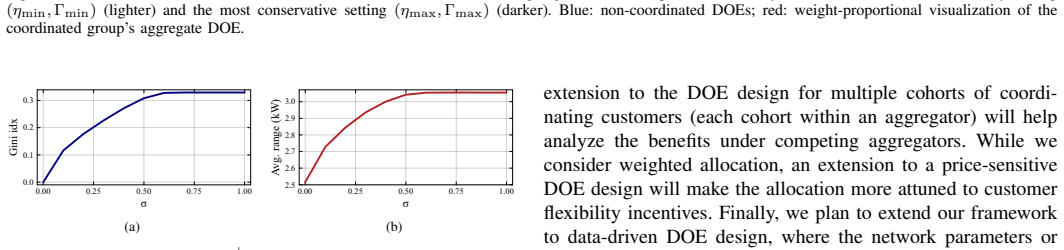

read the original abstract
Dynamic operating envelopes (DOEs) provide a systematic framework to integrate the flexibility of distribution grid resources while safeguarding network limits such as line ratings and voltage bounds. However, the flexibility derived from individual DOEs is often restricted and conservative, especially when some resources can coordinate via communication with an aggregator. This paper presents a convex, geometry-aware framework for constructing DOE for distribution grid customers under partial coordination, with coordinated customers modeled through polytopal flexibility sets and non-coordinated customers through hyperrectangles. The framework additionally incorporates fairness constraints for export and import headroom allocated to the customers within the DOE design. To account for forecast uncertainty in inelastic injections, the DOE design is extended to a robust formulation for bounded uncertainty sets. Case studies on the European Low Voltage Test Feeder indicate that the proposed DOE construction expands total harnessed flexibility, while being consistent with network limits, export/import fairness constraints and is robust to forecast uncertainty. Specifically, coordinating 30% of customers increased the achievable aggregate active-power injection range by approximately 25% relative to the non-coordinated baseline.
Editorial analysis
A structured set of objections, weighed in public.
Referee Report
Summary. The paper proposes a convex, geometry-aware framework for dynamic operating envelopes (DOEs) in distribution grids under partial coordination. Coordinated customers are modeled with polytopal flexibility sets while non-coordinated customers use hyperrectangles; the formulation incorporates export/import fairness constraints and is extended to a robust version over bounded uncertainty sets on inelastic injections. Case studies on the European Low Voltage Test Feeder report that coordinating 30% of customers expands the achievable aggregate active-power injection range by approximately 25% relative to the non-coordinated baseline, while respecting network limits.
Significance. If the polytopal and hyperrectangular flexibility sets faithfully represent device capabilities and the single-feeder results generalize, the work could meaningfully increase harnessed flexibility at the grid edge through selective coordination. The convex formulation, explicit fairness constraints, and robust extension to forecast uncertainty are clear strengths that support efficient computation and practical deployment. However, the headline numerical gain rests on modeling assumptions whose accuracy is not independently validated in the provided results.
major comments (2)
- [Case Studies] Case Studies section: The reported ~25% expansion of the aggregate active-power injection range at 30% coordination is obtained by solving the convex DOE optimization over the chosen polytopal/hyperrectangular sets on the European Low Voltage Test Feeder. No sensitivity analysis to the selection of the coordinated subset, no error bars on the 25% figure, and no comparison against more detailed (non-polytopal) device models are provided; these omissions are load-bearing because the gain can shrink or vanish if the sets over- or under-approximate true joint (P,Q) feasible regions.
- [Robust Formulation] Robust formulation (described after the nominal DOE construction): The extension to bounded uncertainty sets on inelastic injections is stated to preserve convexity and robustness, yet the manuscript does not report how the uncertainty bounds are derived from forecast data or quantify the conservatism introduced relative to the nominal case. This directly affects the claimed robustness and the magnitude of the flexibility gain.
minor comments (2)
- [Abstract] Abstract: The sentence 'coordinating 30% of customers increased the achievable aggregate active-power injection range by approximately 25%' would benefit from a brief qualifier that this holds under the specific polytopal/hyperrectangular modeling choices and the chosen test feeder.
- [Methodology] Notation: The distinction between polytopal sets for coordinated customers and hyperrectangles for others is introduced clearly, but the manuscript would be improved by an explicit table or figure comparing the two representations side-by-side with example device constraints.
Simulated Author's Rebuttal
We thank the referee for the constructive and detailed feedback on our manuscript. We address each major comment below and have revised the manuscript to incorporate additional analyses and clarifications.
read point-by-point responses
-
Referee: [Case Studies] Case Studies section: The reported ~25% expansion of the aggregate active-power injection range at 30% coordination is obtained by solving the convex DOE optimization over the chosen polytopal/hyperrectangular sets on the European Low Voltage Test Feeder. No sensitivity analysis to the selection of the coordinated subset, no error bars on the 25% figure, and no comparison against more detailed (non-polytopal) device models are provided; these omissions are load-bearing because the gain can shrink or vanish if the sets over- or under-approximate true joint (P,Q) feasible regions.
Authors: We agree that the case studies would be strengthened by additional sensitivity analysis. In the revised manuscript, we have added results from multiple randomly selected coordinated subsets of 30% of customers, reporting the mean flexibility gain along with standard deviation to provide error bars around the ~25% figure. The polytopal sets are constructed as convex outer approximations of device-level flexibility regions using standard aggregation techniques from the literature; we have expanded the discussion to explicitly address potential over- or under-approximation and its impact on the reported gains. A direct numerical comparison against non-polytopal device models is not included because high-fidelity joint (P,Q) models for the specific customer devices on the test feeder are not publicly available, but we now cite supporting references on the conservatism of polytopal approximations. revision: partial
-
Referee: [Robust Formulation] Robust formulation (described after the nominal DOE construction): The extension to bounded uncertainty sets on inelastic injections is stated to preserve convexity and robustness, yet the manuscript does not report how the uncertainty bounds are derived from forecast data or quantify the conservatism introduced relative to the nominal case. This directly affects the claimed robustness and the magnitude of the flexibility gain.
Authors: We thank the referee for highlighting this omission. The uncertainty bounds are obtained from historical forecast error data on the European Low Voltage Test Feeder by taking the maximum observed deviation over a 24-hour rolling window at the 95th percentile for each time step; this derivation procedure has been added to the revised Robust Formulation section. We have also included a direct numerical comparison of the robust versus nominal DOE solutions, which shows that the robust formulation reduces the aggregate active-power injection range by 12% on average while ensuring constraint satisfaction for all realizations within the uncertainty set. These additions quantify the conservatism and support the robustness claims. revision: yes
Circularity Check
No circularity; 25% gain is empirical outcome of convex optimization on test feeder
full rationale
The paper defines polytopal sets for coordinated customers and hyperrectangles for others as modeling choices, then solves a convex DOE program incorporating network limits, fairness constraints, and robust uncertainty sets. The reported aggregate active-power injection range expansion is computed as the difference between the coordinated and baseline solutions on the European Low Voltage Test Feeder; it does not reduce to a definitional identity, fitted parameter renamed as prediction, or self-citation chain. No load-bearing steps match the enumerated circularity patterns, and the derivation remains self-contained against the chosen geometry and network data.
Axiom & Free-Parameter Ledger
axioms (2)
- standard math The overall DOE allocation problem remains convex when coordinated customers are modeled as polytopes and non-coordinated ones as hyperrectangles.
- domain assumption Bounded uncertainty sets adequately capture forecast errors in inelastic injections.
Reference graph
Works this paper leans on
-
[1]
Trends in pv applications 2024,
G. Masson, M. de l’Epine, and I. Kaizuka, “Trends in pv applications 2024,” IEA-PVPS Task 1, Tech. Rep., 2024, 29th edition of the IEA- PVPS Trends report
2024
-
[2]
Global energy review 2025,
International Energy Agency, “Global energy review 2025,” IEA, Paris, Tech. Rep., 2025. [Online]. Available: https://www.iea.org/reports/ global-energy-review-2025 [3]IEEE Application Guide for IEEE Std 1547™–2018, IEEE Standard for Interconnection and Interoperability of Distributed Energy Resources with Associated Electric Power Systems Interfaces, Std....
2025
-
[3]
Unlocking the potential of distributed energy resources,
International Energy Agency, “Unlocking the potential of distributed energy resources,” IEA, Paris, Tech. Rep., 2022. [Online]. Available: https://www.iea.org/reports/ unlocking-the-potential-of-distributed-energy-resources
2022
-
[4]
Grid and market services from the edge: Using operating envelopes to unlock network-aware bottom-up flexibility,
M. Z. Liu, L. N. Ochoa, S. Riaz, P. Mancarella, T. Ting, J. San, and J. Theunissen, “Grid and market services from the edge: Using operating envelopes to unlock network-aware bottom-up flexibility,”IEEE Power and Energy Magazine, vol. 19, no. 4, pp. 52–62, 2021
2021
-
[5]
Allocation of dynamic operating envelopes in distribution networks: Technical and equitable perspectives,
M. R. Alam, P. T. Nguyen, L. Naranpanawe, T. K. Saha, and G. Lankesh- wara, “Allocation of dynamic operating envelopes in distribution networks: Technical and equitable perspectives,”IEEE Transactions on Sustainable Energy, vol. 15, no. 1, pp. 173–186, 2023
2023
-
[6]
Project EDGE-deliverable 1.1: Operating envelopes calculation architecture,
M. Z. Liu and L. N. Ochoa, “Project EDGE-deliverable 1.1: Operating envelopes calculation architecture,” 2021
2021
-
[7]
Second generation active network management on orkney,
C. Foote, R. Johnston, F. Watson, R. Currie, D. Macleman, and A. Urquhart, “Second generation active network management on orkney,” in22nd International Conference and Exhibition on Electricity Distribution (CIRED 2013), 2013, p. 0659. [Online]. Available: https://digital-library.theiet.org/doi/abs/10.1049/cp.2013.0864
-
[8]
Flexible access to the distribution system for renewable generators – pilot project 4b final report,
ESB Networks, “Flexible access to the distribution system for renewable generators – pilot project 4b final report,” Tech. Rep., 2021
2021
-
[9]
Accelerating the implementation of operating envelopes across Australia–milestone 4,
A. G. Givisiez and L. Ochoa, “Accelerating the implementation of operating envelopes across Australia–milestone 4,” 2024
2024
-
[10]
Project edge,
Australian Energy Market Operator, “Project edge,” https://aemo.com.au/en/initiatives/major-programs/ nem-distributed-energy-resources-der-program, 2022
2022
-
[11]
Network aware energy market participation of industrial flexibility,
M. U. Hashmi, C. Manna, and D. Van Hertem, “Network aware energy market participation of industrial flexibility,”Available at SSRN, 2024. 10 0 10 20 30 40 50 Load Index −5.0 −2.5 0.0 2.5 5.0 Power (kW) (a)σ ± = 0.5 0 10 20 30 40 50 Load Index −5.0 −2.5 0.0 2.5 5.0 Power (kW) (b)σ ± = 0.3 0 10 20 30 40 50 Load Index −5.0 −2.5 0.0 2.5 5.0 Power (kW) (c)σ ± ...
2024
-
[12]
Impact of dynamic operating envelopes on distribution network hosting capacity for electric vehicles,
H. Fani, M. U. Hashmi, E. J. Palacios-Garcia, and G. Deconinck, “Impact of dynamic operating envelopes on distribution network hosting capacity for electric vehicles,” inIET Conference Proceedings CP876, vol. 2024, no. 5. IET, 2024, pp. 180–185
2024
-
[13]
A decentralized market mechanism for energy communities under operating envelopes,
A. S. Alahmed, G. Cavraro, A. Bernstein, and L. Tong, “A decentralized market mechanism for energy communities under operating envelopes,” IEEE Transactions on Control of Network Systems, vol. 12, no. 1, pp. 313–324, 2024
2024
-
[14]
Dynamic operating envelope-based local energy market for prosumers with electric vehicles,
M. M. Hoque, M. Khorasany, M. I. Azim, R. Razzaghi, and M. Jalili, “Dynamic operating envelope-based local energy market for prosumers with electric vehicles,”IEEE Transactions on Smart Grid, vol. 15, no. 2, pp. 1712–1724, 2023
2023
-
[15]
Der capacity assessment of active distribution systems using dynamic operating envelopes,
M. Mahmoodi, L. Blackhall, S. M. N. RA, A. Attarha, B. Weise, and A. Bhardwaj, “Der capacity assessment of active distribution systems using dynamic operating envelopes,”IEEE Transactions on Smart Grid, 2023
2023
-
[16]
Robust dynamic operating envelopes for DER integration in unbalanced distribution networks,
B. Liu and J. H. Braslavsky, “Robust dynamic operating envelopes for DER integration in unbalanced distribution networks,”IEEE Transactions on Power Systems, vol. 39, no. 2, pp. 3921–3936, 2023
2023
-
[17]
Robust dynamic operating envelopes for flexibility operation using only local voltage measurement,
M. U. Hashmi and D. Van Hertem, “Robust dynamic operating envelopes for flexibility operation using only local voltage measurement,” in2023 International Conference on Smart Energy Systems and Technologies (SEST). IEEE, 2023, pp. 1–6
2023
-
[18]
Enhancing grid hosting capacity with coordinated non-firm connections in industrial energy communities,
S. Bjarghov, S. Stefanussen Foslie, M. Askeland, R. Rana, and H. Taxt, “Enhancing grid hosting capacity with coordinated non-firm connections in industrial energy communities,”Smart Energy, vol. 15, p. 100154,
-
[19]
Available: https://www.sciencedirect.com/science/article/ pii/S2666955224000248
[Online]. Available: https://www.sciencedirect.com/science/article/ pii/S2666955224000248
-
[20]
Network- aware coordination of residential distributed energy resources,
P. Scott, D. Gordon, E. Franklin, L. Jones, and S. Thi ´ebaux, “Network- aware coordination of residential distributed energy resources,”IEEE Transactions on Smart Grid, vol. 10, no. 6, pp. 6528–6537, 2019
2019
-
[21]
A robust optimization method for dynamic operating envelope coordination in distribution networks,
Z. Jiang, Y . Guo, and J. Wang, “A robust optimization method for dynamic operating envelope coordination in distribution networks,” in2024 IEEE 8th Conference on Energy Internet and Energy System Integration (EI2). IEEE, 2024, pp. 5326–5330
2024
-
[22]
Modelling and characterisation of flexibility from distributed energy resources,
S. Riaz and P. Mancarella, “Modelling and characterisation of flexibility from distributed energy resources,”IEEE transactions on power systems, vol. 37, no. 1, pp. 38–50, 2021
2021
-
[23]
Bargaining-based approach for dynamic operating envelope allocation in distribution networks,
Z. Jiang and Y . Guo, “Bargaining-based approach for dynamic operating envelope allocation in distribution networks,”IEEE Transactions on Smart Grid, 2025
2025
-
[24]
Distribution dynamic operating security space characterization for aggregation and congestion capacity evaluation of virtual power plant,
M. Song, Z. Xu, C. Gao, M. Yan, and Q. Hu, “Distribution dynamic operating security space characterization for aggregation and congestion capacity evaluation of virtual power plant,”IEEE Transactions on Smart Grid, 2025
2025
-
[25]
Equitable active-reactive power envelopes for distributed energy resources in power distribution systems,
Y . Gao, X. Xu, Z. Yan, and M. Shahidehpour, “Equitable active-reactive power envelopes for distributed energy resources in power distribution systems,”IEEE Transactions on Smart Grid, 2025
2025
-
[26]
Time-varying operating regions of end-users and feeders in low-voltage distribution networks,
G. Lankeshwara, R. Sharma, R. Yan, T. K. Saha, and J. V . Milanovi ´c, “Time-varying operating regions of end-users and feeders in low-voltage distribution networks,”IEEE Transactions on Power Systems, 2023
2023
-
[27]
Ensuring distribution network in- tegrity using dynamic operating limits for prosumers,
K. Petrou, A. T. Procopiou, L. Gutierrez-Lagos, M. Z. Liu, L. F. Ochoa, T. Langstaff, and J. M. Theunissen, “Ensuring distribution network in- tegrity using dynamic operating limits for prosumers,”IEEE Transactions on Smart Grid, vol. 12, no. 5, pp. 3877–3888, 2021
2021
-
[28]
Fair operating envelopes under uncertainty using chance constrained optimal power flow,
Y . Yi and G. Verbi ˇc, “Fair operating envelopes under uncertainty using chance constrained optimal power flow,”Electric Power Systems Research, vol. 213, p. 108465, 2022
2022
-
[29]
Can locational disparity of prosumer energy optimization due to inverter rules be lim- ited?
M. U. Hashmi, D. Deka, A. Bu ˇsi´c, and D. Van Hertem, “Can locational disparity of prosumer energy optimization due to inverter rules be lim- ited?”IEEE Transactions on Power Systems, vol. 38, no. 6, pp. 5726– 5739, 2022
2022
-
[30]
Dynamic operating envelope-integrated cooperative energy trading: A fair allocation approach,
M. I. Azim, M. M. Hoque, M. Khorasany, R. Razzaghi, M. Jalili, and D. J. Hill, “Dynamic operating envelope-integrated cooperative energy trading: A fair allocation approach,”IEEE Transactions on Power Systems, 2024
2024
-
[31]
The price of robustness,
D. Bertsimas and M. Sim, “The price of robustness,”Operations research, vol. 52, no. 1, pp. 35–53, 2004
2004
-
[32]
V oltage regulation algorithms for multiphase power distribution grids,
V . Kekatos, L. Zhang, G. B. Giannakis, and R. Baldick, “V oltage regulation algorithms for multiphase power distribution grids,”IEEE Transactions on Power Systems, vol. 31, no. 5, pp. 3913–3923, 2015
2015
-
[33]
Optimal sizing of capacitors placed on a radial distribution system,
M. Baran and F. F. Wu, “Optimal sizing of capacitors placed on a radial distribution system,”IEEE Transactions on power Delivery, vol. 4, no. 1, pp. 735–743, 2002
2002
-
[34]
Convex relaxations and linear approximation for optimal power flow in multiphase radial networks,
L. Gan and S. H. Low, “Convex relaxations and linear approximation for optimal power flow in multiphase radial networks,” in2014 power systems computation conference. IEEE, 2014, pp. 1–9
2014
-
[35]
Structure learning in power distribution networks,
D. Deka, S. Backhaus, and M. Chertkov, “Structure learning in power distribution networks,”IEEE Transactions on Control of Network Systems, vol. 5, no. 3, pp. 1061–1074, 2017
2017
-
[36]
Linear current flow equations with application to distribution systems reconfiguration,
H. Ahmadi and J. R. Martı, “Linear current flow equations with application to distribution systems reconfiguration,”IEEE Transactions on Power Systems, vol. 30, no. 4, pp. 2073–2080, 2014
2073
-
[37]
Robust operating envelopes with phase unbalance constraints in unbalanced three-phase networks,
J. S. Russell, P. Scott, and J. Iria, “Robust operating envelopes with phase unbalance constraints in unbalanced three-phase networks,” in2023 IEEE PES Innovative Smart Grid Technologies-Asia (ISGT Asia). IEEE, 2023, pp. 1–5
2023
-
[38]
S. P. Boyd and L. Vandenberghe,Convex optimization. Cambridge university press, 2004
2004
-
[39]
A parametric, second-order cone rep- resentable model of fairness for decision-making problems,
K. Sundar, D. Deka, and R. Bent, “A parametric, second-order cone rep- resentable model of fairness for decision-making problems,”Optimization and Engineering, pp. 1–16, 2025
2025
-
[40]
A quantitative measure of fairness and discrimination,
R. K. Jain, D.-M. W. Chiu, W. R. Haweet al., “A quantitative measure of fairness and discrimination,”Eastern Research Laboratory, Digital Equipment Corporation, Hudson, MA, vol. 21, no. 1, pp. 2022–2023, 1984
2022
-
[41]
A family of convex models to achieve fairness through dispersion control,
A. S. Bhadoriya, D. Deka, and K. Sundar, “A family of convex models to achieve fairness through dispersion control,”arXiv preprint arXiv:2510.23791, 2025
work page internal anchor Pith review arXiv 2025
-
[42]
Fairness for distribution network hosting capacity,
O. Rubbers, S. Kerckhove, M. U. Hashmi, and D. Van Hertem, “Fairness for distribution network hosting capacity,” in2025 IEEE PES Innovative Smart Grid Technologies Conference Europe (ISGT Europe). IEEE, 2025, pp. 1–5
2025
-
[43]
IEEE PES Test Feeder: European low voltage test feeder,
“IEEE PES Test Feeder: European low voltage test feeder,” https://cmte. ieee.org/pes-testfeeders/resources/, IEEE Power and Energy Society, 2015, [Online]
2015
-
[44]
Fisikopoulos and A
V . Fisikopoulos and A. Chalkis,volesti: Volume Approximation and Sampling of Convex Polytopes, 2025, r package version 1.1.2-9. [Online]. Available: https://CRAN.R-project.org/package=volesti
2025
-
[45]
On the measure of concentration with special reference to income and statistics, colorado college publication,
C. Gini, “On the measure of concentration with special reference to income and statistics, colorado college publication,”General series, vol. 208, no. 1, 1936
1936
discussion (0)
Sign in with ORCID, Apple, or X to comment. Anyone can read and Pith papers without signing in.