The inversion number statistic for inversion sequences
Pith reviewed 2026-05-10 06:05 UTC · model grok-4.3
The pith
The inversion number statistic on inversion sequences, studied jointly with four others, recovers the Stirling, Mahonian, Eulerian, Catalan, Narayana, and involution counts via specializations.
A machine-rendered reading of the paper's core claim, the machinery that carries it, and where it could break.
Core claim
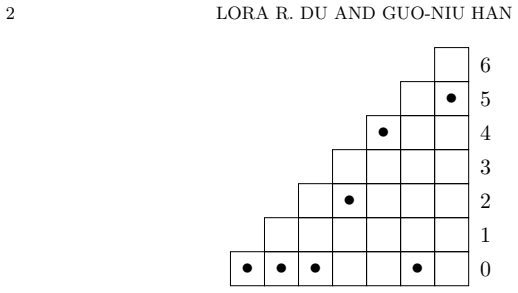
Inversion sequences, also known as subexcedant sequences, form a fundamental class of objects in enumerative combinatorics. In this paper, we study the joint distribution of five statistics on inversion sequences. While several statistics on inversion sequences have been extensively investigated, our contribution is to introduce the inversion number statistic, originally defined for permutations, into the context of inversion sequences. As special cases, we recover classical permutation statistics, including the Stirling, Mahonian and Eulerian distributions, as well as the Catalan and Narayana numbers. Somewhat unexpectedly, our specializations also include the number of involutions in the 2
What carries the argument
The inversion number statistic on inversion sequences, realized through the q-analog of Comtet's expansion formula obtained by replacing the derivative D with the q-derivative D_q.
If this is right
- Special cases of the joint generating function yield the q-Stirling numbers of the first kind.
- Other specializations recover the Mahonian and Eulerian polynomials.
- Further specializations produce the Catalan and Narayana numbers.
- One specialization counts the involutions in the symmetric group.
Where Pith is reading between the lines
- The same five-statistic framework might be applied to other combinatorial objects that admit a natural length or height function.
- The unexpected appearance of involution counts suggests looking for a direct bijection that explains why the statistic combination produces them.
- One could test whether a similar q-analog construction works for other classical expansion formulas beyond Comtet's.
- The approach may generate new q-analogs for statistics whose q-versions were previously unknown.
Load-bearing premise
The q-analog substitution into Comtet's expansion formula correctly encodes the joint distribution of the five statistics and its specializations align with the classical definitions of the recovered numbers.
What would settle it
Compute the five-statistic generating function explicitly for inversion sequences of length 4 and verify whether its specializations exactly reproduce the known Narayana numbers and the number of involutions on 4 elements.
Figures


read the original abstract
Inversion sequences, also known as subexcedant sequences, form a fundamental class of objects in enumerative combinatorics. In this paper, we study the joint distribution of five statistics on inversion sequences. While several statistics on inversion sequences have been extensively investigated, our contribution is to introduce the inversion number statistic, originally defined for permutations, into the context of inversion sequences. As special cases, we recover classical permutation statistics, including the Stirling, Mahonian and Eulerian distributions, as well as the Catalan and Narayana numbers. Somewhat unexpectedly, our specializations also include the number of involutions in the symmetric group. Our study arises from a $q$-analog of Comtet's expansion formula obtained by substituting the classical derivative operator $D$ with the $q$-derivative operator $D_q$.
Editorial analysis
A structured set of objections, weighed in public.
Referee Report
Summary. The paper introduces the inversion number statistic on inversion sequences and studies its joint distribution with four other statistics. It obtains a q-analog of Comtet's expansion formula by substituting the q-derivative D_q for the ordinary derivative D, and shows that specializations of the resulting generating functions recover the Stirling, Mahonian, and Eulerian distributions on permutations, the Catalan and Narayana numbers, and the number of involutions.
Significance. If the substitution step is shown to correctly encode the inversion statistic, the work supplies a unified operator-based framework that recovers multiple classical distributions as special cases of a single joint generating function on inversion sequences. The unexpected appearance of the involution count among the specializations is a notable feature that may point to deeper connections. The approach relies on standard q-analog techniques applied to a cited formula and thereby extends existing enumerative results in a coherent way.
major comments (1)
- [Abstract and main derivation] Abstract and main derivation: the central claim that substituting D_q for D in Comtet's expansion formula directly produces the joint distribution of the five statistics (including the newly defined inversion number) is load-bearing for all subsequent specializations. The manuscript must explicitly verify that the action of D_q increments the q-exponent exactly according to the combinatorial definition of inversions on inversion sequences while leaving the other four statistics unchanged; without a concrete computation or small-case check demonstrating this correspondence, the recovery of the Stirling, Mahonian, Eulerian, Catalan, Narayana, and involution counts remains conditional on an unconfirmed operator-statistic alignment.
Simulated Author's Rebuttal
We are grateful to the referee for their thorough reading and insightful comments. The suggestion to provide an explicit verification of the operator-statistic correspondence is well-taken, and we will incorporate it in the revision.
read point-by-point responses
-
Referee: Abstract and main derivation: the central claim that substituting D_q for D in Comtet's expansion formula directly produces the joint distribution of the five statistics (including the newly defined inversion number) is load-bearing for all subsequent specializations. The manuscript must explicitly verify that the action of D_q increments the q-exponent exactly according to the combinatorial definition of inversions on inversion sequences while leaving the other four statistics unchanged; without a concrete computation or small-case check demonstrating this correspondence, the recovery of the Stirling, Mahonian, Eulerian, Catalan, Narayana, and involution counts remains conditional on an unconfirmed operator-statistic alignment.
Authors: We acknowledge the importance of explicitly confirming that the substitution of D_q for D encodes the inversion number statistic correctly. Upon review, the manuscript derives the q-analog formally but does not include a direct small-case verification. We will add such a verification in the revised manuscript, computing the action of D_q on the generating function for inversion sequences of small length and matching it to the inversion counts, while confirming the other statistics are preserved. This will solidify the foundation for the subsequent specializations. revision: yes
Circularity Check
No circularity: derivation applies external Comtet formula via standard q-substitution to derive new joint distributions
full rationale
The paper begins with Comtet's expansion formula (an external reference) and obtains its q-analog by the standard substitution of the q-derivative operator D_q for D. It then introduces the inversion number statistic on inversion sequences and derives the joint generating function for five statistics. The claimed specializations to Stirling, Mahonian, Eulerian, Catalan, Narayana, and involution numbers function as independent verifications against classically known enumerations rather than as inputs or fitted parameters. No load-bearing step reduces by definition to its own outputs, no self-citation chain is invoked to justify uniqueness or ansatz choices, and the central results remain combinatorially falsifiable outside the paper's own constructions.
Axiom & Free-Parameter Ledger
axioms (2)
- domain assumption Standard definitions of inversion sequences as subexcedant sequences and of the inversion number, descent, and other statistics as in permutation combinatorics.
- domain assumption Comtet's expansion formula admits a valid q-analog under substitution of the q-derivative operator.
Reference graph
Works this paper leans on
-
[1]
Andrews.The theory of partitions, volume Vol
George E. Andrews.The theory of partitions, volume Vol. 2 ofEncyclopedia of Mathematics and its Applications. Addison-Wesley Publishing Co., Reading, Mass.-London-Amsterdam, 1976
work page 1976
-
[2]
A permutation code preserving a dou- ble Eulerian bistatistic.Discrete Appl
Jean-Luc Baril and Vincent Vajnovszki. A permutation code preserving a dou- ble Eulerian bistatistic.Discrete Appl. Math., 224:9–15, 2017
work page 2017
-
[3]
Combinatorial models of creation- annihilation.S´ em
Pawel Blasiak and Philippe Flajolet. Combinatorial models of creation- annihilation.S´ em. Lothar. Combin., 65:Art. B65c, 78, 2010/12
work page 2010
-
[4]
Leonard Carlitz. On abelian fields.Trans. Amer. Math. Soc., 35(1):122–136, 1933
work page 1933
-
[5]
Une formule explicite pour les puissances successives de l’op´ erateur de d´ erivation de Lie.C
Louis Comtet. Une formule explicite pour les puissances successives de l’op´ erateur de d´ erivation de Lie.C. R. Acad. Sci. Paris S´ er. A-B, 276:A165– A168, 1973
work page 1973
-
[6]
Sylvie Corteel, Megan A. Martinez, Carla D. Savage, and Michael Wesel- couch. Patterns in inversion sequences I.Discrete Math. Theor. Comput. Sci., 18(2):Paper No. 2, 21, 2016
work page 2016
-
[7]
A unified combinatorial approach forq- (andp, q-) Stirling numbers.J
Anne de M´ edicis and Pierre Leroux. A unified combinatorial approach forq- (andp, q-) Stirling numbers.J. Statist. Plann. Inference, 34(1):89–105, 1993
work page 1993
-
[8]
Dyck path enumeration.Discrete Math., 204(1-3):167–202, 1999
Emeric Deutsch. Dyck path enumeration.Discrete Math., 204(1-3):167–202, 1999
work page 1999
-
[9]
Multivariable tangent and secantq- derivative polynomials.Mosc
Dominique Foata and Guo-Niu Han. Multivariable tangent and secantq- derivative polynomials.Mosc. J. Comb. Number Theory, 2(3):34–84, 2012
work page 2012
-
[10]
Adriano M. Garsia. On the “maj” and “inv”q-analogues of Eulerian polyno- mials.Linear and Multilinear Algebra, 8(1):21–34, 1979/80
work page 1979
-
[11]
Cambridge University Press, Cambridge, second edition, 2004
George Gasper and Mizan Rahman.Basic hypergeometric series, volume 96 ofEncyclopedia of Mathematics and its Applications. Cambridge University Press, Cambridge, second edition, 2004. With a foreword by Richard Askey
work page 2004
-
[12]
H. W. Gould. Theq-Stirling numbers of first and second kinds.Duke Math. J., 28:281–289, 1961
work page 1961
-
[13]
Eulerian polynomials and theg-indices of Young tableaux.Proc
Guo-Niu Han and Shi-Mei Ma. Eulerian polynomials and theg-indices of Young tableaux.Proc. Amer. Math. Soc., 152(4):1437–1449, 2024
work page 2024
-
[14]
On 102- Avoiding Inversion Sequences.Electron
JiSun Huh, Sangwook Kim, Seunghyun Seo, and Heesung Shin. On 102- Avoiding Inversion Sequences.Electron. J. Combin., 33(2):P2.10, 2026
work page 2026
-
[15]
Refined restricted inversion sequences.S´ em
Dongsu Kim and Zhicong Lin. Refined restricted inversion sequences.S´ em. Lothar. Combin., 78B:Art. 52, 12, 2017
work page 2017
-
[16]
Reduced matrices andq-log-concavity properties ofq-Stirling numbers.J
Pierre Leroux. Reduced matrices andq-log-concavity properties ofq-Stirling numbers.J. Combin. Theory Ser. A, 54(1):64–84, 1990
work page 1990
- [17]
-
[18]
Patterns in inversion sequences II: inversion sequences avoiding triples of relations.J
Megan Martinez and Carla Savage. Patterns in inversion sequences II: inversion sequences avoiding triples of relations.J. Integer Seq., 21(2):Art. 18.2.2, 44, 2018
work page 2018
-
[19]
Stephen C. Milne. Restricted growth functions, rank row matchings of partition lattices, andq-Stirling numbers.Adv. in Math., 43(2):173–196, 1982
work page 1982
-
[20]
The on-line encyclopedia of integer sequences.https: //oeis.org
OEIS Foundation Inc. The on-line encyclopedia of integer sequences.https: //oeis.org
-
[21]
Bruce E. Sagan. A maj statistic for set partitions.European J. Combin., 12(1):69–79, 1991
work page 1991
-
[22]
Carla D. Savage and Michael J. Schuster. Ehrhart series of lecture hall poly- topes and Eulerian polynomials for inversion sequences.J. Combin. Theory Ser. A, 119(4):850–870, 2012
work page 2012
-
[23]
William R. Schmitt and Michael S. Waterman. Linear trees and RNA sec- ondary structure.Discrete Appl. Math., 51(3):317–323, 1994
work page 1994
-
[24]
Richard P. Stanley.Catalan numbers. Cambridge University Press, New York, 2015. Center for Applied Mathematics and KL-AAGDM, Tianjin Univer- sity, Tianjin 300072, P.R. China Email address:loradu@tju.edu.cn I.R.M.A., UMR 7501, Universit´e de Strasbourg et CNRS, 7 rue Ren´e Descartes, F-67084 Strasbourg, France Email address:guoniu.han@unistra.fr
work page 2015
discussion (0)
Sign in with ORCID, Apple, or X to comment. Anyone can read and Pith papers without signing in.