Recognition: unknown
Search for the single production of vector-like quarks decaying into a W boson and a b quark using single-lepton final states in proton-proton collisions at sqrt{s} = 13 TeV
Pith reviewed 2026-05-10 04:51 UTC · model grok-4.3
The pith
No significant excess is observed in a search for singly produced vector-like quarks decaying to Wb, allowing new upper limits on their coupling and mass at 95% confidence level.
A machine-rendered reading of the paper's core claim, the machinery that carries it, and where it could break.
Core claim
The paper establishes that no significant excess over the standard model prediction is observed in the selected single-lepton final states. Upper limits at the 95% confidence level are set on the VLQ production cross section and its coupling κ_W to the standard model sector. For a VLQ decaying exclusively into Wb, the upper limit on κ_W reaches as low as 0.086 for masses around 1.4 TeV, and for κ_W = 0.2 the lower limit on the VLQ mass is 2.4 TeV. These are the most stringent limits to date on the single production of VLQs decaying into Wb.
What carries the argument
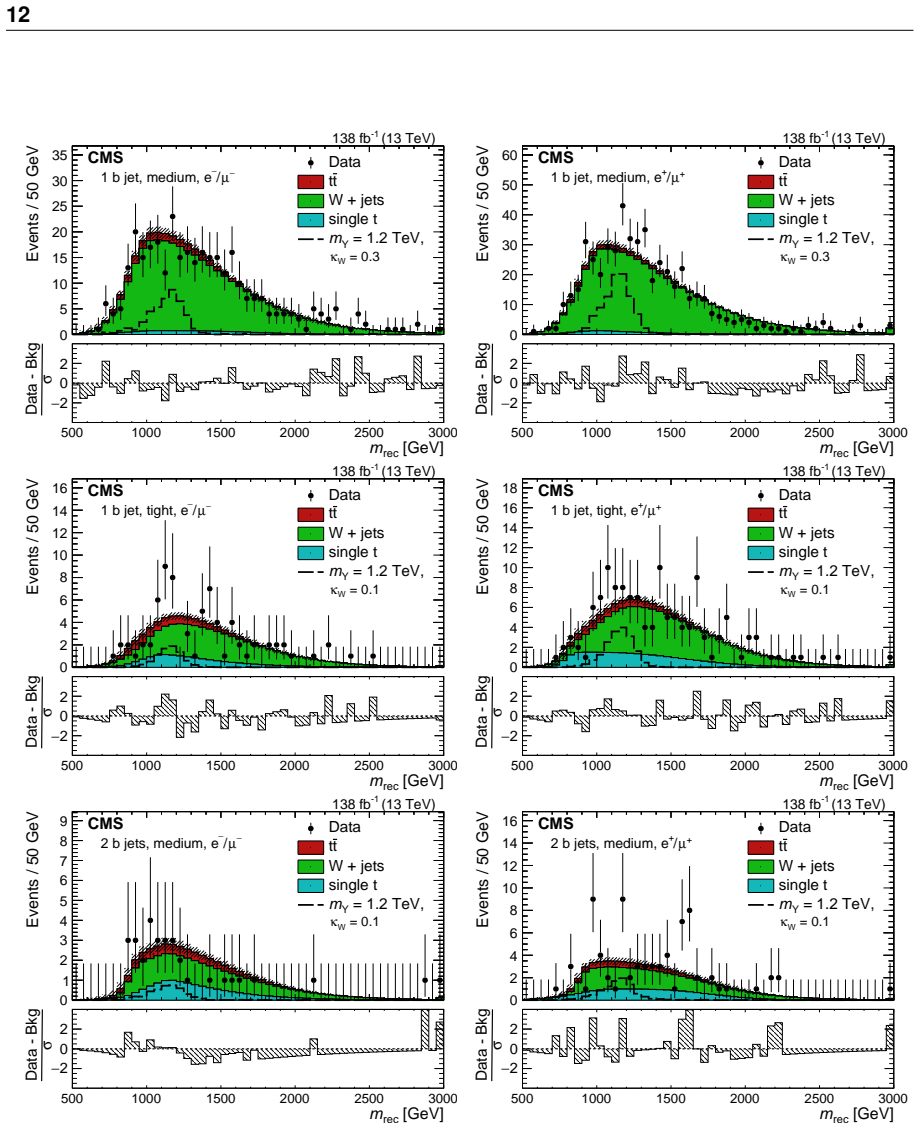
The event selection requiring one electron or muon, large missing transverse momentum, at least one high transverse momentum b-tagged jet, and at least one forward jet, combined with statistical methods to set upper limits on signal strength.
If this is right
- Models predicting vector-like quarks with masses below 2.4 TeV and coupling κ_W of 0.2 are excluded by the data.
- The production cross section of such VLQs is constrained to be below certain values depending on mass and coupling.
- These results can be used to guide future searches in other decay channels or at higher luminosities.
- Extensions of the standard model with vector-like quarks must satisfy these constraints to remain viable.
Where Pith is reading between the lines
- Similar search strategies could be adapted for other vector-like quark decay modes, such as to Z or Higgs bosons.
- The lack of signal suggests that if vector-like quarks exist, they may couple more weakly or be heavier than many theoretical models assume.
- Combining these limits with other CMS or ATLAS searches could provide even stronger constraints on BSM physics.
- Future LHC runs with more data might probe higher masses or smaller couplings.
Load-bearing premise
The analysis assumes that standard model background processes are modeled accurately in simulation and that the detector response and selection efficiencies for signal events are correctly estimated.
What would settle it
A significant excess of events matching the expected signal signature in the data, or a large discrepancy between observed and predicted background yields that cannot be accounted for by uncertainties, would challenge the validity of the derived limits.
Figures



read the original abstract
A search is performed for the single production of a heavy vector-like quark (VLQ), decaying into a W boson and a b quark. The analysis uses proton-proton collision data collected by the CMS experiment at the CERN LHC at a center-of-mass energy of 13 TeV and corresponding to an integrated luminosity of 138 fb$^{-1}$. The search targets events with leptonic W boson decays. The event signature consists of one electron or muon, large transverse momentum imbalance, at least one jet consistent with coming from the fragmentation of a b quark and having large transverse momentum, and at least one jet in the forward region of the detector. No significant excess over the standard model prediction is observed. Upper limits are set at the 95% confidence level on the production cross section of a VLQ and its coupling $\kappa_\mathrm{W}$ to the standard model sector. For a VLQ decaying exclusively into Wb, the upper limit on $\kappa_\mathrm{W}$ depends on the VLQ mass and reaches values as low as 0.086 for masses around 1.4 TeV. For $\kappa_\mathrm{W}$ = 0.2 the lower limit on the VLQ mass is 2.4 TeV. These are the most stringent limits to date on the single production of VLQs decaying into Wb.
Editorial analysis
A structured set of objections, weighed in public.
Referee Report
Summary. The manuscript presents a search for single production of vector-like quarks (VLQs) decaying to Wb in the single-lepton channel, using 138 fb^{-1} of 13 TeV pp collision data collected by CMS. Events are selected requiring one lepton (e or μ), large missing transverse momentum, at least one high-p_T b-tagged jet, and at least one forward jet. No significant excess over the standard-model background prediction is observed. 95% CL upper limits are set on the VLQ production cross section and on the coupling κ_W to the SM sector; for exclusive Wb decays the limit on κ_W reaches 0.086 near 1.4 TeV, while for κ_W = 0.2 the VLQ mass is excluded below 2.4 TeV. The results are stated to be the most stringent to date in this channel.
Significance. If the background modeling, signal efficiencies, and statistical procedure are validated, the result supplies the tightest constraints yet on single VLQ production in the Wb final state. The analysis exploits the full Run-2 dataset together with a topology-specific forward-jet requirement that enhances sensitivity to the single-production mode. The standard CL_s limit-setting approach is used on a null observation, providing a clean, falsifiable bound on a well-motivated BSM scenario.
minor comments (2)
- [Abstract] Abstract: the statement that the limits are 'the most stringent to date' would be strengthened by a one-sentence comparison to the previous best result (e.g., the 2016–2018 CMS or ATLAS single-VLQ Wb search).
- [Introduction] The definition of the coupling κ_W and its relation to the production cross section should be stated explicitly in the introduction or theory section to avoid ambiguity for readers outside the VLQ phenomenology community.
Simulated Author's Rebuttal
We thank the referee for their positive review of the manuscript and for recommending acceptance. The referee's summary accurately captures the key elements of our search for single production of vector-like quarks decaying to Wb in the single-lepton channel with the full 138 fb^{-1} Run-2 dataset.
Circularity Check
No circularity: limits derived from direct data-to-simulation comparison
full rationale
The paper reports a standard LHC search: event selection on single-lepton + MET + b-jet + forward-jet signature, background estimation from simulation with data-driven corrections, and 95% CL upper limits on VLQ cross-section and coupling via the CL_s method. No equation or step reduces a claimed prediction to a fitted parameter of the signal hypothesis, nor does any load-bearing premise rest on a self-citation chain. The null result and limits follow directly from comparing observed yields to independent SM background predictions; the analysis is self-contained against external benchmarks.
Axiom & Free-Parameter Ledger
axioms (1)
- domain assumption Standard model processes accurately describe the background rates and kinematics in the selected single-lepton plus b-jet plus forward-jet final state.
invented entities (1)
-
Vector-like quark
no independent evidence
Reference graph
Works this paper leans on
-
[1]
Phenomenology of 2HDM with vectorlike quarks
A. Arhrib et al., “Phenomenology of 2HDM with vectorlike quarks”,Phys. Rev. D97 (2018) 095015,doi:10.1103/PhysRevD.97.095015,arXiv:1607.08517
-
[2]
The minimal composite Higgs model
K. Agashe, R. Contino, and A. Pomarol, “The minimal composite Higgs model”,Nucl. Phys. B719(2005) 165,doi:10.1016/j.nuclphysb.2005.04.035, arXiv:hep-ph/0412089
-
[3]
Light top partners for a light composite Higgs
O. Matsedonskyi, G. Panico, and A. Wulzer, “Light top partners for a light composite Higgs”,JHEP01(2013) 164,doi:10.1007/JHEP01(2013)164,arXiv:1204.6333
-
[4]
A Large Mass Hierarchy from a Small Extra Dimension
L. Randall and R. Sundrum, “Large mass hierarchy from a small extra dimension ”,Phys. Rev. Lett.83(1999) 3370,doi:10.1103/PhysRevLett.83.3370, arXiv:hep-ph/9905221
work page internal anchor Pith review doi:10.1103/physrevlett.83.3370 1999
-
[5]
I. Antoniadis, “A possible new dimension at a few TeV”,Phys. Lett. B246(1990) 377, doi:10.1016/0370-2693(90)90617-F
-
[6]
Extra vectorlike matter and the lightest Higgs scalar boson mass in low-energy supersymmetry
S. Martin, “Extra vectorlike matter and the lightest Higgs scalar boson mass in low-energy supersymmetry”,Phys. Rev. D81(2010) 035004, doi:10.1103/PhysRevD.81.035004,arXiv:0910.2732
-
[7]
Higgs vacuum stability with vectorlike fermions
S. Gopalakrishna and A. Velusam, “Higgs vacuum stability with vectorlike fermions”, Phys. Rev. D99(2019) 115020,doi:10.1103/PhysRevD.99.115020, arXiv:1812.11303
-
[8]
Vacuum stability in the Standard Model with vectorlike fermions
A. Arsenault, K. Y. Cingiloglu, and M. Frank, “ Vacuum stability in the Standard Model with vectorlike fermions”,Phys. Rev. D107(2023) 036018, doi:10.1103/PhysRevD.107.036018,arXiv:2207.10332
-
[9]
The minimal fermionic model of electroweak baryogenesis
D. Egana-Ugrinovic, “ The minimal fermionic model of electroweak baryogenesis ”, JHEP12(2017) 064,doi:10.1007/JHEP12(2017)064,arXiv:1707.02306
-
[10]
Unification of gauge couplings in the standard model with extra vectorlike families
R. Dermisek, “ Unification of gauge couplings in the standard model with extra vectorlike families ”,Phys. Rev. D87(2013) 055008, doi:10.1103/PhysRevD.87.055008,arXiv:1212.3035
-
[11]
A handbook of vector-like quarks: mixing and single production
J. A. Aguilar-Saavedra, R. Benbrik, S. Heinemeyer, and M. Perez-Victoria, “Handbook of vectorlike quarks: mixing and single production”,Phys. Rev. D88(2013) 094010, doi:10.1103/PhysRevD.88.094010,arXiv:1306.0572
-
[12]
Interplay of vectorlike top partner multiplets in a realistic mixing set-up
G. Cacciapaglia et al., “Interplay of vectorlike top partner multiplets in a realistic mixing set-up”, KEK report KEK-TH-1729, LYCEN-2014-09, 2015.arXiv:1502.00370
-
[13]
CMS Collaboration, “Review of searches for vector-like quarks, vector-like leptons, and heavy neutral leptons in proton-proton collisions at √s=13 TeV at the CMS experiment”,Phys. Rept.1115(2025) 570,doi:10.1016/j.physrep.2024.09.012, arXiv:2405.17605
-
[14]
ATLAS Collaboration, “Combination of the Searches for Pair-Produced Vectorlike Partners of the Third-Generation Quarks at √s=13 TeV with the ATLAS Detector”, Phys. Rev. Lett.121(2018) 211801,doi:10.1103/PhysRevLett.121.211801, arXiv:1808.02343. References 17
-
[15]
ATLAS Collaboration, “Search for pair production of heavy vectorlike quarks decaying into hadronic final states in pp collisions at √s=13 TeV with the ATLAS detector”,Phys. Rev. D98(2018) 092005,doi:10.1103/PhysRevD.98.092005,arXiv:1808.01771
-
[16]
ATLAS Collaboration, “Combination of searches for singly produced vectorlike top quarks in pp collisions at √s=13 TeV with the ATLAS detector”,Phys. Rev. D111 (2025) 012012,doi:10.1103/PhysRevD.111.012012,arXiv:2408.08789
-
[17]
Model independent framework for searches of top partners
M. Buchkremer, A. Cacciapaglia, A. Deandrea, and L. Panizzi, “Model-independent framework for searches of top partners”,Nucl. Phys. B876(2013) 376, doi:10.1016/j.nuclphysb.2013.08.010,arXiv:1305.4172
-
[18]
The TeV physics of strongly interacting W’s and Z’s
M. Chanowitz and M. Caillard, “The TeV physics of strongly interacting W’s and Z’s”, Nucl. Phys. B261(1985) 379,doi:10.1016/0550-3213(85)90580-2
-
[19]
Update of the global electroweak fit and constraints on two-Higgs-doublet models
J. Haller et al., “Update of the global electroweak fit and constraints on two-Higgs-doublet models”,Eur. Phys. J. C78(2018) 675, doi:10.1140/epjc/s10052-018-6131-3,arXiv:1803.01853
-
[20]
Status of the global electroweak fit with Gfitter in the light of new precision measurements
J. Haller et al., “Status of the global electroweak fit with Gfitter in the light of new precision measurements”, inProceedings of the 41st International Conference on High Energy Physics (ICHEP2022). 2022.arXiv:2211.07665
-
[21]
CMS Collaboration, “Search for single production of vector-like quarks decaying into a b quark and a W boson in proton-proton collisions at √s=13 TeV”,Phys. Lett. B772 (2017) 634,doi:10.1016/j.physletb.2017.07.022,arXiv:1701.08328
-
[22]
ATLAS Collaboration, “Search for single production of vector-like quarks decaying into Wb in pp collisions at √s=13 TeV with the ATLAS detector”,JHEP05(2019) 164, doi:10.1007/JHEP05(2019)164,arXiv:1812.07343
-
[23]
ATLAS Collaboration, “Search for single-production of vector-like quarks decaying into Wb in the fully hadronic final state in pp collisions at √s=13 TeV with the ATLAS detector”,JHEP02(2025) 075,doi:10.1007/JHEP02(2025)075, arXiv:2409.20273v2
-
[24]
Aadet al.[ATLAS], JHEP12, 012 (2025) doi:10.1007/JHEP12(2025)012 [arXiv:2506.15515 [hep-ex]]
ATLAS Collaboration, “Search for single production of vector-like quarks decaying into W(ℓν)b in pp collisions at √s=13 TeV with the ATLAS detector”,JHEP12(2025) 012, doi:10.1007/JHEP12(2025)012,arXiv:2506.15515
-
[25]
The CMS experiment at the CERN LHC
CMS Collaboration, “The CMS experiment at the CERN LHC”,JINST3(2008) S08004, doi:10.1088/1748-0221/3/08/S08004
-
[26]
Development of the CMS detector for the CERN LHC Run 3
CMS Collaboration, “Development of the CMS detector for the CERN LHC Run 3”, JINST19(2024) P05064,doi:10.1088/1748-0221/19/05/P05064, arXiv:2309.05466
-
[27]
Performance of the CMS Level-1 trigger in proton-proton collisions at √s=13 TeV
CMS Collaboration, “Performance of the CMS Level-1 trigger in proton-proton collisions at √s=13 TeV”,JINST15(2020) P10017, doi:10.1088/1748-0221/15/10/P10017,arXiv:2006.10165
-
[28]
CMS Collaboration, “The CMS trigger system”,JINST12(2017) P01020, doi:10.1088/1748-0221/12/01/P01020,arXiv:1609.02366. 18
-
[29]
Performance of the CMS high-level trigger during LHC Run 2
CMS Collaboration, “Performance of the CMS high-level trigger during LHC Run 2”, JINST19(2024) P11021,doi:10.1088/1748-0221/19/11/P11021, arXiv:2410.17038
-
[30]
Particle-flow reconstruction and global event description with the CMS detector
CMS Collaboration, “Particle-flow reconstruction and global event description with the CMS detector”,JINST12(2017) P10003,doi:10.1088/1748-0221/12/10/P10003, arXiv:1706.04965
work page internal anchor Pith review Pith/arXiv arXiv doi:10.1088/1748-0221/12/10/p10003 2017
-
[31]
Technical proposal for the Phase-II upgrade of the Compact Muon Solenoid
CMS Collaboration, “Technical proposal for the Phase-II upgrade of the Compact Muon Solenoid”, CMS Technical Proposal CERN-LHCC-2015-010, CMS-TDR-15-02, 2015
2015
-
[32]
Electron and photon reconstruction and identification with the CMS experiment at the CERN LHC
CMS Collaboration, “Electron and photon reconstruction and identification with the CMS experiment at the CERN LHC”,JINST16(2021) P05014, doi:10.1088/1748-0221/16/05/P05014,arXiv:2012.06888
-
[33]
ECAL 2016 refined calibration and Run2 summary plots
CMS Collaboration, “ECAL 2016 refined calibration and Run2 summary plots”, CMS Detector Performance Summary CMS-DP-2020-021, 2020
2016
-
[34]
CMS Collaboration, “Performance of the CMS muon detector and muon reconstruction with proton-proton collisions at √s=13 TeV”,JINST13(2018) P06015, doi:10.1088/1748-0221/13/06/P06015,arXiv:1804.04528
work page internal anchor Pith review Pith/arXiv arXiv doi:10.1088/1748-0221/13/06/p06015 2018
-
[35]
M. Cacciari, G. P . Salam, and G. Soyez, “Fastjet user manual”,Eur. Phys. J. C72(2012) 1896,doi:10.1140/epjc/s10052-012-1896-2,arXiv:1111.6097
-
[36]
M. Cacciari, G. P . Salam, and G. Soyez, “The anti-kT jet clustering algorithm”,JHEP04 (2008) 063,doi:10.1088/1126-6708/2008/04/063,arXiv:0802.1189
-
[37]
M. Cacciari, G. P . Salam, and G. Soyez, “The catchment area of jets”,JHEP04(2008) 005, doi:10.1088/1126-6708/2008/04/005,arXiv:0802.1188
-
[38]
Jet energy scale and resolution in the CMS experiment in pp collisions at 8 TeV
CMS Collaboration, “Jet energy scale and resolution in the CMS experiment in pp collisions at 8 TeV”,JINST12(2017) P02014, doi:10.1088/1748-0221/12/02/P02014,arXiv:1607.03663
-
[39]
Jet flavour classification using DeepJet
E. Bols et al., “Jet flavour classification using DeepJet”,JINST15(2020) P12012, doi:10.1088/1748-0221/15/12/P12012,arXiv:2008.10519
-
[40]
Identification of heavy-flavour jets with the CMS detector in pp collisions at 13 TeV
CMS Collaboration, “Identification of heavy-flavour jets with the CMS detector in pp collisions at 13 TeV”,JINST13(2018) P05011, doi:10.1088/1748-0221/13/05/P05011,arXiv:1712.07158
work page Pith review doi:10.1088/1748-0221/13/05/p05011 2018
-
[41]
CMS Collaboration, “Identification of heavy, energetic, hadronically decaying particles using machine-learning techniques”,JINST15(2020) P06005, doi:10.1088/1748-0221/15/06/p06005,arXiv:2004.08262
-
[42]
CMS Collaboration, “Performance of missing transverse momentum reconstruction in proton-proton collisions at √s=13 TeV using the CMS detector”,JINST14(2019) P07004,doi:10.1088/1748-0221/14/07/P07004,arXiv:1903.06078
-
[43]
Ball, et al., JHEP04, 040 (2015)
NNPDF Collaboration, “Parton distributions for the LHC Run II”,JHEP04(2015) 040, doi:10.1007/JHEP04(2015)040,arXiv:1410.8849
-
[44]
Parton distributions from high-precision collider data
CMS Collaboration, “Parton distributions from high-precision collider data”,Eur. Phys. J. C77(2017) 663,doi:10.1140/epjc/s10052-017-5199-5,arXiv:1706.00428. References 19
work page internal anchor Pith review Pith/arXiv arXiv doi:10.1140/epjc/s10052-017-5199-5 2017
-
[45]
J. Alwall et al., “The automated computation of tree-level and next-to-leading order differential cross sections, and their matching to parton shower simulations”,JHEP07 (2014) 079,doi:10.1007/JHEP07(2014)079,arXiv:1405.0301
-
[46]
Automatic spin-entangled decays of heavy resonances in Monte Carlo simulations
P . Artoisenet, R. Frederix, O. Mattelaer, and R. Rietkerk, “Automatic spin-entangled decays of heavy resonances in Monte Carlo simulations”,JHEP03(2013) 015, doi:10.1007/JHEP03(2013)015,arXiv:1212.3460
-
[47]
Single production of vectorlike quarks with large width at the Large Hadron Collider
A. Carvalho et al., “Single production of vectorlike quarks with large width at the Large Hadron Collider”,Phys. Rev. D98(2018) 015029, doi:10.1103/PhysRevD.98.015029,arXiv:1805.06402
-
[48]
Matching NLO QCD computations with Parton Shower simulations: the POWHEG method
S. Frixione, P . Nason, and C. Oleari, “Matching NLO QCD computations with parton shower simulations: the POWHEG method”,JHEP11(2007) 070, doi:10.1088/1126-6708/2007/11/070,arXiv:0709.2092
work page internal anchor Pith review doi:10.1088/1126-6708/2007/11/070 2007
-
[49]
A New Method for Combining NLO QCD with Shower Monte Carlo Algorithms
P . Nason, “A new method for combining NLO QCD with shower Monte Carlo algorithms”,JHEP11(2004) 040,doi:10.1088/1126-6708/2004/11/040, arXiv:hep-ph/0409146
work page internal anchor Pith review doi:10.1088/1126-6708/2004/11/040 2004
-
[50]
A general framework for implementing NLO calculations in shower Monte Carlo programs: the POWHEG BOX
S. Alioli, P . Nason, C. Oleari, and E. Re, “A general framework for implementing NLO calculations in shower Monte Carlo programs: the POWHEG BOX”,JHEP06(2010) 043, doi:10.1007/JHEP06(2010)043,arXiv:1002.2581
work page internal anchor Pith review doi:10.1007/jhep06(2010)043 2010
-
[51]
Bierlich, et al., SciPost Phys
C. Bierlich et al., “A comprehensive guide to the physics and usage of PYTHIA 8.3”, SciPost Phys. Codeb.2022(2022) 8,doi:10.21468/SciPostPhysCodeb.8, arXiv:2203.11601
-
[52]
R. Frederix and S. Frixione, “Merging meets matching in MC@NLO”,JHEP12(2012) 061,doi:10.1007/JHEP12(2012)061,arXiv:1209.6215
-
[53]
J. Alwall et al., “Comparative study of various algorithms for the merging of parton showers and matrix elements in hadronic collisions”,Eur. Phys. J. C53(2008) 473, doi:10.1140/epjc/s10052-007-0490-5,arXiv:0706.2569
-
[54]
Event generator tunes obtained from underlying event and multiparton scattering measurements
CMS Collaboration, “Event generator tunes obtained from underlying event and multiparton scattering measurements”,Eur. Phys. J. C76(2016) 155, doi:10.1140/epjc/s10052-016-3988-x,arXiv:1512.00815
-
[55]
Precise predictions for V+jets dark matter backgrounds
J. Lindert et al., “Precise predictions for V+jets dark matter backgrounds”,Eur. Phys. J. C 77(2017) 829,doi:10.1140/epjc/s10052-017-5389-1,arXiv:1705.04664
-
[56]
Top++: A Program for the Calculation of the Top-Pair Cross-Section at Hadron Colliders
M. Czakon and A. Mitov, “Top++: A program for the calculation of the top-pair cross-section at hadron colliders”,Comput. Phys. Commun.185(2014) 2930, doi:10.1016/j.cpc.2014.06.021,arXiv:1112.5675
-
[57]
Associated production of a top quark pair with a heavy electroweak gauge boson at NLO+NNLL accuracy
A. Kulesza et al., “Associated production of a top quark pair with a heavy electroweak gauge boson at NLO+NNLL accuracy”,Eur. Phys. J. C79(2019) 249, doi:10.1140/epjc/s10052-019-6746-z,arXiv:1812.08622
-
[58]
MCFM for the Tevatron and the LHC
J. M. Campbell and R. K. Ellis, “MCFM for the Tevatron and the LHC”,Nucl. Phys. B Proc. Suppl.10(2010) 205,doi:10.1016/j.nuclphysbps.2010.08.011, arXiv:1007.3492. 20
-
[59]
Single-top-quark production in the t-channel at NNLO
J. Campbell, T. Neumann, and Z. Sullivan, “Single-top-quark production in thet-channel at NNLO”,JHEP02(2021) 040,doi:10.1007/JHEP02(2021)040, arXiv:2012.01574
-
[60]
Higher-order corrections fortWproduction at high-energy hadron colliders
N. Kidonakis and N. Yamanaka, “Higher-order corrections for tW production at high-energy hadron colliders”,JHEP05(2021) 278, doi:10.1007/JHEP05(2021)278,arXiv:2102.11300
-
[61]
GEANT4 Collaboration, “GEANT4 — a simulation toolkit”,Nucl. Instrum. Meth. A506 (2003) 250,doi:10.1016/S0168-9002(03)01368-8
-
[62]
Adam: A Method for Stochastic Optimization
D. Kingma and J. Ba, “Adam: a method for stochastic optimization”, inProceedings of the 3rd International Conference for Learning Representations. 2014.arXiv:1412.6980
work page internal anchor Pith review Pith/arXiv arXiv 2014
-
[63]
P . Jackson and C. Rogan, “Recursive jigsaw reconstruction: HEP event analysis in the presence of kinematic and combinatoric ambiguities”,Phys. Rev. D96(2017) 112007, doi:10.1103/PhysRevD.96.112007,arXiv:1705.10733
-
[64]
The Kolmogorov–Smirnov test for goodness of fit
F. Massey Jr., “The Kolmogorov–Smirnov test for goodness of fit”,J. Am. Stat. Assoc.46 (1951) 68,doi:10.2307/2280095
-
[65]
On the interpretation ofχ 2 from contingency tables, and the calculation of p
R. A. Fisher, “On the interpretation ofχ 2 from contingency tables, and the calculation of p”,J. Roy. Stat. Soc.85(1922) 87,doi:10.2307/2340521
-
[66]
Precision luminosity measurement in proton-proton collisions at√s=13 TeV in 2015 and 2016 at CMS
CMS Collaboration, “Precision luminosity measurement in proton-proton collisions at√s=13 TeV in 2015 and 2016 at CMS”,Eur. Phys. J. C81(2021) 800, doi:10.1140/epjc/s10052-021-09538-2,arXiv:2104.01927
-
[67]
CMS luminosity measurement for the 2017 data-taking period at√s=13 TeV
CMS Collaboration, “CMS luminosity measurement for the 2017 data-taking period at√s=13 TeV”, CMS Physics Analysis Summary CMS-PAS-LUM-17-004, 2017
2017
-
[68]
CMS luminosity measurement for the 2018 data-taking period at√s=13 TeV
CMS Collaboration, “CMS luminosity measurement for the 2018 data-taking period at√s=13 TeV”, CMS Physics Analysis Summary CMS-PAS-LUM-18-002, 2018
2018
-
[69]
CMS Collaboration, “Measurement of differential t t production cross sections in the full kinematic range using lepton+jets events from proton-proton collisions at √s=13 TeV”,Phys. Rev. D104(2021) 092013,doi:10.1103/PhysRevD.104.092013, arXiv:2108.02803
-
[70]
Observation of tW production in the single-lepton channel in pp collisions at √s=13 TeV
CMS Collaboration, “Observation of tW production in the single-lepton channel in pp collisions at √s=13 TeV”,JHEP11(2021) 111,doi:10.1007/JHEP11(2021)111, arXiv:2109.01706
-
[71]
CMS Collaboration, “Measurement of the inclusive cross sections for W and Z boson production in proton-proton collisions at √s=5.02 and 13 TeV”,JHEP04(2025) 162, doi:10.1007/JHEP04(2025)162,arXiv:2408.03744
-
[72]
CMS Collaboration, “Measurement of the production cross section of a W boson in association with two b jets in pp collisions at √s=8 TeV”,Eur. Phys. J. C77(2017) 92, doi:10.1140/epjc/s10052-016-4573-z,arXiv:arXiv:1608.07561
-
[73]
CMS Collaboration, “Measurement of the production cross section for a W boson in association with a charm quark in proton-proton collisions at √s=13 TeV”,Eur. Phys. J. C84(2024) 27,doi:10.1140/epjc/s10052-023-12258-4,arXiv:2308.02285. References 21
-
[74]
J. Butterworth et al., “PDF4LHC recommendations for LHC Run II”,J. Phys. G43(2016) 02,doi:10.1088/0954-3899/43/2/023001,arXiv:1510.03865
-
[75]
Measurement of the inelastic proton-proton cross section at√s=13 TeV
CMS Collaboration, “Measurement of the inelastic proton-proton cross section at√s=13 TeV”,JHEP07(2018) 161,doi:10.1007/JHEP07(2018)161, arXiv:1802.02613
-
[76]
Statistical methods in experimental physics
F. E. James, “Statistical methods in experimental physics”. World Scientific, Singapore, 2nd edition, 2006.doi:10.1142/6096, ISBN 978-981-270-527-3
-
[77]
Lectures on statistics in theory: Prelude to statistics in practice
R. D. Cousins, “Lectures on statistics in theory: Prelude to statistics in practice”, 2018. arXiv:1807.05996
-
[78]
Trial factors for the look elsewhere effect in high energy physics
E. Gross and O. Vitells, “Trial factors for the look elsewhere effect in high energy physics”,Eur. Phys. J. C70(2010) 525,doi:10.1140/epjc/s10052-010-1470-8, arXiv:1005.1891v3
-
[79]
The CMS statistical analysis and combination tool:COMBINE
CMS Collaboration, “The CMS statistical analysis and combination tool: COMBINE”, Comput. Softw. Big. Sci8(2024) 19,doi:10.1007/s41781-024-00121-4, arXiv:2404.06614
-
[80]
Presentation of search results: the CL s technique
A. L. Read, “Presentation of search results: The CL s technique”,J. Phys. G28(2002) 2693, doi:10.1088/0954-3899/28/10/313
discussion (0)
Sign in with ORCID, Apple, or X to comment. Anyone can read and Pith papers without signing in.