On (distance) Laplacian characteristic polynomials of power graphs
Pith reviewed 2026-05-10 05:19 UTC · model grok-4.3
The pith
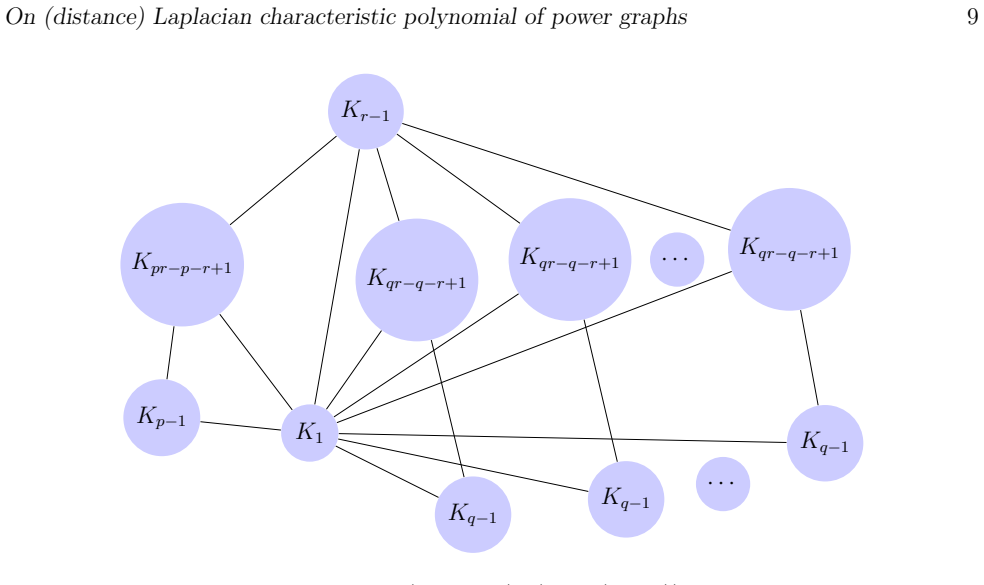
The characteristic polynomials of the Laplacian and distance Laplacian matrices are explicitly obtained for power graphs of groups of order pqr and proper power graphs of cyclic and dicyclic groups.
A machine-rendered reading of the paper's core claim, the machinery that carries it, and where it could break.
Core claim
The characteristic polynomials of the Laplacian and the distance Laplacian matrices of power graphs of groups of order pqr, where p, q and r are primes, are obtained. Further, the characteristic polynomials of these matrices for proper power graphs of cyclic and dicyclic groups are given. The important inequalities for the zeros of the distance Laplacian characteristic polynomials of power graphs of finite groups are presented in comments.
What carries the argument
The power graph of a group, defined with group elements as vertices and edges when one element is a power of the other, used to construct the Laplacian and distance Laplacian matrices whose characteristic polynomials are then computed.
If this is right
- Eigenvalues can be computed directly from the closed-form polynomials for all such graphs.
- Direct comparisons of spectral properties across groups of order pqr become possible.
- Inequalities provide bounds on distance Laplacian eigenvalues for power graphs of arbitrary finite groups.
- Proper power graphs of cyclic and dicyclic groups now have known explicit spectra.
Where Pith is reading between the lines
- The derived formulas might serve as a basis for similar computations in groups with more prime factors if their power graphs exhibit analogous structures.
- These results could aid in investigating how group operations influence the spectral radius or other invariants of the associated graphs.
- Testing the inequalities on non-pqr groups would check their generality beyond the paper's focus.
Load-bearing premise
The standard definitions of power graphs, Laplacian matrices, distance Laplacian matrices, and characteristic polynomials apply without modification to the groups of order pqr and to the proper power graphs of cyclic and dicyclic groups.
What would settle it
Construct the power graph and its distance Laplacian matrix for a specific group of order pqr, such as the cyclic group of order 30, calculate its characteristic polynomial by hand or computer, and verify if it agrees with the expression given in the paper.
Figures
read the original abstract
The characteristic polynomials of the Laplacian and the distance Laplacian matrices of power graphs of groups of order $ pqr $, where $ p,q $ and $ r $ are { primes,} are obtained. Further, the characteristic polynomials of these matrices for proper power graphs of cyclic and dicyclic groups are given. The important inequalities for the zeros of the distance Laplacian characteristic polynomials of power graphs of finite groups are presented in comments.
Editorial analysis
A structured set of objections, weighed in public.
Referee Report
Summary. The manuscript claims to derive explicit closed-form expressions for the characteristic polynomials of the Laplacian and distance-Laplacian matrices of the power graphs of all groups of order pqr (p, q, r distinct primes) via case analysis on the possible group structures (cyclic, semidirect products, etc.). It further supplies the corresponding polynomials for the proper power graphs of cyclic and dicyclic groups and states some inequalities satisfied by the zeros of the distance-Laplacian characteristic polynomials of power graphs of finite groups in general.
Significance. If the derivations are correct and the explicit polynomials are supplied, the work would furnish concrete spectral data for a family of graphs that arise naturally at the intersection of group theory and algebraic graph theory. Such formulas can serve as a reference for eigenvalue computations and for testing conjectures on distance-Laplacian spectra; the inequalities on the zeros would add a modest analytic contribution. The approach relies only on standard definitions of power graphs, transmission degrees, and matrix characteristic polynomials, with no additional ad-hoc assumptions.
major comments (2)
- [Main results / case analysis on groups of order pqr] The central claim is that the polynomials are obtained, yet the manuscript provides neither the explicit closed-form expressions nor the intermediate matrix constructions and determinant calculations for the groups of order pqr. Without these steps, algebraic errors cannot be ruled out and the result cannot be verified (cf. the abstract statement and the case-analysis sections).
- [Inequalities for zeros] The inequalities for the zeros of the distance-Laplacian characteristic polynomials are asserted for power graphs of finite groups in general, but no proof or reference to a supporting lemma is given; this claim is load-bearing for the final section and requires either a self-contained argument or a precise citation.
minor comments (2)
- [Abstract] The abstract contains a stray comma after 'primes' and the phrasing 'are obtained' is repeated without indicating where the explicit formulas appear.
- [Preliminaries] Notation for the power graph, proper power graph, Laplacian matrix L(G), distance Laplacian D^L(G), and transmission degrees should be introduced once at the beginning with consistent symbols throughout.
Simulated Author's Rebuttal
We thank the referee for the careful reading and constructive comments. We address each major comment below and will revise the manuscript to incorporate the requested details.
read point-by-point responses
-
Referee: [Main results / case analysis on groups of order pqr] The central claim is that the polynomials are obtained, yet the manuscript provides neither the explicit closed-form expressions nor the intermediate matrix constructions and determinant calculations for the groups of order pqr. Without these steps, algebraic errors cannot be ruled out and the result cannot be verified (cf. the abstract statement and the case-analysis sections).
Authors: We agree that the explicit closed-form expressions and the intermediate matrix constructions and determinant calculations for groups of order pqr are not presented in sufficient detail in the current manuscript. Although the results are stated via case analysis on the group structures, the derivations were omitted for brevity. In the revised version we will include the explicit polynomials for each case together with the key steps for constructing the Laplacian and distance-Laplacian matrices and computing their characteristic polynomials. revision: yes
-
Referee: [Inequalities for zeros] The inequalities for the zeros of the distance-Laplacian characteristic polynomials are asserted for power graphs of finite groups in general, but no proof or reference to a supporting lemma is given; this claim is load-bearing for the final section and requires either a self-contained argument or a precise citation.
Authors: The inequalities are stated in the final section without an accompanying proof or citation. We will revise that section to supply either a self-contained argument based on standard properties of distance-Laplacian matrices or a precise reference to a supporting lemma. revision: yes
Circularity Check
No significant circularity; direct algebraic derivations
full rationale
The paper derives explicit characteristic polynomials for Laplacian and distance-Laplacian matrices of power graphs via case analysis on group structures (cyclic, semidirect products) of order pqr, using only standard matrix definitions and transmission degrees. No fitted parameters are renamed as predictions, no self-citations form load-bearing uniqueness claims, and no ansatz or renaming reduces the central results to inputs by construction. The derivations are self-contained computations on the given graphs.
Axiom & Free-Parameter Ledger
axioms (1)
- standard math Standard definitions of the power graph of a finite group, the Laplacian matrix, the distance Laplacian matrix, and the characteristic polynomial of a square matrix.
Reference graph
Works this paper leans on
-
[1]
J. Abawajy, A. Kelarev and M. Chowdhury, Power graphs: A survey,Electronic J. Graph Theory Appl.1(2)(2013) 125–147
work page 2013
-
[2]
M. Aouchiche and P. Hansen, Distance spectra of graphs: A survey,Linear Algebra Appl. 458(2014) 301–386
work page 2014
-
[3]
M. Aouchiche and P. Hansen, Two Laplacians for the distance matrix of a graph,Linear Algebra Appl.439(2013) 21–33. 18
work page 2013
-
[4]
M. Aouchiche and P. Hansen, Some properties of the distance Laplacian eigenvalues a graph, Czech. Math. J.64(139)(2014) 751–761
work page 2014
-
[5]
M. Aouchiche, Bilal A. Rather and I. El Hallaoui, On the Greˇ sgorin disks of distance matrices of graphs,Electronic J. Linear Algebra37(2021) 709–717
work page 2021
-
[6]
A. E. Brouwer and W. H. Haemers,Spectra of Graphs, Springer, New York, 2010
work page 2010
-
[7]
P. J. Cameron and S. H. Jafari, On the connectivity and independence number of power graphs of groups,Graphs Comb.49(1)(2020) 895–904
work page 2020
-
[8]
S. Chattopadhyay and P. Panigrahi, On Laplacian spectrum of power graphs of finite cyclic and dihedral groups,Linear Multilinear Algebra63(7)(2015) 1345–1355
work page 2015
-
[9]
I. Chakrabarty, M. Ghosh and M. K. Sen, Undirected power graph of semigroups,Semigroup Forum78(2009) 410–426
work page 2009
-
[10]
D. M. Cvetkovi´ c, P. Rowlison and S. Simi´ c,An Introduction to Theory of Graph spectra, Spectra of graphs, Theory and application, London Math. S. Student Text, 75, Cambridge University Press, Inc. UK, 2010
work page 2010
-
[11]
Fiedler, Algebraic connectivity of graphs,Czechoslovak Math
M. Fiedler, Algebraic connectivity of graphs,Czechoslovak Math. J.23(1973) 298–305
work page 1973
-
[12]
M. Ghorbani and F. Abbasi-Barfaraz, On the characteristic polynomial of power graph, Filomat32(12)(2018) 4375–4387
work page 2018
-
[13]
M. Ghorbani and F. N. Larki, Automorphism group of groups of order pqr,J. Algebraic Structures Appl.1(1)(2014) 49–56
work page 2014
-
[14]
A. Hamzeh and A. R. Ashrafi, Spectrum and L-spectrum of the power graph and its main supergraph for certain finite groups,Filomat31(16)(2017) 5323–5334
work page 2017
-
[15]
Hilal A. Ganie, R. U. Shaban, Bilal A. Rather and S. Pirzada, On distance Laplacian energy, vertex connectivity and independence number of graphs,Czech. Math. J.(2023) 1–15,https://doi.org/10.21136/CMJ.2023.0421-20
-
[16]
H¨ older, Die Gruppen der Ordnungenp3, pq2, pqr, p4,Math
H. H¨ older, Die Gruppen der Ordnungenp3, pq2, pqr, p4,Math. Ann.xliii(1893) 371–410
-
[17]
L. Huiqiu, S. Jinlong and Z. Yuke, A survey on distance spectra of graphs,Advances Math. China50(1)(2021)https://doi.org/10.11845/sxjz.2020012a
- [18]
-
[19]
A. V. Kelarev and S. J. Quinn, Directed graphs and combinatorial properties of semigroups, J. Algebra251(2002) 16-26
work page 2002
-
[20]
Z. Mehranian, A. Gholami and A. R. Ashrafi, A note on the power graph of a finite group, Int. J. Group Theory5(2016) 1–10. On (distance) Laplacian characteristic polynomial of power graphs19
work page 2016
-
[21]
Z. Mehranian, A. Gholami and A. R. Ashrafi, The spectra of power graphs of certain finite groups,Linear Multilinear Algebra65(5)(2016) 1003–1010
work page 2016
-
[22]
R. P. Panda, Laplacian spectra of power graphs of certain finite groups,Graphs Comb. (2019)http://doi.org/10.1007/s00373-019-02070-x
-
[23]
Bilal A. Rather, Hilal A. Ganie and Y. Shang, Distance Laplacian eigenvalues of sun graphs, Appl. Math. Comp.,445(2023) 127847,https://doi.org/10.1016/j.amc.2023.127847
- [24]
-
[25]
Bilal A. Rather, S. Pirzada, T. A. Chishti, and A. M. A. Alghamdi, On normalized Laplacian eigenvalues of power graphs of finite cyclic group,Discrete Math. Algo. Appl.15(2)2250070 (2023),https://doi.org/10.1142/S1793830922500707
-
[26]
Bilal A. Rather, Hilal A. Ganie and M. Aouchiche, On normalized distance Laplacian eigen- values of graphs and applications to graphs defined on groups and rings,Carp. J. Math., 39(1)(2023) 213–230
work page 2023
-
[27]
Bilal A. Rather, Hilal A. Ganie and S. Pirzada, On theA α-spectrum of joined union and its applications to power graphs of certain finite groups,J. Algebra Appl., (2023) 2350257 (23 pages),https://doi.org/10.1142/S0219498823502572
-
[28]
Stevanovi´ c, Large sets of long distance equienergetic graphs,Ars Math
D. Stevanovi´ c, Large sets of long distance equienergetic graphs,Ars Math. Contemp.2(1) (2009) 35–40
work page 2009
discussion (0)
Sign in with ORCID, Apple, or X to comment. Anyone can read and Pith papers without signing in.