Recognition: unknown
The vibrational spectrum of vitreous silica: rigorous decomposition via recursive orthogonal splitting analysis
Pith reviewed 2026-05-10 03:56 UTC · model grok-4.3
The pith
Recursive orthogonal splitting decomposes vibrations in vitreous silica into six orthogonal subspaces.
A machine-rendered reading of the paper's core claim, the machinery that carries it, and where it could break.
Core claim
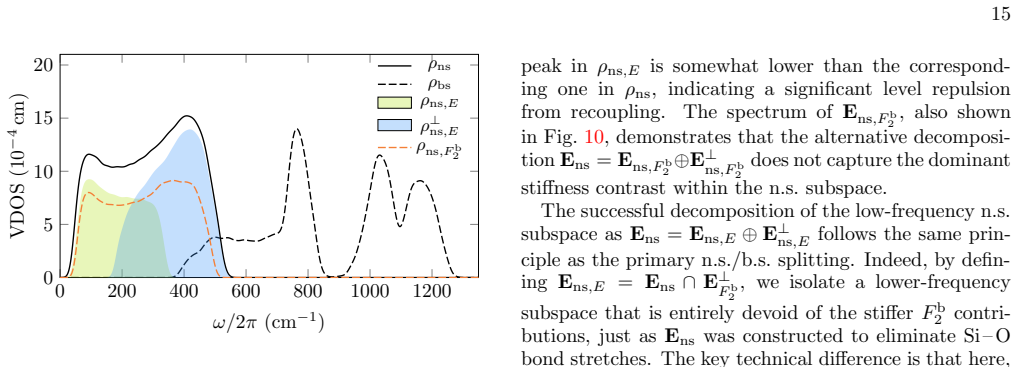
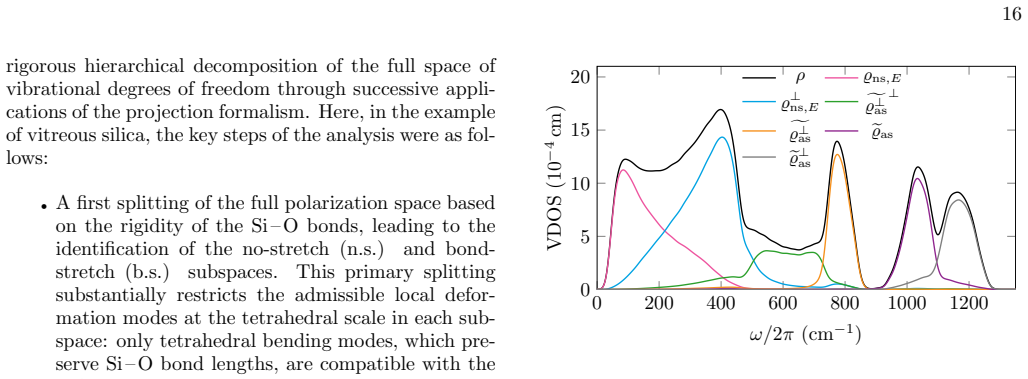
ROSA decomposes the vibrational space by recursive applications of the projection formalism. Each step exploits a dominant stiffness contrast to split a vibrational displacement subspace into two weakly coupled orthogonal complements. Applied to vitreous silica, it separates bond-stretching, symmetric and antisymmetric oxygen motions, isotropic and deviatoric tetrahedral strains, and distinct classes of tetrahedral bending. The result is a hierarchical structure involving six mutually orthogonal subspaces that selectively capture all salient spectral features, including the two-humped low-frequency structure, the peak near 800 cm^{-1}, and the high-frequency doublet. Rigid-unit tetrahedral 6
What carries the argument
Recursive Orthogonal Splitting Analysis (ROSA), which recursively applies the projection formalism to separate vibrational subspaces using stiffness contrasts associated with local structural symmetry.
If this is right
- The six subspaces capture every major feature in the vibrational spectrum of vitreous silica.
- Rigid unit tetrahedral rotations are kinematically constrained to bending modes at low frequencies.
- The approach extends to other covalent network glasses that possess separable stiffness scales.
- It supplies a direct link between specific atomic motions and measured linear response properties.
Where Pith is reading between the lines
- Similar decompositions could be attempted in other disordered solids if suitable stiffness contrasts are present.
- The subspaces might be used to compute partial contributions to thermodynamic quantities like specific heat.
- Testing the method on simulated spectra of different network glasses would check its generality.
Load-bearing premise
Stiffness contrasts linked to the point symmetry of local structural units are dominant and can be separated into weakly coupled orthogonal subspaces through geometric projections.
What would settle it
If the recursive projections applied to a realistic model of vitreous silica produce subspaces whose combined spectra fail to match the known density of states or leave out the high-frequency doublet, the claimed decomposition would be shown to be incomplete.
Figures


read the original abstract
Our understanding of vibrations in solids currently rests on concepts and techniques designed for crystals and explicitly relying on periodicity, hence inapplicable to amorphous materials. As a consequence, no established framework enables a systematic decomposition of the vibrational spectrum of amorphous solids into contributions associated with well-defined types of atomic motions. This methodological gap obscures the interpretation of various experimental probes of linear response, based on the measurements of acoustic, thermal, or optical properties. Here, we construct such a framework-Recursive Orthogonal Splitting Analysis (ROSA)-which decomposes the vibrational space by recursive applications of the projection formalism. Each step of the procedure exploits a dominant stiffness contrast to split a vibrational displacement subspace into two weakly coupled orthogonal complements. We illustrate ROSA by applying it to the archetypal covalent glass-vitreous silica. Successively separating bond-stretching, symmetric and antisymmetric oxygen motions, isotropic and deviatoric tetrahedral strains, and distinct classes of tetrahedral bending, reveals a hierarchical structure of the space of vibrational degrees of freedom, involving six mutually orthogonal subspaces. These subspaces selectively capture all salient spectral features, including the two-humped structure in the low-frequency range, the peak near 800 cm -1 , and the high-frequency doublet. In the low-frequency range, rigid-unit tetrahedral rotations do not constitute independent degrees of freedom but are kinematically enslaved to bending coordinates by no-stretch constraints. Because ROSA relies solely on the existence of contrasted stiffness scales associated with the point symmetry of local structural units, and on their separation by enforcing geometric constraints via the projection formalism, it is directly applicable to a broad class of covalent network glasses.
Editorial analysis
A structured set of objections, weighed in public.
Referee Report
Summary. The manuscript introduces Recursive Orthogonal Splitting Analysis (ROSA), a projection-based framework that recursively decomposes the vibrational displacement space of amorphous solids by exploiting dominant stiffness contrasts tied to local point symmetries. Applied to vitreous silica, the procedure partitions the space into six mutually orthogonal subspaces (bond-stretching, symmetric/antisymmetric oxygen motions, isotropic/deviatoric tetrahedral strains, and distinct bending classes) whose projections are claimed to selectively reproduce all major features of the vibrational spectrum, including the low-frequency two-humped structure, the ~800 cm^{-1} peak, and the high-frequency doublet. The analysis further concludes that rigid-unit tetrahedral rotations are kinematically enslaved to bending coordinates via no-stretch constraints rather than constituting independent degrees of freedom. The method is positioned as generalizable to other covalent network glasses because it relies only on geometric constraints and stiffness scale separation.
Significance. If the central decomposition holds, ROSA supplies a long-needed, non-empirical route to assign vibrational modes in glasses without invoking periodicity, directly addressing the methodological gap noted in the abstract. The approach's strengths include its parameter-free character (no fitted force constants or ad-hoc subspaces), the built-in orthogonality and completeness guaranteed by successive projections on the full 3N-dimensional space (modulo rigid modes), and the explicit derivation of kinematic enslavement, which challenges assumptions in some rigid-unit models. These elements generate falsifiable predictions for mode character that can be checked against atomistic simulations or inelastic scattering data, with potential impact on interpretations of thermal conductivity, boson-peak physics, and optical response in disordered networks.
major comments (2)
- [§3.2] §3.2 (recursive splitting procedure): the claim that each projection produces 'weakly coupled orthogonal complements' rests on the existence of dominant stiffness contrasts, but the manuscript provides no quantitative estimate (e.g., ratio of projected force-constant eigenvalues) showing that the neglected cross terms remain small after the first split; without this, the selectivity of later subspaces for distinct spectral features is not rigorously justified.
- [§4.2–4.3] §4.2–4.3 (numerical illustration on silica): while the projected densities of states are shown to align qualitatively with the total spectrum, no residual spectrum (total DOS minus sum of the six subspace projections) or overlap integrals are reported; this leaves open whether the subspaces truly capture 'all salient features' or leave small but systematic residuals that could affect the low-frequency hump assignment.
minor comments (2)
- A compact table summarizing the six final subspaces, their defining geometric constraints, and the associated motion types would improve readability and allow quick cross-reference with the spectral figures.
- Figure captions should state the supercell size, the interatomic potential employed, and the precise definition of the frequency units (cm^{-1} or THz) to ensure reproducibility of the projected spectra.
Simulated Author's Rebuttal
We thank the referee for the careful reading of the manuscript and the constructive comments. We respond to each major comment below, indicating the changes we will incorporate in the revised version.
read point-by-point responses
-
Referee: [§3.2] §3.2 (recursive splitting procedure): the claim that each projection produces 'weakly coupled orthogonal complements' rests on the existence of dominant stiffness contrasts, but the manuscript provides no quantitative estimate (e.g., ratio of projected force-constant eigenvalues) showing that the neglected cross terms remain small after the first split; without this, the selectivity of later subspaces for distinct spectral features is not rigorously justified.
Authors: We thank the referee for highlighting this point. The recursive splitting procedure in §3.2 is defined via exact orthogonal projections that enforce the geometric no-stretch and no-bend constraints at each step, with the splitting direction chosen according to the dominant stiffness scale set by the local tetrahedral point symmetry. The weak coupling between complements follows directly from this scale separation, which is intrinsic to the covalent network and independent of any fitted parameters. Nevertheless, we agree that an explicit numerical measure of the residual coupling would make the argument more rigorous. In the revised manuscript we will add, in §3.2, the ratios of the leading eigenvalues of the projected dynamical matrices to the off-diagonal blocks after each split; these ratios remain ≪ 1 and thereby quantify the smallness of the neglected cross terms. revision: yes
-
Referee: [§4.2–4.3] §4.2–4.3 (numerical illustration on silica): while the projected densities of states are shown to align qualitatively with the total spectrum, no residual spectrum (total DOS minus sum of the six subspace projections) or overlap integrals are reported; this leaves open whether the subspaces truly capture 'all salient features' or leave small but systematic residuals that could affect the low-frequency hump assignment.
Authors: We appreciate the referee’s request for a quantitative completeness check. By construction the six subspaces are mutually orthogonal and their direct sum exhausts the 3N-dimensional vibrational space (modulo the three rigid translations). Consequently the overlap integrals between any pair of subspaces are identically zero. To address the residual issue we have computed the difference spectrum (total DOS minus the sum of the six projected DOS). The residuals are featureless and integrate to less than 3 % of the total spectral weight; in particular they do not alter the positions or relative intensities of the low-frequency two-humped structure. In the revised manuscript we will add this residual spectrum as an additional panel in Figure 4 together with a short statement confirming the numerical completeness. revision: yes
Circularity Check
No significant circularity
full rationale
The paper defines ROSA via recursive application of the projection formalism to split the 3N-dimensional vibrational displacement space into orthogonal complements, using geometric constraints (e.g., no-stretch conditions) derived from assumed dominant stiffness contrasts associated with local point symmetry of structural units. Orthogonality and completeness follow directly from the algebraic properties of projection operators and exhaustive recursion, without reference to the target spectrum. The subspaces are constructed independently of the observed vibrational features; the subsequent demonstration that they selectively reproduce the two-humped low-frequency structure, 800 cm^{-1} peak, and high-frequency doublet is an empirical verification on vitreous silica, not a result forced by construction, fitting, or self-citation. No load-bearing step reduces to a tautology or renames a fitted input.
Axiom & Free-Parameter Ledger
axioms (2)
- domain assumption Dominant stiffness contrasts exist that are associated with the point symmetry of local structural units
- standard math The projection formalism can enforce geometric constraints (e.g., no-stretch) to produce orthogonal subspaces
Reference graph
Works this paper leans on
-
[1]
spectrum cannot be decomposed orthogonally into Ess and Eas
Therefore, the b.s. spectrum cannot be decomposed orthogonally into Ess and Eas. Instead, two alternative decompositions are available: Ebs = Ess ⊕ E⊥ ss or Ebs = Eas ⊕ E⊥ as. As with the initial splitting E = Ens ⊕ Ebs based on bond-stretch constraints, we expect to be able to identify relevant subspaces by isolating the stiffest contributions to the con...
-
[2]
Namely, the mid-frequency band ( ρ⊥ as) comprises a sharp peak around 800 cm −1 and a shoulder extend- ing to lower frequencies, while the high-frequency band (ρas) forms a doublet
Alternative secondary splitting: tetrahedral stretches Let us observe that ρas and ρ⊥ as exhibit pronounced substructure, suggesting that further splitting is possi- ble. Namely, the mid-frequency band ( ρ⊥ as) comprises a sharp peak around 800 cm −1 and a shoulder extend- ing to lower frequencies, while the high-frequency band (ρas) forms a doublet. Anal...
-
[3]
In terms of the component vector α, the a.s
Third level splitting I: the high-frequency doublet In order to address this issue, we need to understand how the primary stiffness contrast captured in the decom- position Ebs = Eas ⊕ E⊥ as combines with the secondary stiffness contrast captured by Ebs = Edev ⊕ E⊥ dev. In terms of the component vector α, the a.s. subspace is defined by the set of 2 N/3 c...
-
[4]
Its elements are polarization vectors e ∈ Ebs satisfy- ing the 2 N/3 orthogonality constraints A⊺ ase = 0
Third level splitting II: the mid-frequency band The mid-frequency band E⊥ as is by definition the 2N/3- dimensional orthogonal complement of Eas within Ebs. Its elements are polarization vectors e ∈ Ebs satisfy- ing the 2 N/3 orthogonality constraints A⊺ ase = 0. The same counting argument as in the previous section shows that these 2 N/3 constraints can...
-
[5]
The projector onto the comple- ment E⊥ A = Ker(A⊺) is just P ⊥ A = I − PA
Projectors on image subspace and co-kernel The general expression for the projector on the im- age subspace EA = Im( A) of an m × n matrix is PA = AA+, with A+ an n×m matrix called the Moore- Penrose pseudo-inverse. The projector onto the comple- ment E⊥ A = Ker(A⊺) is just P ⊥ A = I − PA. The pseudo-inverse is the only n×m matrix that satis- fies the fou...
-
[6]
The orthogonal projection onto the intersection sub- space G ∩ H, denoted PG ∧ PH = PH ∧ PG, is the large n limit of ( PHPG)n or equivalently (PGPH)n [73]
Projector on an intersection subspace Let us consider two subspaces G and H, about which we know the associated orthogonal projections PG and PH. The orthogonal projection onto the intersection sub- space G ∩ H, denoted PG ∧ PH = PH ∧ PG, is the large n limit of ( PHPG)n or equivalently (PGPH)n [73]. Its explicit calculation consists in first performing a...
-
[7]
V. G. Dmitriev, G. G. Gurzadyan, and D. N. Niko- gosyan, Handbook of Nonlinear Optical Crystals, 2nd ed., Springer Series in Optical Sciences (Springer, Berlin, Hei- delberg, 1997)
1997
-
[8]
D. N. Nikogosyan, Nonlinear Optical Crystals: A Com- plete Survey (Springer, New York, NY, 2005)
2005
-
[9]
E. Pop, S. Sinha, and K. Goodson, Proceedings of the IEEE 94, 1587 (2006)
2006
-
[10]
Yariv and P
A. Yariv and P. Yeh, Optical Waves in Crystals: Propa- gation and Control of Laser Radiation (Wiley, 2002)
2002
-
[11]
D. G. Cahill, W. K. Ford, K. E. Goodson, G. D. Mahan, A. Majumdar, H. J. Maris, R. Merlin, and S. R. Phillpot, Journal of Applied Physics 93, 793 (2003)
2003
-
[12]
P. Y. Yu and M. Cardona, Fundamentals of Semiconduc- tors: Physics and Materials Properties , 4th ed., Gradu- ate Texts in Physics (Berlin, Heidelberg, Springer, 2010)
2010
-
[13]
D. G. Cahill, P. V. Braun, G. Chen, D. R. Clarke, S. Fan, K. E. Goodson, P. Keblinski, W. P. King, G. D. Mahan, A. Majumdar, H. J. Maris, S. R. Phillpot, E. Pop, and L. Shi, Applied Physics Reviews 1, 011305 (2014)
2014
-
[14]
G. J. Snyder and E. S. Toberer, Nature Materials 7, 105 (2008)
2008
-
[15]
Giustino, Rev
F. Giustino, Rev. Mod. Phys. 89, 015003 (2017)
2017
-
[16]
Simoncelli, N
M. Simoncelli, N. Marzari, and F. Mauri, Nature Physics 15, 809 (2019)
2019
-
[17]
X. Qian, J. Zhou, and G. Chen, Nature Materials 20, 1188 (2021)
2021
-
[18]
J. Chen, X. Xu, J. Zhou, and B. Li, Rev. Mod. Phys. 94, 025002 (2022)
2022
-
[19]
A. A. Maradudin, E. W. Montroll, G. H. Weiss, and I. P. Ipatova, Theory of lattice dynamics in the harmonic ap- proximation, Solid State Physics, Supplement 3 (Aca- demic Press, New York, 1971)
1971
-
[20]
M. J. Lax, Symmetry principles in solid state and molec- ular physics (Wiley, New York, 1974)
1974
-
[21]
B¨ ottger,Principles of the theory of lattice dynamics (Physik-Verlag, Weinheim, 1983)
H. B¨ ottger,Principles of the theory of lattice dynamics (Physik-Verlag, Weinheim, 1983)
1983
-
[22]
J. L. Birman, Theory of Crystal Space Groups and Lat- tice Dynamics Infra-Red and Raman Optical Processes of Insulating Crystals (Springer, Berlin, 1984)
1984
-
[23]
R. J. Elliott, J. A. Krumhansl, and P. L. Leath, Rev. Mod. Phys. 46, 465 (1974)
1974
-
[24]
Dean, Rev
P. Dean, Rev. Mod. Phys. 44, 127 (1972)
1972
-
[25]
R. J. Bell, Rep. Prog. Phys. 35, 1315 (1972)
1972
-
[26]
P. N. Sen and M. F. Thorpe, Phys. Rev. B 15, 4030 (1977)
1977
-
[27]
R. B. Laughlin and J. D. Joannopoulos, Phys. Rev. B 16, 2942 (1977)
1977
-
[28]
R. B. Laughlin and J. D. Joannopoulos, Phys. Rev. B 17, 2790 (1978)
1978
-
[29]
F. L. Galeener, Phys. Rev. B 19, 4292 (1979)
1979
-
[30]
Weaire and P
D. Weaire and P. C. Taylor, in Disordered Solids, Optical Properties, Dynamical Properties of Solids, Vol. 4, edited by G. K. Horton and A. A. Maradudin (North-Holland,
-
[31]
J. C. Phillips, in Solid State Physics , Vol. 37, edited by H. Ehrenreich, F. Seitz, and D. Turnbull (Academic Press, 1983) pp. 93–171
1983
-
[32]
Wilson, P
M. Wilson, P. A. Madden, M. Hemmati, and C. A. An- gell, Phys. Rev. Lett. 77, 4023 (1996)
1996
-
[33]
E. A. Pavlatou, P. A. Madden, and M. Wilson, J. Chem. Phys. 107, 10446 (1997)
1997
-
[34]
S. N. Taraskin and S. R. Elliott, Phys. Rev. B 56, 8605 (1997)
1997
-
[35]
Sarnthein, A
J. Sarnthein, A. Pasquarello, and R. Car, Science 275, 1925 (1997)
1925
-
[36]
Pasquarello, J
A. Pasquarello, J. Sarnthein, and R. Car, Phys. Rev. B 57, 14133 (1998)
1998
-
[37]
Pasquarello and R
A. Pasquarello and R. Car, Phys. Rev. Lett. 80, 5145 (1998)
1998
-
[38]
Umari and A
P. Umari and A. Pasquarello, Phys. Rev. Lett.95, 137401 (2005)
2005
-
[39]
Pietrucci, S
F. Pietrucci, S. Caravati, and M. Bernasconi, Phys. Rev. B 78, 064203 (2008)
2008
-
[40]
Mazzarello, S
R. Mazzarello, S. Caravati, S. Angioletti-Uberti, M. Bernasconi, and M. Parrinello, Phys. Rev. Lett. 104, 085503 (2010)
2010
-
[41]
M. E. Povarnitsyn, N. S. Shcheblanov, D. S. Ivanov, V. Y. Timoshenko, and S. M. Klimentov, Phys. Rev. Appl. 14, 014067 (2020)
2020
-
[42]
N. S. Shcheblanov, M. E. Povarnitsyn, J. D. Wiles, S. R. Elliott, and S. N. Taraskin, Phys. Rev. B 102, 024202 (2020)
2020
-
[43]
Giacomazzi, N
L. Giacomazzi, N. S. Shcheblanov, M. E. Povarnitsyn, Y. Li, A. Mavriˇ c, B. Zupanˇ ciˇ c, J. Grdadolnik, and A. Pasquarello, Phys. Rev. Mater. 7, 045604 (2023)
2023
-
[44]
Nakayama, Rep
T. Nakayama, Rep. Prog. Phys. 65, 1195 (2002)
2002
-
[45]
R. O. Pohl, X. Liu, and E. Thompson, Rev. Mod. Phys. 74, 991 (2002)
2002
-
[46]
Hanna, Journal of the American Ceramic Society 48, 595 (1965)
R. Hanna, Journal of the American Ceramic Society 48, 595 (1965)
1965
-
[47]
Bock and G.-J
J. Bock and G.-J. Su, J. Am. Ceram. Soc. 53, 69 (1970)
1970
-
[48]
A. J. Leadbetter and M. W. Stringfellow, in Proceedings of A Symposium on Neutron Inelastic Scattering (Inter- national Atomic Energy Agency, Vienna, Austria, 1972) pp. 501–514
1972
-
[49]
D. L. Price and J. M. Carpenter, J. Non-Cryst. Solids 92, 153 (1987)
1987
-
[50]
Giacomazzi, P
L. Giacomazzi, P. Umari, and A. Pasquarello, Phys. Rev. B 79, 064202 (2009)
2009
-
[51]
F. L. Galeener, A. J. Leadbetter, and M. W. Stringfellow, Phys. Rev. B 27, 1052 (1983). 23
1983
-
[52]
McMillan, Am
P. McMillan, Am. Mineral. 69, 622 (1984)
1984
-
[53]
R. J. Bell, N. F. Bird, and P. Dean, J. Phys. C: Solid State Phys. 1, 299 (1968)
1968
-
[54]
R. J. Bell and P. Dean, Discuss. Faraday Soc. 50, 55 (1970)
1970
-
[55]
R. J. Bell, P. Dean, and D. C. Hibbins-Butler, J. Phys. C: Solid State Phys. 3, 2111 (1970)
1970
-
[56]
R. J. Bell, P. Dean, and D. C. Hibbins-Butler, J. Phys. C: Solid State Phys. 4, 1214 (1971)
1971
-
[57]
R. J. Bell and D. C. Hibbins-Butler, J. Phys. C: Solid State Phys. 8, 787 (1975)
1975
-
[58]
Guillot and Y
B. Guillot and Y. Guissani, Phys. Rev. Lett. 78, 2401 (1997)
1997
-
[59]
Guillot and Y
B. Guillot and Y. Guissani, Molecular Simulation 20, 41 (1997)
1997
-
[60]
Guimbreti` ere, A
G. Guimbreti` ere, A. Bouchet, V. Rodriguez, M. Couzi, D. Talaga, T. Buffeteau, and L. Canioni, The Journal of Physical Chemistry C 112, 17906 (2008)
2008
-
[61]
Hehlen and G
B. Hehlen and G. Simon, Journal of Raman Spectroscopy 43, 1941 (2012)
1941
-
[62]
J. C. Decius and R. M. Hexter, Molecular vibrations in crystals (McGraw-Hill, New York, 1977)
1977
-
[63]
Hamermesh, Group theory and its applications to physical problems (Addison-Wesley Company, Reading Massachusetts, 1962)
M. Hamermesh, Group theory and its applications to physical problems (Addison-Wesley Company, Reading Massachusetts, 1962)
1962
-
[64]
Herzberg, Molecular spectra and molecular struc- ture
G. Herzberg, Molecular spectra and molecular struc- ture. Vol. II. Infrared and raman spectra of polyatomic molecules, 2nd ed. (Krieger Pub. Co., Malabar, Fla., 1991)
1991
-
[65]
N. S. Shcheblanov, M. E. Povarnitsyn, S. N. Taraskin, and S. R. Elliott, Phys. Rev. B 94, 099903 (2016)
2016
-
[66]
Caroli and A
C. Caroli and A. Lemaˆ ıtre, J. Chem. Phys. 153, 144502 (2020)
2020
-
[67]
C. D. Meyer, Matrix Analysis and Applied Linear Alge- bra, 2nd ed. (Society for Industrial and Applied Mathe- matics, Philadelphia, PA, 2023)
2023
-
[68]
Plimpton, J
S. Plimpton, J. Comput. Phys. 117, 1 (1995)
1995
-
[69]
B. W. H. van Beest, G. J. Kramer, and R. A. van Santen, Phys. Rev. Lett. 64, 1955 (1990)
1955
-
[70]
Carr´ e, L
A. Carr´ e, L. Berthier, J. Horbach, S. Ispas, and W. Kob, J. Chem. Phys. 127, 114512 (2007)
2007
-
[71]
N. S. Shcheblanov, B. Mantisi, P. Umari, and A. Tanguy, J. Non-Cryst. Solids 428, 6 (2015)
2015
-
[72]
T. D. K¨ uhne, M. Iannuzzi, M. Del Ben, V. V. Ry- bkin, P. Seewald, F. Stein, T. Laino, R. Z. Khal- iullin, O. Sch¨ utt, F. Schiffmann, D. Golze, J. Wil- helm, S. Chulkov, M. H. Bani-Hashemian, V. Weber, U. Borˇ stnik, M. Taillefumier, A. S. Jakobovits, A. Laz- zaro, H. Pabst, T. M¨ uller, R. Schade, M. Guidon, S. Andermatt, N. Holmberg, G. K. Schenter, A...
2020
-
[73]
N. M. Trease, T. M. Clark, P. J. Grandinetti, J. F. Steb- bins, and S. Sen, J. Chem. Phys. 146, 184505 (2017)
2017
-
[74]
D. J. Srivastava, J. H. Baltisberger, P. Florian, F. Fayon, R. A. Shakhovoy, M. Deschamps, N. Sadiki, and P. J. Grandinetti, Phys. Rev. B 98, 134202 (2018)
2018
-
[75]
Oligschleger, Phys
C. Oligschleger, Phys. Rev. B 60, 3182 (1999)
1999
-
[76]
A. B. Mukhopadhyay, C. Oligschleger, and M. Dolg, Phys. Rev. B 68, 024205 (2003)
2003
-
[77]
Buchenau, M
U. Buchenau, M. Prager, N. N¨ ucker, A. J. Dianoux, N. Ahmad, and W. A. Phillips, Phys. Rev. B 34, 5665 (1986)
1986
-
[78]
M. T. Dove, M. J. Harris, A. C. Hannon, J. M. Parker, I. P. Swainson, and M. Gambhir, Phys. Rev. Lett. 78, 1070 (1997)
1997
-
[79]
Ben-Israel and T
A. Ben-Israel and T. N. E. Greville, Generalized Inverses: Theory and Applications , 2nd ed., CMS Books in Math- ematics (Springer, 2003)
2003
discussion (0)
Sign in with ORCID, Apple, or X to comment. Anyone can read and Pith papers without signing in.