Scenario-Based Stochastic MPC for Energy Hubs with EV Fleets Under Persistent Grid Outages
Pith reviewed 2026-05-10 04:02 UTC · model grok-4.3
The pith
Incorporating outage scenarios into stochastic MPC lets energy hubs with EV fleets match perfect-forecast performance while naive controllers do not.
A machine-rendered reading of the paper's core claim, the machinery that carries it, and where it could break.
Core claim
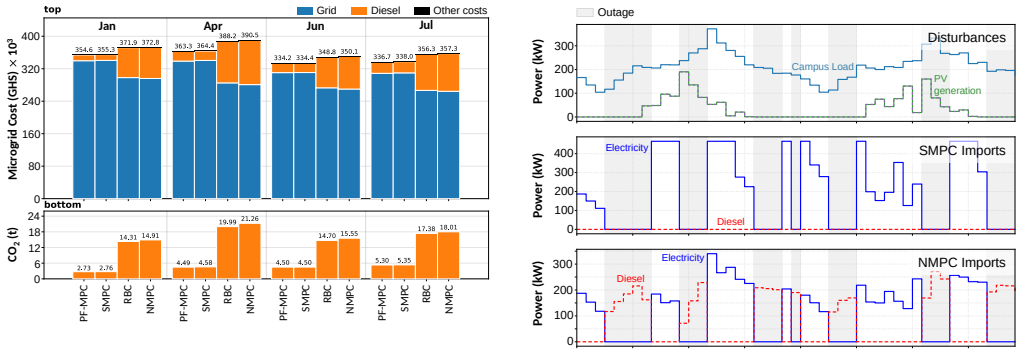
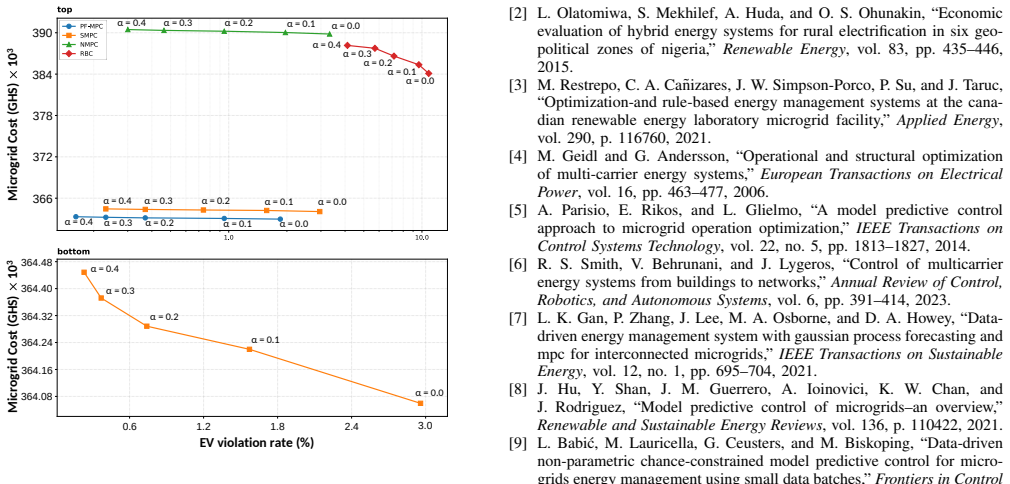
The scenario-based stochastic model predictive controller, fed with outage scenarios drawn from a continuous-time Markov chain and load scenarios drawn from a Gaussian process, delivers total operating costs and emissions within 1 percent of those achieved by a perfect-forecast benchmark on 2023 Ashesi University Energy Hub data. A deterministic buffer sized to cover EV consumption uncertainty eliminates over 90 percent of state-of-charge violations while changing total operating cost by a negligible amount. By contrast, a naive MPC that assumes uninterrupted grid supply yields costs and emissions statistically indistinguishable from those of rule-based control and substantially worse than a
What carries the argument
The scenario-based stochastic model predictive controller that solves a multi-scenario optimization problem at each step, using continuous-time Markov chain samples for grid availability and Gaussian process samples for campus loads.
If this is right
- Outage anticipation through scenario generation becomes a necessary design element for any MPC applied to renewable microgrids that serve EV fleets on weak grids.
- A simple deterministic buffer can substitute for full stochastic modeling of EV demand without materially raising operating costs.
- Controllers that ignore outage probability lose the economic and sustainability gains that the stochastic formulation captures.
- Performance within 1 percent of perfect information indicates that the chosen scenario count and horizon are already sufficient for practical deployment.
Where Pith is reading between the lines
- The same scenario-generation approach could be transferred to other campus or commercial sites that experience seasonal or weather-driven outages.
- Replacing the offline Markov chain with an online-updated model might further reduce the remaining performance gap to the perfect-forecast case.
- Because the buffer adds almost no cost, operators could adopt it immediately even if they retain a simpler MPC formulation.
Load-bearing premise
The Markov chain and Gaussian process scenarios generated from historical data are representative enough of future outage and load behavior that the resulting controller decisions remain near-optimal when applied to the real system.
What would settle it
Deploy the same SMPC on the physical Ashesi Energy Hub during a period containing several actual multi-hour outages and measure whether its realized cost and emission totals exceed the perfect-forecast benchmark by more than a few percent or whether the EV buffer still leaves frequent state-of-charge violations.
Figures
read the original abstract
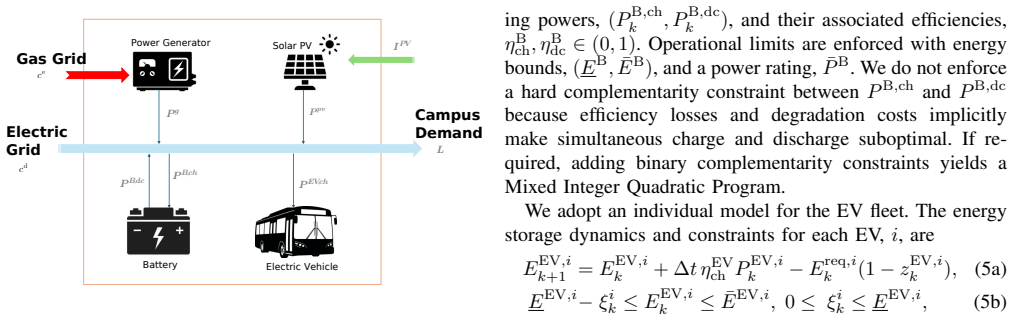
Emissions reduction and resilience to outages motivate the adoption of renewable microgrids. Surprisingly, research integrating both probabilistic grid outages and electric vehicle (EV) charging requirements remains limited. This paper addresses this gap by developing a scenario-based stochastic model predictive controller (SMPC) for a microgrid energy hub comprising solar generation, battery storage, diesel backup, and an EV fleet connected to a weak grid. Grid outage and campus load scenarios are generated from a continuous-time Markov chain and a Gaussian Process, respectively. Using 2023 operational data from the Ashesi University Energy Hub in Ghana, we demonstrate that the SMPC achieves performance within 1\% of a perfect-forecast benchmark. In contrast, a naive MPC that assumes continuous grid availability offers no economic or sustainability advantage over rule-based control, with both incurring significantly higher costs and emissions than the SMPC. These results highlight that outage anticipation is essential for economic viability. Finally, we show that incorporating a deterministic buffer against EV consumption uncertainty eliminates over 90\% of state-of-charge violations with negligible impact on total operating costs
Editorial analysis
A structured set of objections, weighed in public.
Referee Report
Summary. The paper develops a scenario-based stochastic MPC (SMPC) for an energy hub with solar generation, battery storage, diesel backup, and EV fleet under weak-grid conditions with persistent outages. Outage scenarios are generated via continuous-time Markov chain and campus loads via Gaussian process; these feed a stochastic optimization that is evaluated on 2023 Ashesi University operational data. The central claims are that the SMPC achieves performance within 1% of a perfect-forecast benchmark, that a naive MPC assuming continuous grid availability performs no better than rule-based control, and that a deterministic buffer on EV consumption uncertainty removes >90% of state-of-charge violations at negligible extra cost.
Significance. If the scenario generators are shown to be representative, the work fills a documented gap in joint treatment of probabilistic outages and EV fleet constraints inside MPC. The real-data case study from a weak-grid setting supplies concrete evidence that outage anticipation is economically essential and that simple deterministic buffers can be effective, which is directly useful for microgrid operators in similar environments.
major comments (3)
- [§3] §3 (Scenario Generation): The CTMC transition rates and GP kernel hyperparameters are calibrated on the 2023 Ashesi trace, yet no temporal cross-validation, rolling-window hold-out, or out-of-sample test on later periods is reported. Because the headline performance gaps (1% to perfect forecast, >90% violation reduction) rest entirely on the fidelity of these scenario trees, the absence of such validation is load-bearing and must be addressed before the generalization claims can be accepted.
- [§5] §5 (Numerical Results): The perfect-forecast benchmark is stated to be within 1% of SMPC, but the manuscript does not specify whether this benchmark has perfect knowledge of EV arrival/charging uncertainty or only of grid and load trajectories. This distinction directly affects whether the reported gap fairly measures the value of the stochastic formulation versus the value of perfect EV information.
- [§5.3] §5.3 (EV Buffer Analysis): The deterministic buffer is shown to cut SoC violations by >90% with negligible cost penalty, but no sensitivity table or figure varies buffer size against the stochastic scenario set or reports the resulting distribution of violations and costs. Without this, the claim that the buffer is “negligible impact” cannot be assessed for robustness.
minor comments (2)
- [§4] Notation for the scenario tree size and branching factor is introduced without a compact summary table; adding one would improve readability of the computational results.
- [Abstract] The abstract claims “within 1%” without stating the metric (total cost, emissions, or both); this should be explicit.
Simulated Author's Rebuttal
We thank the referee for the constructive and detailed comments. We address each major point below and will revise the manuscript accordingly to improve clarity and robustness.
read point-by-point responses
-
Referee: [§3] §3 (Scenario Generation): The CTMC transition rates and GP kernel hyperparameters are calibrated on the 2023 Ashesi trace, yet no temporal cross-validation, rolling-window hold-out, or out-of-sample test on later periods is reported. Because the headline performance gaps (1% to perfect forecast, >90% violation reduction) rest entirely on the fidelity of these scenario trees, the absence of such validation is load-bearing and must be addressed before the generalization claims can be accepted.
Authors: We agree that additional validation of the scenario generators would strengthen the paper. Although data from periods after 2023 are unavailable, we will add a temporal cross-validation analysis in the revised §3 by partitioning the 2023 trace into multiple training and hold-out segments and reporting the out-of-sample predictive accuracy of the CTMC and GP models. This will support the fidelity of the scenario trees used for the case study. revision: partial
-
Referee: [§5] §5 (Numerical Results): The perfect-forecast benchmark is stated to be within 1% of SMPC, but the manuscript does not specify whether this benchmark has perfect knowledge of EV arrival/charging uncertainty or only of grid and load trajectories. This distinction directly affects whether the reported gap fairly measures the value of the stochastic formulation versus the value of perfect EV information.
Authors: We appreciate this observation on the ambiguity. The perfect-forecast benchmark assumes perfect knowledge of grid availability, campus loads, and EV arrival/charging times and energy demands to establish an upper performance bound. We will revise the description in §5 to state this explicitly and will consider adding a supplementary comparison that retains EV uncertainty in the benchmark to better isolate the contribution of the stochastic outage modeling. revision: yes
-
Referee: [§5.3] §5.3 (EV Buffer Analysis): The deterministic buffer is shown to cut SoC violations by >90% with negligible cost penalty, but no sensitivity table or figure varies buffer size against the stochastic scenario set or reports the resulting distribution of violations and costs. Without this, the claim that the buffer is “negligible impact” cannot be assessed for robustness.
Authors: We acknowledge that a sensitivity study would allow better assessment of robustness. In the revised §5.3 we will include a table that varies buffer size as a percentage of expected EV demand and reports the corresponding SoC violation rates together with the resulting total operating costs under the stochastic scenario set. revision: yes
- Out-of-sample testing on operational data from periods after 2023, as no additional traces beyond the 2023 Ashesi dataset are available.
Circularity Check
No significant circularity; results rest on external data and standard models
full rationale
The paper generates outage scenarios via continuous-time Markov chain and load scenarios via Gaussian process, both fitted to 2023 Ashesi University operational data, then evaluates SMPC performance against a perfect-forecast benchmark, naive MPC, and rule-based control. No derivation step reduces by construction to its own inputs: the 1% gap to perfect forecast and 90% violation reduction are measured outcomes on held-out or simulated trajectories, not tautological re-statements of fitted parameters. No self-citation load-bearing steps, uniqueness theorems, or ansatz smuggling appear in the abstract or described chain. The setup follows standard scenario-based MPC practice with external real-world data as benchmark, warranting only a minor self-citation allowance at most.
Axiom & Free-Parameter Ledger
free parameters (2)
- Markov chain transition rates for outages
- Gaussian process kernel hyperparameters for load
axioms (2)
- domain assumption The continuous-time Markov chain model accurately captures the statistics of grid outage events.
- domain assumption The Gaussian process provides a faithful representation of campus load uncertainty.
Reference graph
Works this paper leans on
-
[1]
Measuring “reasonably reliable
J. Ayaburi, M. Bazilian, J. Kincer, and T. Moss, “Measuring “reasonably reliable” access to electricity services,”The Electricity Journal, vol. 33, no. 7, p. 106828, 2020
work page 2020
-
[2]
L. Olatomiwa, S. Mekhilef, A. Huda, and O. S. Ohunakin, “Economic evaluation of hybrid energy systems for rural electrification in six geo- political zones of nigeria,”Renewable Energy, vol. 83, pp. 435–446, 2015
work page 2015
-
[3]
M. Restrepo, C. A. Ca ˜nizares, J. W. Simpson-Porco, P. Su, and J. Taruc, “Optimization-and rule-based energy management systems at the cana- dian renewable energy laboratory microgrid facility,”Applied Energy, vol. 290, p. 116760, 2021
work page 2021
-
[4]
Operational and structural optimization of multi-carrier energy systems,
M. Geidl and G. Andersson, “Operational and structural optimization of multi-carrier energy systems,”European Transactions on Electrical Power, vol. 16, pp. 463–477, 2006
work page 2006
-
[5]
A model predictive control approach to microgrid operation optimization,
A. Parisio, E. Rikos, and L. Glielmo, “A model predictive control approach to microgrid operation optimization,”IEEE Transactions on Control Systems Technology, vol. 22, no. 5, pp. 1813–1827, 2014
work page 2014
-
[6]
Control of multicarrier energy systems from buildings to networks,
R. S. Smith, V . Behrunani, and J. Lygeros, “Control of multicarrier energy systems from buildings to networks,”Annual Review of Control, Robotics, and Autonomous Systems, vol. 6, pp. 391–414, 2023
work page 2023
-
[7]
L. K. Gan, P. Zhang, J. Lee, M. A. Osborne, and D. A. Howey, “Data- driven energy management system with gaussian process forecasting and mpc for interconnected microgrids,”IEEE Transactions on Sustainable Energy, vol. 12, no. 1, pp. 695–704, 2021
work page 2021
-
[8]
Model predictive control of microgrids–an overview,
J. Hu, Y . Shan, J. M. Guerrero, A. Ioinovici, K. W. Chan, and J. Rodriguez, “Model predictive control of microgrids–an overview,” Renewable and Sustainable Energy Reviews, vol. 136, p. 110422, 2021
work page 2021
-
[9]
L. Babi ´c, M. Lauricella, G. Ceusters, and M. Biskoping, “Data-driven non-parametric chance-constrained model predictive control for micro- grids energy management using small data batches,”Frontiers in Control Engineering, vol. 4, 2023
work page 2023
-
[10]
Stochastic mpc for energy hubs using data driven demand forecasting,
F. Micheli, V . Behrunani, J. Mehr, P. Heer, and J. Lygeros, “Stochastic mpc for energy hubs using data driven demand forecasting,”IF AC- PapersOnLine, vol. 56, no. 2, pp. 11 026–11 031, 2023
work page 2023
-
[11]
H. T. Nguyen and D.-H. Choi, “Distributionally robust model predictive control for smart electric vehicle charging station with v2g/v2v capabil- ity,”IEEE Transactions on Smart Grid, vol. 14, no. 6, pp. 4621–4633, 2023
work page 2023
-
[12]
S. F. Zandrazavi, C. P. Guzman, A. T. Pozos, J. Quiros-Tortos, and J. F. Franco, “Stochastic multi-objective optimal energy management of grid- connected unbalanced microgrids with renewable energy generation and plug-in electric vehicles,”Energy, vol. 241, p. 122884, 2022
work page 2022
-
[13]
D. Arcos–Aviles, A. Salazar, M. Rodriguez, W. Martinez, and F. Guin- joan, “Model predictive control-based energy management system for an isolated electro-thermal microgrid in the amazon region of ecuador,” Energy Conversion and Management, vol. 310, p. 118479, 2024
work page 2024
-
[14]
Risk-averse model predictive operation control of islanded microgrids,
C. A. Hans, P. Sopasakis, J. Raisch, C. Reincke-Collon, and P. Patrinos, “Risk-averse model predictive operation control of islanded microgrids,” IEEE Transactions on Control Systems Technology, vol. 28, no. 6, pp. 2136–2151, 2020
work page 2020
-
[15]
M. Tavakoli, F. Shokridehaki, M. Funsho Akorede, M. Marzband, I. Vechiu, and E. Pouresmaeil, “Cvar-based energy management scheme for optimal resilience and operational cost in commercial building mi- crogrids,”International Journal of Electrical Power & Energy Systems, vol. 100, pp. 1–9, 2018
work page 2018
-
[16]
J. Tobajas, F. Garcia-Torres, P. Roncero-S ´anchez, J. V ´azquez, L. Bella- treche, and E. Nieto, “Resilience-oriented schedule of microgrids with hybrid energy storage system using model predictive control,”Applied Energy, vol. 306, p. 118092, 2022
work page 2022
-
[17]
M. Modarres, M. Kaminskiy, and V . Krivtsov,Reliability Engineering and Risk Analysis: A Practical Guide, 3rd ed. Boca Raton, FL: CRC Press, 2016
work page 2016
-
[18]
A quadratic programming based optimisation to manage electric bus fleet charging,
A. Houbbadi, R. Trigui, S. Pelissier, E. Redondo-Iglesias, and T. Bouton, “A quadratic programming based optimisation to manage electric bus fleet charging,”International Journal of Electric and Hybrid V ehicles, vol. 11, no. 4, pp. 289–307, 2019
work page 2019
-
[19]
Utility Tariffs (Electricity, Gas, Water) – Jul. 2025,
Public Utilities Regulatory Commission, “Utility Tariffs (Electricity, Gas, Water) – Jul. 2025,” 2025
work page 2025
-
[20]
Ex-Pump Prices (Feb. 4, 2025),
National Petroleum Authority, “Ex-Pump Prices (Feb. 4, 2025),” 2025
work page 2025
-
[21]
Carbon emissions methodology note,
Sustainable Energy for All, “Carbon emissions methodology note,” August 2021
work page 2021
discussion (0)
Sign in with ORCID, Apple, or X to comment. Anyone can read and Pith papers without signing in.