Circadian Phase Locking of Epilepsy Seizures in Wearable Data: A Single-Patient Case Study
Pith reviewed 2026-05-10 03:43 UTC · model grok-4.3
The pith
Epilepsy seizures show significant phase concentration relative to the circadian rhythm extracted from wearable inter-beat interval data in a single patient.
A machine-rendered reading of the paper's core claim, the machinery that carries it, and where it could break.
Core claim
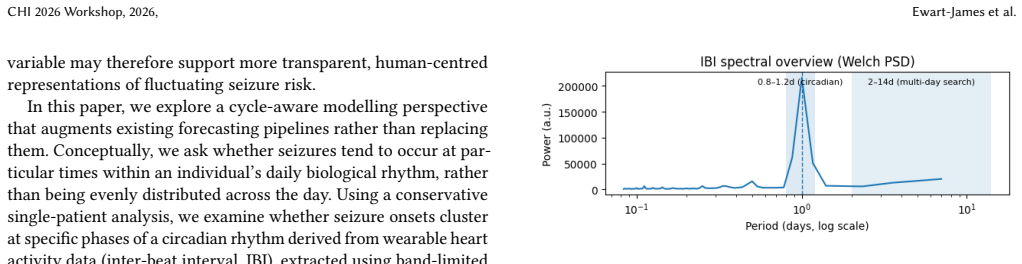
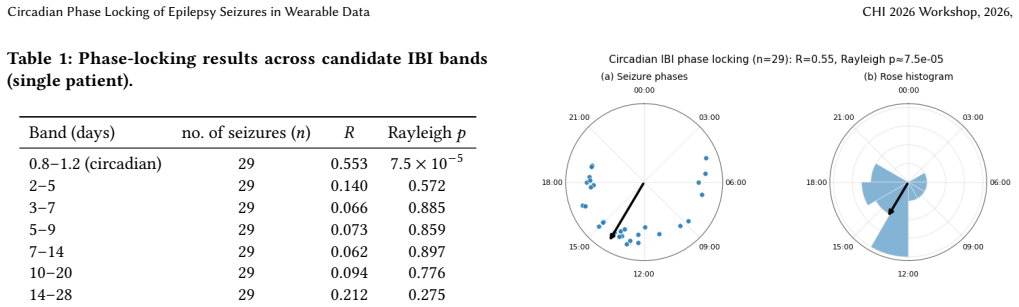
Using band-limited filtering and Hilbert-based phase estimation on inter-beat-interval time series from wearables, together with circular statistical tests on 176 days of single-patient seizure diary data, the authors find statistically significant phase locking of seizures to the circadian component while multiday bands exhibit no reliable clustering; exploratory logistic baselines further indicate detectable structure beyond simple clock-time effects.
What carries the argument
Band-limited filtering and Hilbert phase estimation applied to wearable inter-beat interval (IBI) signals, followed by circular statistical testing of seizure-phase alignment.
Load-bearing premise
The band-limited IBI-derived phase accurately captures the physiologically relevant circadian oscillator for seizure timing, and a single-patient observation can serve as a meaningful proof-of-concept.
What would settle it
A multi-patient dataset in which seizures show no statistically significant phase concentration relative to IBI-derived circadian phase would falsify the reported alignment.
Figures
read the original abstract
Epilepsy is a common, chronic neurological disorder characterized by recurrent seizures caused by sudden bursts of abnormal electrical activity in the brain. Seizures can often be unpredictable, leading to uncertainty and anxiety for people with epilepsy. To address this problem, the Epilepsy UK Priority Setting Partnership identified research into seizure forecasting technology as a priority. Seizure onsets are recorded as discrete events embedded within continuously sampled physiological signals that exhibit strong circadian and multi-day rhythms. Standard modelling approaches often treat time as linear or rely on clock-time features, which may not explicitly capture the underlying physiological phase. In this paper, we examine whether seizure onsets exhibit phase preference relative to circadian rhythms derived from wearable inter-beat interval (IBI) data. As a proof-of-concept, using 176 days wearable and seizure diary data from a single patient, we extract oscillatory components via band-limited filtering and Hilbert-based phase estimation, and test for non-uniform seizure-phase alignment using circular statistics. We observe significant circadian phase concentration, while multiday bands do not show consistent or statistically significant phase clustering in this dataset. Exploratory logistic baselines indicate modest but detectable structure beyond simple clock-time effects. We argue that explicit physiological phase representations provide an interpretable bridge between continuous wearable sensing and sparse clinical events and may augment existing seizure forecasting pipelines. We discuss implications for multi-scale modelling, patient-facing interfaces, and future multi-patient validation
Editorial analysis
A structured set of objections, weighed in public.
Referee Report
Summary. The manuscript presents a single-patient case study using 176 days of wearable inter-beat interval (IBI) data and seizure diary entries. It applies band-limited filtering followed by Hilbert transform to extract circadian and multiday oscillatory phases from the IBI time series, then uses circular statistics to test for non-uniform phase alignment of seizure onsets. The central finding is statistically significant phase concentration in the circadian band but inconsistent and non-significant clustering in multiday bands; exploratory logistic regression shows modest predictive structure beyond simple clock-time features. The work positions the approach as a proof-of-concept for incorporating physiological phase representations into seizure forecasting pipelines.
Significance. If the central statistical observation holds under scrutiny, the paper demonstrates a practical method for deriving endogenous phase from continuous wearable signals to analyze sparse clinical events, offering an interpretable alternative to clock-time features in epilepsy modeling. This could support multi-scale forecasting and patient interfaces. The application of circular statistics to real wearable data is a clear strength, as is the explicit comparison to clock-time baselines. However, the single-patient scope and unvalidated proxy nature of the IBI phase constrain broader claims about circadian locking.
major comments (3)
- [Methods (band-limited filtering)] Methods, band-limited filtering and Hilbert phase estimation: The frequency bands used for circadian and multiday extraction are free parameters with no sensitivity analysis or pre-specification reported. Because the reported significance of circadian phase concentration depends on these choices, the central claim requires explicit robustness checks across plausible band limits to confirm it is not an artifact of band selection.
- [Results (statistical tests)] Results, circular statistics tests: No multiple-comparison correction is described despite testing several frequency bands. If the circadian p-value does not survive correction, the claimed distinction between circadian concentration and lack of multiday clustering would be weakened, directly affecting the paper's strongest claim.
- [Discussion] Discussion: The interpretation that IBI-derived phase captures the physiologically relevant circadian oscillator for seizure timing rests on an unvalidated assumption. No cross-check against independent markers (actigraphy, temperature, or melatonin) is provided, leaving open the possibility that the observed clustering reflects a correlated but non-causal rhythm rather than true circadian phase locking.
minor comments (3)
- [Abstract] Abstract and Results: Report the exact circular test statistic (e.g., Rayleigh z or r) in addition to the p-value for the circadian finding to allow readers to assess effect size.
- [Figures] Figures: Ensure phase histograms or polar plots include sample size (n=number of seizures) and any confidence intervals; label frequency bands explicitly on all relevant panels.
- [Methods] Methods: Provide the precise frequency cutoffs used for each band and the Hilbert transform implementation details (e.g., windowing) to support reproducibility.
Simulated Author's Rebuttal
We thank the referee for the constructive comments, which help clarify the scope and limitations of this single-patient proof-of-concept study. We address each major point below and indicate planned revisions.
read point-by-point responses
-
Referee: Methods, band-limited filtering and Hilbert phase estimation: The frequency bands used for circadian and multiday extraction are free parameters with no sensitivity analysis or pre-specification reported. Because the reported significance of circadian phase concentration depends on these choices, the central claim requires explicit robustness checks across plausible band limits to confirm it is not an artifact of band selection.
Authors: We agree that the band limits are important parameters. In the revised manuscript we will add a sensitivity analysis that systematically varies the circadian band edges (e.g., 0.8–1.2 cycles/day) and the multiday band definitions, reporting the resulting range of circular-statistics p-values. This analysis will be placed in the Methods and Results sections to demonstrate that the reported circadian phase concentration is robust to reasonable band choices. revision: yes
-
Referee: Results, circular statistics tests: No multiple-comparison correction is described despite testing several frequency bands. If the circadian p-value does not survive correction, the claimed distinction between circadian concentration and lack of multiday clustering would be weakened, directly affecting the paper's strongest claim.
Authors: We accept the need for correction. The revised manuscript will apply a multiple-comparison correction (Bonferroni or FDR) across the tested frequency bands and will report both uncorrected and corrected p-values. We will then discuss whether the circadian result remains significant after correction and how this affects the interpretation of the circadian-versus-multiday distinction. revision: yes
-
Referee: Discussion: The interpretation that IBI-derived phase captures the physiologically relevant circadian oscillator for seizure timing rests on an unvalidated assumption. No cross-check against independent markers (actigraphy, temperature, or melatonin) is provided, leaving open the possibility that the observed clustering reflects a correlated but non-causal rhythm rather than true circadian phase locking.
Authors: We agree that IBI phase is a derived proxy and that its direct correspondence to the central circadian pacemaker is an assumption. Because the study is limited to a single patient and only wearable IBI data were collected, independent validation markers are unavailable. In the revised Discussion we will explicitly state this limitation, describe the IBI phase as a heart-rate-variability-derived physiological rhythm rather than a direct circadian oscillator, and outline the need for future multi-modal validation studies. revision: partial
- Independent circadian markers (actigraphy, temperature, melatonin) were not collected in this single-patient wearable-only dataset, so direct cross-validation of the IBI phase cannot be performed.
Circularity Check
No significant circularity in observational statistical pipeline
full rationale
The paper is a single-patient case study performing direct statistical analysis on observed wearable IBI time series and seizure events. It applies standard band-limited filtering and Hilbert phase extraction to derive circadian phase, then applies circular statistics (e.g., Rayleigh test) to check for non-uniform seizure-phase alignment. No equations, derivations, or predictions are present that reduce to fitted parameters by construction, self-definitions, or self-citation chains. The central claim is an empirical observation from data without any load-bearing step that is tautological or renames a known result as a new derivation. The analysis is self-contained against external benchmarks of phase concentration testing.
Axiom & Free-Parameter Ledger
free parameters (1)
- frequency bands for circadian and multiday filtering
axioms (1)
- domain assumption Seizure onsets can be treated as discrete point events on a circle for Rayleigh or similar tests
Reference graph
Works this paper leans on
-
[1]
Maxime O. Baud, Jonathan K. Kleen, Emily A. Mirro, Jason C. Andrechak, David King-Stephens, Edward F. Chang, and Vikram R. Rao. 2018. Multi-day rhythms modulate seizure risk in epilepsy.Nature Communications9, 1 (2018), 88. doi:10. 1038/s41467-017-02577-y
work page 2018
-
[2]
1992, Proceedings of the IEEE, 80, 520, doi: 10.1109/5.135376
B. Boashash. 1992. Estimating and interpreting the instantaneous frequency of a signal. I. Fundamentals.Proc. IEEE80, 4 (1992), 520–538. doi:10.1109/5.135376
-
[3]
George E. P. Box, Gwilym M. Jenkins, Gregory C. Reinsel, and Greta M. Ljung. 2015.Time Series Analysis: Forecasting and Control. John Wiley & Sons
work page 2015
-
[4]
Butterworth, Stephen. 1930. On the theory of filter amplifiers.Wireless Engineer 7, 6 (1930), 536–541
work page 1930
-
[5]
N. I. Fisher. 1995.Statistical Analysis of Circular Data. Cambridge University Press
work page 1995
-
[6]
Gregg, Tal Pal Attia, Mona Nasseri, Boney Joseph, Philippa Karoly, Jie Cui, Rachel E
Nicholas M. Gregg, Tal Pal Attia, Mona Nasseri, Boney Joseph, Philippa Karoly, Jie Cui, Rachel E. Stirling, Pedro F. Viana, Thomas J. Richner, Ewan S. Nurse, Andreas Schulze-Bonhage, Mark J. Cook, Gregory A. Worrell, Mark P. Richardson, Dean R. Freestone, and Benjamin H. Brinkmann. 2023. Seizure occurrence is linked to multiday cycles in diverse physiolog...
-
[7]
Philippa J. Karoly, Rachel E. Stirling, Dean R. Freestone, Ewan S. Nurse, Ma- tias I. Maturana, Amy J. Halliday, Andrew Neal, Nicholas M. Gregg, Benjamin H. Brinkmann, Mark P. Richardson, Andre La Gerche, David B. Grayden, Wendyl D’Souza, and Mark J. Cook. 2021. Multiday cycles of heart rate are associated with seizure likelihood: An observational cohort ...
-
[8]
Federico Mason, Anna Scarabello, Lisa Taruffi, Elena Pasini, Giovanna Calandra- Buonaura, Luca Vignatelli, and Francesca Bisulli. 2024. Heart Rate Variability as a Tool for Seizure Prediction: A Scoping Review.Journal of Clinical Medicine13, 3 (2024), 747. doi:10.3390/jcm13030747
-
[9]
Emily E. V. Quilter, Samuel Downes, Mairi Therese Deighan, Liz Stuart, Rosie Charles, Phil Tittensor, Leandro Junges, Peter Kissack, Yasser Qureshi, Ar- avind Kumar Kamaraj, and Amberly Brigden. 2024. A Digital Intervention for Capturing the Real-Time Health Data Needed for Epilepsy Seizure Forecasting: Protocol for a Formative Co-Design and Usability Stu...
-
[10]
Michael H. Smolensky, Ronald A. Siegel, Erhard Haus, Ramon Hermida, and Francesco Portaluppi. 2012. Biological Rhythms, Drug Delivery, and Chronother- apeutics. InFundamentals and Applications of Controlled Release Drug Delivery, Juergen Siepmann, Ronald A. Siegel, and Michael J. Rathbone (Eds.). Springer, 359–443
work page 2012
-
[11]
Rachel E. Stirling, David B. Grayden, Wendyl D’Souza, Mark J. Cook, Ewan Nurse, Dean R. Freestone, Daniel E. Payne, Benjamin H. Brinkmann, Tal Pal Attia, Pedro F. Viana, Mark P. Richardson, and Philippa J. Karoly. 2021. Forecasting Seizure Likelihood With Wearable Technology.Frontiers in Neurology12 (2021). doi:10.3389/fneur.2021.704060 Publisher: Frontiers
- [12]
discussion (0)
Sign in with ORCID, Apple, or X to comment. Anyone can read and Pith papers without signing in.