Far-Field Absolute Gain Antenna Measurements at Sub-THz Frequencies: A New Interpretation
Pith reviewed 2026-05-10 03:52 UTC · model grok-4.3
The pith
A modified far-field equation redefines the minimum measurement distance for accurate sub-THz antenna gain by combining the aperture effects of both transmit and receive antennas.
A machine-rendered reading of the paper's core claim, the machinery that carries it, and where it could break.
Core claim
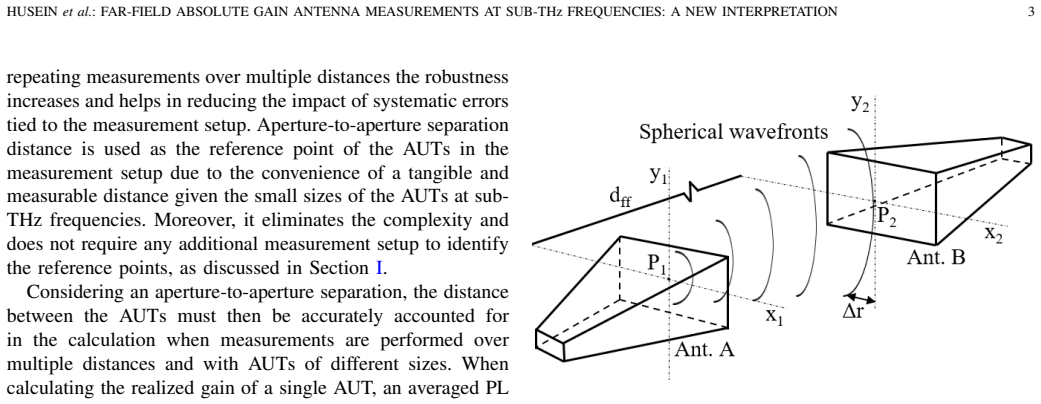
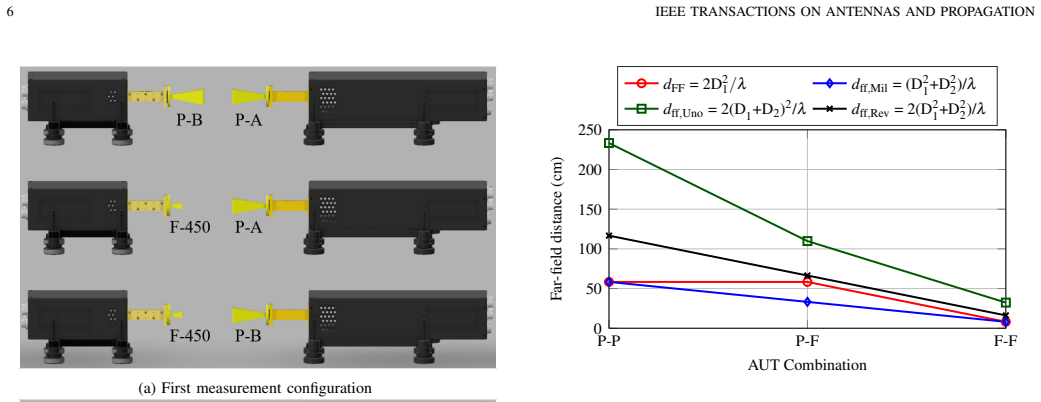
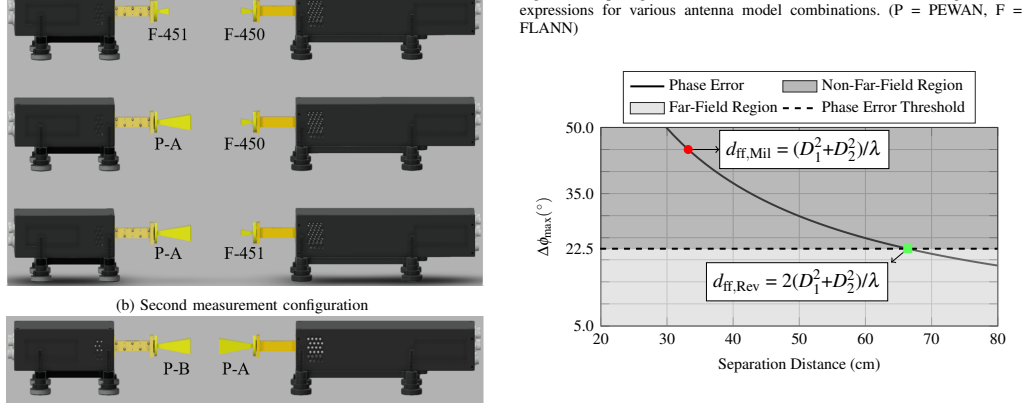
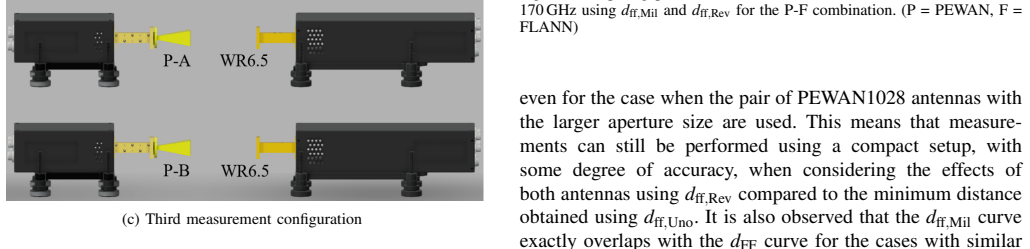
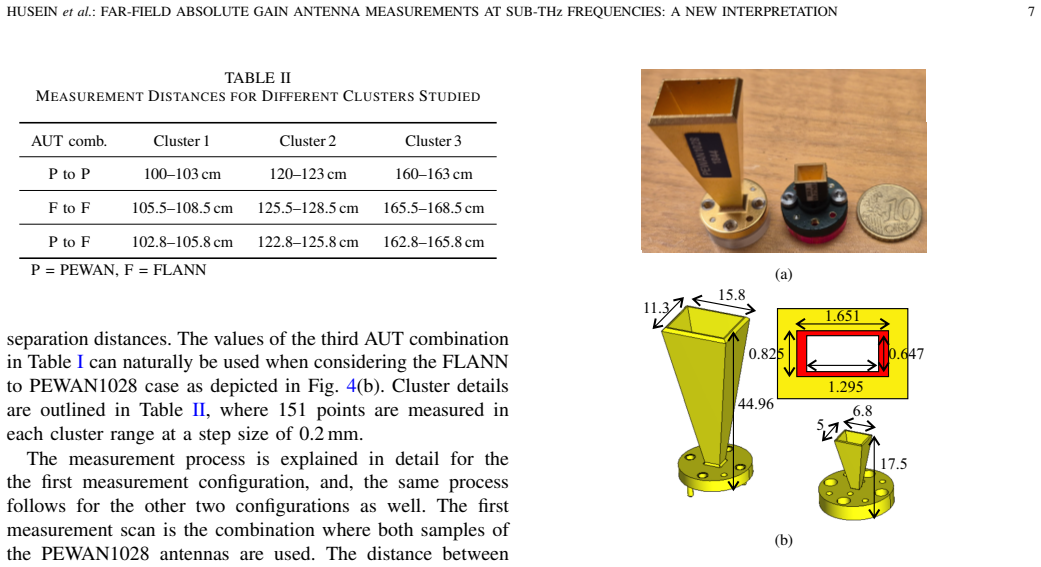
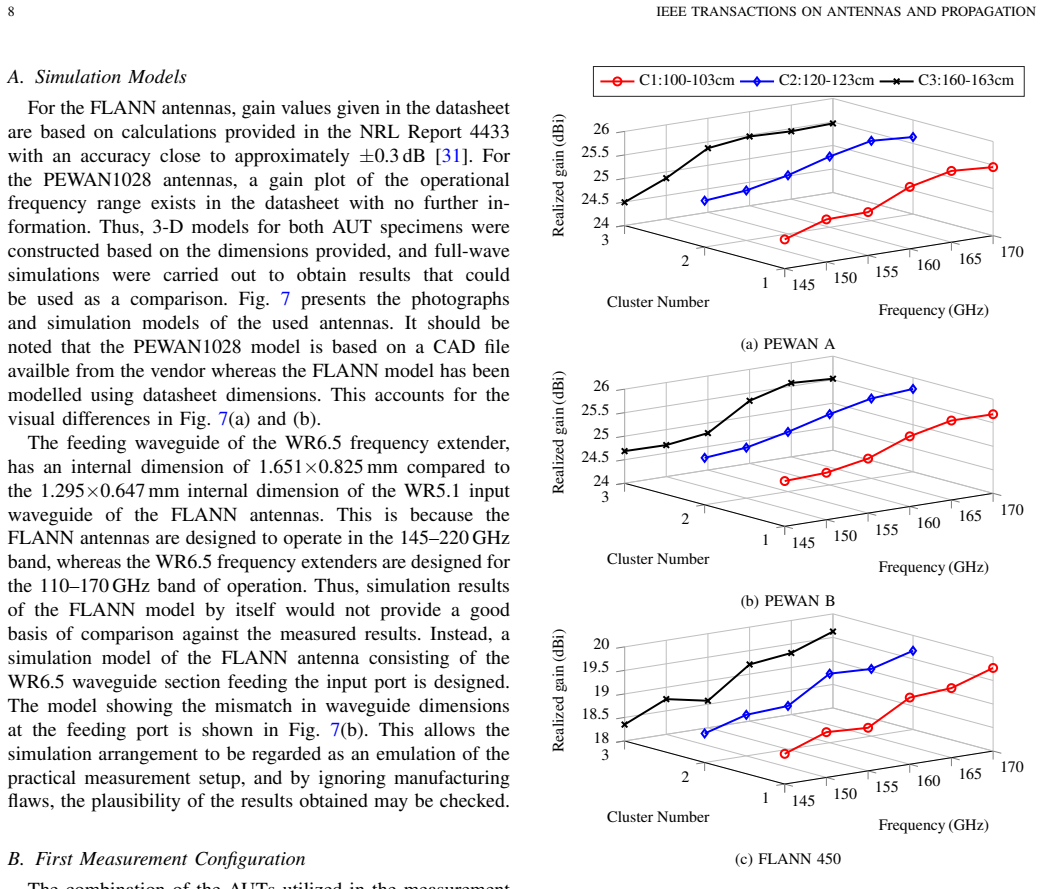
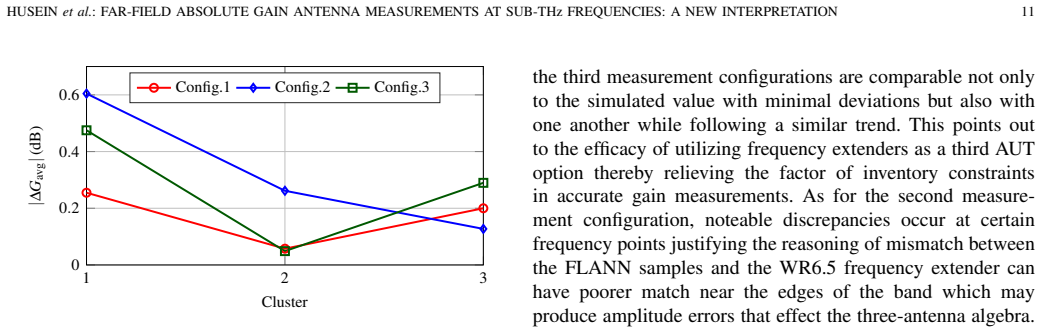
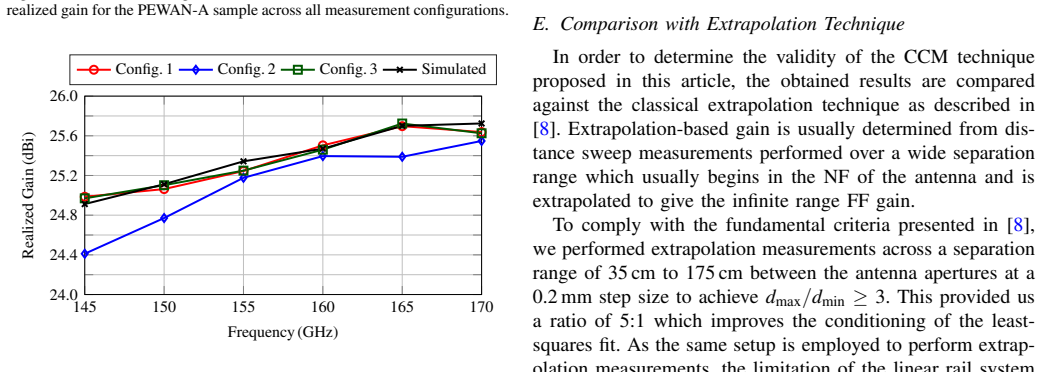
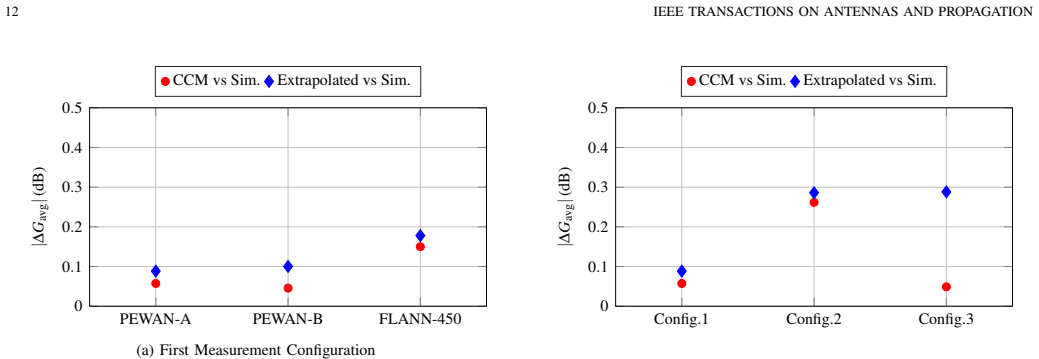
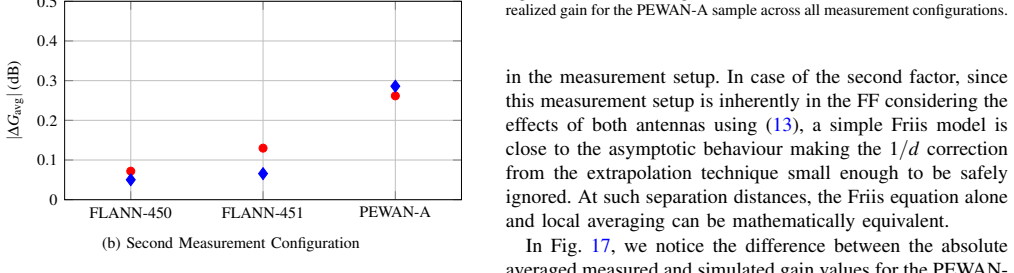
By applying the proposed modified FF formulation, the approach redefines the FF distance by considering the combined effects of both the transmitting and receiving antennas, accounting for their aperture sizes and radiation characteristics. This allows precise gain characterization within a compact measurement footprint. The theoretical model was validated through radiated measurements and simulations for both similar and dissimilar antenna pairs, confirming that reliable results can be achieved despite mismatches.
What carries the argument
The modified far-field distance equation, derived to replace the single-antenna 2D²/λ rule by summing the effective contributions from both antennas' apertures and patterns before applying the Friis transmission formula in the three-antenna method.
If this is right
- Absolute gain data for sub-THz horns can be obtained in laboratory footprints far smaller than traditional requirements.
- The three-antenna method remains usable with dissimilar antennas, removing the need for perfectly matched pairs.
- Measurement time and facility cost drop because only localized distance clusters are required.
- The same compact technique supports rapid characterization for 6G, high-frequency sensing, and imaging systems.
Where Pith is reading between the lines
- The approach could be tested on other antenna types such as arrays or lenses to see whether the same combined-aperture rule still holds.
- If validated more broadly, the method might reduce reliance on large anechoic chambers in industrial sub-THz metrology.
- Extending the derivation to include mutual coupling or near-field corrections could further shrink viable test distances.
Load-bearing premise
The theoretically derived modified far-field equation correctly identifies the onset of far-field behavior for the tested commercial horn antennas across 145-170 GHz, even when the transmit and receive antennas differ.
What would settle it
Repeat the gain measurements on the same antenna pairs at the conventionally calculated far-field distance and check whether the extracted gain values agree with the compact-setup results within the stated measurement uncertainty.
Figures
read the original abstract
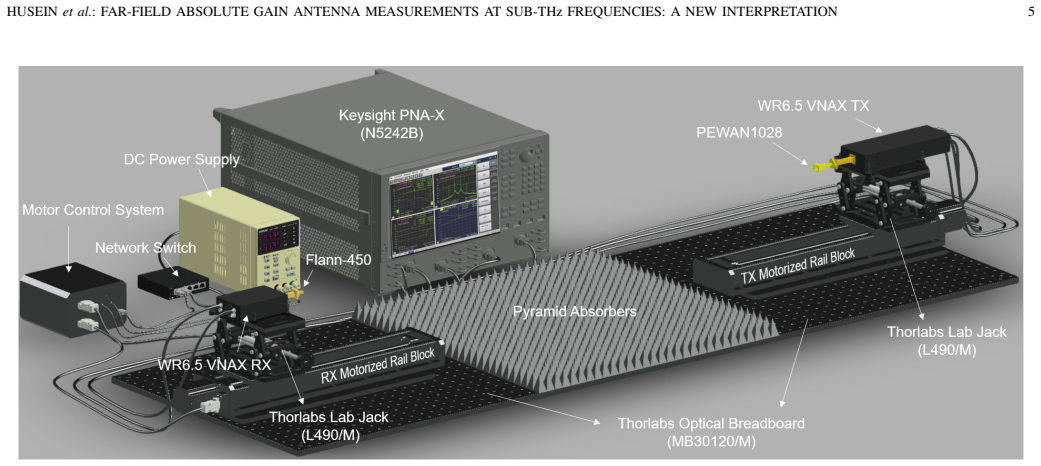
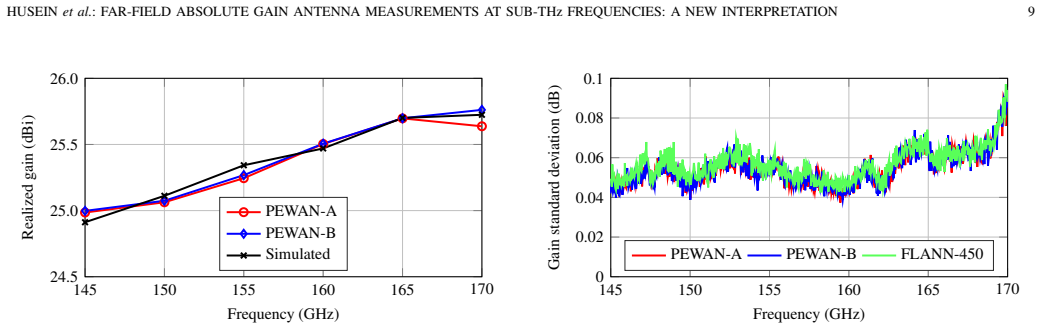
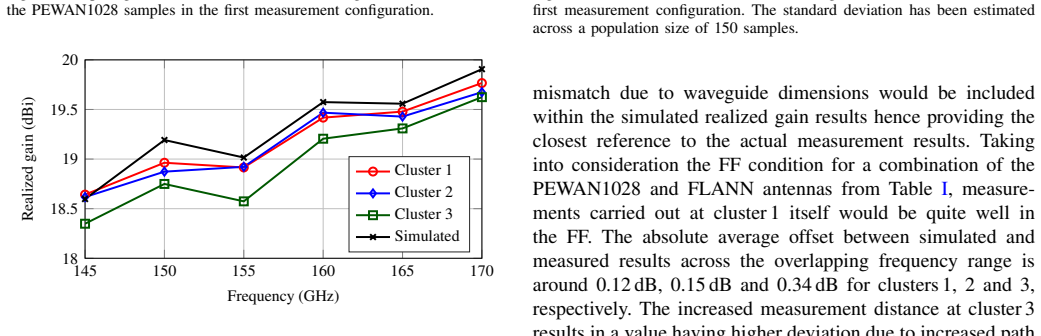
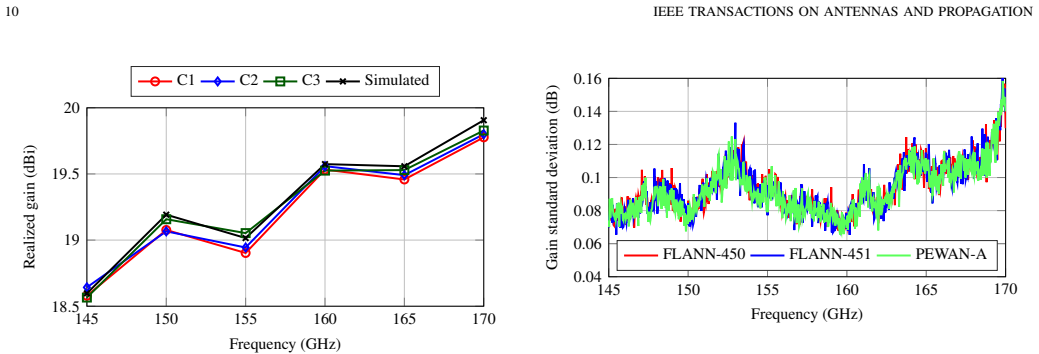
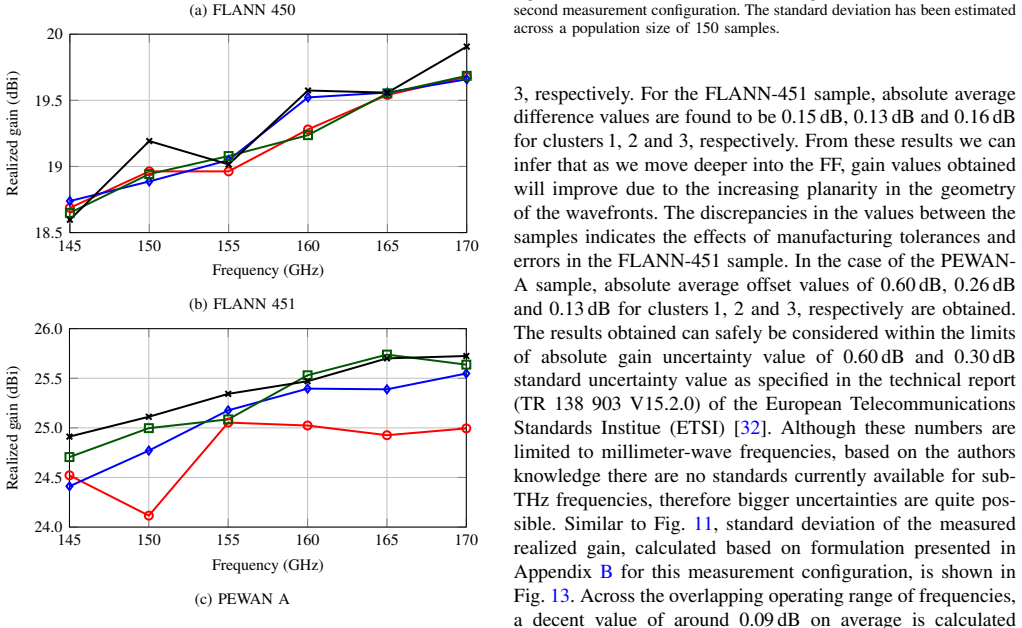
The evolution of large aperture antennas and arrays at the sub-THz band (100-300 GHz) results in traditional far-field (FF) gain measurements to require large distances due to the high frequency nature making them impractical in many laboratory environments. In the presented work, absolute antenna gain measurements are performed in localized distance clusters for commercial horn antennas in the sub-THz range of 145-170 GHz using the three-antenna method, leveraging a theoretically derived modified FF equation along with the Friis transmission equation to enable a compact measurement setup. By applying the proposed modified FF formulation, the approach aims to redefine the FF distance by considering the combined effects of both the transmitting and receiving antennas, accounting for their aperture sizes and radiation characteristics. This allows precise gain characterization within a compact measurement footprint. The proposed theoretical model was validated through radiated measurements and simulations, demonstrating its effectiveness in this case study. Also, measurements were performed using dissimilar antenna pair combinations due to inventory constraints, a common challenge both in research and in industry. Despite the mismatches, the presented work demonstrates that reliable and sufficiently accurate measurement results can still be achieved. This highlights the practical feasibility of the compact cluster measurement technique without compromising measurement integrity. The compact setup ensures efficiency in the measurement time and cost, making it a robust solution for both research and industrial needs in sub-THz antenna characterization for applications including 6G, high frequency sensing, and imaging systems.
Editorial analysis
A structured set of objections, weighed in public.
Referee Report
Summary. The paper claims that a theoretically derived modified far-field (FF) distance criterion, which accounts for the combined aperture sizes and radiation characteristics of both transmitting and receiving antennas, enables accurate absolute gain measurements of commercial horn antennas at 145-170 GHz using the three-antenna method and Friis transmission equation in compact distance clusters. This is validated via radiated measurements and simulations, even when using dissimilar antenna pairs due to inventory constraints, yielding reliable results without large measurement distances.
Significance. If the modified FF formulation is shown to render the Friis equation sufficiently accurate without residual near-field errors, the work would provide a practical solution for sub-THz antenna characterization in space-constrained labs, supporting applications in 6G, sensing, and imaging. The emphasis on mismatched pairs reflects real-world constraints and adds applicability, but the current lack of quantitative consistency metrics limits the assessed impact.
major comments (3)
- Abstract: The central claim that the approach yields 'reliable and sufficiently accurate' results for dissimilar horn pairs lacks any reported quantitative metrics such as error bars, standard deviations, cross-pair gain consistency values for the same antenna, or residual error after applying the modification.
- Derivation of modified FF equation (theoretical model section): The equation is described as 'theoretically derived' to redefine FF distance based on combined Tx/Rx effects, but no explicit derivation steps, assumptions about phase curvature/amplitude taper, or independent comparison to the standard 2D²/λ criterion are provided, creating risk of circularity when the same data is used for both derivation and validation.
- Validation and results (measurements/simulations section): No data exclusion criteria, statistical analysis, or assessment of how the modification affects Friis accuracy specifically for dissimilar commercial horns at 145-170 GHz is included, which is load-bearing for the claim that near-field errors are adequately mitigated.
minor comments (2)
- Abstract: The title references sub-THz (100-300 GHz) while the work focuses on 145-170 GHz; clarify the exact frequency range and any extrapolation.
- Throughout: Ensure all equations in the modified FF and Friis application are numbered and explicitly referenced when discussing their use with the three-antenna method.
Simulated Author's Rebuttal
We thank the referee for the constructive feedback, which identifies opportunities to strengthen the clarity and quantitative support in our manuscript. We respond to each major comment below and will revise the paper accordingly.
read point-by-point responses
-
Referee: Abstract: The central claim that the approach yields 'reliable and sufficiently accurate' results for dissimilar horn pairs lacks any reported quantitative metrics such as error bars, standard deviations, cross-pair gain consistency values for the same antenna, or residual error after applying the modification.
Authors: We agree that the abstract would be strengthened by explicit quantitative metrics. In the revised manuscript we will report standard deviations from repeated measurements, cross-pair gain consistency values for each antenna under test, and an estimate of residual error after applying the modified criterion. revision: yes
-
Referee: Derivation of modified FF equation (theoretical model section): The equation is described as 'theoretically derived' to redefine FF distance based on combined Tx/Rx effects, but no explicit derivation steps, assumptions about phase curvature/amplitude taper, or independent comparison to the standard 2D²/λ criterion are provided, creating risk of circularity when the same data is used for both derivation and validation.
Authors: The modified criterion was obtained by superposing the individual far-field distance requirements of the two antennas while accounting for their effective apertures and radiation patterns. To address the concern, the revised theoretical section will contain the full step-by-step derivation, explicit statements of the phase-curvature and amplitude-taper assumptions, and a purely theoretical comparison against the conventional 2D²/λ rule that does not rely on the measurement data set. revision: yes
-
Referee: Validation and results (measurements/simulations section): No data exclusion criteria, statistical analysis, or assessment of how the modification affects Friis accuracy specifically for dissimilar commercial horns at 145-170 GHz is included, which is load-bearing for the claim that near-field errors are adequately mitigated.
Authors: We accept that additional statistical detail is warranted. The revised results section will state the data-exclusion criteria (e.g., SNR threshold), present mean gain values together with standard deviations, and include a direct side-by-side comparison of Friis-derived gains obtained with and without the modified distance criterion for the dissimilar horn pairs over 145–170 GHz. revision: yes
Circularity Check
Theoretical derivation of modified FF distance remains independent of measurement data
full rationale
The paper presents a theoretically derived modified far-field equation that redefines the FF distance by accounting for the combined aperture sizes and radiation characteristics of both transmitting and receiving antennas. This formulation is then combined with the Friis transmission equation to enable gain extraction via the three-antenna method in compact setups. The model is explicitly validated through separate simulations and radiated measurements on commercial horn antennas at 145-170 GHz (including dissimilar pairs), rather than being fitted to or derived from those measurements. No load-bearing self-citations, self-definitional reductions, or renaming of known results are evident in the provided text; the central claim is a theoretical adjustment whose accuracy is tested externally to its own inputs.
Axiom & Free-Parameter Ledger
axioms (1)
- domain assumption The Friis transmission equation remains valid when the separation distance satisfies the modified far-field condition derived from combined antenna apertures.
Reference graph
Works this paper leans on
-
[1]
White paper on RF enabling 6G – opportunities and challenges from technology to spectrum,
A. P ¨arssinenet al., “White paper on RF enabling 6G – opportunities and challenges from technology to spectrum,” University of Oulu, 2020, White paper, (6G Research Visions, No. 13). [Online]. Available: http://urn.fi/urn:isbn:9789526228419
work page 2020
-
[2]
T. Eichler and R. Ziegler,White paper: Fundamentals of THz technology for 6G. Rohde & Schwarz, July 2022. [Online]. Available: https: //www.rohde-schwarz.com/solutions/test-and-measurement/wireless- communication/cellular-standards/6g/white-paper-fundamentals-of-thz- technology-for-6g-by-rohde-schwarz-registration 255934.html
work page 2022
-
[3]
A plane-polar approach for far-field construction from near-field measurements,
Y . Rahmat-Samii, V . Galindo-Israel, and R. Mittra, “A plane-polar approach for far-field construction from near-field measurements,”IEEE Trans. Antennas Propag., vol. 28, no. 2, pp. 216–230, 1980
work page 1980
-
[4]
The radiation pattern of an antenna from near-field correla- tion measurements,
M. Hamid, “The radiation pattern of an antenna from near-field correla- tion measurements,”IEEE Trans. Antennas Propag., vol. 16, no. 3, pp. 351–353, 1968
work page 1968
-
[5]
Hologram-based compact range for submillimeter- wave antenna testing,
A. Lonnqvistet al., “Hologram-based compact range for submillimeter- wave antenna testing,”IEEE Trans. Antennas Propag., vol. 53, no. 10, pp. 3151–3159, 2005
work page 2005
-
[6]
Testing of a 1.5-m reflector antenna at 322 ghz in a catr based on a hologram,
J. Hakliet al., “Testing of a 1.5-m reflector antenna at 322 ghz in a catr based on a hologram,”IEEE Trans. Antennas Propag., vol. 53, no. 10, pp. 3142–3150, 2005
work page 2005
-
[7]
Horn antenna analysis as applied to the evaluation of the gain-transfer method,
G. Mayhew-Ridgers, J. Odendaal, and J. Joubert, “Horn antenna analysis as applied to the evaluation of the gain-transfer method,”IEEE Trans. Instrum. Meas., vol. 49, no. 5, pp. 949–958, Oct. 2000
work page 2000
-
[8]
A. Newell, R. Baird, and P. Wacker, “Accurate measurement of an- tenna gain and polarization at reduced distances by an extrapolation technique,”IEEE Trans. Antennas Propag., vol. 21, no. 4, pp. 418–431, Apr. 1973
work page 1973
-
[9]
Antenna gain measure- ments by an extended version of the NBS extrapolation method,
A. G. Repjar, A. C. Newell, and R. C. Baird, “Antenna gain measure- ments by an extended version of the NBS extrapolation method,”IEEE Trans. Instrum. Meas., vol. 32, no. 1, pp. 88–91, Mar. 1983
work page 1983
-
[10]
Intercomparison of standard gain horn antennas atW-band,
J.-S. Kang, N.-W. Kang, D. G. Gentle, K. MacReynolds, and M. H. Francis, “Intercomparison of standard gain horn antennas atW-band,” IEEE Trans. Instrum. Meas., vol. 60, no. 7, pp. 2627–2633, July 2011
work page 2011
-
[11]
A note on a simple transmission formula,
H. Friis, “A note on a simple transmission formula,”Proc. IRE, vol. 34, no. 5, pp. 254–256, May 1946
work page 1946
-
[12]
IEEE standard test procedures for antennas,
“IEEE standard test procedures for antennas,”ANSI/IEEE Std 149-1979, pp. 78–98, 1979
work page 1979
-
[13]
Accurate measurement for millimeter-wave antenna based on the ex- trapolation range,
L. Xiao, M. Donglin, H. Pan, S. Zhenfei, L. Jinyuan, and L. Haoyu, “Accurate measurement for millimeter-wave antenna based on the ex- trapolation range,” in2018 11th Global Symp. Millim. Waves (GSMM), Boulder, CO, USA, May 2018, pp. 1–3
work page 2018
-
[14]
X. Zhao, H. Ban, R. Wang, and X. Liu, “Standard antenna measurement for mobile communication based on the three-antenna extrapolation tech- nique,” in2023 IEEE 7th Int. Symp. Electromagn. Compat. (ISEMC), Hangzhou, China, Oct. 2023, pp. 1–4
work page 2023
-
[15]
Measurement method of passive antenna for mobile communication system,
“Measurement method of passive antenna for mobile communication system,” Ministry of Industry and Information Technology of the Peo- ple’s Republic of China, Beijing, China, Industry Standard: YD/T 2868- 2020, 2020
work page 2020
-
[16]
Field strength above 1 GHz: Measurement procedures for standard antennas,
R. Bowman, “Field strength above 1 GHz: Measurement procedures for standard antennas,”Proc. IEEE, vol. 55, no. 6, pp. 981–990, June 1967
work page 1967
-
[17]
Near-field gain correction for trans- mission between horn antennas,
J. D. Hunter and I. G. Morgan, “Near-field gain correction for trans- mission between horn antennas,”IEEE Trans. Instrum. Meas., vol. 26, no. 1, pp. 58–61, Mar. 1977
work page 1977
-
[18]
Fast and accurate measurement of on- axis gain and on-axis polarization at a finite distance,
S. Pivnenko and O. Breinbjerg, “Fast and accurate measurement of on- axis gain and on-axis polarization at a finite distance,” in2013 7th Eur. Conf. Antennas Propag. (EuCAP), Gothenburg, Sweden, Apr. 2013, pp. 810–814
work page 2013
-
[19]
J. Odendaal and C. Pistorius, “A method to measure the aperture field and experimentally determine the near-field phase center of a horn antenna,”IEEE Trans. Instrum. Meas., vol. 42, no. 1, pp. 51–53, Feb. 1993
work page 1993
-
[20]
Determination of gain for pyramidal-horn antenna on basis of phase center location,
K. Harima, M. Sakasai, and K. Fujii, “Determination of gain for pyramidal-horn antenna on basis of phase center location,” in2008 IEEE Int. Symp. Electromagn. Compat. (ISEMC), Detroit, MI, USA, Aug. 2008, pp. 1–5
work page 2008
-
[21]
Phase center measurements based on the three-antenna method,
T. Hertel, “Phase center measurements based on the three-antenna method,” inIEEE Ant. Propag. Soc. Int. Symp. Digest. (APS/URSI), vol. 3, Columbus, OH, USA, June 2003, pp. 816–819
work page 2003
-
[22]
Accurate gain measurement of horn antennas in the shortened far field,
H. Hollmann, “Accurate gain measurement of horn antennas in the shortened far field,”IEEE Trans. Instrum. Meas., vol. 38, no. 2, pp. 617–618, Apr. 1989
work page 1989
-
[23]
Accurate gain measurement technique for limited antenna separations,
A. J. van den Biggelaaret al., “Accurate gain measurement technique for limited antenna separations,”IEEE Trans. Antennas Propag., vol. 69, no. 10, pp. 6772–6782, Oct. 2021
work page 2021
-
[24]
Contactless RF probe interconnect technology enabling broadband testing to the terahertz range,
A. Rivera-Lavado, M. Ali, D. Gallego-Cabo, L.-E. Garc ´ıa-Mu˜noz, D. V . Lioubtchenko, and G. Carpintero, “Contactless RF probe interconnect technology enabling broadband testing to the terahertz range,”IEEE Trans. THz Sci. Technol., vol. 13, no. 1, pp. 34–43, Jan. 2023
work page 2023
-
[25]
C. A. Balanis,Antenna Theory: Analysis and Design, 3rd ed.Hoboken, NJ: John Wiley, 2005. [26]WAVASORB ® VHP Advanced Broadband Pyramidal Absorber, Emerson & Cuming Anechoic Chambers nv, Westerlo, Belgium,
work page 2005
-
[26]
[Online]. Available: https://www.ecanechoicchambers.com/pdf/ W A V ASORB%20VHP%20datasheet%20full%20versionfinal.pdf
-
[27]
G. Mayhew-Ridgers, P. A. van Jaarsveld, and J. W. Odendaal, “Three- antenna characterization techniques employing spherical near-field scan- ning with higher-order probe correction,”IEEE Trans. Antennas Propag., vol. 71, no. 9, pp. 7220–7228, 2023
work page 2023
-
[28]
Range distance requirements for large antenna measurements,
T. Uno and S. Adachi, “Range distance requirements for large antenna measurements,”IEEE Trans. Antennas Propag., vol. 37, no. 6, pp. 707– 720, June 1989
work page 1989
-
[29]
Radio frequency spectrum characteristics, measurement of,
“Radio frequency spectrum characteristics, measurement of,” Military Standard: MIL-STD-449D, February 1973
work page 1973
-
[30]
Errors in shortened far-field gain measurement due to mutual coupling,
T. Hirano, J. Hirokawa, and M. Ando, “Errors in shortened far-field gain measurement due to mutual coupling,”IEEE Trans. Antennas Propag., vol. 62, no. 10, pp. 5386–5388, Oct. 2014
work page 2014
-
[31]
Design and calibration of microwave antenna gain stan- dards,
W. T. Slayton, “Design and calibration of microwave antenna gain stan- dards,” Naval Research Laboratory, Washington D.C., USA, Technical Report 4433, Nov. 1954
work page 1954
-
[32]
3GPP, “5G; NR; Derivation of test tolerances and measurement uncer- tianity for User Equipment (UE) and conformance test cases (release 15),” 3GPP, Tech. Rep. TR 138.903 V15.2.0 (2019-04), 2019
work page 2019
-
[33]
Z. Song, D. Gentle, H. Lin, X. Liu, and J. Li, “Accurate gain calibration for a WR10 standard gain horn (SGH) using the three-antenna extrapo- lation technique,” inIET Int. Radar Conf. 2015, Hangzhou, China, Oct. 2015, pp. 1–5
work page 2015
-
[34]
C. Bender and S. Orszag,Advanced Mathematical Methods for Sci- entists and Engineers: Asymptotic Methods and Perturbation Theory. McGraw-Hill, 1978
work page 1978
discussion (0)
Sign in with ORCID, Apple, or X to comment. Anyone can read and Pith papers without signing in.