Quantum quenches in a spin-1 chain with tunable symmetry
Pith reviewed 2026-05-10 03:08 UTC · model grok-4.3
The pith
Tuning a spin-1 chain to SU(3) symmetry reveals a new conserved quantity that limits the states reachable after a quantum quench.
A machine-rendered reading of the paper's core claim, the machinery that carries it, and where it could break.
Core claim
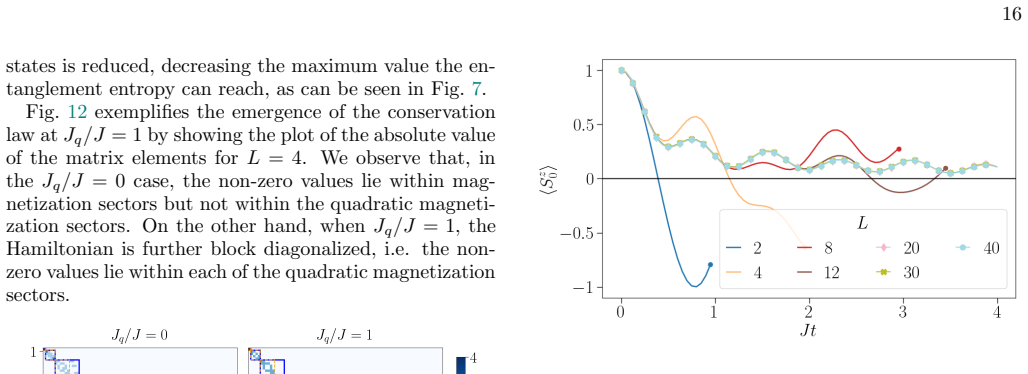
In the SU(3)-symmetric limit of the spin-1 Heisenberg chain, an additional conserved quantity exists that is not present in the SU(2) case. Numerical simulations of quenches from various initial states show that the post-quench dynamics are governed by the restricted number of accessible states allowed by this conservation law, leading to characteristic patterns in magnetization, entanglement entropy, and spin correlations.
What carries the argument
The new conserved quantity at the SU(3) symmetric point, which partitions the Hilbert space into sectors whose size determines the reachable states after a quench.
Load-bearing premise
The TEBD simulations remain accurate for the system sizes, evolution times, and parameter ranges studied, with truncation errors not affecting the identification of the conserved quantity or the reported dynamical features.
What would settle it
An exact diagonalization study on small systems that finds the proposed quantity is not conserved, or a quench where the measured long-time observables exceed the number of states permitted by the conservation law.
Figures





read the original abstract
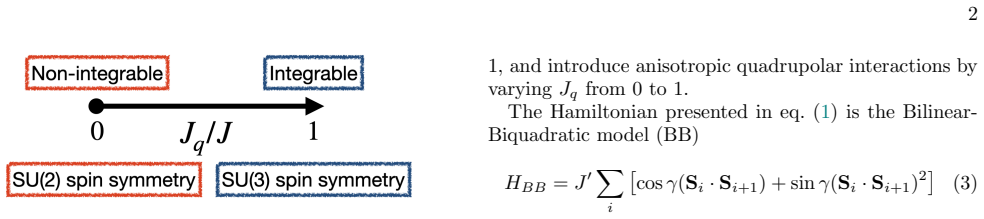
In recent years, the dynamics of interacting quantum systems far from equilibrium have attracted significant research interest. Driven by rapid progress in quantum simulators, various non-equilibrium phenomena have now been realized experimentally. In this work, we use the time-evolving block decimation (TEBD) method to investigate the dynamics of an anisotropic spin-1 Heisenberg chain for a wide range of experimentally accessible initial states. By adjusting the parameter $J_q$ that controls the quadrupolar interaction strength, we can tune the system from a non-integrable SU(2) Heisenberg model to an integrable SU(3) Heisenberg model. We examine the local magnetization, entanglement entropy, and spin correlations, and characterize their dependence on $J_q$. We identify a new conserved quantity at the SU(3) symmetric point and provide a theoretical framework to explain our numerical observations in terms of the number of accessible states permitted by this conservation law. Our results provide a route to realize a rich array of non-equilibrium behavior in spin-1 lattice models, which can be engineered in several experimental platforms such as ultracold atoms in optical lattices.
Editorial analysis
A structured set of objections, weighed in public.
Referee Report
Summary. The manuscript uses TEBD simulations to study quantum quench dynamics in an anisotropic spin-1 Heisenberg chain, tuning the quadrupolar interaction J_q to interpolate between the non-integrable SU(2) and integrable SU(3) points. It reports the time evolution of local magnetization, entanglement entropy, and spin correlations across a range of initial states, identifies a new conserved quantity at the SU(3) symmetric point, and introduces a theoretical framework that attributes the observed dynamical features to the reduced number of accessible states enforced by this conservation law.
Significance. If the new conserved quantity is exactly conserved, the work would usefully illustrate how an additional integral of motion at the SU(3) point restricts the reachable Hilbert space and thereby shapes quench dynamics in a tunable spin-1 model. The numerical exploration over experimentally relevant initial states and the explicit link to ultracold-atom platforms are strengths. However, the central framework rests on an unverified numerical observation rather than an analytical demonstration, which limits the immediate impact until the conservation is placed on firmer ground.
major comments (1)
- [Section identifying the new conserved quantity at the SU(3) point] The section identifying the new conserved quantity at the SU(3) point: the claim that a specific operator is exactly conserved is supported only by the numerical observation that its expectation value remains time-independent in TEBD runs. No analytical verification that this operator commutes with the SU(3)-symmetric Hamiltonian (i.e., explicit computation of [H, Q] = 0 on the local interaction terms) is provided. Because the subsequent counting argument for accessible states depends on exact conservation, this numerical evidence alone is insufficient to establish the central claim.
minor comments (2)
- [Methods] The methods description provides insufficient detail on the TEBD bond dimensions employed, truncation thresholds, system sizes, and any convergence or error-bar analysis. These checks are needed to confirm that the reported constancy of the candidate conserved quantity is not influenced by numerical truncation.
- Figure captions and axis labels should explicitly indicate the values of J_q and the specific initial states corresponding to each curve to improve readability when comparing dynamics across the SU(2)–SU(3) crossover.
Simulated Author's Rebuttal
We thank the referee for their careful reading of the manuscript and for identifying the need for stronger analytical support of the conserved quantity. We address this point directly below and will incorporate the requested verification in the revised version.
read point-by-point responses
-
Referee: [Section identifying the new conserved quantity at the SU(3) point] The section identifying the new conserved quantity at the SU(3) point: the claim that a specific operator is exactly conserved is supported only by the numerical observation that its expectation value remains time-independent in TEBD runs. No analytical verification that this operator commutes with the SU(3)-symmetric Hamiltonian (i.e., explicit computation of [H, Q] = 0 on the local interaction terms) is provided. Because the subsequent counting argument for accessible states depends on exact conservation, this numerical evidence alone is insufficient to establish the central claim.
Authors: We agree that an explicit analytical demonstration is required to place the conservation law on firm ground. While the TEBD data show that the expectation value of the identified operator remains constant to machine precision across all simulated times and system sizes, this alone does not constitute a proof. We have now computed the commutator [H_SU(3), Q] directly on the local two-site interaction terms of the SU(3)-symmetric Hamiltonian and verified that it vanishes identically. The explicit form of Q and the step-by-step commutator evaluation will be added to the revised manuscript (new subsection in Sec. III). This analytical result confirms exact conservation, thereby justifying the Hilbert-space counting argument and the explanation of the observed dynamical restrictions. revision: yes
Circularity Check
No circularity: conservation law identified numerically then used to interpret independent dynamical features
full rationale
The manuscript reports TEBD simulations of quenches in the spin-1 chain, observes time-independent expectation values for a candidate operator at the SU(3) point, and labels this operator a new conserved quantity. It then invokes the resulting restriction on accessible states to account for the saturation behavior of entanglement entropy and correlation functions. This chain does not reduce any claimed prediction to a fitted parameter by construction, nor does it rely on self-citation for a uniqueness theorem or smuggle an ansatz; the numerical constancy and the subsequent counting argument remain logically distinct steps supported by the same simulation data but not tautological.
Axiom & Free-Parameter Ledger
axioms (2)
- domain assumption The Hamiltonian is the standard anisotropic spin-1 Heisenberg model plus quadrupolar interaction controlled by J_q
- domain assumption TEBD accurately captures the unitary time evolution for the chosen initial states and evolution times
Reference graph
Works this paper leans on
-
[1]
(1) in fixed magnetization sectors [73] and employ ED to simulate small chains up toL∼12 sites
Exact diagonalization We block-diagonalize eq. (1) in fixed magnetization sectors [73] and employ ED to simulate small chains up toL∼12 sites. ED results were used to benchmark con- vergence of our TEBD simulations at short times and to diagnose finite-size effects (see Appendix C for a discus- sion)
-
[2]
Time evolving block-decimation Tensor network algorithms exploit the entanglement area laws of quantum many-body systems, whose states access only a subspace of the exponentially growing Hilbert space. These algorithms include DMRG (Density Matrix Renormalization Group) [74, 75] and TEBD [76]. In this work, we implement the TEBD algorithm to compute the t...
-
[3]
Letℓ 1,ℓ −1 andℓ 0 be the number of sites withσ= 1,−1,0 respectively
Number of accessible eigenstates Consider an initial state with a fixed magnetizationM and quadratic magnetizationM 2. Letℓ 1,ℓ −1 andℓ 0 be the number of sites withσ= 1,−1,0 respectively. Note thatℓ 1 +ℓ 0 +ℓ −1 =L, and thatℓ 1 −ℓ −1 =M. When Jq/J <1 only the total magnetization is conserved, and the number of available states can be obtained by sum- min...
-
[4]
Relative frequency of out-of-plane alignments A similar combinatorial argument explains the freez- ing of certain correlation functions in theJ q/J= 1 limit. First, we isolate the center bond, denoted as|σ 0, σ1⟩, and define a complementary chain of ˜L=L−2 sites. This re- duced chain has a fixed magnetization of ˜M=M−M bond and quadratic magnetization ˜M2...
work page 2023
-
[5]
Sz j Sz j+1, X i Sz i # − = 0,(B3a)
Net magnetization The magnetization operator, defined as M= X i Sz i ,(B1) commutes with the Hamiltonian, [H,P Sz i ] = 0, for every value of its parametersJ z, Jxy andJ q, and thus provides a conservation law valid for all of the systems considered in this work. To prove this, we first write the commutation relations ofS z i with spinS a i and quadrupola...
-
[6]
Sz i Sz i+1, X i λ8 i # − = 0,(B12a)
Quadratic magnetization We show that the quadratic magnetization operator M2 = X i (Sz i )2 (B4) is a constant of motion whenJ q =J xy = 1 in equation (1). The proof is carried out using the Gell-Mann matri- ces, the usual representation of the SU(3) algebra. The SU(3) algebra is spanned by eight Hermitian and traceless matrices, given by: λ1 = 0 1 0 ...
-
[7]
A general quantum state can be writ- ten as: |ψ⟩= X σ cσ |σ⟩(D1) whereσ= (σ 1,
Matrix Product States Consider a chain ofLsites, each with a local Hilbert space dimensiond. A general quantum state can be writ- ten as: |ψ⟩= X σ cσ |σ⟩(D1) whereσ= (σ 1, . . . , σi, . . . , σL) denotes the basis con- figurations andc σ are the expansion coefficients⟨ψ|σ⟩. A full description of a general spin chain state requires dL coefficients to be ac...
-
[8]
Suzuki-T rotter decomposition The time evolution of a quantum state|ψ(t)⟩is gov- erned by the unitary operatorU(dt) =e −iHdt, such that |ψ(t+dt)⟩=U(dt)|ψ(t)⟩. We consider the action of this operator on a quantum state in MPS form for an infinitesimal time stepdt. Spin chain Hamiltonians with nearest-neighbor inter- actions can be written asH=H even+Hodd, ...
-
[9]
Calculation of observables and physical measures The evolution of relevant observables and physical measures can be computed using the updated MPS rep- resentation. The procedure depends on whether the op- erator associated with this observable acts on a single site or on two sites. Other measures rely on the inner product between two MPS (e.g., the fidel...
-
[10]
This error increases as the entropy approaches the numerical limit set byS max = log(χ)
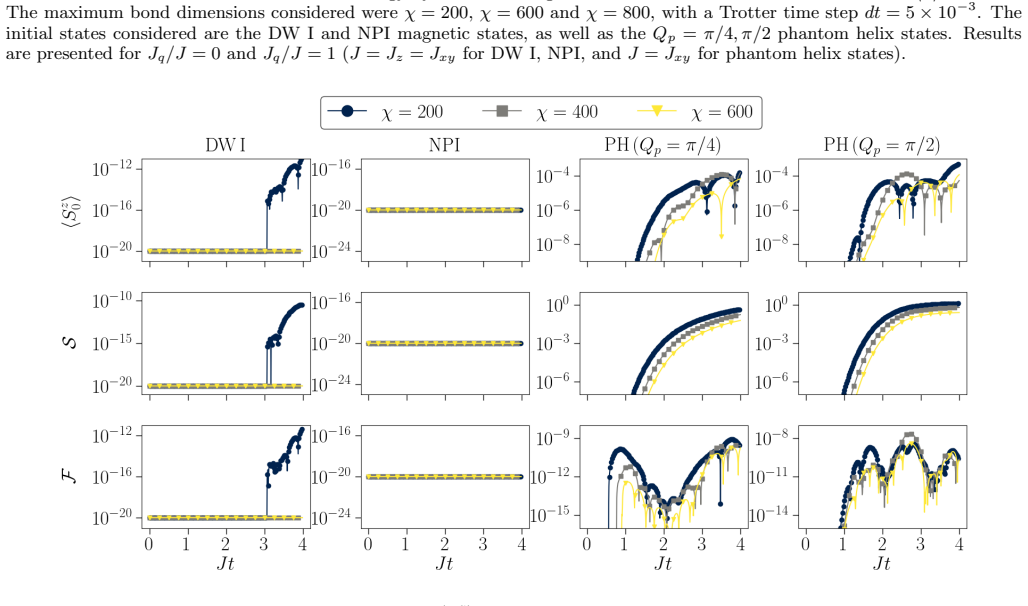
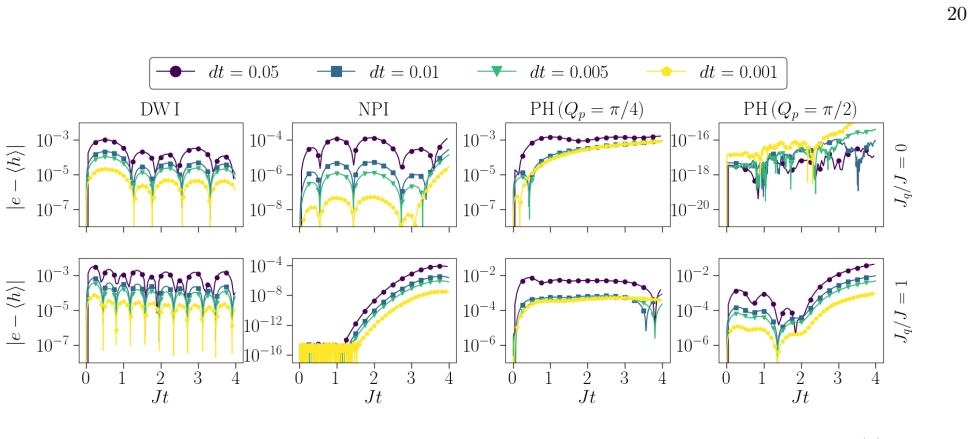
T runcation errors An approximation error in the TEBD algorithm occurs when the MPS matrices are truncated because their bond dimension exceeds the maximum bond allowedχ. This error increases as the entropy approaches the numerical limit set byS max = log(χ). Time evolution under a time-independent Hamiltonian should preserve the system’s initial energy. ...
-
[11]
T rotter approximation errors In contrast to truncation errors, the Trotter error man- ifests during the short-time evolution. Scaling asO(dt 2) [see Eq. (D5)], this error implies a strict trade-off: while reducing the time stepdtenhances numerical precision, it significantly increases the computational cost. 20 FIG. 16. Absolute difference of the initial...
-
[12]
R. Nandkishore and D. A. Huse, Many-body localiza- tion and thermalization in quantum statistical mechan- ics, Annu. Rev. Condens. Matter Phys.6, 15 (2015)
work page 2015
-
[13]
Altman, Many-body localization and quantum ther- malization, Nat
E. Altman, Many-body localization and quantum ther- malization, Nat. Phys.14, 979 (2018)
work page 2018
-
[14]
D. A. Abanin, E. Altman, I. Bloch, and M. Serbyn, Col- loquium: Many-body localization, thermalization, and entanglement, Rev. Mod. Phys.91, 021001 (2019)
work page 2019
-
[15]
T. Mori, T. N. Ikeda, E. Kaminishi, and M. Ueda, Ther- malization and prethermalization in isolated quantum systems: a theoretical overview, J. Phys. B: At. Mol. Opt. Phys.51, 112001 (2018)
work page 2018
-
[16]
A. Chandran, T. Iadecola, V. Khemani, and R. Moessner, Quantum many-body scars: A quasiparticle perspective, Annu. Rev. Conden. Ma. P.14, 443 (2023)
work page 2023
- [17]
-
[18]
S. Moudgalya, B. A. Bernevig, and N. Regnault, Quan- tum many-body scars and Hilbert space fragmentation: a review of exact results, Rep. Prog. Phys.85, 086501 (2022)
work page 2022
-
[19]
P. Sala, T. Rakovszky, R. Verresen, M. Knap, and F. Poll- mann, Ergodicity breaking arising from hilbert space fragmentation in dipole-conserving hamiltonians, Phys. Rev. X10, 011047 (2020)
work page 2020
-
[20]
V. Khemani, M. Hermele, and R. Nandkishore, Local- ization from hilbert space shattering: From theory to physical realizations, Phys. Rev. B101, 174204 (2020)
work page 2020
-
[21]
S. Moudgalya and O. I. Motrunich, Hilbert space frag- mentation and commutant algebras, Phys. Rev. X12, 011050 (2022)
work page 2022
-
[22]
Heyl, Dynamical quantum phase transitions: a re- view, Rep
M. Heyl, Dynamical quantum phase transitions: a re- view, Rep. Progr. Phys.81, 054001 (2018)
work page 2018
-
[23]
D. V. Else, C. Monroe, C. Nayak, and N. Y. Yao, Discrete time crystals, Annu. Rev. Conden. Ma. P.11, 467 (2020)
work page 2020
-
[24]
K. Sacha and J. Zakrzewski, Time crystals: a review, Rep. Progr. Phys.81, 016401 (2018)
work page 2018
- [25]
-
[26]
Directed-graph epidemio- logical models of computer viruses,
V. Khemani, R. Moessner, and S. Sondhi, A brief history of time crystals (2019), arXiv:1910.10745 [cond-mat.str- el]
-
[27]
M. P. Zaletel, M. Lukin, C. Monroe, C. Nayak, F. Wilczek, and N. Y. Yao, Colloquium: Quantum and classical discrete time crystals, Rev. Mod. Phys.95, 031001 (2023)
work page 2023
-
[28]
F. Borgonovi, F. M. Izrailev, L. F. Santos, and V. G. Zelevinsky, Quantum chaos and thermalization in iso- lated systems of interacting particles, Phys. Rep.626, 1 (2016)
work page 2016
-
[29]
L. D’Alessio, Y. Kafri, A. Polkovnikov, and M. Rigol, From quantum chaos and eigenstate thermalization to statistical mechanics and thermodynamics, Adv. Phys. 65, 239 (2016)
work page 2016
-
[30]
L. J. I. Moon, P. M. Schindler, R. J. Smith, E. Druga, Z.- R. Zhang, M. Bukov, and A. Ajoy, Sensing with discrete time crystals, Nat. Phys. , 1 (2026)
work page 2026
-
[31]
Z. Li, S. Colombo, C. Shu, G. Velez, S. Pilatowsky- Cameo, R. Schmied, S. Choi, M. Lukin, E. Pedrozo- Pe˜ nafiel, and V. Vuleti´ c, Improving metrology with quan- tum scrambling, Science380, 1381 (2023)
work page 2023
- [32]
-
[33]
M. S. Rudner and N. H. Lindner, Band structure engi- neering and non-equilibrium dynamics in floquet topo- logical insulators, Nat. Rev. Phys.2, 229 (2020)
work page 2020
-
[34]
C. Weitenberg and J. Simonet, Tailoring quantum gases by floquet engineering, Nat. Phys.17, 1342 (2021)
work page 2021
-
[35]
V. Montenegro, C. Mukhopadhyay, R. Yousefjani, S. Sarkar, U. Mishra, M. G. Paris, and A. Bayat, Quan- tum metrology and sensing with many-body systems, Phys. Rep.1134, 1 (2025)
work page 2025
-
[36]
K. D. Agarwal, S. Mondal, A. Sahoo, D. Rakshit, A. Sen, and U. Sen, Quantum sensing with ultracold simulators in lattice and ensemble systems: A review, Int. J. Mod. Phys. C , 2543006 (2025)
work page 2025
-
[37]
S. Taie, R. Yamazaki, S. Sugawa, and Y. Takahashi, An su (6) mott insulator of an atomic fermi gas realized by large-spin pomeranchuk cooling, Nat. Phys.8, 825 (2012)
work page 2012
- [38]
- [39]
-
[40]
C. Hofrichter, L. Riegger, F. Scazza, M. H¨ ofer, D. R. Fernandes, I. Bloch, and S. F¨ olling, Direct probing of the mott crossover in the su (n) fermi-hubbard model, Phys. Rev. X6, 021030 (2016)
work page 2016
-
[41]
G. Pasqualetti, O. Bettermann, N. Darkwah Oppong, E. Ibarra-Garc´ ıa-Padilla, S. Dasgupta, R. T. Scalettar, K. R. Hazzard, I. Bloch, and S. F¨ olling, Equation of state and thermometry of the 2d su (n) fermi-hubbard model, Phys. Rev. Lett.132, 083401 (2024)
work page 2024
-
[42]
M. A. Cazalilla and A. M. Rey, Ultracold fermi gases with emergent su (n) symmetry, Rep. Progr. Phys.77, 124401 (2014)
work page 2014
-
[43]
L. Fallani, Multicomponent spin mixtures of two-electron fermions (2023), arXiv:2308.06591 [cond-mat.quant-gas]
-
[44]
C. Gas-Ferrer, A. Rubio-Abadal, S. Buob, L. Bezzo, J. H¨ oschele, and L. Tarruell, Spin-resolved mi- croscopy of 87sr su(n) fermi-hubbard systems (2026), arXiv:2603.05478 [cond-mat.quant-gas]
-
[45]
E. Ibarra-Garc´ ıa-Padilla and S. Choudhury, Many-body physics of ultracold alkaline-earth atoms with SU(N)- 22 symmetric interactions, J. Phys.: Condens. Matter37, 083003 (2024)
work page 2024
-
[46]
B. Mukherjee, J. M. Hutson, and K. R. A. Hazzard, SU(N) magnetism with ultracold molecules, New J. Phys. 27, 013013 (2025)
work page 2025
- [47]
-
[48]
B. Song, Y. Yan, C. He, Z. Ren, Q. Zhou, and G.-B. Jo, Evidence for bosonization in a three-dimensional gas of su (n) fermions, Phys. Rev. X10, 041053 (2020)
work page 2020
-
[49]
S. Taie, E. Ibarra-Garc´ ıa-Padilla, N. Nishizawa, Y. Takasu, Y. Kuno, H.-T. Wei, R. T. Scalettar, K. R. Hazzard, and Y. Takahashi, Observation of antiferromag- netic correlations in an ultracold su (n) hubbard model, Nat. Phys.18, 1356 (2022)
work page 2022
-
[50]
D. Tusi, L. Franchi, L. F. Livi, K. Baumann, D. Bene- dicto Orenes, L. Del Re, R. E. Barfknecht, T.-W. Zhou, M. Inguscio, G. Cappellini,et al., Flavour-selective lo- calization in interacting lattice fermions, Nat. Phys.18, 1201 (2022)
work page 2022
- [51]
-
[52]
Papanicolaou, Unusual phases in quantum spin-1 sys- tems, Nucl
N. Papanicolaou, Unusual phases in quantum spin-1 sys- tems, Nucl. Phy. B305, 367 (1988)
work page 1988
-
[53]
C. Honerkamp and W. Hofstetter, Ultracold fermions and the su (n) hubbard model, Phys. Rev. Lett.92, 170403 (2004)
work page 2004
- [54]
-
[55]
A. V. Gorshkov, M. Hermele, V. Gurarie, C. Xu, P. S. Julienne, J. Ye, P. Zoller, E. Demler, M. D. Lukin, and A. Rey, Two-orbital su (n) magnetism with ultracold alkaline-earth atoms, Nat. Phys.6, 289 (2010)
work page 2010
-
[56]
S. R. Manmana, K. R. Hazzard, G. Chen, A. E. Feiguin, and A. M. Rey, Su (n) magnetism in chains of ultracold alkaline-earth-metal atoms: Mott transitions and quan- tum correlations, Phys. Rev. A84, 043601 (2011)
work page 2011
- [57]
-
[58]
P. Nataf and F. Mila, Exact diagonalization of Heisenberg SU(n) models, Phys. Rev. Lett.113, 127204 (2014)
work page 2014
-
[59]
S. Xu, J. T. Barreiro, Y. Wang, and C. Wu, Interaction effects with varying n in su (n) symmetric fermion lattice systems, Phys. Rev. Lett.121, 167205 (2018)
work page 2018
-
[60]
D. Yamamoto, C. Suzuki, G. Marmorini, S. Okazaki, and N. Furukawa, Quantum and thermal phase transitions of the triangular su(3) Heisenberg model under magnetic fields, Phys. Rev. Lett.125, 057204 (2020)
work page 2020
-
[61]
T. Botzung and P. Nataf, Exact diagonalization of su (n) fermi-hubbard models, Phys. Rev. Lett.132, 153001 (2024)
work page 2024
-
[62]
T. Botzung and P. Nataf, Numerical observation of su (n) nagaoka ferromagnetism, Phys. Rev. B109, 235131 (2024)
work page 2024
- [63]
-
[64]
I. Affleck, T. Kennedy, E. H. Lieb, and H. Tasaki, Rig- orous results on valence-bond ground states in antiferro- magnets, Phys. Rev. Lett.59, 799 (1987)
work page 1987
-
[65]
A. L¨ auchli, F. Mila, and K. Penc, Quadrupolar phases of thes= 1 bilinear-biquadratic Heisenberg model on the triangular lattice, Phys. Rev. Lett.97, 087205 (2006)
work page 2006
-
[66]
A. Pires, Ferroquadrupolar phase of thes= 1 bilin- ear–biquadratic Heisenberg model on the square lattice, J. Magn. Magn. Mater.370, 106 (2014)
work page 2014
- [67]
-
[68]
C. Luo, T. Datta, and D.-X. Yao, Spin and quadrupolar orders in the spin-1 bilinear-biquadratic model for iron- based superconductors, Phys. Rev. B93, 235148 (2016)
work page 2016
- [69]
-
[70]
A. M. Tsvelik, Field-theory treatment of the Heisenberg spin-1 chain, Phys. Rev. B42, 10499 (1990)
work page 1990
-
[71]
B. Ye, F. Machado, J. Kemp, R. B. Hutson, and N. Y. Yao, Universal Kardar-Parisi-Zhang dynamics in inte- grable quantum systems, Phys. Rev. Lett.129, 230602 (2022)
work page 2022
-
[73]
R. Sasaki and T. Ruijgrok, An integrable SU(3) spin chain, Phys. A: Stat. Mech. Appl.113, 388 (1982)
work page 1982
-
[74]
G. De Chiara, S. Montangero, P. Calabrese, and R. Fazio, Entanglement entropy dynamics of Heisenberg chains, J. Stat. Mech.: Theory Exp.2006(03), P03001
work page 2006
-
[75]
H. K. Park and S. Lee, Proof of nonintegrability of the spin-1 bilinear-biquadratic chain model, Phys. Rev. B 111, 134444 (2025)
work page 2025
- [76]
-
[77]
J. M. Deutsch, Quantum statistical mechanics in a closed system, Phys. Rev. A43, 2046 (1991)
work page 2046
-
[78]
K. Penc and A. M. L¨ auchli, Spin Nematic Phases in Quantum Spin Systems, inIntroduction to Frustrated Magnetism: Materials, Experiments, Theory, Vol. 164, edited by C. Lacroix, P. Mendels, and F. Mila (Springer, Berlin, 2011) p. 331
work page 2011
-
[79]
T. A. T´ oth,Quadrupolar Ordering in Two-Dimensional Spin-One Systems, Ph.D. thesis, EPFL (2011)
work page 2011
-
[80]
G. Misguich, K. Mallick, and P. L. Krapivsky, Dynamics of the spin- 1 2 Heisenberg chain initialized in a domain- wall state, Phys. Rev. B96, 195151 (2017)
work page 2017
-
[81]
Pozsgay, The generalized Gibbs ensemble for Heisen- berg spin chains, J
B. Pozsgay, The generalized Gibbs ensemble for Heisen- berg spin chains, J. Stat. Mech.: Theory Exp.2013(07), P07003
work page 2013
discussion (0)
Sign in with ORCID, Apple, or X to comment. Anyone can read and Pith papers without signing in.