Care Trajectories Are Linked to Mental Health and Mortality in Cancer Patients
Pith reviewed 2026-05-10 03:16 UTC · model grok-4.3
The pith
Care trajectories in over 8,000 cancer patients form nine phenotypes that independently predict mortality.
A machine-rendered reading of the paper's core claim, the machinery that carries it, and where it could break.
Core claim
Using Dynamic Time Warping and hierarchical clustering on sequences of healthcare encounters spanning up to 37 years, we identified nine distinct trajectory phenotypes in over 8,000 cancer patients. These phenotypes significantly improved mortality prediction in generalized linear models beyond conventional covariates and showed independent predictive value. Two high-risk patterns emerged: long-term complex pathways with up to 196 events (OR up to 3.38) and shorter intense trajectories (median 78 events, OR 2.32). Notably, high-utilization clusters correlated with lower baseline anxiety scores, suggesting a complex interplay between care intensity, psychological burden, and survival outcomes
What carries the argument
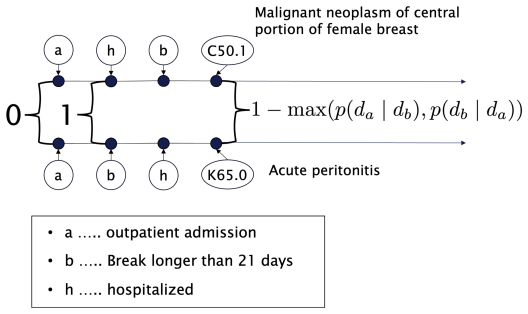
Dynamic Time Warping (DTW) applied to sequences of healthcare encounters, followed by hierarchical clustering to derive nine trajectory phenotypes that capture temporal patterns in care utilization.
If this is right
- Trajectory clusters add explanatory power to mortality prediction beyond conventional clinical, demographic, and socioeconomic covariates.
- All eight non-reference clusters exhibit substantially higher mortality odds than the low-utilization reference group.
- Long-term complex care pathways show mortality odds ratios up to 3.38.
- Shorter intense trajectories show a mortality odds ratio of 2.32.
- High-utilization complexity clusters are associated with significantly lower baseline anxiety scores.
Where Pith is reading between the lines
- Real-time tracking of a patient's position within these trajectory phenotypes could flag high-risk cases early for intervention.
- The link between intense care use and lower anxiety may reflect adaptation or selection that deserves targeted study.
- If the phenotypes replicate across other cancer types or health systems, they could feed directly into electronic health record risk tools.
- Trajectory data might help design trials that test whether changing care intensity alters survival in matched groups.
Load-bearing premise
The nine clusters identified represent stable and clinically meaningful phenotypes of care rather than artifacts of the patient cohort, encounter coding, or the choice of distance metric and linkage method.
What would settle it
Re-running the DTW and hierarchical clustering on an independent cohort of cancer patients yields clusters that do not improve mortality prediction after adjustment for standard covariates.
Figures


read the original abstract
Treatment of cancer involves heterogeneous, complex care pathways. The relationship between these longitudinal trajectories, baseline mental health, and prognostic outcomes remains poorly understood. We introduce an interpretable time-analysis framework leveraging these temporal dynamics, analyzing care patterns spanning up to 37 years for >8,000 patients. Using Dynamic Time Warping (DTW) and Hierarchical Clustering on sequence data of healthcare encounters, we identified nine distinct, robust trajectory phenotypes. We evaluated their prognostic utility by incorporating them into generalized linear models alongside conventional clinical, demographic, and socioeconomic covariates. The trajectory clusters significantly enhanced mortality prediction and maintained independent predictive significance. Compared to a low-utilization reference group (mortality 31.5%), all eight remaining clusters exhibited substantially higher mortality odds. We uncovered two primary high-risk trajectory patterns: long-term, complex care pathways reflecting chronic disease courses (up to 196 events; mortality OR up to 3.38, 95% CI 2.13-5.37), and shorter but intense trajectories indicating rapid progression (median 78 events; OR 2.32, 95% CI 1.82-2.97). Unexpectedly, the high-utilization complexity clusters were associated with significantly lower baseline anxiety scores, highlighting a divergent relationship between trajectory intensity, mortality risk, and initial psychological burden. These results demonstrate that incorporating temporal healthcare utilization data uncovers robust trajectory phenotypes capturing multidimensional prognostic information. This offers significant explanatory power beyond established static variables for refining risk stratification in precision oncology.
Editorial analysis
A structured set of objections, weighed in public.
Referee Report
Summary. The manuscript claims that Dynamic Time Warping combined with hierarchical clustering applied to longitudinal healthcare encounter sequences from >8,000 cancer patients over up to 37 years identifies nine distinct trajectory phenotypes. Incorporating these clusters as categorical predictors in generalized linear models alongside standard clinical, demographic, and socioeconomic covariates significantly enhances mortality prediction, with all non-reference clusters showing elevated mortality odds (reference group 31.5% mortality; high-risk ORs up to 3.38, 95% CI 2.13-5.37 for complex long-term pathways and 2.32, 95% CI 1.82-2.97 for intense short trajectories). The work also reports an inverse association between high-utilization clusters and baseline anxiety scores.
Significance. If the clusters prove stable and the predictive associations hold under proper validation, the framework could meaningfully advance precision oncology by demonstrating that temporal care-utilization patterns capture multidimensional prognostic information beyond static covariates. The large cohort size and extended follow-up period represent clear strengths that would support broader applicability in risk stratification once methodological gaps are closed.
major comments (3)
- [Methods] Methods section (clustering and GLM steps): Clustering via DTW and hierarchical clustering is described as performed on the full cohort prior to using the resulting nine phenotypes as predictors in the generalized linear models. This procedure risks data leakage, as cluster assignments can encode sample-specific encounter patterns; the reported independent predictive significance and enhancement of mortality prediction may therefore be inflated rather than reflecting generalizable signal.
- [Abstract and Results] Abstract and Results (mortality models): The abstract states that clusters 'significantly enhanced mortality prediction' and reports specific odds ratios with CIs, yet provides no details on the GLM specification (e.g., logistic vs. other link function), adjustment for right-censoring, competing risks, or time-to-event structure despite follow-up extending to 37 years. These omissions are load-bearing for the central prognostic claim.
- [Methods] Methods (cluster validation): No quantitative assessment of cluster stability, sensitivity to the free parameter (number of clusters), linkage method, or external/cross-validated performance is reported. Without such checks, the assertion that the nine phenotypes are 'robust' and clinically meaningful phenotypes rather than artifacts of the specific cohort or distance metric remains unsupported.
minor comments (2)
- [Abstract] The abstract uses the term 'robust trajectory phenotypes' without accompanying stability metrics or sensitivity analyses; these should be added to the main text for clarity.
- [Results] Notation for the nine clusters (e.g., how the reference low-utilization group is defined) could be made more explicit when first introduced in the results.
Simulated Author's Rebuttal
We thank the referee for their constructive comments, which have helped us identify areas to improve the rigor and clarity of our manuscript. We address each major comment below.
read point-by-point responses
-
Referee: [Methods] Methods section (clustering and GLM steps): Clustering via DTW and hierarchical clustering is described as performed on the full cohort prior to using the resulting nine phenotypes as predictors in the generalized linear models. This procedure risks data leakage, as cluster assignments can encode sample-specific encounter patterns; the reported independent predictive significance and enhancement of mortality prediction may therefore be inflated rather than reflecting generalizable signal.
Authors: We acknowledge this valid concern regarding potential data leakage. The clustering was indeed performed on the entire cohort's trajectories, which span the full follow-up period. To mitigate this and ensure the predictive value is not inflated, we will revise the analysis to perform clustering exclusively on training data within a cross-validation framework. The GLM will then be fit and evaluated on held-out test sets using the cluster labels derived only from training data. This change will be detailed in the Methods section of the revised manuscript. revision: yes
-
Referee: [Abstract and Results] Abstract and Results (mortality models): The abstract states that clusters 'significantly enhanced mortality prediction' and reports specific odds ratios with CIs, yet provides no details on the GLM specification (e.g., logistic vs. other link function), adjustment for right-censoring, competing risks, or time-to-event structure despite follow-up extending to 37 years. These omissions are load-bearing for the central prognostic claim.
Authors: We appreciate this observation. The mortality models in the manuscript are logistic regression GLMs with a logit link function, treating mortality as a binary outcome. We did not adjust for right-censoring or use time-to-event models in the primary analysis. In the revised manuscript, we will explicitly state the GLM details (logistic regression) in the Abstract and Methods. Additionally, we will include supplementary analyses using Cox proportional hazards models to account for time-to-event and censoring, providing a more robust evaluation of the prognostic utility of the trajectory clusters. revision: yes
-
Referee: [Methods] Methods (cluster validation): No quantitative assessment of cluster stability, sensitivity to the free parameter (number of clusters), linkage method, or external/cross-validated performance is reported. Without such checks, the assertion that the nine phenotypes are 'robust' and clinically meaningful phenotypes rather than artifacts of the specific cohort or distance metric remains unsupported.
Authors: We agree that formal validation metrics would strengthen the claim of robustness. While the manuscript notes the clusters as 'robust' based on the consistency of the hierarchical clustering dendrogram and interpretability of the resulting phenotypes, no quantitative measures were provided. In revision, we will add quantitative assessments including the silhouette score for cluster quality, bootstrap resampling to evaluate stability of assignments, and sensitivity analyses varying the number of clusters and linkage methods. These will be reported in the Methods and Results sections to support the selection of nine phenotypes. revision: yes
Circularity Check
No significant circularity in derivation chain
full rationale
The paper first applies Dynamic Time Warping and hierarchical clustering unsupervised to the full set of care-encounter sequences to obtain nine trajectory phenotypes. These phenotypes are subsequently entered as a categorical factor into generalized linear models for mortality alongside demographic, clinical, and socioeconomic covariates. Because the clustering step uses only the sequence data and does not incorporate the mortality outcome, the reported odds ratios, predictive enhancement, and independent significance are empirical associations obtained from the GLM fit rather than quantities that reduce by construction to the clustering inputs. No equation equates a model output to a fitted clustering parameter, no self-citation supplies a load-bearing uniqueness theorem, and no ansatz or renaming of a known result is invoked. The analysis is performed in-sample, but this is a methodological choice about validation, not a definitional circularity. The derivation chain therefore remains self-contained against the paper's own stated inputs.
Axiom & Free-Parameter Ledger
free parameters (1)
- number of clusters
axioms (2)
- domain assumption Dynamic Time Warping distances between care-event sequences reflect clinically comparable trajectories
- domain assumption Hierarchical clustering produces robust, non-overlapping phenotypes in this dataset
Reference graph
Works this paper leans on
-
[1]
Socioeconomic Disparities in Endometrial Cancer Survival in Germany: A Survival Analysis Using Population-Based Cancer Registry Data
Ahmed Bedir et al. “Socioeconomic Disparities in Endometrial Cancer Survival in Germany: A Survival Analysis Using Population-Based Cancer Registry Data”. In:Journal of Cancer Research and Clinical Oncology148.5 (May 2022), pp. 1087–1095.issn: 1432-1335.doi:10. 1007/s00432-021-03908-9. PMID:35064816
2022
-
[2]
Chongfa Chen et al. “Trends in 5-Year Cancer Survival Disparities by Race and Ethnicity in the US between 2002-2006 and 2015-2019”. In: Scientific Reports14.1 (Sept. 30, 2024), p. 22715.issn: 2045-2322.doi: 10.1038/s41598-024-73617-z. PMID:39349542
-
[3]
Jyoti Dixit et al. “Health-Related Quality of Life and Its Determi- nants among Cancer Patients: Evidence from 12,148 Patients of Indian Database”. In:Health and Quality of Life Outcomes22.1 (Mar. 13, 2024), p. 26.issn: 1477-7525.doi: 10.1186/s12955- 024- 02227- 0. PMID:38481231
-
[4]
Yufei Jiang et al. “Global Pattern and Trends of Colorectal Cancer Survival: A Systematic Review of Population-Based Registration Data”. In:Cancer Biology & Medicine19.2 (Sept. 6, 2021), pp. 175–186.issn: 2095-3941.doi: 10.20892/j.issn.2095- 3941.2020.0634 . PMID: 34486877
-
[5]
Ainhoa Ulibarri-Ochoa et al. “Differences in Quality of Life and Emo- tional Well-being in Breast, Colon, and Lung Cancer Patients During Outpatient Adjuvant Chemotherapy: A Longitudinal Study”. In:Can- cer Nursing46.2 (Mar. 2023–Apr. 1), E99–E109.issn: 1538-9804.doi: 10.1097/NCC.0000000000001070. PMID:35283472
-
[6]
Lasse Meyer et al. “A Stratification System for Breast Cancer Based on Basoluminal Tumor Cells and Spatial Tumor Architecture”. In: Cancer Cell43.9 (Sept. 8, 2025), 1637–1655.e9.issn: 1878-3686.doi: 10.1016/j.ccell.2025.06.019. PMID:40680742. 15
-
[7]
Paul Riviere et al. “Prostate-Specific Antigen Stratification for Predict- ing Advanced Prostate Cancer Events in Men Approaching Age Limits for Recommended Screening”. In:The Journal of Urology212.5 (Nov. 2024),pp.701–709.issn:1527-3792.doi: 10.1097/JU.0000000000004138. PMID:38968170
-
[8]
Brenda J. van Stigt et al. “Interval Cancer Risk after the Upper Age Limit of Screening Has Been Reached: Informing Risk Stratification in FIT-based Colorectal Cancer Screening”. In:International Journal of Cancer156.9 (May 1, 2025), pp. 1783–1790.issn: 1097-0215.doi: 10.1002/ijc.35294. PMID:39697047
-
[9]
Age Stratification and Prognostic Factor Analysis in Pediatric Differentiated Thyroid Cancer
Ophir Winder et al. “Age Stratification and Prognostic Factor Analysis in Pediatric Differentiated Thyroid Cancer”. In:The Laryngoscope 134.11 (Nov. 2024), pp. 4818–4825.issn: 1531-4995.doi: 10.1002/ lary.31592. PMID:39387721
2024
-
[10]
Joseph M. Unger et al. “Persistent Disparity: Socioeconomic Deprivation and Cancer Outcomes in Patients Treated in Clinical Trials”. In:Journal of Clinical Oncology39.12 (Apr. 20, 2021), pp. 1339–1348.issn: 0732- 183X, 1527-7755.doi:10.1200/JCO.20.02602
-
[11]
Yuan Hou et al. “Cardiac Risk Stratification in Cancer Patients: A Longitudinal Patient-Patient Network Analysis”. In:PLoS medicine 18.8 (Aug. 2021), e1003736.issn: 1549-1676.doi: 10.1371/journal. pmed.1003736. PMID:34339408
-
[12]
Changhee Lee et al. “Developing Machine Learning Algorithms for Dy- namic Estimation of Progression during Active Surveillance for Prostate Cancer”. In:NPJ digital medicine5.1 (Aug. 6, 2022), p. 110.issn: 2398- 6352.doi:10.1038/s41746-022-00659-w. PMID:35933478
-
[13]
Jeremy Mason et al. “Prediction of Metastatic Patterns in Bladder Cancer: Spatiotemporal Progression and Development of a Novel, Web- based Platform for Clinical Utility”. In:European Urology Open Science 32 (Oct. 2021), pp. 8–18.issn: 2666-1683.doi: 10.1016/j.euros. 2021.07.006. PMID:34667954
-
[14]
Olivier Morin et al. “An Artificial Intelligence Framework Integrating Longitudinal Electronic Health Records with Real-World Data Enables Continuous Pan-Cancer Prognostication”. In:Nature Cancer2.7 (July 2021), pp. 709–722.issn: 2662-1347.doi:10.1038/s43018-021-00236-
-
[15]
Hyojung Paik and Jimin Kim. “Condensed Trajectory of the Temporal Correlation of Diseases and Mortality Extracted from over 300,000 Patients in Hospitals”. In:PloS One16.10 (2021), e0257894.issn: 1932-6203.doi:10.1371/journal.pone.0257894. PMID:34610032. 16
-
[16]
The TRIPOD-LLM reporting guideline for studies using large language models
Davide Placido et al. “A Deep Learning Algorithm to Predict Risk of Pancreatic Cancer from Disease Trajectories”. In:Nature Medicine29.5 (May 2023), pp. 1113–1122.issn: 1546-170X.doi:10.1038/s41591- 023-02332-5. PMID:37156936
-
[17]
VMRA-MaR: An Asymmetry-Aware Temporal Framework for Longitudinal Breast Cancer Risk Prediction
Zijun Sun, Solveig Thrun, and Michael Kampffmeyer. “VMRA-MaR: An Asymmetry-Aware Temporal Framework for Longitudinal Breast Cancer Risk Prediction”. In:Medical Image Computing and Computer Assisted Intervention – MICCAI 2025. Ed. by James C. Gee et al. Cham: Springer Nature Switzerland, 2026, pp. 660–669.isbn: 978-3- 032-05182-0.doi:10.1007/978-3-032-05182-0_64
-
[18]
Visualising Disease Trajectories from Population-WideData
Jessica Xin Hjaltelin et al. “Visualising Disease Trajectories from Population-WideData”.In:Frontiers in Bioinformatics3(2023),p.1112113. issn:2673-7647.doi: 10.3389/fbinf.2023.1112113.PMID: 36844930
-
[19]
AlexanderGaigeretal.“TheCancerSurvivalIndex—APrognosticScore Integrating Psychosocial and Biological Factors in Patients Diagnosed with Cancer or Haematologic Malignancies”. In:Cancer Medicine11.18 (2022), pp. 3387–3396.issn: 2045-7634.doi:10.1002/cam4.4697
-
[20]
Refining Colorectal Cancer Classification and Clinical Stratification through a Single-Cell Atlas
Ateeq M. Khaliq et al. “Refining Colorectal Cancer Classification and Clinical Stratification through a Single-Cell Atlas”. In:Genome Biology 23.1 (May 11, 2022), p. 113.issn: 1474-760X.doi:10.1186/s13059- 022-02677-z. PMID:35538548
-
[21]
Xiaozhu Liu et al. “Risk Stratification Model for Predicting the Over- all Survival of Elderly Triple-Negative Breast Cancer Patients: A Population-Based Study”. In:Frontiers in Medicine8 (2021), p. 705515. issn: 2296-858X.doi: 10.3389/fmed.2021.705515. PMID: 34621757
-
[22]
Ruud F. W. Franssen et al. “The Association Between Treatment Interval and Survival in Patients With Colon or Rectal Cancer: A Systematic Review”. In:World Journal of Surgery45.9 (Sept. 2021), pp. 2924–2937.issn: 1432-2323.doi: 10.1007/s00268-021-06188-z. PMID:34175967
-
[23]
Kou Kou et al. “Treatment Intervals and Survival for Women Diagnosed with Early Breast Cancer in Queensland: The Breast Cancer Outcomes Study, a Population-Based Cohort Study”. In:The Medical Journal of Australia219.9 (Nov. 6, 2023), pp. 409–416.issn: 1326-5377.doi: 10.5694/mja2.52091. PMID:37667512
-
[24]
Tingting Wei et al. “Impact of the Diagnosis-to-Treatment Interval on the Survival of Patients with Papillary Thyroid Cancer”. In:Journal of Investigative Surgery: The Official Journal of the Academy of Surgical Research38.1 (Dec. 2025), p. 2456463.issn: 1521-0553.doi: 10.1080/ 08941939.2025.2456463. PMID:39956540. 17
-
[25]
Alexia Giannoula et al. “Identifying Temporal Patterns in Patient Disease Trajectories Using Dynamic Time Warping: A Population- Based Study”. In:Scientific Reports8.1 (Mar. 9, 2018), p. 4216.issn: 2045-2322.doi:10.1038/s41598-018-22578-1
-
[26]
Alexia Giannoula et al. “Exploring Long-Term Breast Cancer Survivors’ Care Trajectories Using Dynamic Time Warping-Based Unsupervised Clustering”. In:Journal of the American Medical Informatics Associa- tion: JAMIA31.4 (Apr. 3, 2024), pp. 820–831.issn: 1527-974X.doi: 10.1093/jamia/ocad251. PMID:38193340
-
[27]
Socioeconomic Inequalities in Cervical Cancer Mortality in Canada, 1990 and 2019: A Trend Analysis
M. Fay, M. Hu, and M. Hajizadeh. “Socioeconomic Inequalities in Cervical Cancer Mortality in Canada, 1990 and 2019: A Trend Analysis”. In:Public Health227 (Feb. 2024), pp. 210–218.issn: 1476-5616.doi: 10.1016/j.puhe.2023.12.014. PMID:38241902
-
[28]
Thomas P. Lawler et al. “Area-Level Socioeconomic Status Is Associated with Colorectal Cancer Screening, Incidence and Mortality in the US: A Systematic Review and Meta-Analysis”. In:Social Science & Medicine (1982)381 (Sept. 2025), p. 118212.issn: 1873-5347.doi: 10.1016/j. socscimed.2025.118212. PMID:40472644
work page doi:10.1016/j 1982
-
[29]
João L. Marôco, Mahdiyeh M. Manafi, and Laura L. Hayman. “Race and Ethnicity Disparities in Cardiovascular and Cancer Mortality: The Role of Socioeconomic Status-a Systematic Review and Meta-analysis”. In:Journal of Racial and Ethnic Health Disparities12.1 (Feb. 2025), pp. 285–297.issn: 2196-8837.doi: 10.1007/s40615- 023- 01872- 3. PMID:38038904
-
[30]
Fengge Wang et al. “Social Support, Social Strain, Stressful Life Events and Mortality Among Postmenopausal Women With Breast Cancer”. In:Psycho-Oncology33.11 (Nov. 2024), e70013.issn: 1099-1611.doi: 10.1002/pon.70013. PMID:39520665
-
[31]
Rong Zhao, Hulin Liu, and Jinnan Gao. “Side Effects of Endocrine Therapy Are Associated With Depression and Anxiety in Breast Cancer Patients Accepting Endocrine Therapy: A Cross-Sectional Study in China”. In:Frontiers in Psychology13 (2022), p. 905459.issn: 1664- 1078.doi:10.3389/fpsyg.2022.905459. PMID:35615194
-
[32]
Peng Ji et al. “Association between Socioeconomic Factors at Diagnosis and Survival in Breast Cancer: A Population-based Study”. In:Cancer Medicine9.5 (Mar. 2020), pp. 1922–1936.issn: 2045-7634, 2045-7634. doi:10.1002/cam4.2842
-
[33]
Socio-Economic Inequalities in Lung Cancer Outcomes: An Overview of Systematic Reviews
Daniel Redondo-Sánchez et al. “Socio-Economic Inequalities in Lung Cancer Outcomes: An Overview of Systematic Reviews”. In:Can- cers14.2 (Jan. 13, 2022), p. 398.issn: 2072-6694.doi: 10 . 3390 / cancers14020398. 18
2022
-
[34]
The Impact of COVID-19 on Cancer Care of Outpatients with Low Socioeconomic Status
E.L. Zeilinger et al. “The Impact of COVID-19 on Cancer Care of Outpatients with Low Socioeconomic Status”. In:International Journal of Cancer151.1 (2022), pp. 77–82.issn: 1097-0215.doi: 10.1002/ijc. 33960
work page doi:10.1002/ijc 2022
-
[35]
Shuowen Fang et al. “Self-Rated Health and Health-Related Quality of Life among Cancer Patients: The Serial Multiple Mediation of Anxiety and Depression”. In:BMC psychology12.1 (July 30, 2024), p. 415.issn: 2050-7283.doi:10.1186/s40359-024-01919-y. PMID:39080782
-
[36]
Sookyung Jeong and Eun Jeong Kim. “Effect of Depression and Em- powerment on Medication Adherence in Patients with Breast Cancer: A Descriptive Survey”. In:BMC nursing24.1 (Jan. 14, 2025), p. 47.issn: 1472-6955.doi:10.1186/s12912-024-02680-8. PMID:39806337
-
[37]
The Role of Coping and Posttraumatic Stress in Fostering Posttraumatic Growth and Quality of Life Among Women with Breast Cancer
Amy R. Senger et al. “The Role of Coping and Posttraumatic Stress in Fostering Posttraumatic Growth and Quality of Life Among Women with Breast Cancer”. In:Journal of Clinical Psychology in Medical Settings31.2 (June 2024), pp. 368–378.issn: 1573-3572.doi:10.1007/ s10880-023-09977-x. PMID:37803095
2024
-
[38]
The Mediating Role of Depression in the Association Between Death Anxiety and Quality of Life in Elderly Prostate Cancer Patients
Haifeng Song, Fengyi He, and Xiaoling Zhang. “The Mediating Role of Depression in the Association Between Death Anxiety and Quality of Life in Elderly Prostate Cancer Patients”. In:Actas Espanolas De Psiquiatria53.4 (Aug. 2025), pp. 791–801.issn: 1578-2735.doi: 10. 62641/aep.v53i4.1921. PMID:40791044
2025
-
[39]
H. Sakoe and S. Chiba. “Dynamic Programming Algorithm Optimiza- tion for Spoken Word Recognition”. In:IEEE Transactions on Acoustics, Speech, and Signal Processing26.1 (Feb. 1978), pp. 43–49.issn: 0096- 3518.doi:10.1109/TASSP.1978.1163055
-
[40]
Noah Forrest et al. “A Dynamic Time Warping Extension to Consensus Weight-Based Cachexia Criteria Improves Prediction of Cancer Patient Outcomes”. In:JCSM communications8.1 (2025), e107.issn: 2996-1394. doi:10.1002/rco2.107. PMID:40151817
-
[41]
IdentifyingCommonDiseaseTrajectoriesofAlzheimer’s Disease with Electronic Health Records
MingzhouFuetal.“IdentifyingCommonDiseaseTrajectoriesofAlzheimer’s Disease with Electronic Health Records”. In:EBioMedicine118 (Aug. 2025), p. 105831.issn: 2352-3964.doi: 10 . 1016 / j . ebiom . 2025 . 105831. PMID:40592257
2025
-
[42]
Analyzing Patient Trajectories With Artificial Intelligence
Ahmed Allam et al. “Analyzing Patient Trajectories With Artificial Intelligence”. In:Journal of Medical Internet Research23.12 (Dec. 3, 2021), e29812.issn: 1438-8871.doi:10.2196/29812
-
[43]
“Dynamic Time Warping”. In: Meinard Müller.Information Retrieval for Music and Motion. Berlin, Heidelberg: Springer Berlin Heidelberg, 2007, pp. 69–84.isbn: 978-3-540-74048-3.doi:10.1007/978-3-540- 74048-3_4. 19
-
[44]
Temporal Representation of Care Trajectories of Cancer Patients Using Data from a Regional Information System: An Application in Breast Cancer
Gautier Defossez et al. “Temporal Representation of Care Trajectories of Cancer Patients Using Data from a Regional Information System: An Application in Breast Cancer”. In:BMC Medical Informatics and Decision Making14.1 (Dec. 2014), p. 24.issn: 1472-6947.doi: 10 . 1186/1472-6947-14-24
2014
-
[45]
Fiona C. Ingleby et al. “An Investigation of Cancer Survival Inequalities Associated with Individual-Level Socio-Economic Status, Area-Level Deprivation, and Contextual Effects, in a Cancer Patient Cohort in England and Wales”. In:BMC Public Health22.1 (Dec. 2022), p. 90. issn: 1471-2458.doi:10.1186/s12889-022-12525-1
-
[46]
Using Sequences of Life-Events to Predict Hu- man Lives
Germans Savcisens et al. “Using Sequences of Life-Events to Predict Hu- man Lives”. In:Nature Computational Science4.1 (Jan. 2024), pp. 43– 56.issn: 2662-8457.doi:10.1038/s43588-023-00573-5. 20 A Supplementary Information Figure S1: Heatmap displaying the prevalence of various diagnoses (ICD codes) across 9 clusters. Clusters 4 and 5 exhibit the most sign...
discussion (0)
Sign in with ORCID, Apple, or X to comment. Anyone can read and Pith papers without signing in.