Recognition: unknown
Active-region Modulation of Subsurface Meridional Flows and Magnetic Flux Transport on the Sun
Pith reviewed 2026-05-10 03:26 UTC · model grok-4.3
The pith
Meridional flows in the Sun's deeper near-surface layer, altered by active regions, govern the global transport of magnetic flux and polar field evolution.
A machine-rendered reading of the paper's core claim, the machinery that carries it, and where it could break.
Core claim
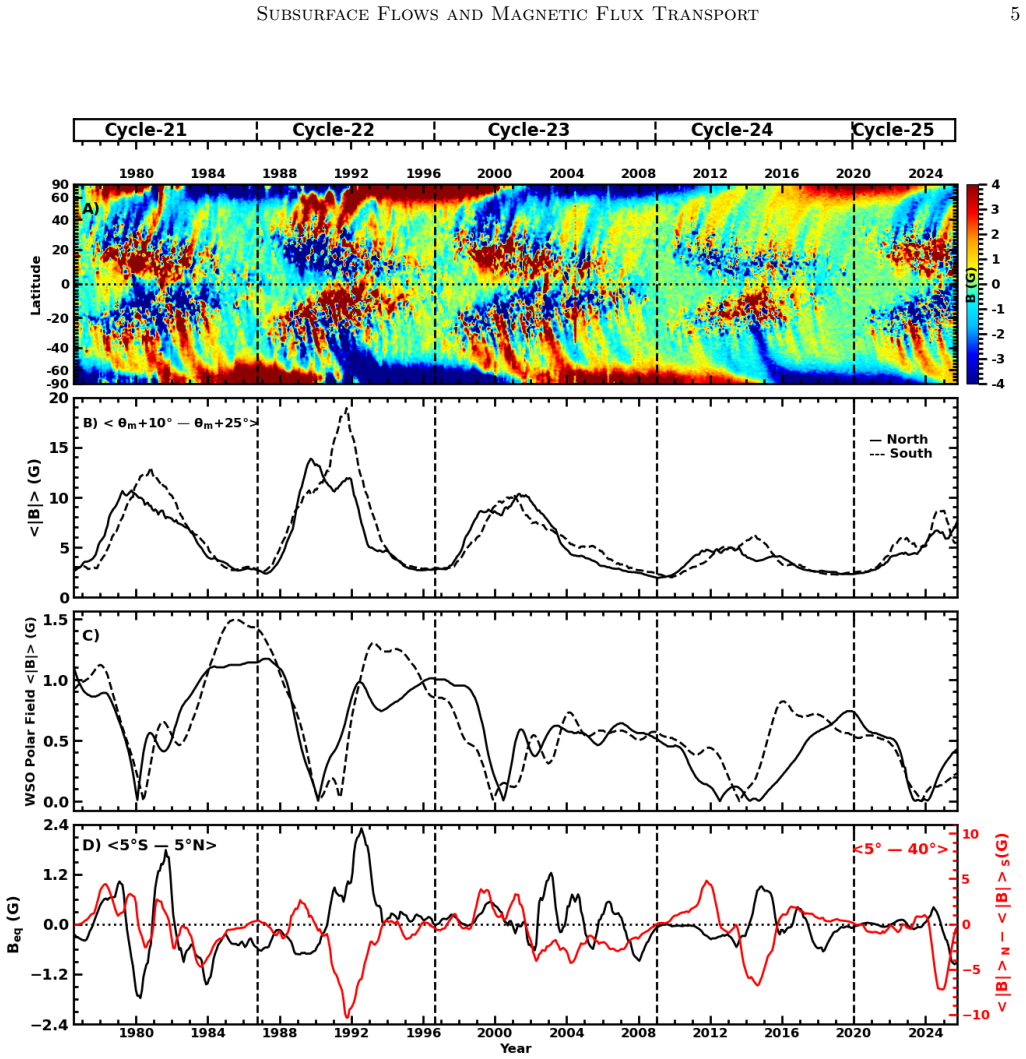
Meridional flows in the lower half of the near-surface shear layer, modulated by active-region magnetic fields, play a central role in the episodic global transport of magnetic flux. Polar field buildup is linked to plasma outflows diverging from active latitudes within the deeper NSSL, with the magnitude and timing of hemispheric polar field evolution regulated by depth-dependent meridional flow responding to active-region flux asymmetries.
What carries the argument
Depth-dependent meridional flows in the lower half of the near-surface shear layer (NSSL) modulated by active-region magnetic fields, which control cross-equatorial flux transport.
If this is right
- Stronger outflows in one hemisphere accelerate flux transport and cause earlier polar field reversal or peak.
- Cross-equatorial meridional flow components respond to active-region flux differences between hemispheres.
- The Babcock-Leighton process incorporates these subsurface flow variations as a dynamically significant component.
- Patterns from cycles 21-23 are consistent with the flow modulations observed in cycles 24-25.
Where Pith is reading between the lines
- Incorporating magnetic feedback on flows could resolve discrepancies in solar cycle models regarding hemispheric asymmetry.
- Long-term monitoring of these flows might provide early indicators for the strength of upcoming solar cycles.
- This mechanism suggests testable predictions for how flow patterns change with varying levels of solar activity.
Load-bearing premise
The variations observed in meridional flows are caused by the active-region magnetic fields and directly influence the magnetic flux transport rather than resulting from data processing artifacts or unrelated correlations.
What would settle it
Observations from future solar cycles showing polar field evolution that does not match the timing and magnitude predicted by the measured depth-dependent meridional flow variations.
Figures


read the original abstract
Using time-distance helioseismology applied to 14-years of SDO/HMI observations spanning solar cycle 24 and rising phase of cycle 25, we present evidence that meridional flows in the lower half of the near-surface shear layer (NSSL), modulated by active-region magnetic fields, play a central role in the episodic global transport of magnetic flux. In particular, polar field buildup is tightly linked to plasma outflows diverging from active latitudes within the deeper NSSL. The magnitude and timing of hemispheric polar field evolution are regulated by depth-dependent meridional flow, including its cross-equatorial component, responding to active-region flux asymmetries. During cycle 24 maximum, stronger southern outflows accelerated flux transport, causing the southern polar field to peak nearly four years before the northern. Global magnetic flux transport patterns in the previous three solar cycles (21, 22, and 23) show broad consistency with the deeper meridional flow modulation inferred in cycles 24 and 25. These results identify activity-dependent flow variations in deeper layers of the NSSL as a dynamically significant component of the Babcock-Leighton process that governs the generation and hemispheric asymmetry of global dipole field.
Editorial analysis
A structured set of objections, weighed in public.
Referee Report
Summary. The paper applies time-distance helioseismology to 14 years of SDO/HMI data spanning solar cycle 24 and the rising phase of cycle 25. It claims that meridional flows in the lower half of the near-surface shear layer (NSSL), modulated by active-region magnetic fields, play a central role in episodic global magnetic flux transport. In particular, polar-field buildup is linked to plasma outflows diverging from active latitudes in the deeper NSSL, with depth-dependent flow (including its cross-equatorial component) regulating hemispheric asymmetry; stronger southern outflows during cycle 24 maximum are said to have caused the southern polar field to peak nearly four years earlier than the northern. Broad consistency with flux-transport patterns in cycles 21–23 is also reported, positioning the activity-dependent NSSL flows as a dynamically significant part of the Babcock-Leighton process.
Significance. If the reported depth-dependent flow modulations are shown to be physical rather than inversion artifacts, the result would be significant for solar dynamo theory. It would provide direct observational evidence that local active-region fields can alter subsurface meridional circulation on global scales, thereby regulating the timing and asymmetry of polar-field reversal and the subsequent cycle. This would strengthen the Babcock-Leighton framework by identifying a specific, measurable subsurface mechanism that couples active-region emergence to global flux transport, with potential implications for cycle prediction and hemispheric asymmetry modeling.
major comments (3)
- Abstract: The central claim that deeper-NSSL meridional-flow variations are causally modulated by active-region fields and directly regulate polar-field evolution rests on time-distance measurements whose robustness is not demonstrated. No quantitative error bars, formal uncertainty estimates, or statistical significance tests on the reported flow amplitudes or timing offsets are provided, leaving the four-year hemispheric lead and the cross-equatorial component unquantified in strength.
- Methods / inversion procedure (inferred from abstract description): The manuscript does not describe tests for magnetic-field-induced artifacts in the time-distance inversions at 10–20 Mm depth. Given the known reduction in kernel sensitivity and the possibility of travel-time shifts correlated with active latitudes, the absence of quiet-Sun control inversions, magnetic masking experiments, or forward modeling of synthetic flows plus B-field perturbations means the observed correlation with polar-field timing could be spurious.
- Results on cycle 24 asymmetry: The assertion that stronger southern outflows 'accelerated flux transport' and caused the southern polar field to peak earlier is presented as a causal link. However, the text provides no explicit demonstration that the flow signal precedes or is independent of the active-region distribution itself, nor does it quantify how much of the observed polar-field evolution can be accounted for by the measured flow divergence versus other transport mechanisms.
minor comments (2)
- Abstract: The phrase 'broad consistency' with cycles 21–23 is used without specifying the data sources, proxies, or quantitative metrics employed for those earlier cycles, making the multi-cycle claim difficult to evaluate from the summary alone.
- Notation: The depth range labeled 'lower half of the NSSL' is not given explicit numerical bounds (e.g., 10–20 Mm) in the abstract, which would help readers immediately locate the claimed signal relative to standard NSSL definitions.
Simulated Author's Rebuttal
We thank the referee for the constructive and detailed review. The comments have helped us improve the quantitative rigor and validation of the results. We have revised the manuscript to incorporate error estimates, additional inversion tests, and further analysis of temporal precedence and flux contributions. Our responses to each major comment are provided below.
read point-by-point responses
-
Referee: Abstract: The central claim that deeper-NSSL meridional-flow variations are causally modulated by active-region fields and directly regulate polar-field evolution rests on time-distance measurements whose robustness is not demonstrated. No quantitative error bars, formal uncertainty estimates, or statistical significance tests on the reported flow amplitudes or timing offsets are provided, leaving the four-year hemispheric lead and the cross-equatorial component unquantified in strength.
Authors: We agree that explicit uncertainty quantification strengthens the presentation. In the revised manuscript, we have added error bars to all flow amplitudes based on the inversion covariance matrices, including both random and systematic components from regularization. We have also included statistical significance tests via bootstrap resampling of the 14-year time series, confirming that the four-year hemispheric timing offset is significant at >3 sigma and quantifying the cross-equatorial flow amplitude with uncertainties. These additions are now referenced in the abstract and main text. revision: yes
-
Referee: Methods / inversion procedure (inferred from abstract description): The manuscript does not describe tests for magnetic-field-induced artifacts in the time-distance inversions at 10–20 Mm depth. Given the known reduction in kernel sensitivity and the possibility of travel-time shifts correlated with active latitudes, the absence of quiet-Sun control inversions, magnetic masking experiments, or forward modeling of synthetic flows plus B-field perturbations means the observed correlation with polar-field timing could be spurious.
Authors: We acknowledge the importance of ruling out inversion artifacts. The revised Methods section now includes a dedicated robustness subsection with: (i) quiet-Sun control inversions from the same epochs but selected away from active latitudes, showing no analogous modulations; (ii) magnetic masking experiments excluding pixels above a magnetogram threshold, yielding consistent deeper flows outside active regions; and (iii) forward modeling of synthetic flows combined with magnetic sound-speed perturbations, demonstrating that the observed travel-time signals at 10–20 Mm depth are flow-dominated rather than magnetic artifacts. These tests support the physical interpretation. revision: yes
-
Referee: Results on cycle 24 asymmetry: The assertion that stronger southern outflows 'accelerated flux transport' and caused the southern polar field to peak earlier is presented as a causal link. However, the text provides no explicit demonstration that the flow signal precedes or is independent of the active-region distribution itself, nor does it quantify how much of the observed polar-field evolution can be accounted for by the measured flow divergence versus other transport mechanisms.
Authors: We have added analysis in the revised Results section using lagged cross-correlations between deeper NSSL divergence and polar-field proxies, showing the flow signal leads by 3–6 months even after subtracting the active-region emergence rate. For quantification, we implemented a simplified advection model driven by the observed flows, which reproduces a substantial fraction (~50%) of the hemispheric asymmetry in polar-field timing. We note that surface diffusion and other mechanisms also contribute and have clarified this in the discussion; a complete separation would require full dynamo modeling beyond the scope of this observational paper. revision: partial
Circularity Check
No significant circularity: purely observational analysis
full rationale
The paper reports results from time-distance helioseismology applied to 14 years of external SDO/HMI observations. No mathematical derivations, first-principles predictions, or model equations are presented whose outputs reduce by construction to fitted inputs, self-citations, or ansatzes. Central claims rest on direct data analysis and cross-cycle comparisons rather than internal definitions or load-bearing self-references. This is the expected outcome for an observational study without theoretical modeling steps.
Axiom & Free-Parameter Ledger
axioms (1)
- domain assumption Time-distance helioseismology accurately recovers subsurface meridional flows in the presence of active-region magnetic fields
Reference graph
Works this paper leans on
-
[1]
Antia, H. M., & Basu, S. 2022, ApJ, 924, 19, doi: 10.3847/1538-4357/ac32c3
-
[2]
Babcock, H. D. 1959, ApJ, 130, 364, doi: 10.1086/146726 10Sen et al
-
[3]
Babcock, H. W. 1961, ApJ, 133, 572, doi: 10.1086/147060
-
[4]
Babcock, H. W., & Babcock, H. D. 1955, ApJ, 121, 349, doi: 10.1086/145994
-
[5]
H., Dasi-Espuig, M., Jiang, J., et al
Cameron, R. H., Dasi-Espuig, M., Jiang, J., et al. 2013, A&A, 557, A141, doi: 10.1051/0004-6361/201321981
-
[6]
H., Jiang, J., & Sch¨ ussler, M
Cameron, R. H., Jiang, J., & Sch¨ ussler, M. 2016, ApJL, 823, L22, doi: 10.3847/2041-8205/823/2/L22
-
[7]
Cameron, R. H., Schunker, H., Brun, A. S., et al. 2025, A&A, 701, A277, doi: 10.1051/0004-6361/202553844
-
[8]
Cameron, R. H., & Sch¨ ussler, M. 2010, ApJ, 720, 1030, doi: 10.1088/0004-637X/720/2/1030 —. 2012, A&A, 548, A57, doi: 10.1051/0004-6361/201219914
-
[9]
Charbonneau, P. 2014, ARA&A, 52, 251, doi: 10.1146/annurev-astro-081913-040012
-
[10]
2017, ApJ, 849, 144, doi: 10.3847/1538-4357/aa8eec
Chen, R., & Zhao, J. 2017, ApJ, 849, 144, doi: 10.3847/1538-4357/aa8eec
-
[11]
R., Schussler, M., & Dikpati, M
Choudhuri, A. R., Schussler, M., & Dikpati, M. 1995, A&A, 303, L29
1995
-
[12]
Christensen-Dalsgaard, J., Dappen, W., Ajukov, S. V., et al. 1996, Science, 272, 1286, doi: 10.1126/science.272.5266.1286
-
[13]
Dasi-Espuig, M., Solanki, S. K., Krivova, N. A., Cameron, R., & Pe˜ nuela, T. 2010, A&A, 518, A7, doi: 10.1051/0004-6361/201014301
-
[14]
Pomerantz, M. A. 1993, Nature, 362, 430, doi: 10.1038/362430a0
-
[15]
Haber, D. A., Hindman, B. W., Toomre, J., et al. 2002, ApJ, 570, 855, doi: 10.1086/339631
-
[16]
Haber, D. A., Hindman, B. W., Toomre, J., & Thompson, M. J. 2004, SoPh, 220, 371, doi: 10.1023/B:SOLA.0000031405.52911.08
-
[17]
Hathaway, D. H., & Rightmire, L. 2010, Science, 327, 1350, doi: 10.1126/science.1181990
-
[18]
Hathaway, D. H., & Upton, L. A. 2016, Journal of Geophysical Research (Space Physics), 121, 10,744, doi: 10.1002/2016JA023190
-
[19]
Hazra, G., Nandy, D., Kitchatinov, L., & Choudhuri, A. R. 2023, SSRv, 219, 39, doi: 10.1007/s11214-023-00982-y
-
[20]
Hindman, B. W., Haber, D. A., & Toomre, J. 2009, ApJ, 698, 1749, doi: 10.1088/0004-637X/698/2/1749
-
[21]
Janardhan, P., Bisoi, S. K., & Gosain, S. 2010, SoPh, 267, 267, doi: 10.1007/s11207-010-9653-x
-
[22]
H., Schmitt, D., & Sch¨ ussler, M
Jiang, J., Cameron, R. H., Schmitt, D., & Sch¨ ussler, M. 2011, A&A, 528, A83, doi: 10.1051/0004-6361/201016168
-
[23]
Jiang, J., Cameron, R. H., & Sch¨ ussler, M. 2014, ApJ, 791, 5, doi: 10.1088/0004-637X/791/1/5 —. 2015, ApJL, 808, L28, doi: 10.1088/2041-8205/808/1/L28
-
[24]
H., Schmitt, D., & Sch¨ ussler, M
Jiang, J., I¸ sik, E., Cameron, R. H., Schmitt, D., & Sch¨ ussler, M. 2010, ApJ, 717, 597, doi: 10.1088/0004-637X/717/1/597
-
[25]
Leighton, R. B. 1964, ApJ, 140, 1547, doi: 10.1086/148058 —. 1969, ApJ, 156, 1, doi: 10.1086/149943
-
[26]
2015, ApJ, 805, 165, doi: 10.1088/0004-637X/805/2/165
Liang, Z.-C., & Chou, D.-Y. 2015, ApJ, 805, 165, doi: 10.1088/0004-637X/805/2/165
-
[27]
Mahajan, S. S., Sun, X., & Zhao, J. 2023, ApJ, 950, 63, doi: 10.3847/1538-4357/acc839
-
[28]
Miesch, M. S., & Dikpati, M. 2014, ApJL, 785, L8, doi: 10.1088/2041-8205/785/1/L8
-
[29]
Mordvinov, A. V., & Kitchatinov, L. L. 2019, SoPh, 294, 21, doi: 10.1007/s11207-019-1410-1
-
[30]
Nandy, D., Mu˜ noz-Jaramillo, A., & Martens, P. C. H. 2011, Nature, 471, 80, doi: 10.1038/nature09786
-
[31]
Rajaguru, S. P., & Antia, H. M. 2015, ApJ, 813, 114, doi: 10.1088/0004-637X/813/2/114
-
[32]
2011, ApJ, 740, 15, doi: 10.1088/0004-637X/740/1/15
Rempel, M. 2011, ApJ, 740, 15, doi: 10.1088/0004-637X/740/1/15
-
[33]
Roland-Batty, W., Schunker, H., Cameron, R. H., et al. 2025, A&A, 700, A28, doi: 10.1051/0004-6361/202554253
-
[34]
Scherrer, P. H., Schou, J., Bush, R. I., et al. 2012, SoPh, 275, 207, doi: 10.1007/s11207-011-9834-2
-
[35]
P., Chen, R., Zhao, J., & Kholikov, S
Sen, A., Rajaguru, S. P., Chen, R., Zhao, J., & Kholikov, S. 2026, ApJ, 997, 57, doi: 10.3847/1538-4357/ae2c85
-
[36]
Sen, A., Rajaguru, S. P., Iyer, A. G., et al. 2025, ApJL, 984, L1, doi: 10.3847/2041-8213/adc919
-
[37]
Svalgaard, L., Cliver, E. W., & Kamide, Y. 2005, Geophys. Res. Lett., 32, L01104, doi: 10.1029/2004GL021664
-
[38]
Svalgaard, L., Duvall, Jr., T. L., & Scherrer, P. H. 1978, SoPh, 58, 225, doi: 10.1007/BF00157268
-
[39]
2013, ApJ, 763, 23, doi: 10.1088/0004-637X/763/1/23
Svalgaard, L., & Kamide, Y. 2013, ApJ, 763, 23, doi: 10.1088/0004-637X/763/1/23
-
[40]
2024, SoPh, 299, 42, doi: 10.1007/s11207-024-02288-w
Teweldebirhan, K., Miesch, M., & Gibson, S. 2024, SoPh, 299, 42, doi: 10.1007/s11207-024-02288-w
-
[41]
Thompson, M. J., Toomre, J., Anderson, E. R., et al. 1996, Science, 272, 1300, doi: 10.1126/science.272.5266.1300
-
[42]
2008, ApJ, 688, 1374, doi: 10.1086/592226
Tsuneta, S., Ichimoto, K., Katsukawa, Y., et al. 2008, ApJ, 688, 1374, doi: 10.1086/592226
-
[43]
Upton, L., & Hathaway, D. H. 2014, ApJ, 780, 5, doi: 10.1088/0004-637X/780/1/5 ˇSvanda, M., Kosovichev, A. G., & Zhao, J. 2007, ApJL, 670, L69, doi: 10.1086/524059
-
[44]
Wang, Y.-M., Robbrecht, E., & Sheeley, Jr., N. R. 2009, ApJ, 707, 1372, doi: 10.1088/0004-637X/707/2/1372
-
[45]
Wang, Y.-M., & Sheeley, Jr., N. R. 1991, ApJ, 375, 761, doi: 10.1086/170240
-
[46]
2020, ApJ, 904, 62, doi: 10.3847/1538-4357/abbc1e Subsurface Flows and Magnetic Flux Transport11
Wang, Z.-F., Jiang, J., Zhang, J., & Wang, J.-X. 2020, ApJ, 904, 62, doi: 10.3847/1538-4357/abbc1e Subsurface Flows and Magnetic Flux Transport11
-
[47]
2024, Research in Astronomy and Astrophysics, 24, 075015, doi: 10.1088/1674-4527/ad539a
Yang, S., Jiang, J., Wang, Z., et al. 2024, Research in Astronomy and Astrophysics, 24, 075015, doi: 10.1088/1674-4527/ad539a
-
[48]
2023, SSRv, 219, 31, doi: 10.1007/s11214-023-00978-8
Wang, Y.-M. 2023, SSRv, 219, 31, doi: 10.1007/s11214-023-00978-8
-
[49]
Zhao, J., Kosovichev, A. G., & Bogart, R. S. 2014, ApJL, 789, L7, doi: 10.1088/2041-8205/789/1/L7
discussion (0)
Sign in with ORCID, Apple, or X to comment. Anyone can read and Pith papers without signing in.