Recognition: unknown
From Awareness to Intent: Mitigating Silent Driving System Failures through Prospective Situation Awareness Enhancing Interfaces
Pith reviewed 2026-05-10 03:39 UTC · model grok-4.3
The pith
Situational awareness moderates how prospective awareness interfaces improve takeover performance in silent vehicle automation failures.
A machine-rendered reading of the paper's core claim, the machinery that carries it, and where it could break.
Core claim
Situational awareness serves as an important moderating factor through which PSAE interfaces improve takeover performance. Providing perceptual cues was most effective in enhancing SA, while communicating system intent was superior for building trust. A potential correlate of SA appears in neuroactivity.
What carries the argument
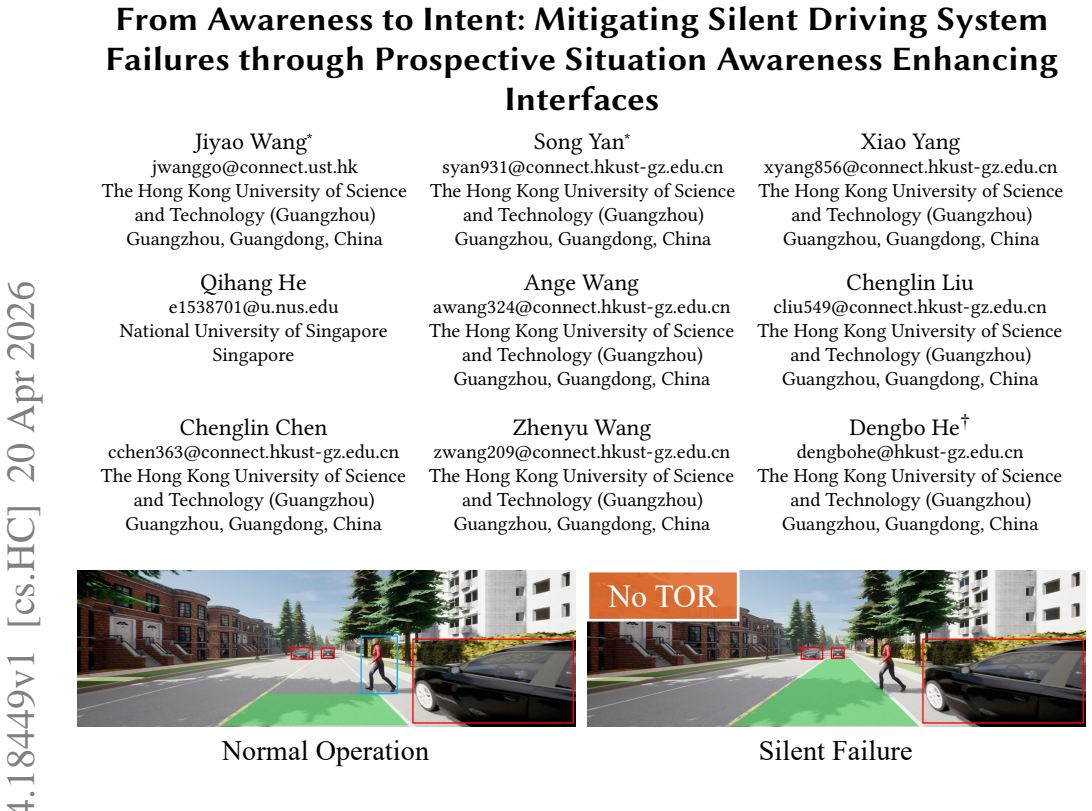
Prospective Situation Awareness Enhancing (PSAE) interfaces via augmented reality head-up display that raise situational awareness to moderate driver takeover in silent failures.
If this is right
- Perceptual cues delivered through the interface most reliably raise situational awareness.
- Sharing system intent through the interface builds greater trust than perceptual cues alone.
- Neuroactivity patterns may track situational awareness levels during these events.
- Transparency-oriented designs can help drivers manage silent automation failures without explicit alerts.
Where Pith is reading between the lines
- Designers could prioritize perceptual over intent-based elements when the main goal is faster hazard response.
- The same interface logic might apply to other supervisory roles where automation can fail without warning.
- Real-road validation would show whether the simulator effects shrink or hold under higher stakes.
Load-bearing premise
The simulator setup, participant group, and specific AR interface designs produce effects that carry over to real-world driving with production vehicles and varied driver populations.
What would settle it
A follow-up experiment in actual vehicles that finds no takeover improvement from the interfaces once situational awareness levels are held constant would undermine the claimed moderation.
Figures


read the original abstract
Silent automation failures, where a system fails to detect a hazard without warning, pose a critical safety challenge for partially automated vehicles. While research has mostly focused on takeover requests, how to support a driver in silent failure remains underexplored. We conducted a multi-modal driving simulator study with 48 participants to investigate how different Prospective Situation Awareness Enhancement (PSAE) interfaces, delivered via augmented reality head-up display, affect takeover performance. By integrating behavioral, subjective psychological, and physiological data, our analysis suggests that situational awareness (SA) serves as an important moderating factor through which PSAE interfaces improve takeover performance. Further, we found that providing perceptual cues was most effective in enhancing SA, while communicating system intent was superior for building trust. Finally, we identified a potential correlate of SA in the neuroactivity. Overall, this paper contributes to understanding how transparency-oriented interfaces may support drivers and provides design insights into HMI design for silent failures.
Editorial analysis
A structured set of objections, weighed in public.
Referee Report
Summary. The manuscript reports results from a 48-participant driving-simulator study examining Prospective Situation Awareness Enhancement (PSAE) interfaces delivered via augmented-reality head-up display for silent automation failures in partially automated vehicles. Integrating behavioral takeover metrics, subjective SA and trust ratings, and physiological measures, the authors conclude that situational awareness functions as an important moderating factor through which the interfaces improve takeover performance; perceptual cues are most effective for SA while intent communication best supports trust, and a neurophysiological correlate of SA is identified.
Significance. If the mediation pathway is statistically confirmed, the work would supply concrete, multi-modal evidence linking interface transparency features to driver awareness and performance in an underexplored failure mode, offering actionable HMI design guidance for automated-vehicle safety.
major comments (3)
- [Abstract / Results] Abstract and Results sections: the claim that SA 'serves as an important moderating factor through which PSAE interfaces improve takeover performance' is not supported by any described formal mediation analysis (Baron-Kenny steps, bootstrapped indirect effects, or SEM). With n=48 and multiple conditions, separate main-effect tests or correlations alone cannot establish that SA change statistically accounts for performance change rather than both being parallel outcomes of the interfaces.
- [Methods / Results] Methods and Results: the manuscript provides no information on the statistical models used (e.g., repeated-measures ANOVA, mixed-effects regression), effect sizes, a priori power analysis, exclusion criteria, or correction for multiple comparisons. These omissions prevent evaluation of whether the reported effects are robust given the sample size and the integration of behavioral, subjective, and physiological dependent variables.
- [Discussion] Discussion: the generalization from simulator findings to real-world production vehicles and diverse driver populations is asserted without supporting evidence or acknowledged limitations on ecological validity, yet this assumption underpins the design-insight claims for silent-failure mitigation.
minor comments (2)
- [Abstract] The abstract states that 'providing perceptual cues was most effective' and 'communicating system intent was superior' but does not indicate whether these comparisons were pre-planned or post-hoc, nor the exact statistical contrasts used.
- [Figures / Tables] Figure and table captions should explicitly state the dependent variables, conditions, and sample sizes so that readers can interpret the multi-modal results without returning to the text.
Simulated Author's Rebuttal
We thank the referee for their constructive comments on our manuscript. We have carefully considered each point and provide point-by-point responses below, indicating where revisions will be made to address the concerns.
read point-by-point responses
-
Referee: [Abstract / Results] Abstract and Results sections: the claim that SA 'serves as an important moderating factor through which PSAE interfaces improve takeover performance' is not supported by any described formal mediation analysis (Baron-Kenny steps, bootstrapped indirect effects, or SEM). With n=48 and multiple conditions, separate main-effect tests or correlations alone cannot establish that SA change statistically accounts for performance change rather than both being parallel outcomes of the interfaces.
Authors: We appreciate this observation. Our current analysis includes correlations showing associations between SA and performance, but lacks a formal mediation analysis. In the revised manuscript, we will add a mediation analysis using bootstrapped indirect effects to test whether SA mediates the relationship between the PSAE interfaces and takeover performance. revision: yes
-
Referee: [Methods / Results] Methods and Results: the manuscript provides no information on the statistical models used (e.g., repeated-measures ANOVA, mixed-effects regression), effect sizes, a priori power analysis, exclusion criteria, or correction for multiple comparisons. These omissions prevent evaluation of whether the reported effects are robust given the sample size and the integration of behavioral, subjective, and physiological dependent variables.
Authors: We agree that these methodological details are crucial. The revised manuscript will include a detailed description of the statistical models (repeated-measures ANOVA with appropriate follow-ups), effect sizes, a post-hoc power analysis (as a priori power was not performed prior to data collection), participant exclusion criteria, and adjustments for multiple comparisons. revision: yes
-
Referee: [Discussion] Discussion: the generalization from simulator findings to real-world production vehicles and diverse driver populations is asserted without supporting evidence or acknowledged limitations on ecological validity, yet this assumption underpins the design-insight claims for silent-failure mitigation.
Authors: We concur that the Discussion should more explicitly address limitations. We will revise the Discussion section to acknowledge the constraints of the simulator study, such as reduced ecological validity compared to on-road testing and the characteristics of our participant pool, while clarifying that our design insights are preliminary and intended to guide future real-world validation. revision: yes
Circularity Check
Empirical study with no derivations or self-referential reductions
full rationale
The paper reports results from a multi-modal driving simulator experiment (n=48) that integrates behavioral, subjective, and physiological measures. The claim that SA serves as a moderating factor is presented as an outcome of the data analysis rather than a mathematical derivation or fitted prediction. No equations, parameter fits, uniqueness theorems, or ansatzes appear in the provided text. No self-citations are used to justify core premises. The analysis chain is self-contained in the collected data and does not reduce any result to its inputs by construction.
Axiom & Free-Parameter Ledger
axioms (2)
- standard math Standard assumptions underlying statistical tests (normality, independence, etc.) for behavioral and physiological data
- domain assumption Situational awareness and trust are measurable psychological constructs that moderate performance in takeover scenarios
Reference graph
Works this paper leans on
-
[1]
Mohanad Abukmeil, Angelo Genovese, Vincenzo Piuri, Francesco Rundo, and Fabio Scotti. 2021. Towards explainable semantic segmentation for autonomous driving systems by multi-scale variational attention. In2021 IEEE International Conference on Autonomous Systems (ICAS). IEEE, 1–5
2021
-
[2]
Giulio Bianchi Piccinini, Esko Lehtonen, Fabio Forcolin, Johan Engström, Deike Albers, Gustav Markkula, Johan Lodin, and Jesper Sandin. 2020. How do drivers respond to silent automation failures? Driving simulator study and comparison of computational driver braking models.Human factors62, 7 (2020), 1212–1229
2020
-
[3]
National Transportation Safety Board. 2018. Preliminary Report: Highway (HWY18MH010).Preliminary Report on First Autonomous Vehicle Test Car Fatality in Arizona on(2018)
2018
-
[4]
Jianqin Cao, Li Lin, Jingyu Zhang, Liang Zhang, Ya Wang, and Jifang Wang
-
[5]
The development and validation of the perceived safety of intelligent connected vehicles scale.Accident Analysis & Prevention154 (2021), 106092
2021
-
[6]
Camila R Carvalho, J Marvin Fernández, Antonio J Del-Ama, Filipe Oliveira Bar- roso, and Juan C Moreno. 2023. Review of electromyography onset detection methods for real-time control of robotic exoskeletons.Journal of neuroengineer- ing and rehabilitation20, 1 (2023), 141
2023
-
[7]
James F Cavanagh and Michael J Frank. 2014. Frontal theta as a mechanism for cognitive control.Trends in cognitive sciences18, 8 (2014), 414–421
2014
-
[8]
Kuan-Ting Chen, Huei-Yen Winnie Chen, Ann Bisantz, Su Shen, and Ercan Sahin. 2023. Where failures may occur in automated driving: a fault tree analysis approach.Journal of cognitive engineering and decision making17, 2 (2023), 147–165
2023
-
[9]
Qingxin Chen, Jialong Li, and Kenji Tei. 2023. Attention-guiding takeover requests for situation awareness in semi-autonomous driving. InCompanion of the 2023 ACM/IEEE International Conference on Human-Robot Interaction. 416–421
2023
-
[10]
Kashyap Chitta, Aditya Prakash, and Andreas Geiger. 2021. Neat: Neural atten- tion fields for end-to-end autonomous driving. InProceedings of the IEEE/CVF International Conference on Computer Vision. 15793–15803
2021
-
[11]
Andy Clark. 2013. Whatever next? Predictive brains, situated agents, and the future of cognitive science.Behavioral and brain sciences36, 3 (2013), 181–204
2013
-
[12]
Joseph B Claveria, Salvador Hernandez, Jason C Anderson, and Eric L Jessup
-
[13]
Understanding truck driver behavior with respect to cell phone use and vehicle operation.Transportation research part F: traffic psychology and behaviour 65 (2019), 389–401
2019
-
[14]
2013.Statistical power analysis for the behavioral sciences
Jacob Cohen. 2013.Statistical power analysis for the behavioral sciences. rout- ledge
2013
-
[15]
2013.Applied multiple regression/correlation analysis for the behavioral sciences
Jacob Cohen, Patricia Cohen, Stephen G West, and Leona S Aiken. 2013.Applied multiple regression/correlation analysis for the behavioral sciences. Routledge
2013
-
[16]
2014.Analyzing neural time series data: theory and practice
Mike X Cohen. 2014.Analyzing neural time series data: theory and practice. MIT press
2014
-
[17]
Michael GH Coles. 1989. Modern mind-brain reading: Psychophysiology, physi- ology, and cognition.Psychophysiology26, 3 (1989), 251–269
1989
-
[18]
Mark Colley, Benjamin Eder, Jan Ole Rixen, and Enrico Rukzio. 2021. Effects of semantic segmentation visualization on trust, situation awareness, and cognitive load in highly automated vehicles. InProceedings of the 2021 CHI conference on human factors in computing systems. 1–11
2021
-
[19]
Mark Colley, Max Rädler, Jonas Glimmann, and Enrico Rukzio. 2022. Effects of scene detection, scene prediction, and maneuver planning visualizations on trust, situation awareness, and cognitive load in highly automated vehicles.Pro- ceedings of the ACM on Interactive, Mobile, Wearable and Ubiquitous Technologies 6, 2 (2022), 1–21
2022
-
[20]
Mark Colley, Oliver Speidel, Jan Strohbeck, Jan Ole Rixen, Jan Henry Belz, and Enrico Rukzio. 2023. Effects of uncertain trajectory prediction visualization in highly automated vehicles on trust, situation awareness, and cognitive load.Pro- ceedings of the ACM on Interactive, Mobile, Wearable and Ubiquitous Technologies 7, 4 (2023), 1–23
2023
-
[21]
2021.Taxonomy and defini- tions for terms related to driving automation systems for on-road motor vehicles
On-Road Automated Driving (ORAD) Committee. 2021.Taxonomy and defini- tions for terms related to driving automation systems for on-road motor vehicles. SAE international
2021
-
[22]
David Crundall. 2016. Hazard prediction discriminates between novice and experienced drivers.Accident Analysis & Prevention86 (2016), 47–58
2016
-
[23]
Luca Cultrera, Federico Becattini, Lorenzo Seidenari, Pietro Pala, and Alberto Del Bimbo. 2023. Explaining autonomous driving with visual attention and end-to-end trainable region proposals.Journal of Ambient Intelligence and Humanized Computing(2023), 1–13
2023
-
[24]
Mary Missy Cummings. 2014. Man versus machine or man+ machine?IEEE Intelligent Systems29, 5 (2014), 62–69
2014
-
[25]
Carlo J De Luca. 1997. The use of surface electromyography in biomechanics. Journal of applied biomechanics13, 2 (1997), 135–163
1997
-
[26]
Joost CF De Winter, Riender Happee, Marieke H Martens, and Neville A Stanton
-
[27]
Effects of adaptive cruise control and highly automated driving on work- load and situation awareness: A review of the empirical evidence.Transportation research part F: traffic psychology and behaviour27 (2014), 196–217
2014
-
[28]
Arnaud Delorme and Scott Makeig. 2004. EEGLAB: an open source toolbox for analysis of single-trial EEG dynamics including independent component analysis.Journal of neuroscience methods134, 1 (2004), 9–21
2004
-
[29]
Yuqi Deng, Robert MG Reinhart, Inyong Choi, and Barbara G Shinn- Cunningham. 2019. Causal links between parietal alpha activity and spatial auditory attention.elife8 (2019), e51184
2019
-
[30]
Yaohan Ding, Lesong Jia, and Na Du. 2024. One size does not fit all: Designing and evaluating criticality-adaptive displays in highly automated vehicles. In Proceedings of the 2024 CHI Conference on Human Factors in Computing Systems. 1–15
2024
-
[31]
Finale Doshi-Velez and Been Kim. 2017. Towards a rigorous science of inter- pretable machine learning.arXiv preprint arXiv:1702.08608(2017)
work page internal anchor Pith review arXiv 2017
-
[32]
Alexey Dosovitskiy, German Ros, Felipe Codevilla, Antonio Lopez, and Vladlen Koltun. 2017. CARLA: An open urban driving simulator. InConference on robot learning. PMLR, 1–16
2017
-
[33]
Na Du, Feng Zhou, Elizabeth Pulver, Dawn Tilbury, Lionel P Robert, Anuj K Pradhan, and X Jessie Yang. 2020. Predicting takeover performance in condi- tionally automated driving. InExtended abstracts of the 2020 chi conference on human factors in computing systems. 1–8
2020
-
[34]
Na Du, Feng Zhou, Dawn Tilbury, Lionel Peter Robert, and X Jessie Yang
-
[35]
In13th international conference on automotive user interfaces and interactive vehicular applications
Designing alert systems in takeover transitions: The effects of display information and modality. In13th international conference on automotive user interfaces and interactive vehicular applications. 173–180
-
[36]
Mica R Endsley. 1995. Measurement of situation awareness in dynamic systems. Human factors37, 1 (1995), 65–84
1995
-
[37]
Mica R Endsley. 2017. Toward a theory of situation awareness in dynamic systems. InSituational awareness. Routledge, 9–42
2017
-
[38]
Alexander Feierle, Fabian Schlichtherle, and Klaus Bengler. 2021. Augmented reality head-up display: A visual support during malfunctions in partially au- tomated driving?IEEE Transactions on Intelligent Transportation Systems23, 5 (2021), 4853–4865
2021
-
[39]
Xiaofeng Gao, Xingwei Wu, Samson Ho, Teruhisa Misu, and Kumar Akash. 2022. Effects of augmented-reality-based assisting interfaces on drivers’ object-wise situational awareness in highly autonomous vehicles. In2022 IEEE Intelligent Vehicles Symposium (IV). IEEE, 563–572
2022
-
[40]
Rafael Cirino Gonçalves, Tyron Louw, Gustav Markkula, and Natasha Merat
-
[41]
Applicability of risky decision-making theory to understand drivers’ behaviour during transitions of control in vehicle automation. In17ºCongresso Internacional de Ergonomia e Usabilidade de Interfaces Humano-Tecnologia eo 17 ºCongresso Internacional de Ergonomia e Usabilidade de Interfaces e Interação Humano-Computador. Blucher, 140–154
-
[42]
Thomas Alexander Goodge, Frank Pollick, and Stephen Anthony Brewster. 2024. Can You Hazard a Guess?: Evaluating the Effect of Augmented Reality Cues on Driver Hazard Prediction. InProceedings of the 2024 CHI Conference on Human Factors in Computing Systems. 1–28
2024
-
[43]
Alexandre Gramfort, Martin Luessi, Eric Larson, Denis A. Engemann, Daniel Strohmeier, Christian Brodbeck, Roman Goj, Mainak Jas, Teon Brooks, Lauri Parkkonen, and Matti S. Hämäläinen. 2013. MEG and EEG Data Analysis with MNE-Python.Frontiers in Neuroscience7, 267 (2013), 1–13. doi:10.3389/fnins. 2013.00267
-
[44]
Andreas Gregoriades and Maria Pampaka. 2016. Enhancing drivers’ situation awareness. InAdvances in Human Aspects of Transportation: Proceedings of the AHFE 2016 International Conference on Human Factors in Transportation, July 27-31, 2016, Walt Disney World®, Florida, USA. Springer, 301–312
2016
-
[45]
Peter A Hancock. 2020. Imposing limits on autonomous systems. InNew paradigms in ergonomics. Routledge, 134–141
2020
-
[46]
Peter A Hancock, Illah Nourbakhsh, and Jack Stewart. 2019. On the future of transportation in an era of automated and autonomous vehicles.Proceedings of the National Academy of Sciences116, 16 (2019), 7684–7691
2019
-
[47]
Paul W Hodges and Bang H Bui. 1996. A comparison of computer-based methods for the determination of onset of muscle contraction using electromyography. Electroencephalography and Clinical Neurophysiology/Electromyography and Motor Control101, 6 (1996), 511–519
1996
-
[48]
Chunxi Huang, Jiyao Wang, Ange Wang, Qihao Huang, and Dengbo He. 2025. The Effect of Advanced Driver Assistance Systems on Truck Drivers’ Defensive Driving Behaviors: Insights from a Preliminary On-Road Study.International Journal of Human–Computer Interaction(2025), 1–15
2025
-
[49]
Chunxi Huang, Jiyao Wang, Song Yan, and Dengbo He. 2024. Exploring factors related to drivers’ mental model of and trust in advanced driver assistance systems using an ABN-based mixed approach.IEEE Transactions on Human- Machine Systems(2024). Mitigating Silent Driving System Failures through Prospective Situation Awareness Enhancing Interfaces Conference...
2024
-
[50]
Wei-Chi Huang, Lin-Han Fan, Zi-Jian Han, and Ya-Feng Niu. 2024. Enhancing safety in conditionally automated driving: Can more takeover request visual information make a difference in hazard scenarios with varied hazard visibility? Accident Analysis & Prevention205 (2024), 107687
2024
-
[51]
Highway Loss Data Institute. 2023. Predicted availability of safety features on registered vehicles—a 2023 update.HLDI Bull40, 2 (2023)
2023
-
[52]
Kyung Hun Jung, Jack T Labriola, and Hyunjin Baek. 2023. Projecting the planned trajectory of a Level–2 automated vehicle in the windshield: Effects on human drivers’ take–over response to silent failures.Applied Ergonomics111 (2023), 104047
2023
-
[53]
Dina Kanaan and Birsen Donmez. 2024. How are automation failures character- ized in the driving domain? Insights from a scoping review.Journal of Cognitive Engineering and Decision Making18, 4 (2024), 293–301
2024
-
[54]
Alex Kendall and Yarin Gal. 2017. What uncertainties do we need in bayesian deep learning for computer vision?Advances in neural information processing systems30 (2017)
2017
-
[55]
Gwangbin Kim, Dohyeon Yeo, Taewoo Jo, Daniela Rus, and SeungJun Kim
-
[56]
What and when to explain? on-road evaluation of explanations in highly automated vehicles.Proceedings of the ACM on Interactive, Mobile, Wearable and Ubiquitous Technologies7, 3 (2023), 1–26
2023
-
[57]
Moritz Körber, Christian Gold, David Lechner, and Klaus Bengler. 2016. The influence of age on the take-over of vehicle control in highly automated driving. Transportation research part F: traffic psychology and behaviour39 (2016), 19–32
2016
-
[58]
CY KRAMERß. 1956. Extension of multiple range tests to group means with unequal numbers of replication.Biometrics12 (1956), 307–310
1956
-
[59]
Okkeun Lee, Rebecca Currano, Dave Miller, Hyochang Kim, and David Sirkin
-
[60]
InProceedings of the 16th International Conference on Automotive User Interfaces and Interactive Vehicular Applications
Designing Visual Signals to Support Situation Awareness Recovery in Con- ditional Automated Driving. InProceedings of the 16th International Conference on Automotive User Interfaces and Interactive Vehicular Applications. 248–258
-
[61]
Sangwon Lee, Jeonguk Hong, Gyewon Jeon, Jeongmin Jo, Sanghyeok Boo, Hwiseong Kim, Seoyoon Jung, Jieun Park, Inheon Choi, and Sangyeon Kim
-
[62]
Investigating effects of multimodal explanations using multiple In-vehicle displays for takeover request in conditionally automated driving.Transportation research part F: traffic psychology and behaviour96 (2023), 1–22
2023
-
[63]
Qingkun Li, Zhenyuan Wang, Wenjun Wang, Chao Zeng, Guofa Li, Quan Yuan, and Bo Cheng. 2021. An adaptive time budget adjustment strategy based on a take-over performance model for passive fatigue.IEEE Transactions on Human- Machine Systems52, 5 (2021), 1025–1035
2021
-
[64]
Tyron Louw, Jonny Kuo, Richard Romano, Vishnu Radhakrishnan, Michael G Lenné, and Natasha Merat. 2019. Engaging in NDRTs affects drivers’ responses and glance patterns after silent automation failures.Transportation research part F: traffic psychology and behaviour62 (2019), 870–882
2019
-
[65]
Scott M Lundberg and Su-In Lee. 2017. A unified approach to interpreting model predictions.Advances in neural information processing systems30 (2017)
2017
-
[66]
Karthik Mahadevan, Sowmya Somanath, and Ehud Sharlin. 2018. Communi- cating awareness and intent in autonomous vehicle-pedestrian interaction. In Proceedings of the 2018 CHI conference on human factors in computing systems. 1–12
2018
-
[67]
Scott Makeig. 1993. Auditory event-related dynamics of the EEG spectrum and effects of exposure to tones.Electroencephalography and clinical neurophysiology 86, 4 (1993), 283–293
1993
-
[68]
Vladimir Maksimenko, Xinwei Li, Eui-Jin Kim, and Prateek Bansal. 2025. Video- Based experiments better unveil societal biases towards ethical decisions of autonomous vehicles.Transportation Research Part C: Emerging Technologies 179 (2025), 105284
2025
-
[69]
J-B Manchon, Mercedes Bueno, and Jordan Navarro. 2022. How the initial level of trust in automated driving impacts drivers’ behaviour and early trust construction.Transportation research part F: traffic psychology and behaviour86 (2022), 281–295
2022
-
[70]
Gustav Markkula, Richard Romano, Ruth Madigan, Charles W Fox, Oscar T Giles, and Natasha Merat. 2018. Models of human decision-making as tools for estimating and optimizing impacts of vehicle automation.Transportation research record2672, 37 (2018), 153–163
2018
-
[71]
Daniel McFadden. 1972. Conditional logit analysis of qualitative choice behavior. (1972)
1972
-
[72]
Ranjana K Mehta and Raja Parasuraman. 2013. Neuroergonomics: a review of applications to physical and cognitive work.Frontiers in human neuroscience7 (2013), 889
2013
-
[73]
Rhiannon Michelmore, Matthew Wicker, Luca Laurenti, Luca Cardelli, Yarin Gal, and Marta Kwiatkowska. 2020. Uncertainty quantification with statistical guarantees in end-to-end autonomous driving control. In2020 IEEE international conference on robotics and automation (ICRA). IEEE, 7344–7350
2020
-
[74]
John A Michon. 1985. A critical view of driver behavior models: what do we know, what should we do? InHuman behavior and traffic safety. Springer, 485–524
1985
-
[75]
Tim Miller. 2019. Explanation in artificial intelligence: Insights from the social sciences.Artificial intelligence267 (2019), 1–38
2019
-
[76]
Brian Ka-Jun Mok, Mishel Johns, Key Jung Lee, Hillary Page Ive, David Miller, and Wendy Ju. 2015. Timing of unstructured transitions of control in automated driving. In2015 IEEE intelligent vehicles symposium (IV). IEEE, 1167–1172
2015
-
[77]
Callum Mole, Jami Pekkanen, William Sheppard, Tyron Louw, Richard Romano, Natasha Merat, Gustav Markkula, and Richard Wilkie. 2020. Predicting takeover response to silent automated vehicle failures.Plos one15, 11 (2020), e0242825
2020
-
[78]
Alfonso Montella, Filomena Mauriello, Mariano Pernetti, and Maria Rella Ric- cardi. 2021. Rule discovery to identify patterns contributing to overrepresenta- tion and severity of run-off-the-road crashes.Accident Analysis & Prevention 155 (2021), 106119
2021
-
[79]
George Nasser, Ben W Morrison, Mark W Wiggins, and Angela Hoang. 2025. The mismatch between perceived situation awareness and hazard recognition in automated driving.Applied Ergonomics128 (2025), 104562
2025
-
[80]
Sina Nordhoff, Tyron Louw, Ruth Madigan, Yee Mun Lee, Satu Innamaa, Esko Lehtonen, Fanny Malin, Afsaneh Bjorvatn, Anja Beuster, Riender Happee, et al
discussion (0)
Sign in with ORCID, Apple, or X to comment. Anyone can read and Pith papers without signing in.