Recognition: unknown
Binary Evolution Can Mimic the Pair-Instability Mass Gap in Black Hole Mergers
Pith reviewed 2026-05-10 03:36 UTC · model grok-4.3
The pith
Binary evolution through mass transfer can produce a cutoff in black hole masses that mimics the pair-instability gap.
A machine-rendered reading of the paper's core claim, the machinery that carries it, and where it could break.
Core claim
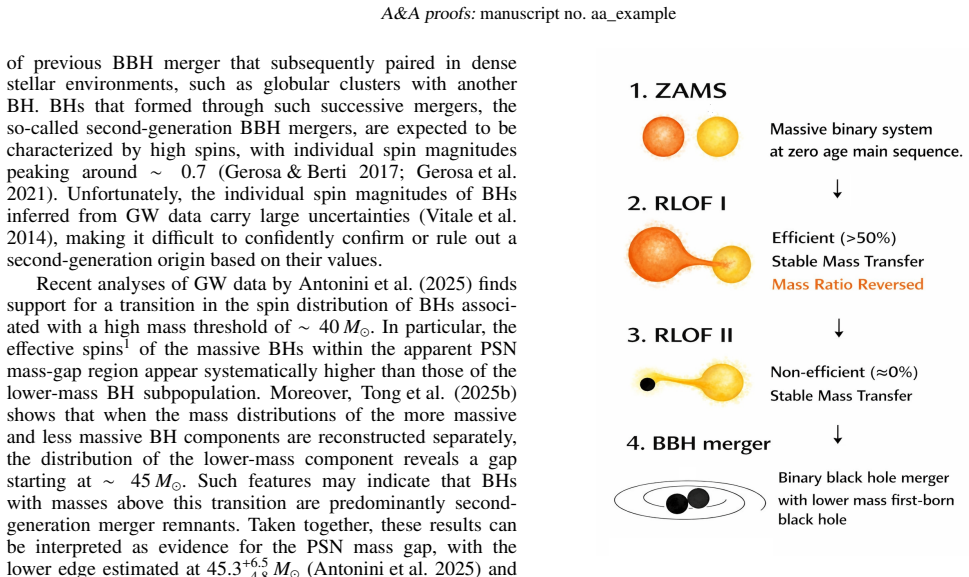
Efficient mass transfer over 50% during the first Roche-lobe overflow, followed by a highly non-conservative second mass transfer phase, naturally limits the mass of the first-born black hole to the stripped primary mass while the second-born black hole can accrete and grow, resulting in a negligible fraction of mergers where the less massive black hole exceeds 45 solar masses and thus mimicking the pair-instability mass gap.
What carries the argument
Mass transfer efficiency in the two phases of Roche-lobe overflow in binary systems, with the first phase being efficient and the second highly non-conservative.
Load-bearing premise
That the mass transfer efficiency exceeds 50 percent in the first Roche-lobe overflow and that the second phase is highly non-conservative, with these values treated as inputs rather than calculated from physics.
What would settle it
A large number of observed black hole mergers with the smaller component above 45 solar masses and positive effective spins would indicate that the binary mass transfer mechanism does not produce the gap as described.
Figures

read the original abstract
The recent O4a release from the LIGO-Virgo-KAGRA collaboration, which significantly increased the number of gravitational-wave (GW) detections, reveals features with potentially important astrophysical implications. One notable example is a hint of the so-called pair-instability mass gap. In particular, the observed decline in the number of black holes (BHs) with mass above 45 Msun, together with indications of possibly higher spins for BHs above this threshold, has been interpreted by Antonini et al. and Tong et al. as evidence for pair-instability supernovae. In this work, we investigate whether mass transfer in binary systems can produce BH components' mass distribution that mimics the pair-instability limit. We use both the population synthesis code StarTrack and a simple semi-analytical framework to highlight the impact of mass transfer efficiency on the BH masses. We find that efficient mass transfer (over 50%) during the first Roche-lobe overflow, followed by a highly non-conservative second mass transfer phase, naturally limits the mass of the first-born BH and produces a cutoff that mimics a mass gap. While the upper mass limit for the more massive BH is increased through accretion during the first mass-transfer phase and is ultimately set by the pair-instability limit, the less massive BH is limited to the stripped primary mass. As a result, the fraction of systems in which the less massive BH exceeds 45 Msun is negligible. While the pair-instability mass gap is a plausible interpretation of current GW data, similar features can naturally arise from binary evolution. Future detections will help distinguish between these scenarios. In particular, a predominance of positive effective spins or low-spin events within the gap would challenge the pair-instability interpretation and instead support a binary-interaction origin for high-mass BHs.
Editorial analysis
A structured set of objections, weighed in public.
Referee Report
Summary. The paper claims that binary evolution, specifically efficient mass transfer (>50%) during the first Roche-lobe overflow followed by a highly non-conservative second mass-transfer phase, can produce a sharp cutoff in the mass of the less-massive black hole around 45 solar masses. This mimics the pair-instability mass gap feature hinted at in LIGO-Virgo-KAGRA O4a data. The result is demonstrated using both the StarTrack population-synthesis code and a semi-analytical model, with the upper mass limit for the primary BH still set by pair instability while the secondary is limited by the stripped primary mass. The authors argue this provides a viable alternative explanation and suggest spin distributions (positive effective spins or low-spin events in the gap) as a future discriminator.
Significance. If the central result holds under broader assumptions, the work provides a concrete alternative astrophysical channel that can reproduce an observed feature in GW mass distributions without invoking pair-instability supernovae. The combination of population synthesis and semi-analytic modeling is a strength, as is the explicit prediction for spin observables that can be tested with future detections. This underscores the need to marginalize over binary-evolution uncertainties when interpreting mass-gap features.
major comments (2)
- [Abstract and semi-analytical framework] The central claim that the cutoff 'naturally' arises from binary evolution rests on the specific choice of mass-transfer efficiency >50% for the first RLOF and highly non-conservative second phase. These efficiencies are imposed as inputs in both the StarTrack runs and the semi-analytical framework rather than emerging from the stellar-structure equations or independent calibration; the location and sharpness of the resulting BH-mass cutoff are direct functions of these two free parameters (see abstract and the description of the semi-analytical model).
- [Results section (StarTrack and semi-analytic comparisons)] It is not shown whether the mimicry of the 45 Msun cutoff persists across a plausible range of efficiencies or requires tuning to match the observed threshold. The paper does not report a systematic exploration or sensitivity study of the efficiency parameters, which are the load-bearing assumptions for the reproduced feature.
minor comments (2)
- [Introduction] The abstract cites Antonini et al. and Tong et al. for the pair-instability interpretation; full bibliographic details and a brief summary of their specific claims should be included in the introduction for context.
- [Figures and captions] Figure captions (or the relevant results figures) should explicitly state the exact efficiency values adopted in the StarTrack runs and the semi-analytic model to allow direct comparison.
Simulated Author's Rebuttal
We thank the referee for the detailed and constructive report. The comments highlight important points about the framing of our assumptions and the robustness of the results. We address each major comment below and will make corresponding revisions to improve clarity and strengthen the analysis.
read point-by-point responses
-
Referee: [Abstract and semi-analytical framework] The central claim that the cutoff 'naturally' arises from binary evolution rests on the specific choice of mass-transfer efficiency >50% for the first RLOF and highly non-conservative second phase. These efficiencies are imposed as inputs in both the StarTrack runs and the semi-analytical framework rather than emerging from the stellar-structure equations or independent calibration; the location and sharpness of the resulting BH-mass cutoff are direct functions of these two free parameters (see abstract and the description of the semi-analytical model).
Authors: We agree that the efficiencies are input parameters, as is standard in binary population synthesis. Our use of >50% for the first RLOF is motivated by observational indications of relatively efficient mass transfer in massive binaries and by prior theoretical work on stable Roche-lobe overflow. The highly non-conservative second phase is likewise motivated by the expectation of significant mass loss during the subsequent evolution of the secondary. Nevertheless, we acknowledge that the word 'naturally' in the abstract and introduction may overstate the case when these values are chosen rather than self-consistently derived. We will revise the abstract, introduction, and semi-analytical model description to state explicitly that the cutoff appears under the assumption of efficient first mass transfer followed by a non-conservative second phase, and we will add references to the literature supporting these efficiency ranges. This change will be made without altering the underlying calculations. revision: partial
-
Referee: [Results section (StarTrack and semi-analytic comparisons)] It is not shown whether the mimicry of the 45 Msun cutoff persists across a plausible range of efficiencies or requires tuning to match the observed threshold. The paper does not report a systematic exploration or sensitivity study of the efficiency parameters, which are the load-bearing assumptions for the reproduced feature.
Authors: We accept this criticism. The present manuscript demonstrates the effect for our fiducial choice of parameters but does not explore the dependence on efficiency. We will add a new subsection (or appendix) that varies the first RLOF efficiency from 30% to 70% and the degree of non-conservativeness in the second phase. For each combination we will show the resulting distribution of the less-massive black-hole mass and quantify how the location and sharpness of the cutoff change. This will clarify the range of efficiencies for which the 45 solar-mass feature is reproduced and will demonstrate that the result does not require extreme fine-tuning within the range of values commonly considered in the literature. revision: yes
Circularity Check
No significant circularity; result is conditional on stated model inputs
full rationale
The paper demonstrates via StarTrack population synthesis and a semi-analytical model that binary evolution under specific mass-transfer assumptions (efficient first RLOF >50%, highly non-conservative second phase) can produce a BH mass cutoff mimicking the pair-instability gap. This is presented as a possibility ('can mimic', 'naturally limits' under the chosen efficiencies), not as a first-principles derivation or generic outcome. No equations reduce the cutoff to the inputs by construction, no parameters are fitted then relabeled as predictions, and no self-citation chains or uniqueness theorems are invoked to force the result. The assumptions are explicit inputs, and the finding is self-contained as a conditional simulation outcome without circular reduction.
Axiom & Free-Parameter Ledger
free parameters (2)
- first_RLOF_efficiency
- second_RLOF_nonconservativeness
axioms (1)
- domain assumption Standard assumptions of binary stellar evolution and common-envelope physics as implemented in StarTrack
Reference graph
Works this paper leans on
-
[1]
ApJ , fjournal=
Fournier, Paul , title=. ApJ , fjournal=
-
[2]
An important paper , journal=
-
[3]
Another Unreal Paper , journal=
-
[4]
A Last Unreal Paper , journal=
-
[5]
Effects of Neutrino-driven Kicks on the Supernova Explosion Mechanism. , keywords =. doi:10.1086/500933 , archivePrefix =. astro-ph/0512033 , primaryClass =
-
[6]
Journal of Physics Conference Series , year = 2008, series =
Supernova theory: Simulation and neutrino fluxes. Journal of Physics Conference Series , year = 2008, series =. doi:10.1088/1742-6596/136/2/022040 , adsurl =
-
[7]
Core-collapse Supernovae from 9 to 120 Solar Masses Based on Neutrino-powered Explosions. , keywords =. doi:10.3847/0004-637X/821/1/38 , archivePrefix =. 1510.04643 , primaryClass =
-
[8]
L., Belczynski, K., Wiktorowicz, G., et al
Compact Remnant Mass Function: Dependence on the Explosion Mechanism and Metallicity. , keywords =. doi:10.1088/0004-637X/749/1/91 , archivePrefix =. 1110.1726 , primaryClass =
-
[9]
On the Maximum Mass of Stellar Black Holes. , keywords =. doi:10.1088/0004-637X/714/2/1217 , archivePrefix =. 0904.2784 , primaryClass =
-
[10]
, keywords =
Spectrum formation in clumped stellar winds: consequences for the analyses of Wolf-Rayet spectra. , keywords =
-
[11]
The Luminous Blue Variables: Astrophysical Geysers. , keywords =. doi:10.1086/133478 , adsurl =
-
[12]
Evolutionary roads leading to low effective spins, high black hole masses, and O1/O2 rates for LIGO/Virgo binary black holes. , keywords =. doi:10.1051/0004-6361/201936528 , archivePrefix =. 1706.07053 , primaryClass =
-
[13]
Pulsational Pair-instability Supernovae. I. Pre-collapse Evolution and Pulsational Mass Ejection. , keywords =. doi:10.3847/1538-4357/ab4fe5 , archivePrefix =. 1901.11136 , primaryClass =
-
[15]
arXiv e-prints , keywords =
Modeling the outcome of supernova explosions in binary population synthesis using the stellar compactness. arXiv e-prints , keywords =
-
[16]
arXiv e-prints , keywords =
High mass but low spin: an exclusion region to rule out hierarchical black-hole mergers as a mechanism to populate the pair-instability mass gap. arXiv e-prints , keywords =
-
[17]
The Mass distribution of stellar black holes.Astrophys
Charles D. Bailyn and Raj K. Jain and Paolo Coppi and Jerome A. Orosz , title =. doi:10.1086/305614 , url =
-
[18]
M., Sravan, N., Cantrell, A., et al
Will M. Farr and Niharika Sravan and Andrew Cantrell and Laura Kreidberg and Charles D. Bailyn and Ilya Mandel and Vicky Kalogera , title =. doi:10.1088/0004-637x/741/2/103 , url =
-
[19]
The Black Hole Mass Distribution in the Galaxy. , keywords =. doi:10.1088/0004-637X/725/2/1918 , archivePrefix =. 1006.2834 , primaryClass =
-
[20]
Constraining the masses of microlensing black holes and the mass gap with Gaia DR2. , keywords =. doi:10.1051/0004-6361/201935842 , archivePrefix =. 1904.07789 , primaryClass =
-
[21]
GWTC-2: Compact Binary Coalescences Observed by LIGO and Virgo during the First Half of the Third Observing Run. Physical Review X , keywords =. doi:10.1103/PhysRevX.11.021053 , archivePrefix =. 2010.14527 , primaryClass =
-
[23]
Pulsational pair instability as an explanation for the most luminous supernovae. , keywords =. doi:10.1038/nature06333 , archivePrefix =. 0710.3314 , primaryClass =
-
[24]
Observation of Gravitational Waves from Two Neutron Star-Black Hole Coalescences. , keywords =. doi:10.3847/2041-8213/ac082e , archivePrefix =. 2106.15163 , primaryClass =
-
[25]
Population Properties of Compact Objects from the Second LIGO-Virgo Gravitational-Wave Transient Catalog. , keywords =. doi:10.3847/2041-8213/abe949 , archivePrefix =. 2010.14533 , primaryClass =
-
[26]
The distribution of low-mass stars in the Galactic disc. , keywords =. doi:10.1093/mnras/262.3.545 , adsurl =
-
[27]
37th Meeting of the Polish Astronomical Society , year = "2016", editor =
Microlensing by single black holes in the Galaxy. 37th Meeting of the Polish Astronomical Society , year = "2016", editor =
2016
-
[28]
A statistical study of 233 pulsar proper motions. , keywords =. doi:10.1111/j.1365-2966.2005.09087.x , adsnote =
-
[29]
Black Holes from Stars to Galaxies -- Across the Range of Masses , year = "2007", editor =
Observational evidence for stellar-mass black holes. Black Holes from Stars to Galaxies -- Across the Range of Masses , year = "2007", editor =. doi:10.1017/S1743921307004590 , archivePrefix =. astro-ph/0612312 , primaryClass =
-
[30]
Research supported by the National Science Foundation
Black holes, white dwarfs, and neutron stars: The physics of compact objects. Research supported by the National Science Foundation. New York, Wiley-Interscience, 1983, 663 p. , year = 1983, adsurl =
1983
-
[31]
, archivePrefix = "arXiv", eprint =
Predicting the binary black hole population of the Milky Way with cosmological simulations. , archivePrefix = "arXiv", eprint =. doi:10.1093/mnras/sty2035 , adsurl =
-
[33]
Study of Gamma-Ray Burst Binary Progenitors. , eprint =. doi:10.1086/339860 , adsurl =
-
[34]
A Comprehensive Study of Young Black Hole Populations. , eprint =. doi:10.1086/422191 , adsurl =
-
[35]
, archivePrefix = "arXiv", eprint =
The Binarity of Milky Way F,G,K Stars as a Function of Effective Temperature and Metallicity. , archivePrefix = "arXiv", eprint =. doi:10.1088/2041-8205/788/2/L37 , adsurl =
-
[36]
On the likelihood of detecting gravitational waves from Population III compact object binaries. , archivePrefix = "arXiv", eprint =. doi:10.1093/mnras/stx1759 , adsurl =
-
[37]
Improved Estimates of the Milky Way's Stellar Mass and Star Formation Rate from Hierarchical Bayesian Meta-Analysis. , archivePrefix = "arXiv", eprint =. doi:10.1088/0004-637X/806/1/96 , adsurl =
-
[38]
Rediscovering Our Galaxy , year = 2018, series =
The age and abundance structure of the stellar populations in the central sub-kpc of the Milky Way. Rediscovering Our Galaxy , year = 2018, series =. doi:10.1017/S1743921317007426 , adsurl =. arXiv:1707.05960 , editor =
-
[39]
2011, ApJ, 729, 16, doi: 10.1088/0004-637X/729/1/16
Chemodynamical Simulations of the Milky Way Galaxy. , archivePrefix = "arXiv", eprint =. doi:10.1088/0004-637X/729/1/16 , adsurl =
-
[40]
Abundance trends in kinematical groups of the Milky Way's disk. , eprint =. doi:10.1051/0004-6361:20042390 , adsurl =
-
[41]
Metallicity and Kinematics of the Galactic Halo from the LAMOST Sample Stars. , keywords =. 2018. doi:10.3847/1538-4357/aacf91 , archivePrefix =. 1806.10315 , primaryClass =
-
[42]
Improved astrophysical parameters for the Geneva-Copenhagen Survey
New constraints on the chemical evolution of the solar neighbourhood and Galactic disc(s). Improved astrophysical parameters for the Geneva-Copenhagen Survey. , archivePrefix = "arXiv", eprint =. doi:10.1051/0004-6361/201016276 , adsurl =
-
[43]
Clues of a two-phase formation history of the Milky Way disk
The age structure of stellar populations in the solar vicinity. Clues of a two-phase formation history of the Milky Way disk. , archivePrefix = "arXiv", eprint =. doi:10.1051/0004-6361/201321397 , adsurl =
-
[44]
Chemical and dynamical evolution of the Milky Way and Local Group , year = 2015, month = jan, eid =
The formation and evolution of the galactic disks. Chemical and dynamical evolution of the Milky Way and Local Group , year = 2015, month = jan, eid =
2015
-
[45]
Estimating the dark matter halo mass of our Milky Way using dynamical tracers. , keywords =. 2015. doi:10.1093/mnras/stv1647 , archivePrefix =. 1502.03477 , primaryClass =
-
[46]
Tracing Galaxy Formation with Stellar Halos. I. Methods. , eprint =. doi:10.1086/497422 , adsurl =
-
[47]
Binary Interaction Dominates the Evolution of Massive Stars. Science , archivePrefix = "arXiv", eprint =. doi:10.1126/science.1223344 , adsurl =
-
[48]
, archivePrefix = "arXiv", eprint =
Missing Black Holes Unveil the Supernova Explosion Mechanism. , archivePrefix = "arXiv", eprint =. doi:10.1088/0004-637X/757/1/91 , adsurl =
-
[49]
2020 , series =
Ivanova, Natalia and Justham, Stephen and Ricker, Paul , title =. 2020 , series =
2020
-
[51]
On the Rarity of Double Black Hole Binaries: Consequences for Gravitational Wave Detection. , eprint =. doi:10.1086/513562 , adsurl =
-
[52]
42nd COSPAR Scientific Assembly , year = 2018, series =
A 2.3 Solar-mass neutron star. 42nd COSPAR Scientific Assembly , year = 2018, series =
2018
-
[53]
The maximum mass of a neutron star.Astrophys
The Maximum Mass of a Neutron Star. , eprint =. doi:10.1086/310296 , adsurl =
-
[54]
Binary Systems, their Evolution and Environments , year = 2014, archivePrefix = "arXiv", eprint =
Black hole X-ray transients: The formation puzzle. Binary Systems, their Evolution and Environments , year = 2014, archivePrefix = "arXiv", eprint =
2014
-
[55]
Environment Observation and Climate Modelling Through International Space Projects , year = 1992, editor =
Endpoints of stellar evolution: The incidence of stellar mass black holes in the galaxy. Environment Observation and Climate Modelling Through International Space Projects , year = 1992, editor =
1992
-
[56]
arXiv e-prints , keywords =
Binary neutron star formation and the origin of GW170817. arXiv e-prints , keywords =. 2018
2018
-
[57]
VizieR Online Data Catalog , keywords =
VizieR Online Data Catalog: Proper motionsof pulsars (Hobbs+, 2005). VizieR Online Data Catalog , keywords =. 2006
2005
-
[58]
arXiv e-prints , keywords =
Pulsational Pair-Instability Supernova I: Pre-collapse Evolution and Pulsational Mass Ejection. arXiv e-prints , keywords =. 2019
2019
-
[59]
arXiv e-prints , keywords =
The origin of low spin of black holes in LIGO/Virgo mergers. arXiv e-prints , keywords =. 2017
2017
-
[60]
A Comprehensive Study of Binary Compact Objects as Gravitational Wave Sources: Evolutionary Channels, Rates, and Physical Properties. , keywords =. 2002. doi:10.1086/340304 , archivePrefix =. astro-ph/0111452 , primaryClass =
-
[61]
Observation of Gravitational Waves from a Binary Black Hole Merger. , keywords =. 2016. doi:10.1103/PhysRevLett.116.061102 , archivePrefix =. 1602.03837 , primaryClass =
-
[62]
Binary Black Hole Mergers in the First Advanced LIGO Observing Run. Phys. Rev. X , keywords =. 2016. doi:10.1103/PhysRevX.6.041015 , archivePrefix =. 1606.04856 , primaryClass =
-
[63]
GW151226: Observation of Gravitational Waves from a 22-Solar-Mass Binary Black Hole Coalescence. , keywords =. 2016. doi:10.1103/PhysRevLett.116.241103 , archivePrefix =. 1606.04855 , primaryClass =
-
[64]
GW170104: Observation of a 50-Solar-Mass Binary Black Hole Coalescence at Redshift 0.2. , keywords =. 2017. doi:10.1103/PhysRevLett.118.221101 , archivePrefix =. 1706.01812 , primaryClass =
-
[65]
GW170608: Observation of a 19 Solar-mass Binary Black Hole Coalescence. , keywords =. 2017. doi:10.3847/2041-8213/aa9f0c , archivePrefix =. 1711.05578 , primaryClass =
-
[66]
arXiv e-prints , keywords =
GWTC-1: A Gravitational-Wave Transient Catalog of Compact Binary Mergers Observed by LIGO and Virgo during the First and Second Observing Runs. arXiv e-prints , keywords =. 2018
2018
-
[67]
GW170814: A Three-Detector Observation of Gravitational Waves from a Binary Black Hole Coalescence. , keywords =. 2017. doi:10.1103/PhysRevLett.119.141101 , archivePrefix =. 1709.09660 , primaryClass =
-
[68]
A two-solar-mass neutron star measured using Shapiro delay. , archivePrefix = "arXiv", eprint =. doi:10.1038/nature09466 , adsurl =
-
[69]
A Massive Pulsar in a Compact Relativistic Binary. Science , archivePrefix = "arXiv", eprint =. doi:10.1126/science.1233232 , adsurl =
-
[70]
Swihart and Jay Strader and Tyrel J
Samuel J. Swihart and Jay Strader and Tyrel J. Johnson and C. C. Cheung and David Sand and Laura Chomiuk and Asher Wasserman and S. 2FGL J0846.0 2820: A New Neutron Star Binary with a Giant Secondary and Variable -Ray Emission , journal =. doi:10.3847/1538-4357/aa9937 , url =
-
[71]
arXiv e-prints , keywords =
Constraining the masses of microlensing black holes and the mass gap with Gaia DR2. arXiv e-prints , keywords =. 2019
2019
-
[72]
Dissolution is the solution: on the reduced mass-to-light ratios of Galactic globular clusters. , keywords =. 2009. doi:10.1051/0004-6361/200811453 , archivePrefix =. 0903.4683 , primaryClass =
-
[73]
Formation of Globular Clusters in Hierarchical Cosmology. , keywords =. 2005. doi:10.1086/428636 , archivePrefix =. astro-ph/0305199 , primaryClass =
-
[74]
Mapping the Galactic Halo. I. The ``Spaghetti'' Survey. , keywords =. 2000. doi:10.1086/301357 , archivePrefix =. astro-ph/0001492 , primaryClass =
-
[75]
Kinematics of Metal-poor Stars in the Galaxy. III. Formation of the Stellar Halo and Thick Disk as Revealed from a Large Sample of Nonkinematically Selected Stars. , keywords =. 2000. doi:10.1086/301409 , archivePrefix =. astro-ph/0003087 , primaryClass =
-
[76]
Identification of A-colored Stars and Structure in the Halo of the Milky Way from Sloan Digital Sky Survey Commissioning Data. , keywords =. 2000. doi:10.1086/309386 , archivePrefix =. astro-ph/0004128 , primaryClass =
-
[77]
Star Counts Redivivus. IV. Density Laws through Photometric Parallaxes. , keywords =. 2002. doi:10.1086/342469 , archivePrefix =. astro-ph/0206323 , primaryClass =
-
[78]
The effects of dynamical substructure on Milky Way mass estimates from the high-velocity tail of the local stellar halo. , keywords =. 2019. doi:10.1093/mnrasl/slz092 , archivePrefix =. 1905.09834 , primaryClass =
-
[79]
2016, MNRAS, 458, 3012, doi: 10.1093/mnras/stw426
Black hole, neutron star and white dwarf candidates from microlensing with OGLE-III. , keywords =. 2016. doi:10.1093/mnras/stw426 , archivePrefix =. 1509.04899 , primaryClass =
-
[80]
arXiv e-prints , keywords =
Populations of stellar mass Black holes from binary systems. arXiv e-prints , keywords =. 2019
2019
-
[81]
Grids of stellar models with rotation. I. Models from 0.8 to 120 M _ ☉ at solar metallicity (Z = 0.014). , keywords =. 2012. doi:10.1051/0004-6361/201117751 , archivePrefix =. 1110.5049 , primaryClass =
-
[82]
The Chemical Composition of the Sun. , archivePrefix = "arXiv", eprint =. doi:10.1146/annurev.astro.46.060407.145222 , adsurl =
-
[83]
Did LIGO Detect Dark Matter?. , keywords =. 2016. doi:10.1103/PhysRevLett.116.201301 , archivePrefix =. 1603.00464 , primaryClass =
-
[84]
Casares, J. and Charles, P. A. , title = ". , volume =. 1994 , month =. doi:10.1093/mnras/271.1.L5 , url =
discussion (0)
Sign in with ORCID, Apple, or X to comment. Anyone can read and Pith papers without signing in.