Opinion polarization from compression-based decision making where agents optimize local complexity and global simplicity
Pith reviewed 2026-05-10 02:56 UTC · model grok-4.3
The pith
Agents balancing local diversity against global simplicity generate persistent opinion polarization.
A machine-rendered reading of the paper's core claim, the machinery that carries it, and where it could break.
Core claim
The central claim is that polarization with heterogeneous clusters arises when agents make pairwise adoption decisions that maximize local Shannon entropy while minimizing global Shannon entropy. Simulations show that distinct groups form and persist with ongoing opinion variation within and between them, that this occurs most clearly at moderate local group sizes, and that stronger cognitive compression increases structural unpredictability.
What carries the argument
Pairwise decision rule that adopts an opinion only when the resulting drop in global Shannon entropy exceeds the rise in local Shannon entropy.
If this is right
- Moderate local group sizes produce clear, heterogeneous opinion clusters while smaller sizes fragment and larger sizes prevent distinct clusters.
- Opinions continue to adjust after clusters emerge, creating persistent variation within and between groups.
- Higher cognitive compression increases unpredictability in the emerging group structures.
- Polarization patterns appear without requiring opinions to become fixed once groups form.
Where Pith is reading between the lines
- The mechanism implies that changing how people perceive local uniqueness or global complexity could alter polarization outcomes.
- Platform designs that shift effective group sizes or compression levels may sustain or reduce dynamic divisions.
- The model could be tested by checking whether human subjects exhibit entropy-like tradeoffs in controlled pairwise opinion tasks.
Load-bearing premise
That human opinion choices can be modeled as an entropy tradeoff between local distinctiveness and global simplicity without needing extra social or cognitive mechanisms.
What would settle it
A controlled experiment in which participants repeatedly adjust opinions after clusters have formed and the rate of ongoing change is measured against the model's prediction of continued variation.
Figures


read the original abstract
Understanding social polarization requires integrating insights from psychology, sociology, and complex systems science. Agent-based modeling provides a natural framework to combine perspectives from different fields and explore how individual cognition shapes collective outcomes. This study introduces a novel agent-based model that integrates two cognitive and social mechanisms: the desire to be unique within a group (optimal distinctiveness theory) and the tendency to simplify complex information (cognitive compression). In the model, virtual agents interact in pairs and decide whether to adopt each other's opinions by balancing two opposing drives: maximizing opinion diversity within their local social group while simplifying the overall opinion landscape, with both evaluated using Shannon entropy. We show that the combination of these mechanisms can reproduce real-world patterns, such as the emergence of distinct heterogeneous opinion clusters. Moreover, unlike many existing models where opinions become fixed once opinion groups form, individuals in our model continue to adjust their opinions after clusters emerge, leading to ongoing variation within and between opinion groups. Computational experiments reveal that polarization emerges when local group sizes are moderate (consistent with Dunbar's number), while smaller groups cause fragmentation and larger ones hinder distinct cluster formation. Higher cognitive compression increases unpredictability, while lower compression produces more consistent group structures. These results demonstrate how simple psychological rules can generate complex, realistic social behavior and advance understanding of polarization in human societies.
Editorial analysis
A structured set of objections, weighed in public.
Referee Report
Summary. The paper presents an agent-based model in which agents interact pairwise and adopt or retain opinions by balancing two entropy-based drives: maximizing local Shannon entropy (opinion diversity within a small interacting group, motivated by optimal distinctiveness) against minimizing global Shannon entropy (overall opinion landscape simplicity, motivated by cognitive compression). Computational experiments are reported to show that this rule produces heterogeneous opinion clusters with ongoing intra- and inter-cluster variation, that moderate local group sizes (near Dunbar's number) favor distinct clusters while smaller sizes fragment and larger sizes suppress them, and that higher compression strength increases unpredictability.
Significance. If the simulations are reproducible and the entropy proxies are shown to be non-tautological, the work supplies a generative, cognitively motivated mechanism that can sustain dynamic opinion variation after clusters form, offering a potential alternative to static cluster models in the polarization literature and linking psychological theory to complex-systems outcomes.
major comments (3)
- [Model description] Model description (presumably §2 or §3): the pairwise decision rule is stated only in qualitative terms (balancing local vs. global Shannon entropy); no explicit equation, update probability, or optimization procedure is supplied, so it is impossible to determine how the two entropy terms are combined, whether the rule is deterministic or stochastic, or how the claimed parameter-free character (if asserted) is achieved.
- [Results] Results section: the claim that the model 'reproduces real-world patterns' is unsupported by any quantitative metric, error bars, statistical test, or direct comparison to empirical opinion distributions or polarization indices; the abstract and summary provide no validation data.
- [Evaluation] Evaluation of outcomes: because Shannon entropy is used both to drive the agents' local decisions and to characterize the resulting polarization (cluster heterogeneity, intra-group variation), it is unclear whether the reported emergence of sustained variation is an independent prediction or follows tautologically from the entropy definitions; a concrete test (e.g., an alternative non-entropy diversity measure) is needed.
minor comments (2)
- The abstract and introduction should explicitly state the number of agents, opinion space dimensionality, and simulation run length so that the reported dependence on group size can be assessed for robustness.
- Notation for local vs. global entropy should be introduced with distinct symbols and a brief reminder of the Shannon formula to avoid reader confusion.
Simulated Author's Rebuttal
We thank the referee for the thoughtful and constructive comments, which have helped us identify areas for improvement. We address each major point below and will incorporate revisions to enhance clarity, rigor, and validation in the manuscript.
read point-by-point responses
-
Referee: [Model description] Model description (presumably §2 or §3): the pairwise decision rule is stated only in qualitative terms (balancing local vs. global Shannon entropy); no explicit equation, update probability, or optimization procedure is supplied, so it is impossible to determine how the two entropy terms are combined, whether the rule is deterministic or stochastic, or how the claimed parameter-free character (if asserted) is achieved.
Authors: We agree that the decision rule requires an explicit mathematical formulation for full reproducibility. In the revised manuscript, we will add the precise update rule in §2: the probability that agent i adopts agent j's opinion is p = sigmoid(α ΔH_local - λ ΔH_global), where ΔH_local is the change in local Shannon entropy within the interacting group (maximized for distinctiveness) and ΔH_global is the change in global entropy (minimized for compression), with α a normalization factor and λ the compression strength. The rule is stochastic, and the model remains free of additional tunable parameters beyond the explicitly varied group size and λ. revision: yes
-
Referee: [Results] Results section: the claim that the model 'reproduces real-world patterns' is unsupported by any quantitative metric, error bars, statistical test, or direct comparison to empirical opinion distributions or polarization indices; the abstract and summary provide no validation data.
Authors: The referee correctly notes the absence of quantitative empirical validation. We will revise the Results section to include direct comparisons: we will report polarization indices (e.g., cluster size distributions and intra-cluster variance) matched against Pew Research Center opinion survey data, with error bars from 50 independent runs per parameter setting and Kolmogorov-Smirnov tests for distributional similarity. This will substantiate the reproduction claim while clarifying that the primary contribution is the generative mechanism. revision: yes
-
Referee: [Evaluation] Evaluation of outcomes: because Shannon entropy is used both to drive the agents' local decisions and to characterize the resulting polarization (cluster heterogeneity, intra-group variation), it is unclear whether the reported emergence of sustained variation is an independent prediction or follows tautologically from the entropy definitions; a concrete test (e.g., an alternative non-entropy diversity measure) is needed.
Authors: We acknowledge the valid concern regarding potential circularity. In the revision, we will add a dedicated evaluation subsection using independent, non-entropy metrics: specifically, the temporal evolution of opinion vector variance and the count of distinct clusters (defined via k-means on opinion embeddings). These analyses will show that sustained intra- and inter-cluster variation persists under these alternative measures, confirming that the dynamics generate genuine ongoing heterogeneity rather than a definitional artifact. revision: yes
Circularity Check
No significant circularity in the derivation chain
full rationale
The paper presents a generative agent-based model in which agents make pairwise opinion-update decisions by balancing local Shannon entropy (diversity within the interacting group) against global Shannon entropy (overall landscape simplicity). The reported outcomes—emergence of heterogeneous opinion clusters with sustained intra- and inter-cluster variation—are obtained via computational simulation for moderate local group sizes. These results are not equivalent to the input definitions by construction; the entropy-based rule is an explicit modeling choice whose dynamical consequences are explored numerically rather than tautologically restated. No self-citations, fitted parameters renamed as predictions, or uniqueness theorems are invoked as load-bearing steps in the provided text. The model is offered as a demonstration of emergent behavior, not a calibrated predictor, rendering the derivation self-contained.
Axiom & Free-Parameter Ledger
free parameters (2)
- local group size
- cognitive compression strength
axioms (2)
- domain assumption Shannon entropy can serve as a quantitative proxy for both local opinion diversity (complexity) and global opinion uniformity (simplicity).
- domain assumption Pairwise interactions and entropy-based adoption decisions are sufficient to generate emergent macroscopic polarization patterns.
Reference graph
Works this paper leans on
-
[1]
oil spill
DellaPosta D. Pluralistic collapse: The “oil spill” model of mass opinion polarization. American Sociological Review. 2020;85(3):507–536
2020
-
[2]
Graham MH, Svolik MW. Democracy in America? Partisanship, Polarization, and the Robustness of Support for Democracy in the United States. American Political Science Review. 2020;114(2):392–409. doi:10.1017/S0003055420000052
-
[3]
United We Stand, Divided We Rule: How Political Polarization Erodes Democracy
Arbatli E, Rosenberg D. United We Stand, Divided We Rule: How Political Polarization Erodes Democracy. Democratization. 2021;28(2):285–307. doi:10.1080/13510347.2020.1818068
-
[4]
Boomerangs Versus Javelins: How Polarization Constrains Communication on Climate Change
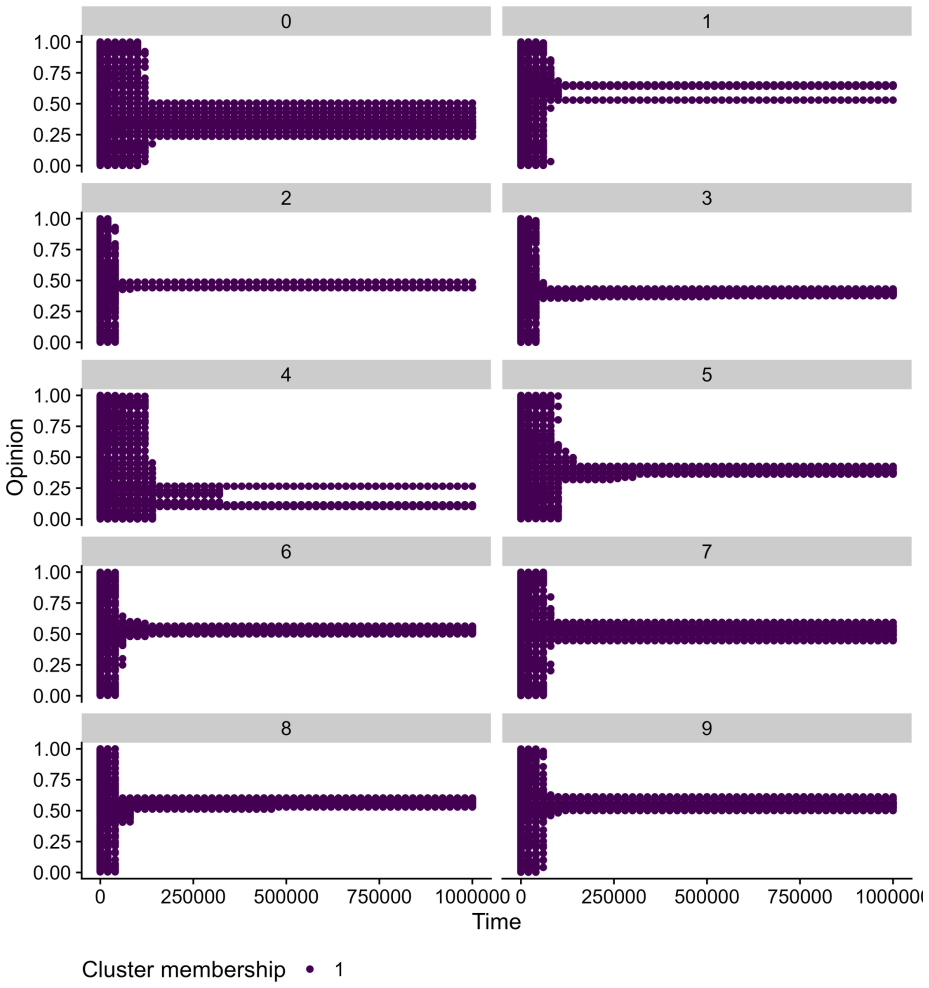
Zhou J. Boomerangs Versus Javelins: How Polarization Constrains Communication on Climate Change. Environmental Politics. 2016;25(5):788–811. doi:10.1080/09644016.2016.1166602. 14/22 Fig 7. S1 Fig. Cluster membership for each simulation (panels) where l = 100.The color of each agent corresponds to their cluster membership, which was obtained from Sec. . He...
-
[5]
How elite partisan polarization affects public opinion formation
Druckman JN, Peterson E, Slothuus R. How elite partisan polarization affects public opinion formation. American Political Science Review. 2013;107(1):57–79. doi:10.1017/S0003055412000500
-
[6]
Ideologues without issues: The polarizing consequences of ideological identities
Mason L. Ideologues without issues: The polarizing consequences of ideological identities. Public Opinion Quarterly. 2018;82(S1):866–887. doi:10.1093/poq/nfy005
-
[7]
The role of (social) media in political polarization: a systematic review
Kubin E, Von Sikorski C. The role of (social) media in political polarization: a systematic review. Annals of the International Communication Association. 2021;45(3):188–206
2021
-
[8]
Status threat, not economic hardship, explains the 2016 presidential vote
Mutz DC. Status threat, not economic hardship, explains the 2016 presidential vote. Proceedings of the National Academy of Sciences. 2018;115(19):E4330–E4339. doi:10.1073/pnas.1718155115
-
[9]
Theories of behaviour and behaviour change across the social and behavioural sciences: a scoping review
Davis R, Campbell R, Hildon Z, Hobbs L, Michie S. Theories of behaviour and behaviour change across the social and behavioural sciences: a scoping review. Health psychology review. 2015;9(3):323–344
2015
-
[10]
Modelling social norms: an integration of the norm-utility approach with beliefs dynamics
Gavrilets S, Tverskoi D, S´ anchez A. Modelling social norms: an integration of the norm-utility approach with beliefs dynamics. Philosophical Transactions of the Royal Society B. 2024;379(1897):20230027
2024
-
[11]
Beyond collective intelligence: Collective adaptation
Galesic M, Barkoczi D, Berdahl AM, Biro D, Carbone G, Giannoccaro I, et al. Beyond collective intelligence: Collective adaptation. Journal of the Royal Society interface. 2023;20(200):20220736
2023
-
[12]
The spontaneous emergence of conventions: An experimental study of cultural evolution
Centola D, Baronchelli A. The spontaneous emergence of conventions: An experimental study of cultural evolution. Proceedings of the National Academy of Sciences. 2015;112(7):1989–1994
2015
-
[13]
Statistical physics of social dynamics
Castellano C, Fortunato S, Loreto V. Statistical physics of social dynamics. Reviews of modern physics. 2009;81(2):591–646
2009
-
[14]
What Explains Country-Level Differences in Political Belief System Coherence? Political Behavior
Warncke P. What Explains Country-Level Differences in Political Belief System Coherence? Political Behavior. 2025;47:1853–1876. doi:10.1007/s11109-025-10015-9
-
[15]
Attitude networks as intergroup realities: Using network-modelling to research attitude-identity relationships in polarized political contexts
L¨ uders A, Carpentras D, Quayle M. Attitude networks as intergroup realities: Using network-modelling to research attitude-identity relationships in polarized political contexts. British Journal of Social Psychology. 2024;63(1):37–51
2024
-
[16]
Strategic attitude expressions as identity performance and identity creation in interaction
O’Reilly C, Mannion S, Maher PJ, Smith EM, MacCarron P, Quayle M. Strategic attitude expressions as identity performance and identity creation in interaction. Communications Psychology. 2024;2(1):27
2024
-
[17]
Indirect social influence and diffusion of innovations: An experimental approach
Miranda M, Pereda M, S´ anchez A, Estrada E. Indirect social influence and diffusion of innovations: An experimental approach. PNAS nexus. 2024;3(10):pgae409
2024
-
[18]
Mapping public health responses with attitude networks: the emergence of opinion-based groups in the UK’s early COVID-19 response phase
Maher PJ, MacCarron P, Quayle M. Mapping public health responses with attitude networks: the emergence of opinion-based groups in the UK’s early COVID-19 response phase. British Journal of Social Psychology. 2020;59(3):641–652
2020
-
[19]
Mapping the global opinion space to explain anti-vaccine attraction
Carpentras D, L¨ uders A, Quayle M. Mapping the global opinion space to explain anti-vaccine attraction. Scientific reports. 2022;12(1):6188
2022
-
[20]
Multidimensional polarization dynamics in US election data in the long term (2012–2020) and in the 2020 election cycle
Dinkelberg A, O’Reilly C, MacCarron P, Maher PJ, Quayle M. Multidimensional polarization dynamics in US election data in the long term (2012–2020) and in the 2020 election cycle. Analyses of Social Issues and Public Policy. 2021;21(1):284–311
2012
-
[21]
Opening strategies in the game of go from feudalism to superhuman AI
Chen Y, Speer A, de Bruin B, Carpentras D, Warncke P. A “broken egg” of U.S. Political Beliefs: Using response-item networks (ResIN) to measure ideological polarization. Network Science. 2025;13:e20. doi:10.1017/nws.2025.10016
-
[22]
Local cascades induced global contagion: How heterogeneous thresholds, exogenous effects, and unconcerned behaviour govern online adoption spreading
Karsai M, I˜ niguez G, Kikas R, Kaski K, Kert´ esz J. Local cascades induced global contagion: How heterogeneous thresholds, exogenous effects, and unconcerned behaviour govern online adoption spreading. Scientific reports. 2016;6(1):27178. 19/22
2016
-
[23]
Finding polarized communities and tracking information diffusion on Twitter: a network approach on the Irish Abortion Referendum
Pena CB, MacCarron P, O’Sullivan DJ. Finding polarized communities and tracking information diffusion on Twitter: a network approach on the Irish Abortion Referendum. Royal Society Open Science. 2025;12(1):240454
2025
-
[24]
Mixing beliefs among interacting agents
Deffuant G, Neau D, Amblard F, Weisbuch G. Mixing beliefs among interacting agents. Advances in Complex Systems. 2000;3(01n04):87–98
2000
-
[25]
Reaching a consensus
DeGroot MH. Reaching a consensus. Journal of the American Statistical association. 1974;69(345):118–121
1974
-
[26]
The dissemination of culture: A model with local convergence and global polarization
Axelrod R. The dissemination of culture: A model with local convergence and global polarization. Journal of conflict resolution. 1997;41(2):203–226
1997
-
[27]
Integrating social and cognitive aspects of belief dynamics: towards a unifying framework
Galesic M, Olsson H, Dalege J, Van Der Does T, Stein DL. Integrating social and cognitive aspects of belief dynamics: towards a unifying framework. Journal of the Royal Society Interface. 2021;18(176):20200857
2021
-
[28]
Network science on belief system dynamics under logic constraints
Friedkin NE, Proskurnikov AV, Tempo R, Parsegov SE. Network science on belief system dynamics under logic constraints. Science. 2016;354(6310):321–326
2016
-
[29]
A new model of opinion dynamics for social actors with multiple interdependent attitudes and prejudices
Parsegov SE, Proskurnikov AV, Tempo R, Friedkin NE. A new model of opinion dynamics for social actors with multiple interdependent attitudes and prejudices. In: 2015 54th IEEE Conference on Decision and Control (CDC). IEEE; 2015. p. 3475–3480
2015
-
[30]
Models of social influence: Towards the next frontiers
Flache A, M¨ as M, Feliciani T, Chattoe-Brown E, Deffuant G, Huet S, et al. Models of social influence: Towards the next frontiers. Jasss-The journal of artificial societies and social simulation. 2017;20(4):2
2017
-
[31]
Computational social psychology
Vallacher RR, Read SJ, Nowak A. Computational social psychology. Routledge; 2017
2017
-
[32]
Opinion dynamics driven by various ways of averaging
Hegselmann R, Krause U. Opinion dynamics driven by various ways of averaging. Computational Economics. 2005;25:381–405
2005
-
[33]
Noisy continuous-opinion dynamics
Pineda M, Toral R, Hernandez-Garcia E. Noisy continuous-opinion dynamics. Journal of Statistical Mechanics: Theory and Experiment. 2009;2009(08):P08001
2009
-
[34]
Diffusing opinions in bounded confidence processes
Pineda M, Toral R, Hern´ andez-Garc´ ıa E. Diffusing opinions in bounded confidence processes. The European Physical Journal D. 2011;62:109–117
2011
-
[35]
Online intergroup polarization across political fault lines: An integrative review
Bliuc AM, Bouguettaya A, Felise KD. Online intergroup polarization across political fault lines: An integrative review. Frontiers in Psychology. 2021;12:641215
2021
-
[36]
Quayle M. Social identity networks: People holding attitudes are a collective social identity information system and bipartite networks are a useful way to represent them. European Review of Social Psychology. 2025;0(0):1–66. doi:10.1080/10463283.2025.2514433
-
[37]
Durrheim K, Quayle M. Human murmuration: Group polarisation as compression in interaction-language dynamics captured by large language models. European Review of Social Psychology. 2025;0(0):1–40. doi:10.1080/10463283.2025.2499332
-
[38]
Polarization is the psychological foundation of collective engagement
Smith LG, Thomas EF, Bliuc AM, McGarty C. Polarization is the psychological foundation of collective engagement. Communications psychology. 2024;2(1):41
2024
-
[39]
Uniqueness: The human pursuit of difference
Snyder CR, Fromkin HL. Uniqueness: The human pursuit of difference. Springer Science & Business Media; 2012
2012
-
[40]
The social self: On being the same and different at the same time
Brewer MB. The social self: On being the same and different at the same time. Personality and social psychology bulletin. 1991;17(5):475–482
1991
-
[41]
On the so-called ‘superior conformity of the self’behavior: Twenty experimental investigations
Codol JP. On the so-called ‘superior conformity of the self’behavior: Twenty experimental investigations. European journal of social psychology. 1975;5(4):457–501. 20/22
1975
-
[42]
Social differentiation and social originality
Lemaine G. Social differentiation and social originality. European Journal of Social Psychology. 1974;4(1):17–52
1974
-
[43]
Using Collective Identities for
Pickett CL, Geoffrey J. Using Collective Identities for. Individuality and the group: Advances in social identity. 2006; p. 56
2006
-
[44]
Individuality and the group: Advances in social identity
Postmes T, Jetten J. Individuality and the group: Advances in social identity. Sage; 2006
2006
-
[45]
They are all the same!
Rubin M, Badea C. They are all the same!... but for several different reasons: A review of the multicausal nature of perceived group variability. Current Directions in Psychological Science. 2012;21(6):367–372
2012
-
[46]
Optimal distinctiveness theory: A framework for social identity, social cognition, and intergroup relations
Leonardelli GJ, Pickett CL, Brewer MB. Optimal distinctiveness theory: A framework for social identity, social cognition, and intergroup relations. In: Advances in experimental social psychology. vol. 43. Elsevier; 2010. p. 63–113
2010
-
[47]
Public opinion
Lippmann W. Public opinion. 1922. URL: http://infomotions com/etexts/gutenberg/dirs/etext04/pbp nn10 htm. 1965
1922
-
[48]
Culture: copying, compression, and conventionality
Tamariz M, Kirby S. Culture: copying, compression, and conventionality. Cognitive science. 2015;39(1):171–183
2015
-
[49]
The limits of reason
Chaitin G. The limits of reason. Scientific American. 2006;294(3):74–81
2006
-
[50]
A mathematical theory of communication
Shannon CE. A mathematical theory of communication. The Bell system technical journal. 1948;27(3):379–423
1948
-
[51]
Chunking mechanisms in human learning
Gobet F, Lane PC, Croker S, Cheng PC, Jones G, Oliver I, et al. Chunking mechanisms in human learning. Trends in cognitive sciences. 2001;5(6):236–243
2001
-
[52]
The magical number seven, plus or minus two: Some limits on our capacity for processing information
Miller GA. The magical number seven, plus or minus two: Some limits on our capacity for processing information. Psychological review. 1956;63(2):81
1956
-
[53]
Simple and complex working memory tasks allow similar benefits of information compression
Mathy F, Chekaf M, Cowan N. Simple and complex working memory tasks allow similar benefits of information compression. Journal of Cognition. 2018;1(1):31
2018
-
[54]
Bondedness and sociality
Dunbar RI, Shultz S. Bondedness and sociality. Behaviour. 2010; p. 775–803
2010
-
[55]
The social brain hypothesis
Dunbar RI. The social brain hypothesis. Evolutionary Anthropology: Issues, News, and Reviews: Issues, News, and Reviews. 1998;6(5):178–190
1998
-
[56]
Neocortex size as a constraint on group size in primates
Dunbar RI. Neocortex size as a constraint on group size in primates. Journal of human evolution. 1992;22(6):469–493
1992
-
[57]
Encephalization is not a universal macroevolutionary phenomenon in mammals but is associated with sociality
Shultz S, Dunbar R. Encephalization is not a universal macroevolutionary phenomenon in mammals but is associated with sociality. Proceedings of the National Academy of Sciences. 2010;107(50):21582–21586
2010
-
[58]
Neocortex size and behavioural ecology in primates
Barton RA. Neocortex size and behavioural ecology in primates. Proceedings of the Royal Society of London Series B: Biological Sciences. 1996;263(1367):173–177
1996
-
[59]
Ventromedial prefrontal volume predicts understanding of others and social network size
Lewis PA, Rezaie R, Brown R, Roberts N, Dunbar RI. Ventromedial prefrontal volume predicts understanding of others and social network size. Neuroimage. 2011;57(4):1624–1629
2011
-
[60]
Orbital prefrontal cortex volume predicts social network size: an imaging study of individual differences in humans
Powell J, Lewis PA, Roberts N, Garcia-Finana M, Dunbar RI. Orbital prefrontal cortex volume predicts social network size: an imaging study of individual differences in humans. Proceedings of the Royal Society B: Biological Sciences. 2012;279(1736):2157–2162
2012
-
[61]
Online social network size is reflected in human brain structure
Kanai R, Bahrami B, Roylance R, Rees G. Online social network size is reflected in human brain structure. Proceedings of the Royal Society B: Biological Sciences. 2012;279(1732):1327–1334. 21/22
2012
-
[62]
Modeling users’ activity on twitter networks: Validation of dunbar’s number
Gon¸ calves B, Perra N, Vespignani A. Modeling users’ activity on twitter networks: Validation of dunbar’s number. PloS one. 2011;6(8):e22656
2011
-
[63]
Unravelling the size distribution of social groups with information theory in complex networks
Hernando A, Villuendas D, Vesperinas C, Abad M, Plastino A. Unravelling the size distribution of social groups with information theory in complex networks. The European Physical Journal B. 2010;76:87–97
2010
-
[64]
Organizational Structure and Scalar Stress
Johnson GA. Organizational Structure and Scalar Stress. In: Theory and Explanation in Archaeology
-
[65]
Kuijt I. People and space in early agricultural villages: Exploring daily lives, community size, and architecture in the Late Pre-Pottery Neolithic. Journal of Anthropological Archaeology. 2000;19(1):75–102. doi:10.1006/jaar.1999.0342
-
[66]
Agent-based modeling: Methods and techniques for simulating human systems
Bonabeau E. Agent-based modeling: Methods and techniques for simulating human systems. Proceedings of the national academy of sciences. 2002;99(suppl 3):7280–7287
2002
-
[67]
What’s magic about magic numbers? Chunking and data compression in short-term memory
Mathy F, Feldman J. What’s magic about magic numbers? Chunking and data compression in short-term memory. Cognition. 2012;122(3):346–362
2012
-
[68]
How Big Is a Chunk? By combining data from several experiments, a basic human memory unit can be identified and measured
Simon HA. How Big Is a Chunk? By combining data from several experiments, a basic human memory unit can be identified and measured. Science. 1974;183(4124):482–488
1974
-
[69]
Network science
Barab´ asi AL, P´ osfai M. Network science. Cambridge, United Kingdom: Cambridge University Press
-
[70]
Available from:https://networksciencebook.com/
-
[71]
The Application of Cluster Analysis in Strategic Management Research: An Analysis and Critique
Ketchen Jr DJ, Shook CL. The Application of Cluster Analysis in Strategic Management Research: An Analysis and Critique. Strategic Management Journal. 1996;17(6):441–458. doi:10.1002/(SICI)1097-0266(199606)17:6¡441::AID-SMJ819¿3.0.CO;2-G
-
[72]
Analysis of mean-field approximation for Deffuant opinion dynamics on networks
Dubovskaya A, Fennell SC, Burke K, Gleeson JP, O‘Kiely D. Analysis of mean-field approximation for Deffuant opinion dynamics on networks. SIAM Journal on Applied Mathematics. 2023;83(2):436–459. doi:10.1137/22M1499765
-
[73]
Some methods for classification and analysis of multivariate observations
MacQueen J. Some methods for classification and analysis of multivariate observations. In: Proceedings of the Fifth Berkeley Symposium on Mathematical Statistics and Probability. vol. 1; 1967. p. 281–297
1967
-
[74]
Silhouettes: a graphical aid to the interpretation and validation of cluster analysis
Rousseeuw PJ. Silhouettes: a graphical aid to the interpretation and validation of cluster analysis. Journal of Computational and Applied Mathematics. 1987;20:53–65
1987
-
[75]
Generalized mean-field approximation for the Deffuant opinion dynamics model on networks
Fennell SC, Burke K, Quayle M, Gleeson JP. Generalized mean-field approximation for the Deffuant opinion dynamics model on networks. Physical Review E. 2021;103(1):012314
2021
-
[76]
Modeling diffusion in networks with communities: A multitype branching process approach
Dubovskaya A, Pena CB, O’Sullivan DJ. Modeling diffusion in networks with communities: A multitype branching process approach. Physical Review E. 2025;111(3):034310
2025
-
[77]
Opinion formation and distribution in a bounded-confidence model on various networks
Meng XF, Van Gorder RA, Porter MA. Opinion formation and distribution in a bounded-confidence model on various networks. Physical Review E. 2018;97(2):022312
2018
-
[78]
Small but slow world: How network topology and burstiness slow down spreading
Karsai M, Kivel¨ a M, Pan RK, Kaski K, Kert´ esz J, Barab´ asi AL, et al. Small but slow world: How network topology and burstiness slow down spreading. Physical Review E—Statistical, Nonlinear, and Soft Matter Physics. 2011;83(2):025102
2011
-
[79]
Grimm V, Railsback SF, Vincenot CE, Berger U, Gallagher C, DeAngelis DL, et al. The ODD protocol for describing agent-based and other simulation models: a second update to improve clarity, replication, and structural realism. Journal of Artificial Societies and Social Simulation. 2020;23(2):7. doi:10.18564/jasss.4259. 22/22
discussion (0)
Sign in with ORCID, Apple, or X to comment. Anyone can read and Pith papers without signing in.