Recognition: unknown
AffectCity: An Empirical Investigation of Complexity, Transparency, and Materiality in Shaping Affective Perception of Building Facades
Pith reviewed 2026-05-10 03:27 UTC · model grok-4.3
The pith
Perceived complexity of building facades is the dominant driver of emotional arousal and valence, with human perception acting as the key link to measurable features.
A machine-rendered reading of the paper's core claim, the machinery that carries it, and where it could break.
Core claim
Buildings shape how people feel, yet the mechanisms through which specific facade properties drive affective states remain empirically underspecified. Focusing on complexity, transparency, and materiality, perceived complexity emerges as the dominant affective predictor with significant positive associations for arousal and valence and curvilinear amplification at higher levels. Machine-derived metrics show limited direct predictive power; human perceptual evaluation functions as a necessary intermediate layer, with perceived materiality mediating the machine-valence relationship. Transparency exhibits an inverted-U with valence, and artificiality suppresses arousal consistent with biophilic
What carries the argument
Human perceptual evaluation as a necessary intermediate layer between machine-vision-derived surface metrics and affective outcomes, with perceived complexity as the strongest predictor.
If this is right
- Facade design guidelines can prioritize optimal complexity levels to enhance positive affective responses in urban settings.
- Machine vision tools for facade analysis must incorporate human perceptual ratings to accurately predict emotional impact.
- Transparency and materiality can be adjusted based on their specific relationships to valence and arousal for better biophilic outcomes.
- Cross-context studies can build on the moderate stability of complexity and materiality ratings while accounting for valence's context dependence.
Where Pith is reading between the lines
- These results imply that cities could use perceptual data to design facades that reduce negative emotions or increase engagement in public spaces.
- The approach opens paths to integrate affective modeling into architectural software for real-time design feedback.
- Extending the dataset to more global contexts might reveal cultural differences in how complexity affects valence.
Load-bearing premise
The sample of 86 facade images and 85 participants represents typical affective responses to building facades sufficiently to support the mediation and prediction claims.
What would settle it
Finding no significant mediation effect or no association between perceived complexity and arousal in a replication study using a larger and more diverse set of participants and real-world facade observations would falsify the central claims.
Figures




read the original abstract
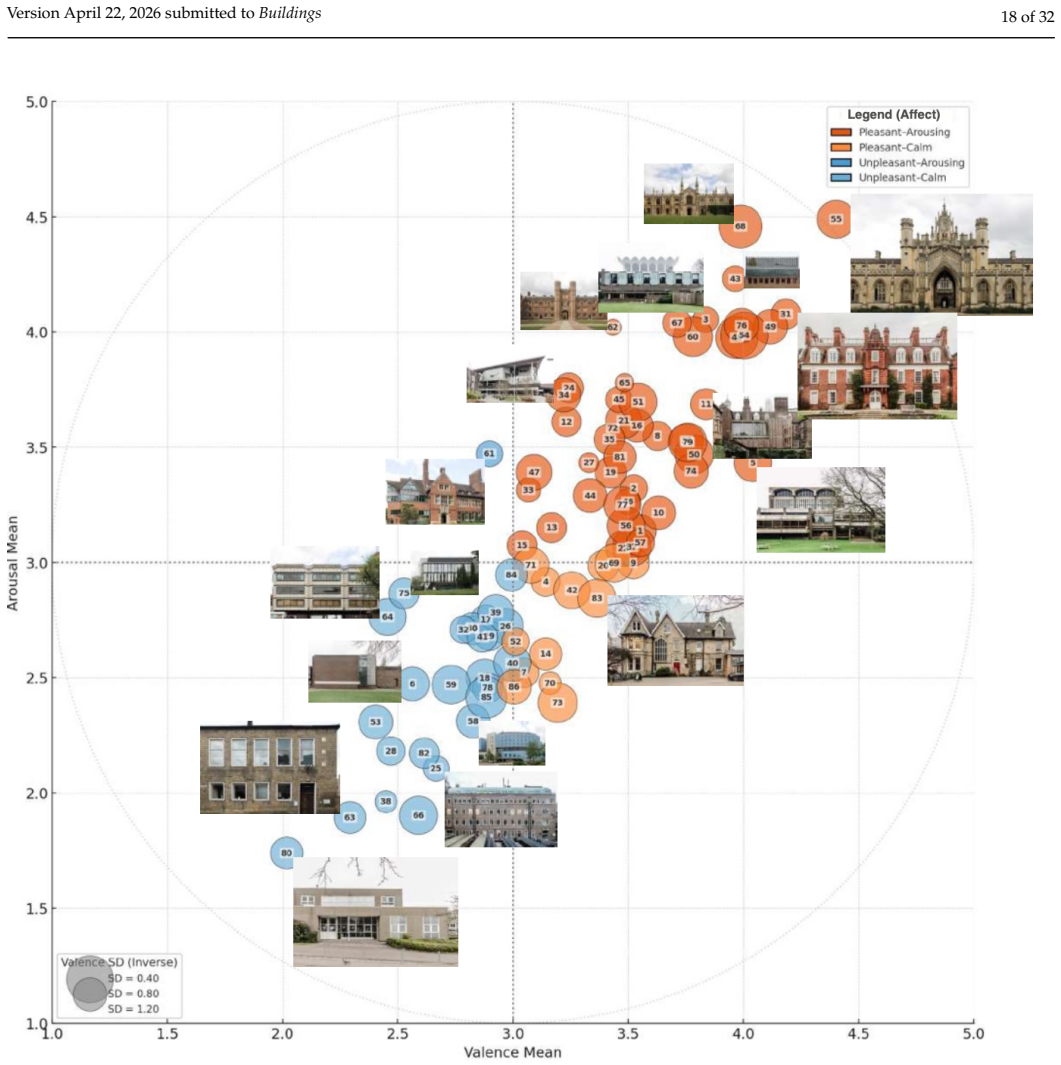
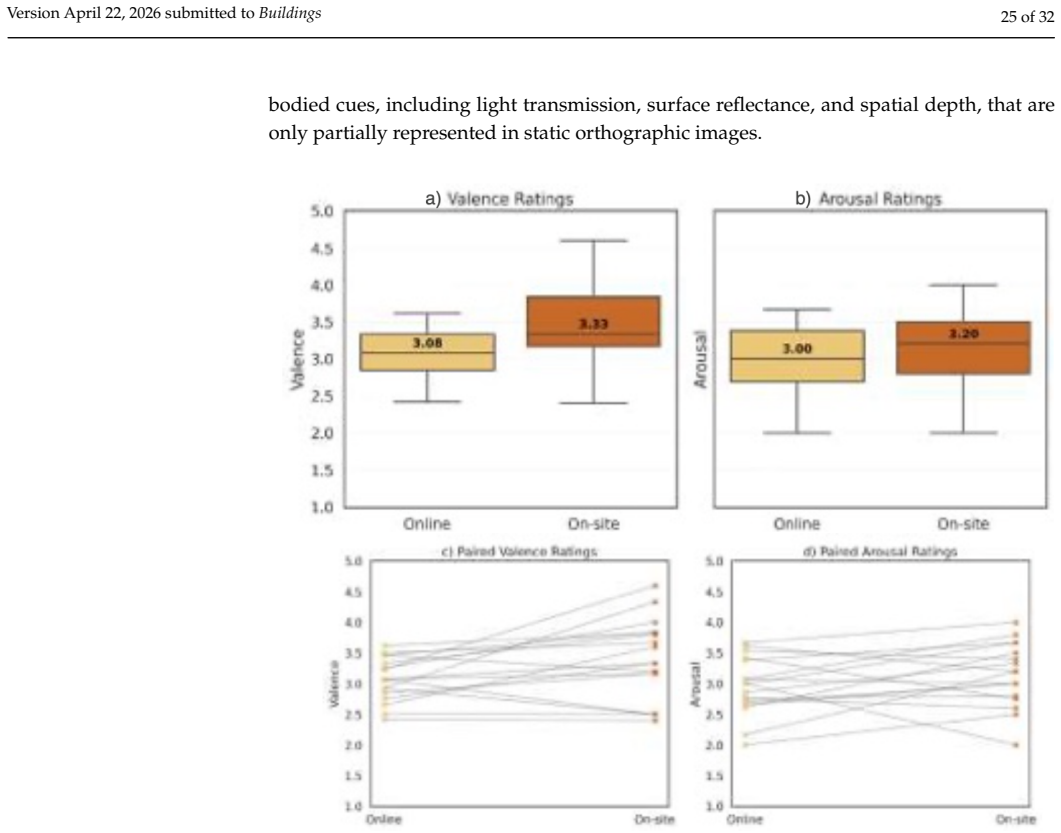
Buildings shape how people feel, yet the mechanisms through which specific facade properties drive affective states remain empirically underspecified. Here we introduce the Cambridge Facade Affect Dataset (CFAD), 86 orthogonally rectified facade images annotated with continuous arousal and valence ratings from 85 participants, and establish a validated pipeline linking machine-vision-derived surface metrics to human affective responses. Focusing on three quantifiable attributes, complexity, transparency (window-to-wall ratio), and materiality (proportion of natural versus artificial surface composition), we show that perceived complexity is the dominant affective predictor, with significant positive associations for both arousal (beta = 0.507, p < 0.001) and valence (beta = 0.376, p < 0.001) and a curvilinear amplification at higher complexity levels. Transparency exhibits an inverted-U relationship with valence, while increasing surface artificiality suppresses arousal and reduces pleasantness consistent with biophilic response theory. Critically, machine-derived metrics show limited direct predictive power over affective outcomes; mediation analyses reveal that human perceptual evaluation functions as a necessary intermediate layer, with perceived materiality significantly mediating the machine-valence relationship (indirect effect = -0.205, p = 0.003). Cross-context validation demonstrates moderate stability of complexity and materiality ratings across image-based and in-situ conditions, while affective responses, particularly valence, exhibit significant context-dependence (ICC = 0.332). These findings advance facade research from descriptive morphological analysis toward predictive, perception-grounded modelling, and provide an empirically validated basis for affect-informed design of the urban environment.
Editorial analysis
A structured set of objections, weighed in public.
Referee Report
Summary. The paper introduces the Cambridge Facade Affect Dataset (CFAD) with 86 orthogonally rectified facade images and continuous arousal/valence ratings from 85 participants. It tests three facade attributes—complexity, transparency (window-to-wall ratio), and materiality (natural vs. artificial surface proportion)—and reports that perceived complexity is the dominant predictor (arousal beta=0.507, p<0.001; valence beta=0.376, p<0.001) with curvilinear amplification at high levels. Transparency shows an inverted-U with valence, artificiality suppresses arousal, machine metrics have weak direct effects, and human perceptual ratings mediate the machine-to-affect link (e.g., perceived materiality indirect effect=-0.205, p=0.003). Cross-context validation shows moderate stability for complexity/materiality but context-dependence for valence (ICC=0.332).
Significance. If the statistical results and mediation models hold, the work supplies a reusable dataset and validated pipeline that moves facade research from purely morphological description to perception-grounded, predictive modeling. The explicit mediation tests, quadratic terms, and in-situ vs. image comparison provide falsifiable links between machine-vision metrics and affective outcomes, with direct relevance to biophilic design and urban HCI.
major comments (2)
- [§4.3] §4.3 (Mediation models): the reported indirect effect for perceived materiality on machine-valence is load-bearing for the central claim that human perception is a necessary intermediate layer, yet the manuscript does not report the full set of path coefficients, standard errors for the indirect effect, or bootstrap confidence intervals; without these the mediation conclusion cannot be fully evaluated.
- [§3.2] §3.2 (Image selection): the claim that the 86 CFAD images support general inferences about facade affect rests on the orthogonal rectification and diversity criteria, but the exact stratification by complexity/transparency/materiality bins and any exclusion rules for atypical facades are not quantified, weakening the representativeness argument for the mediation and cross-context results.
minor comments (3)
- [Table 2] Table 2: the quadratic term for complexity-arousal is significant but the manuscript does not state whether the model includes all lower-order terms and interactions; add the full regression table with all predictors.
- [Figure 4] Figure 4: the curvilinear plots lack participant-level scatter or 95% confidence bands around the fitted lines, reducing visual assessment of effect size and outlier influence.
- [§5.1] §5.1: the ICC=0.332 for valence context-dependence is reported without the corresponding ICCs for arousal or the exact formula (one-way vs. two-way random effects); clarify the ICC type and interpretation.
Simulated Author's Rebuttal
We thank the referee for the constructive and detailed feedback. The comments highlight opportunities to increase transparency in our statistical reporting and dataset documentation, which we will address in the revision.
read point-by-point responses
-
Referee: [§4.3] §4.3 (Mediation models): the reported indirect effect for perceived materiality on machine-valence is load-bearing for the central claim that human perception is a necessary intermediate layer, yet the manuscript does not report the full set of path coefficients, standard errors for the indirect effect, or bootstrap confidence intervals; without these the mediation conclusion cannot be fully evaluated.
Authors: We agree that the full mediation statistics are required to allow readers to evaluate the central claim. The manuscript currently reports only the indirect effect and its p-value. In the revised version we will expand §4.3 to include the complete path coefficients (a, b, c′), their standard errors, and 95% bootstrap confidence intervals for the indirect effects, presented in a new table. revision: yes
-
Referee: [§3.2] §3.2 (Image selection): the claim that the 86 CFAD images support general inferences about facade affect rests on the orthogonal rectification and diversity criteria, but the exact stratification by complexity/transparency/materiality bins and any exclusion rules for atypical facades are not quantified, weakening the representativeness argument for the mediation and cross-context results.
Authors: Section 3.2 describes the orthogonal rectification procedure and the intent to sample across the three attributes, but does not provide numerical bin counts or explicit exclusion criteria. We will revise §3.2 to add a quantitative summary of the stratification (number of images per complexity, transparency, and materiality bin) together with the precise exclusion rules, either in the main text or as a supplementary table. revision: yes
Circularity Check
No significant circularity in empirical derivation chain
full rationale
The manuscript reports an empirical investigation based on a new dataset (CFAD: 86 images rated by 85 participants), machine-vision surface metrics, and standard statistical procedures (linear and quadratic regressions yielding reported betas, plus mediation models with indirect effects). No equations or derivations are present that reduce any claimed result to its inputs by construction. Self-citations of prior facade work, if present, are not load-bearing for the central claims, which rest on the fresh data collection, within-subjects ratings, ICC values, and mediation estimates. The work is self-contained against external benchmarks and does not exhibit any of the enumerated circularity patterns.
Axiom & Free-Parameter Ledger
axioms (2)
- domain assumption Participant arousal and valence ratings are reliable and valid measures of affective response to static facade images.
- domain assumption The 86 selected images adequately sample the range of complexity, transparency, and materiality in real building facades.
Reference graph
Works this paper leans on
-
[1]
City living and urban upbringing affect neural social stress processing in humans
Lederbogen, F.; Kirsch, P .; Haddad, L.; Streit, F.; Tost, H.; Schuch, P .; Wüst, S.; Pruessner, J.C.; Rietschel, M.; Deuschle, M.; et al. City living and urban upbringing affect neural social stress processing in humans. Nature 2011, 474, 498–501. https://doi.org/10.1038/nature10190
-
[2]
Tost, H.; Reichert, M.; Braun, U.; Reinhard, I.; Peters, R.; Lautenbach, S.; Meyer-Lindenberg, A. Neural correlates of individual differences in affective benefit of real-life urban green space exposure. Nature Neuroscience 2015, 18, 799–805. https://doi.org/10.1038/nn.4035
-
[3]
Green infrastructure and health
Nieuwenhuijsen, M.J. Green infrastructure and health. Annual Review of Public Health 2021, 42, 317–328. https://doi.org/10.1146/annurev-publhealth-090419-102511
-
[4]
Chatterjee, A.; Vartanian, O. Neuroaesthetics. T rends in Cognitive Sciences 2014, 18, 370–375. https://doi.org/10.1016/j.tics.2014.03.003
-
[5]
Impact of contour on aesthetic judgments and approach-avoidance decisions in architecture
Vartanian, O.; Navarrete, G.; Chatterjee, A.; Fich, L.B.; Leder, H.; Modroño, C.; Nadal, M.; Rostrup, N.; Skov , M. Impact of contour on aesthetic judgments and approach-avoidance decisions in architecture. Proceedings of the National Academy of Sciences 2013, 110, 10446–10453. https://doi.org/10.1073/pnas.1301227110
-
[6]
Buildings, beauty , and the brain: A neuroscience of architectural experience
Coburn, A.; Vartanian, O.; Chatterjee, A. Buildings, beauty , and the brain: A neuroscience of architectural experience. Journal of Cognitive Neuroscience 2017, 29, 1521–1531. https://doi.org/ 10.1162/jocn_a_01146. https://doi.org/10.3390/buildings1010000 V ersion April 22, 2026 submitted to Buildings 30 of 32
-
[8]
Humanise: A maker’s guide to designing our cities ; Penguin, 2023
Heatherwick, T. Humanise: A maker’s guide to designing our cities ; Penguin, 2023
2023
-
[9]
Russell, J.A. A circumplex model of affect. Journal of Personality and Social Psychology 1980, 39, 1161–1178. https://doi.org/10.1037/h0077714
-
[10]
Russell, J.A.; Barrett, L.F. Core affect, prototypical emotional episodes, and other things called emotion: Dissecting the elephant. Journal of Personality and Social Psychology 1999, 76, 805–819. https://doi.org/10.1037/0022-3514.76.5.805
-
[11]
The theory of constructed emotion: An active inference account of interoception and categorization
Barrett, L.F. The theory of constructed emotion: An active inference account of interoception and categorization. Social Cognitive and Affective Neuroscience 2017, 12, 1–23. https://doi.org/ 10.1093/scan/nsw154
-
[12]
Environmental neuroscience unravels the pathway from the physical environment to mental health
Kühn, S.; Gallinat, J. Environmental neuroscience unravels the pathway from the physical environment to mental health. Nature Mental Health 2024, 2, 263–269. https://doi.org/10.103 8/s44220-023-00137-6
2024
-
[13]
On the relationship between emotion and cognition
Pessoa, L. On the relationship between emotion and cognition. Nature Reviews Neuroscience 2008, 9, 148–158. https://doi.org/10.1038/nrn2317
-
[14]
Urban green spaces and health: A review of evidence, 2016
World Health Organization Regional Office for Europe. Urban green spaces and health: A review of evidence, 2016
2016
-
[15]
Psychological and neural responses to architectural interiors
Coburn, A.; Vartanian, O.; Kenett, Y .N.; Nadal, M.; Hartung, F.; Hayn-Leichsenring, G.; Navar- rete, G.; González Mora, J.L.; Chatterjee, A. Psychological and neural responses to architectural interiors. Cortex 2020, 126, 217–241. https://doi.org/10.1016/j.cortex.2020.01.009
-
[16]
Measuring the unmeasurable: Urban design qualities related to walkabil- ity
Ewing, R.; Handy , S. Measuring the unmeasurable: Urban design qualities related to walkabil- ity . Journal of Urban Design 2009, 14, 65–84. https://doi.org/10.1080/13574800802451155
-
[17]
Deep learning the city: Quantifying urban perception at a global scale
Dubey , A.; Naik, N.; Parikh, D.; Raskar, R.; Hidalgo, C.A. Deep learning the city: Quantifying urban perception at a global scale. In Proceedings of the Proceedings of the European Confer- ence on Computer Vision. Springer, 2016, pp. 196–212. https://doi.org/10.1007/978-3-319-46 448-0_12
-
[18]
Using deep learning to quantify the beauty of outdoor places
Seresinhe, C.I.; Preis, T.; Moat, H.S. Using deep learning to quantify the beauty of outdoor places. Royal Society Open Science 2017, 4, 170170. https://doi.org/10.1098/rsos.170170
-
[19]
Proceedings of the Royal Society of London
Marr, D.; Hildreth, E. Theory of edge detection. Proceedings of the Royal Society of London. Series B: Biological Sciences 1980, 207, 187–217. https://doi.org/10.1098/rspb.1980.0020
-
[20]
What makes Paris look like Paris? ACM T ransactions on Graphics2012, 31, 1–9
Doersch, C.; Singh, S.; Gupta, A.; Sivic, J.; Efros, A.A. What makes Paris look like Paris? ACM T ransactions on Graphics2012, 31, 1–9. https://doi.org/10.1145/2185520.2185597
-
[21]
Fractals, skylines, nature and beauty
Stamps, A.E. Fractals, skylines, nature and beauty . Landscape and Urban Planning 2002, 60, 163–
2002
-
[22]
https://doi.org/10.1016/S0169-2046(02)00054-3
-
[24]
Adaptive façades for emotionally enriching indoor environments
Beatini, V .; Pantilimonescu, F.; Djebbara, Z.; Drı¸ scu, M.C. Adaptive façades for emotionally enriching indoor environments. Journal of Building Engineering 2024, 98, 111472. https://doi. org/10.1016/j.jobe.2024.111472
-
[25]
Urban design aesthetics: The evaluative qualities of building exteriors
Nasar, J.L. Urban design aesthetics: The evaluative qualities of building exteriors. Environment and Behavior 1994, 26, 377–401. https://doi.org/10.1177/001391659402600305
-
[26]
Akalın, A.; Yıldırım, K.; Wilson, C.; Kılıço ˘ glu, Ö. Architecture and engineering students’ eval- uations of house façades: Preference, complexity and impressiveness. Journal of Environmental Psychology 2009, 29, 124–132. https://doi.org/10.1016/j.jenvp.2008.05.005
-
[27]
Gregorians, L.; Fernandez V elasco, P .; Zisch, F.E.; Spiers, H.J. Architectural experience: Clar- ifying its central components and their relation to core affect with a set of first-person-view videos. bioRxiv 2022. Preprint, https://doi.org/10.1101/2022.04.05.487021
-
[28]
Lindal, P .J.; Hartig, T. Architectural variation, building height, and the restorative quality of urban residential streetscapes. Journal of Environmental Psychology 2013, 33, 26–36. https: //doi.org/10.1016/j.jenvp.2012.09.003
-
[29]
Aesthetics and Psychobiology; Appleton-Century-Crofts, 1971
Berlyne, D.E. Aesthetics and Psychobiology; Appleton-Century-Crofts, 1971. https://doi.org/10.3390/buildings1010000 V ersion April 22, 2026 submitted to Buildings 31 of 32
-
[30]
˙Imamo ˘ glu, Ç. Complexity , liking and familiarity: Architecture and non-architecture Turkish students’ assessments of traditional and modern house façades. Journal of Environmental Psy- chology 2000, 20, 5–16. https://doi.org/10.1006/jevp.1999.0155
-
[31]
The Ecological Approach to Visual Perception ; Houghton Mifflin, 1979
Gibson, J.J. The Ecological Approach to Visual Perception ; Houghton Mifflin, 1979
1979
-
[32]
The restorative benefits of nature: Toward an integrative framework
Kaplan, S. The restorative benefits of nature: Toward an integrative framework. Journal of Environmental Psychology 1995, 15, 169–182. https://doi.org/10.1016/0272-4944(95)90001-2
-
[33]
Stress recovery during exposure to natural and urban environments
Ulrich, R.S.; Simons, R.F.; Losito, B.D.; Fiorito, E.; Miles, M.A.; Zelson, M. Stress recovery during exposure to natural and urban environments. Journal of Environmental Psychology 1991, 11, 201–230. https://doi.org/10.1016/S0272-4944(05)80184-7
-
[34]
Cognitive Psychology; Appleton-Century-Crofts, 1967
Neisser, U. Cognitive Psychology; Appleton-Century-Crofts, 1967
1967
-
[35]
Zajonc, R.B. On the primacy of affect. American Psychologist 1984, 39, 117–123. https://doi. org/10.1037/0003-066X.39.2.117
-
[36]
Emotion and Adaptation; Oxford University Press, 1991
Lazarus, R.S. Emotion and Adaptation; Oxford University Press, 1991
1991
-
[37]
What are emotions? and how can they be measured? Social science information , 44(4): 695–729, 2005
Scherer, K.R. What are emotions? And how can they be measured? Social Science Information 2005, 44, 695–729. https://doi.org/10.1177/0539018405058216
-
[38]
The urban brain: Analysing outdoor physical activity with mobile EEG
Aspinall, P .; Mavros, P .; Coyne, R.; Roe, J. The urban brain: Analysing outdoor physical activity with mobile EEG. British Journal of Sports Medicine 2013, 49, 272–276. https://doi.org/10.1136/ bjsports-2012-091877
2013
-
[39]
Zhang, Z.; Zhuo, K.; Wei, W.; Li, F.; Yin, J.; Xu, L. Emotional responses to the visual patterns of urban streets: Evidence from physiological and subjective indicators. International Journal of Environmental Research and Public Health 2021, 18, 9677. https://doi.org/10.3390/ijerph18189 677
-
[40]
The impact of architectural form on physiological stress: a systematic review
Valentine, C. The impact of architectural form on physiological stress: a systematic review. Frontiers in Computer Science 2024, 5, 1237531. https://doi.org/10.3389/fcomp.2023.1237531
-
[41]
Aydın, Y .C.; Mirzaei, P .A. A novel mathematical model to measure individuals’ perception of the symmetry level of building façades. Architectural Engineering and Design Management 2022, 18, 261–278. https://doi.org/10.1080/17452007.2020.1862042
-
[42]
Hashemi Kashani, S.M.; Pazhouhanfar, M.; van Oel, C.J. Role of physical attributes of preferred building façades on perceived visual complexity: A discrete choice experiment. Environment, Development and Sustainability 2023, 25, 9458–9477. https://doi.org/10.1007/s10668-023-02980 -0
-
[43]
Tall buildings and the urban skyline: The effect of visual com- plexity on preferences
Heath, T.; Smith, S.G.; Lim, B. Tall buildings and the urban skyline: The effect of visual com- plexity on preferences. Environment and Behavior 2000, 32, 541–556. https://doi.org/10.1177/ 00139160021972658
2000
-
[44]
The aesthetic advantage of greener cities: Measuring affective perception of urban streetscapes
Hollander, J.B.; Anderson, E.C. The aesthetic advantage of greener cities: Measuring affective perception of urban streetscapes. Urban Forestry & Urban Greening 2020, 48, 126576. https: //doi.org/10.1016/j.ufug.2019.126576
-
[45]
The influence of emotional response and aesthetic perception of shopping mall façade color on entry decisions
Zhu, Z.; Liu, Y .; Chen, Y . The influence of emotional response and aesthetic perception of shopping mall façade color on entry decisions. Buildings 2024, 14, 2302. https://doi.org/10.3 390/buildings14082302
2024
-
[46]
Affective response to architecture: Investigating human reaction to spaces with different geometry
Shemesh, A.; Talmon, R.; Karp, O.; Amir, I.; Bar, M.; Grobman, Y .J. Affective response to architecture: Investigating human reaction to spaces with different geometry . Architectural Science Review 2017, 60, 116–125. https://doi.org/10.1080/00038628.2016.1266597
-
[47]
Zhao, J.; Suo, W. Research on the construction and application of a SVM-based quantification model for streetscape visual complexity . Land 2024, 13, 1953. https://doi.org/10.3390/land1 3111953
-
[48]
Marin, M.M.; Leder, H. Berlyne revisited: Evidence for the multifaceted nature of hedonic tone in the appreciation of paintings and music. Frontiers in Human Neuroscience 2016, 10, 536. https://doi.org/10.3389/fnhum.2016.00536
-
[49]
Reber, R.; Schwarz, N.; Winkielman, P . Processing fluency and aesthetic pleasure: Is beauty in the perceiver’s processing experience? Personality and Social Psychology Review 2004, 8, 364–382. https://doi.org/10.1207/s15327957pspr0804_3
-
[50]
Beder, D.; Pelowski, M.; ˙Imamo ˘ glu, Ç. Influence of complexity and Gestalt principles on aes- thetic preferences for building façades: An eye-tracking study . Journal of Eye Movement Research 2024, 17, 1–15. https://doi.org/10.16910/jemr.17.2.4. https://doi.org/10.3390/buildings1010000 V ersion April 22, 2026 submitted to Buildings 32 of 32
-
[51]
Greenery on residential buildings: Does it affect preferences and perceptions of beauty? Journal of Environmental Psychology 2011, 31, 89–98
White, E.V .; Gatersleben, B. Greenery on residential buildings: Does it affect preferences and perceptions of beauty? Journal of Environmental Psychology 2011, 31, 89–98. https://doi.org/10 .1016/j.jenvp.2010.11.002
2011
-
[52]
Windows, view, and office characteristics predict physical and psychological discomfort
Ariës, M.B.C.; V eitch, J.A.; Newsham, G.R. Windows, view, and office characteristics predict physical and psychological discomfort. Journal of Environmental Psychology 2010, 30, 533–541. https://doi.org/10.1016/j.jenvp.2009.12.004
-
[53]
Wang, F.; Munakata, J. Simulated window views from different floors: How roof types of surrounding buildings associate with subjective restoration. Urban Forestry & Urban Greening 2023, 80, 128096. https://doi.org/10.1016/j.ufug.2023.128096
-
[54]
Yin, J.; Zhu, S.; MacNaughton, P .; Allen, J.G.; Spengler, J.D. Physiological and cognitive performance of exposure to biophilic indoor environments. Building and Environment 2023, 228, 109810. https://doi.org/10.1016/j.buildenv .2018.01.006
-
[55]
Tarkhan, N.; Klimenka, M.; Fang, K.; Duarte, F.; Ratti, C.; Reinhart, C. Mapping façade materi- als utilizing zero-shot segmentation for applications in urban microclimate research. Scientific Reports 2025, 15, 5492. https://doi.org/10.1038/s41598-025-86307-1
-
[56]
Pyvision: Agentic vision with dynamic tooling.CoRR, abs/2507.07998, 2025
Lüddecke, T.; Ecker, A.S. Image segmentation using text and image prompts. In Proceedings of the Proceedings of the IEEE/CVF Conference on Computer Vision and Pattern Recognition, 2022, pp. 7086–7096. https://doi.org/10.48550/arXiv .2112.10003
work page internal anchor Pith review doi:10.48550/arxiv 2022
-
[57]
Measuring emotion: the self-assessment manikin and the semantic differential
Bradley , M.M.; Lang, P .J. Measuring emotion: The Self-Assessment Manikin and the Semantic Differential. Journal of Behavior Therapy and Experimental Psychiatry 1994, 25, 49–59. https: //doi.org/10.1016/0005-7916(94)90063-9
-
[58]
Higuera-Trujillo, J.L.; Llinares, C.; Macagno, E. The cognitive-emotional design and study of architectural space: A scoping review of neuroarchitecture and its precursor approaches. Sensors 2021, 21, 2193. https://doi.org/10.3390/s21062193
-
[59]
Chiamulera, C.; Padovani, M.; Beltramello, A.; Sartori, G.; Broggio, E.; Perini, L. Measuring arousal and valence generated by the dynamic experience of architectural forms in virtual environments. Scientific Reports 2022, 12, 13303. https://doi.org/10.1038/s41598-022-17689-9
-
[60]
Walking through architectural spaces: The impact of interior forms on human brain dynamics
Banaei, M.; Hatami, J.; Yazdanfar, A.; Gramann, K. Walking through architectural spaces: The impact of interior forms on human brain dynamics. Frontiers in Human Neuroscience 2017, 11, 477. https://doi.org/10.3389/fnhum.2017.00477
-
[61]
Westfall, J.; Kenny , D.A.; Judd, C.M. Statistical power and optimal design in experiments in which samples of participants respond to samples of stimuli. Journal of Experimental Psychology: General 2014, 143, 2020–2045. https://doi.org/10.1037/xge0000014
-
[62]
Power analysis and effect size in mixed-effects models: A tutorial
Brysbaert, M.; Stevens, M. Power analysis and effect size in mixed-effects models: A tutorial. Journal of Cognition 2018, 1, 1–20. https://doi.org/10.5334/joc.10
-
[63]
Masked autoencoders are scalable vision learners
Liu, Z.; Hu, H.; Lin, Y .; Yao, Z.; Xie, Z.; Wei, Y .; Ning, J.; Cao, Y .; Zhang, Z.; Dong, L.; et al. Swin Transformer V2: Scaling up capacity and resolution. In Proceedings of the Proceedings of the IEEE/CVF Conference on Computer Vision and Pattern Recognition, 2022, pp. 11999–12009. https://doi.org/10.1109/CVPR52688.2022.01170
-
[64]
Seeing the city: Using eye-tracking technology to explore cognitive responses to the built environment
Hollander, J.B.; Purdy , A.; Wiley , A.; Foster, V .; Jacob, R.J.K.; Taylor, H.A.; Brunié, T.T. Seeing the city: Using eye-tracking technology to explore cognitive responses to the built environment. Journal of Urbanism: International Research on Placemaking and Urban Sustainability 2019, 12, 156–
2019
-
[65]
https://doi.org/10.1080/17549175.2018.1531908
-
[66]
Context based emotion recognition using EMOTIC dataset
Kosti, R.; Álvarez, J.M.; Recasens, A.; Lapedriza, À. Context based emotion recognition using EMOTIC dataset. IEEE T ransactions on Pattern Analysis and Machine Intelligence 2020, 42, 2755–
2020
-
[67]
Alvarez, Adria Recasens, and Agata Lapedriza
https://doi.org/10.1109/TPAMI.2019.2916866. https://doi.org/10.3390/buildings1010000
discussion (0)
Sign in with ORCID, Apple, or X to comment. Anyone can read and Pith papers without signing in.