Thrust Regulation Through Wing Linkage Modulation on the Aerobat Platform: Piezoelectric Slip-Stick Actuated Regulator Development
Pith reviewed 2026-05-10 03:47 UTC · model grok-4.3
The pith
Modulating the length of a key wing linkage allows independent thrust control in a bat-inspired flapping robot.
A machine-rendered reading of the paper's core claim, the machinery that carries it, and where it could break.
Core claim
This work establishes linkage-length modulation via embedded slip-stick actuation as a viable approach to independent wing thrust control. Static experiments confirm that altering the R1 link length directly impacts lift force magnitude and timing, while the developed mechanism provides the means to achieve such modulation in operation.
What carries the argument
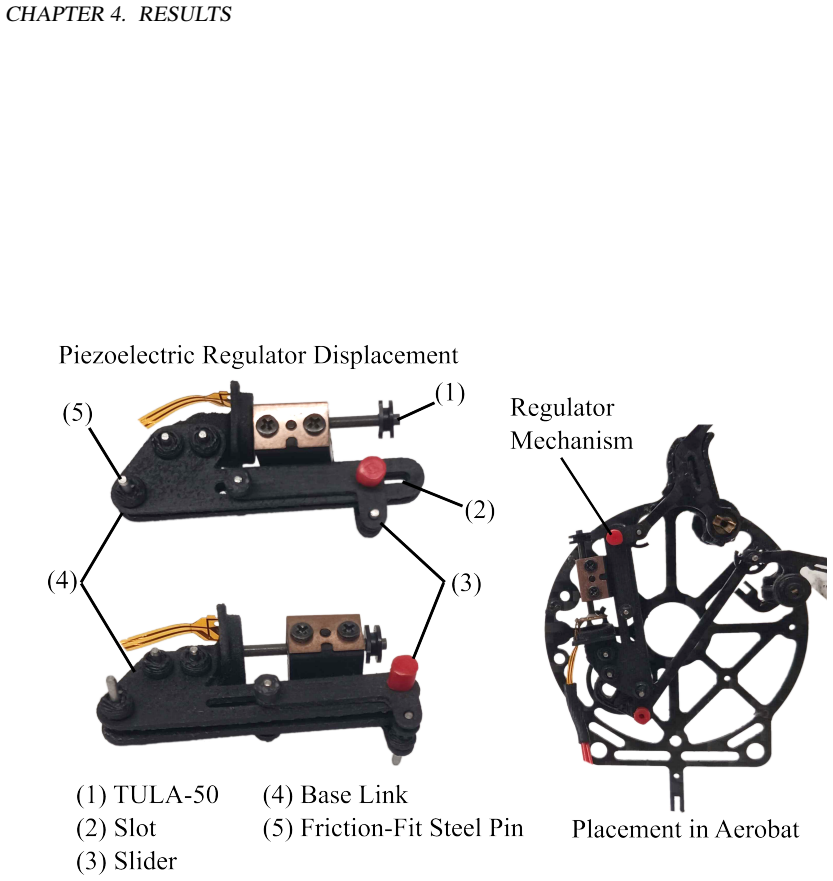
The direct-drive variable-length mechanism actuated by the TULA-50 piezoelectric slip-stick actuator, which adjusts the effective length of the R1 link in the computational structure linkage.
If this is right
- Independent control of each wing's thrust becomes possible without adding weight from separate motors.
- The observed 37% lift increase and shifted peak timing suggest improved maneuverability during flapping cycles.
- Piezoelectric slip-stick actuation provides a lightweight, embedded solution suitable for small-scale robots.
- Similar length modulation could extend to other planar linkage mechanisms in flapping-wing designs.
Where Pith is reading between the lines
- If the force output of the actuator is improved, full dynamic testing and flight experiments could validate real-time thrust regulation.
- The compliance issues in earlier mechanisms highlight the need for stiffer structural components in such regulators.
- This method might enable more efficient energy use by optimizing force timing without changing the main motor speed.
Load-bearing premise
That the force-amplifying mechanism paired with the TULA-50 piezoelectric actuator can generate enough output force to modulate the link during actual flapping motion.
What would settle it
A successful dynamic test where the mechanism modulates the R1 link length at 3-5 Hz flapping frequencies and produces measurable changes in lift force without actuator stalling.
Figures





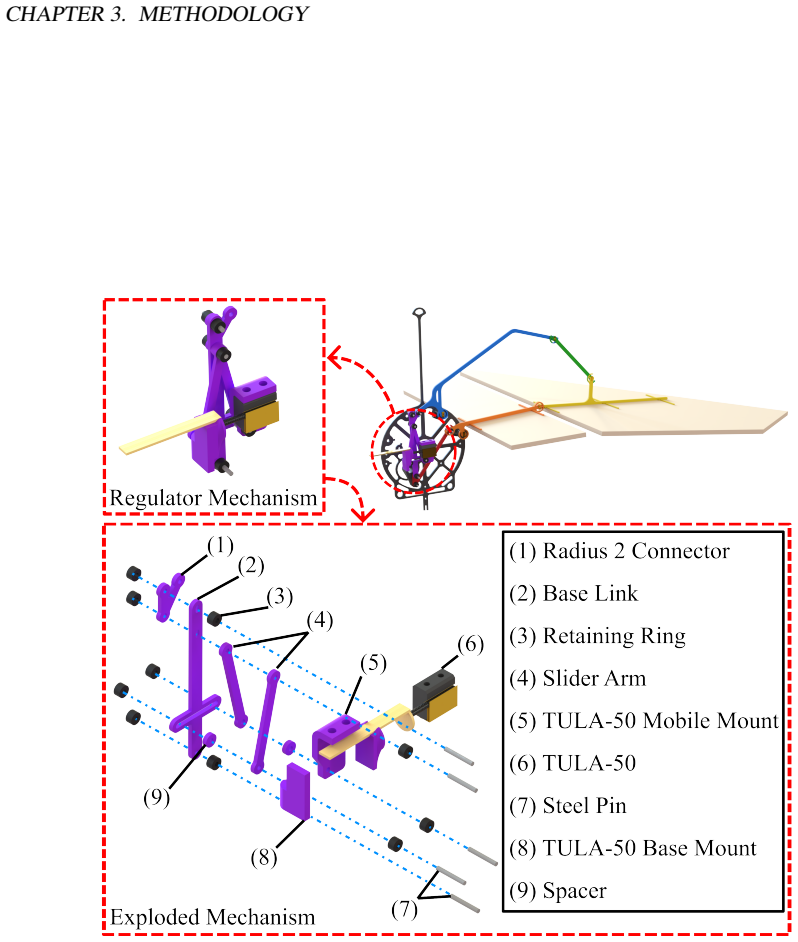
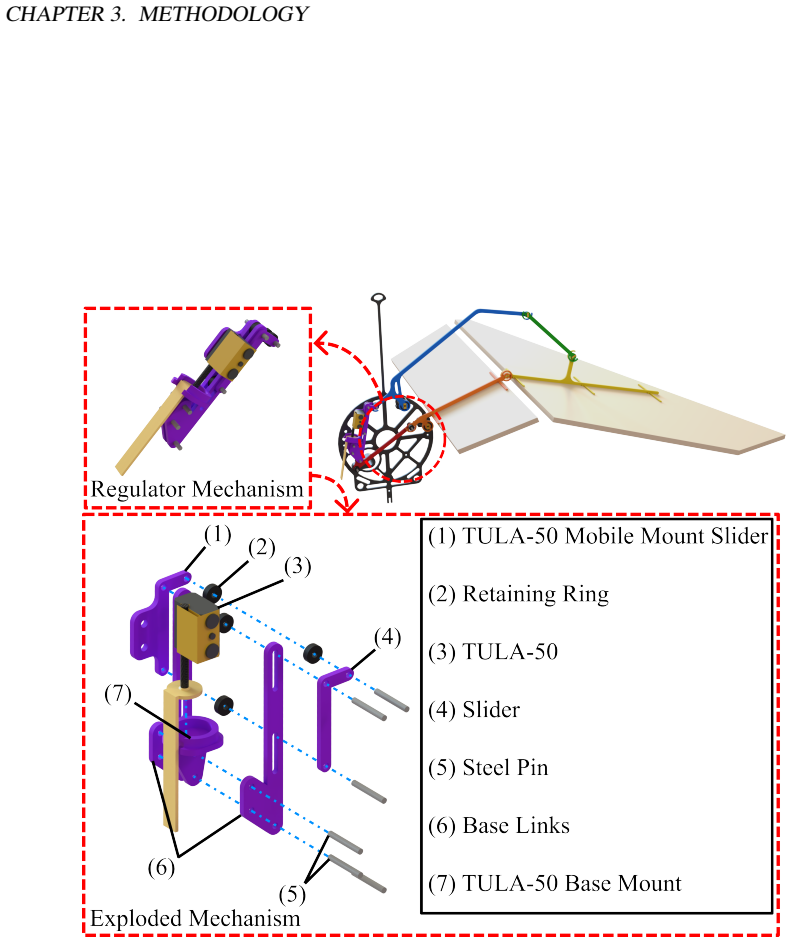
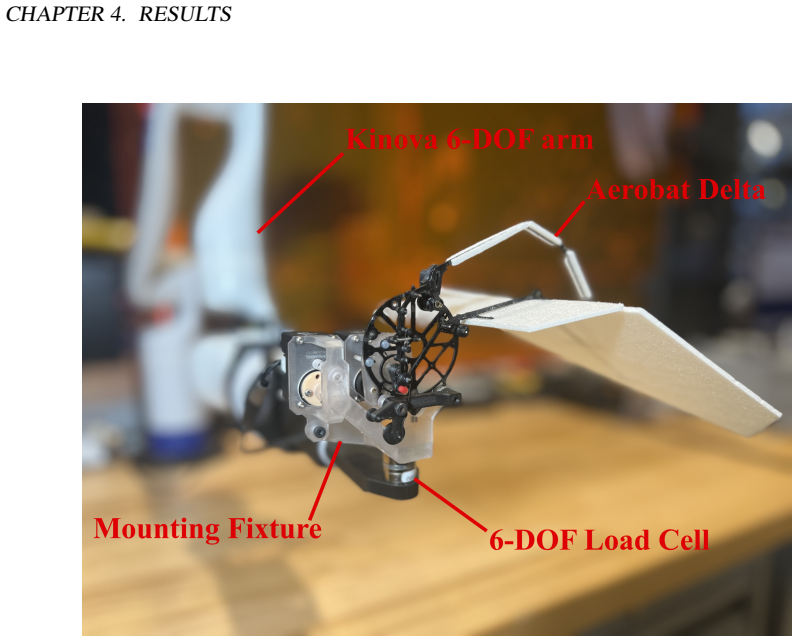


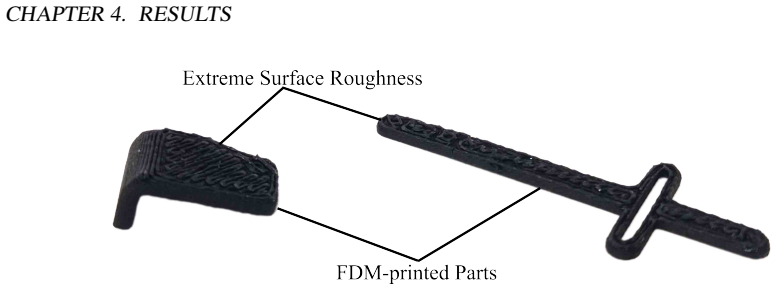
read the original abstract
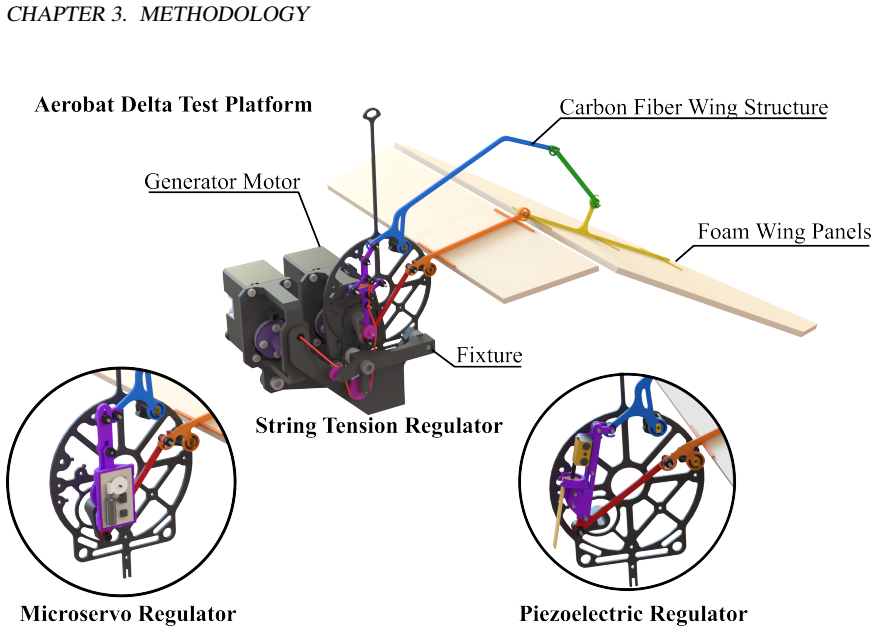
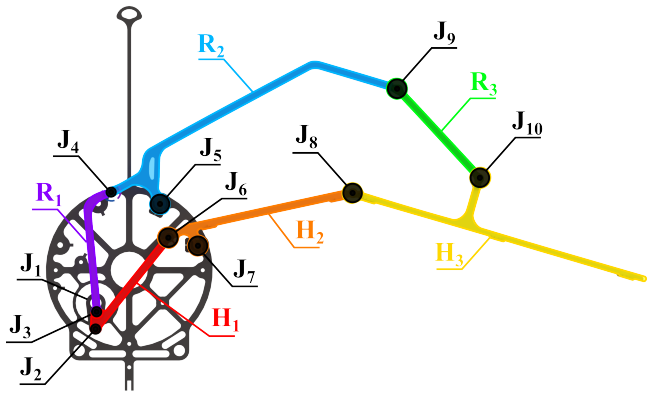
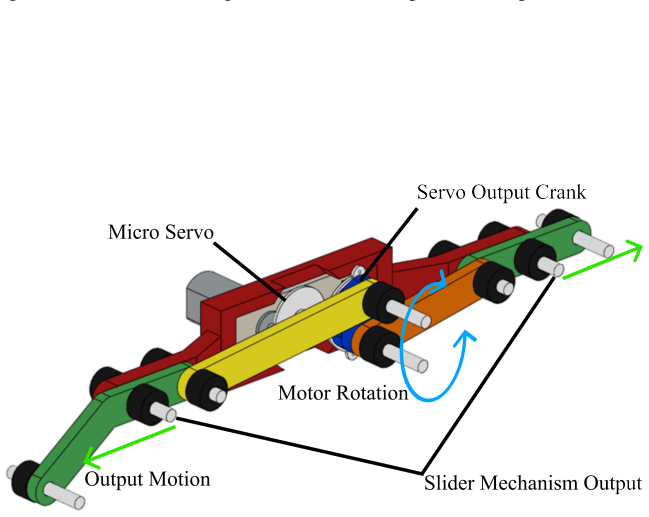
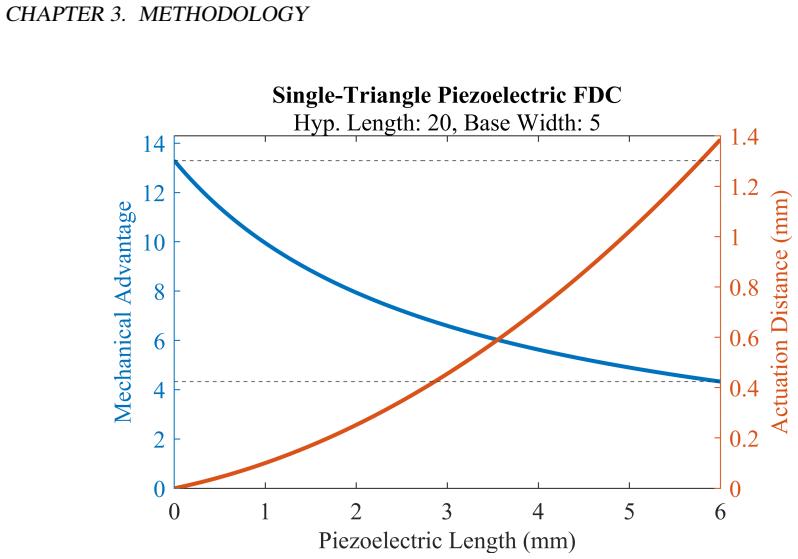
Aerobat is a bat-inspired flapping-wing robot with a wing gait generate by the computational structure, a planar linkage of carbon fiber links driven by a single motor. This design minimizes weight but couples both wings to a shared input motor, eliminating independent thrust control and preventing asymmetric maneuvers. This thesis investigates thrust regulation by modifying the effective length of the first radius link $R_1$ in the computational structure. Static experiments using FDM-printed $R_1$ links at three lengths (28.58, 29.33, and 30.08 mm) across 3,4, and 5 Hz flapping frequencies demonstrated that a 1.5 mm length increase produced a 37% increase in peak lift force and shifted peak force timing within the downstroke. An additional experiment using a string-actuated regulator mechanism was performed. Further actuation methods were evaluated: sub-gram micro-servo and piezoelectric slip-stick. After both the string-tension and micro-servo actuation methods failed due to structural member compliance and motor fragility respectively, a TULA-50 piezoelectric slip-stick actuator was selected. Multiple force-amplifying mechanisms were prototyped, resulting in a direct-drive variable-length mechanism. This final mechanism was demonstrated in a preliminary bench-top test, though insufficient force output prevented dynamic testing during flapping. This work establishes linkage-length modulation via embedded slip-stick actuation as a viable approach to independent wing thrust control.
Editorial analysis
A structured set of objections, weighed in public.
Referee Report
Summary. The manuscript investigates thrust regulation for the Aerobat bat-inspired flapping-wing robot by modulating the effective length of the R1 link in its single-motor computational structure. Static experiments with FDM-printed R1 links of lengths 28.58 mm, 29.33 mm, and 30.08 mm at 3–5 Hz flapping frequencies demonstrate that a 1.5 mm length increase yields up to 37% higher peak lift force and shifts peak timing. Multiple actuation approaches (string, micro-servo, piezoelectric slip-stick) were evaluated; after others failed, a direct-drive mechanism using the TULA-50 piezoelectric slip-stick actuator was prototyped and bench-tested, but insufficient force output prevented dynamic flapping tests. The work concludes that this establishes linkage-length modulation via embedded slip-stick actuation as a viable approach to independent wing thrust control.
Significance. The static experimental results provide clear, reproducible physical evidence that R1 length directly affects lift force magnitude and timing, offering a potential lightweight path to asymmetric thrust without extra motors. If the force-output limitation of the TULA-50 mechanism can be resolved, the approach could meaningfully advance independent control in flapping-wing platforms. However, the absence of dynamic modulation under flapping loads means the practical significance for embedded actuation remains prospective rather than demonstrated.
major comments (2)
- [Abstract] Abstract: The claim that the work 'establishes linkage-length modulation via embedded slip-stick actuation as a viable approach to independent wing thrust control' is not supported by the reported results. The final TULA-50 direct-drive prototype was shown only in a preliminary bench-top test; the manuscript explicitly states that insufficient force output prevented dynamic testing during flapping, leaving the viability of the actuation method for the intended use case unproven.
- [The manuscript] The manuscript: The static length-sensitivity results (37% lift change) are load-bearing for the sensitivity claim but do not address the central requirement of embedded, load-bearing modulation. The gap between fixed-link experiments and the failed dynamic actuation test undermines the transition to the viability conclusion without additional evidence or revised scope.
minor comments (1)
- [Abstract] The abstract references an additional string-actuated regulator experiment without providing quantitative results or comparison to the printed-link data; expanding this in the main text would improve clarity on why it was abandoned.
Simulated Author's Rebuttal
We thank the referee for the thoughtful and constructive review. We agree that the abstract overstates the strength of the evidence for viability of the embedded actuation under load, and we will revise the manuscript accordingly to temper claims, better articulate the gap between static sensitivity results and dynamic actuation, and add explicit discussion of limitations and future work. The static experiments remain a core contribution demonstrating the principle of thrust regulation via R1 modulation.
read point-by-point responses
-
Referee: [Abstract] Abstract: The claim that the work 'establishes linkage-length modulation via embedded slip-stick actuation as a viable approach to independent wing thrust control' is not supported by the reported results. The final TULA-50 direct-drive prototype was shown only in a preliminary bench-top test; the manuscript explicitly states that insufficient force output prevented dynamic testing during flapping, leaving the viability of the actuation method for the intended use case unproven.
Authors: We concur that the abstract's concluding claim exceeds what the results demonstrate. The bench-top test confirms basic functionality of the direct-drive TULA-50 mechanism for length modulation, and the static experiments quantify the lift sensitivity (up to 37% peak increase for 1.5 mm change), but without integrated flapping tests the full viability under aerodynamic loads remains unproven. We will revise the abstract to state that the work develops a prototype mechanism and provides supporting static evidence, thereby establishing the approach as promising for independent thrust control rather than definitively viable. revision: yes
-
Referee: [The manuscript] The manuscript: The static length-sensitivity results (37% lift change) are load-bearing for the sensitivity claim but do not address the central requirement of embedded, load-bearing modulation. The gap between fixed-link experiments and the failed dynamic actuation test undermines the transition to the viability conclusion without additional evidence or revised scope.
Authors: The static results are foundational because they isolate and quantify the direct causal effect of R1 length on lift magnitude and timing, which is a prerequisite for any modulation strategy. The manuscript then details the systematic evaluation of actuation methods (string, micro-servo, and piezoelectric slip-stick), the design iterations for force amplification, and the resulting direct-drive prototype that successfully modulates length in bench tests. While we acknowledge the gap to load-bearing dynamic operation, the prototype development itself constitutes evidence that embedded slip-stick actuation is feasible in principle. We will revise the manuscript to explicitly discuss this transition, state the force-output limitation as a current engineering constraint, and outline targeted next steps (e.g., actuator selection or mechanical advantage improvements) to close the gap. revision: yes
Circularity Check
No significant circularity; purely experimental paper with no derivations
full rationale
The manuscript contains no mathematical derivations, equations, fitted parameters, predictions, or self-citations of uniqueness theorems. All content consists of hardware prototyping descriptions and direct physical bench-top measurements of lift force under static length changes. The central claim of viability rests on experimental outcomes rather than any reduction of outputs to inputs by construction, satisfying the default expectation of non-circularity for experimental work.
Axiom & Free-Parameter Ledger
Reference graph
Works this paper leans on
-
[1]
Pohl, D. W. , title =. Review of Scientific Instruments , volume =. 1987 , doi =
work page 1987
-
[2]
Renner, Ch. and Niedermann, Ph. and Kent, A. D. and Fischer,. A Vertical Piezoelectric Inertial slider , journal =. 1990 , doi =
work page 1990
- [3]
-
[4]
Li, J. and Huang, H. and Morita, T. , title =. Sensors and Actuators A: Physical , volume =. 2019 , doi =
work page 2019
- [5]
-
[6]
International Journal of Smart and Nano Materials , volume =
Yingqi Lin and Dawei An and Zhenyu Lin and Xiaoting Chen and Weiqing Huang , title =. International Journal of Smart and Nano Materials , volume =. 2024 , publisher =
work page 2024
-
[7]
Zhong, B. W. and Liao, Z. and Hu, H. Z. and Liu, S. L. and He, C. G. and Sun, L. N. , title =. Precision Engineering , volume =. 2025 , doi =
work page 2025
-
[8]
Ma, K. Y. and Chirarattananon, P. and Fuller, S. B. and Wood, R. J. , title =. Science , volume =. 2013 , doi =
work page 2013
-
[9]
Ozaki, T. and Hamaguchi, K. , title =. IEEE Robotics and Automation Letters , volume =. 2018 , doi =
work page 2018
-
[10]
Jafferis, N. T. and Helbling, E. F. and Karpelson, M. and Wood, R. J. , title =. Nature , volume =. 2019 , doi =
work page 2019
-
[11]
Yang, X. and Chen, Y. and Chang, L. and Calder\'. IEEE Robotics and Automation Letters , volume =. 2019 , doi =
work page 2019
-
[12]
Ozaki, T. and Ohta, N. and Jimbo, T. and Hamaguchi, K. , title =. Nature Electronics , volume =. 2021 , doi =
work page 2021
-
[13]
Ozaki, T. and Ohta, N. and Jimbo, T. and Hamaguchi, K. , title =. IEEE Robotics and Automation Letters , volume =. 2023 , doi =
work page 2023
-
[14]
Zhang, C. and Rossi, C. , title =. Bioinspiration & Biomimetics , volume =. 2017 , doi =
work page 2017
-
[15]
Ryu, S. W. and Lee, J. G. and Kim, H. J. , title =. Journal of Bionic Engineering , volume =. 2020 , doi =
work page 2020
-
[16]
Singh, S. and Zuber, M. and Hamidon, M. N. and Mazlan, N. and Basri, A. A. and Ahmad, K. A. , title =. Progress in Aerospace Sciences , volume =. 2022 , doi =
work page 2022
-
[17]
Han, J.-H. and Han, Y.-J. and Yang, H.-H. and Lee, S.-G. and Lee, E.-H. , title =. Aerospace , volume =. 2023 , doi =
work page 2023
-
[18]
Nekoo, S. R. and Rashad, R. and De Wagter, C. and Fuller, S. B. and de Croon, G. and Stramigioli, S. and Ollero, A. , title =. The International Journal of Robotics Research , year =
-
[19]
Breguet, J.-M. and Clavel, R. , title =. Proceedings of the International Symposium on Micromechatronics and Human Science (MHS) , pages =. 1998 , doi =
work page 1998
-
[20]
Edeler, C. and Meyer, I. and Fatikow, S. , title =. Journal of Micro-Nano Mechatronics , volume =. 2011 , doi =
work page 2011
-
[21]
Peng, J. Y. and Chen, X. B. , title =. IEEE/ASME Transactions on Mechatronics , volume =. 2011 , doi =
work page 2011
-
[22]
Zhang, Z. M. and An, Q. and Li, J. W. and Zhang, W. J. , title =. The International Journal of Advanced Manufacturing Technology , volume =. 2012 , doi =
work page 2012
-
[23]
Karpelson, M. and Wei, G.-Y. and Wood, R. J. , title =. 2008 IEEE International Conference on Robotics and Automation (ICRA) , pages =. 2008 , doi =
work page 2008
-
[24]
Helbling, E. F. and Wood, R. J. , title =. Applied Mechanics Reviews (ASME) , volume =. 2018 , doi =
work page 2018
-
[25]
Chen, C. and Zhang, T. , title =. Micromachines , volume =. 2019 , doi =
work page 2019
-
[26]
Phan, H. V. and Park, H. C. , title =. Progress in Aerospace Sciences , volume =. 2019 , doi =
work page 2019
-
[27]
Hassanalian, M. and Abdelkefi, A. , title =. Drones , volume =. 2019 , doi =
work page 2019
- [28]
- [29]
- [30]
-
[31]
Huang, Haifeng and He, Wei and Fu, Qiang and He, Xiuyu and Sun, Changyin , journal=. A Bio-Inspired Flapping-Wing Robot With Cambered Wings and Its Application in Autonomous Airdrop , year=
-
[32]
Gerdes, J. and Holness, A. and Perez-Rosado, A. and Roberts, L. and Greisinger, A. and Barnett, E. and Kempny, J. and Lingam, D. and Yeh, C.-H. and Bruck, H. A. and Gupta, S. K. , title =. Soft Robotics , volume =. 2014 , doi =
work page 2014
-
[33]
Bruck, H. A. and Gupta, S. K. , title =. Biomimetics , volume =. 2023 , doi =
work page 2023
-
[34]
Olejnik, D. and Sujit, A. and Karasek, M. and Remes, B. and de Croon, G. , title =. 10th International Micro-Air Vehicles Conference (IMAV 2018) , address =. 2018 , url =
work page 2018
-
[35]
Ajanic, E. and Paolini, A. and Coster, C. and Floreano, D. and Johansson, C. , title =. Advanced Intelligent Systems , volume =. 2023 , doi =
work page 2023
-
[36]
Karasek, M. and Hua, A. and Nan, Y. and Lalami, M. and Preumont, A. , title =. International Micro Air Vehicle Conference and Competition (IMAV 2014) , address =
work page 2014
-
[37]
Chen, A. and Song, B. and Liu, K. and Wang, Z. and Xue, D. and Qi, H. , title =. Science Advances , year =
-
[38]
Liu, G. and Pan, E. and Sun, W. and Wang, S. and Xu, W. and Yan, L. , title =. Communications Engineering , volume =. 2025 , doi =
work page 2025
-
[39]
Chen, A. and Song, B. and Wang, Z. and Xue, D. and Liu, K. , title =. IEEE Transactions on Robotics , volume =. 2023 , doi =
work page 2023
-
[40]
Bahlman, J. W. and Swartz, S. M. and Breuer, K. S. , title =. Bioinspiration & Biomimetics , volume =. 2013 , doi =
work page 2013
-
[41]
Alireza Ramezani and Soon-Jo Chung and Seth Hutchinson , title =. Science Robotics , volume =. 2017 , doi =
work page 2017
-
[42]
Ramezani, A. and Shi, X. and Chung, S.-J. and Hutchinson, S. , title =. IEEE International Conference on Robotics and Automation (ICRA) , pages =. 2016 , doi =
work page 2016
-
[43]
Hoff, J. and Ramezani, A. and Chung, S.-J. and Hutchinson, S. , title =. Proceedings of Robotics: Science and Systems (RSS) , address =. 2016 , doi =
work page 2016
-
[44]
Hoff, J. and Ramezani, A. and Chung, S.J. and Hutchinson, S. , title =. The International Journal of Robotics Research , volume =. 2018 , doi =
work page 2018
-
[45]
Ramezani, A. and Ahmed, S. U. and Hoff, J. and Chung, S.-J. and Hutchinson, S. , title =. Conference on Biomimetic and Biohybrid Systems (Living Machines) , series =. 2017 , publisher =
work page 2017
-
[46]
Hoff, J. and Syed, U. and Ramezani, A. and Hutchinson, S. , title =. IEEE/RSJ International Conference on Intelligent Robots and Systems (IROS) , pages =
- [47]
-
[48]
Lessieur, A. and Sihite, E. and Dangol, P. and Singhal, A. and Ramezani, A. , title =. SPIE Defense + Commercial Sensing, Unmanned Systems Technology XXIII , volume =. 2021 , doi =
work page 2021
-
[49]
Sihite, E. and Ramezani, A. , title =. 59th IEEE Conference on Decision and Control (CDC) , pages =
-
[50]
Sihite, E. and Darabi, A. and Dangol, P. and Lessieur, A. and Ramezani, A. , title =. American Control Conference (ACC) , year =. 2103.16566 , archiveprefix =
- [51]
- [52]
-
[53]
Sihite, E. and Ramezani, A. , title =. The International Journal of Robotics Research , volume =. 2024 , doi =
work page 2024
-
[54]
Hovering Control of Flapping Wings in Tandem with Multi-Rotors , year=
Dhole, Aniket and Gupta, Bibek and Salagame, Adarsh and Niu, Xuejian and Xu, Yizhe and Venkatesh, Kaushik and Ghanem, Paul and Mandralis, Ioannis and Sihite, Eric and Ramezani, Alireza , journal=. Hovering Control of Flapping Wings in Tandem with Multi-Rotors , year=
-
[55]
Gupta, B. and Sihite, E. and Ramezani, A. , title =. IEEE/ASME International Conference on Advanced Intelligent Mechatronics (AIM) , address =
-
[56]
Pitroda, S. and Sihite, E. and Krishnamurthy, K.V. and Wang, C. and Salagame, A. and Ramezani, A. and Gharib, M. , title =. American Control Conference (ACC) , year =. 2411.11218 , archiveprefix =
-
[57]
Gupta, B. and Kim, M. and Park, A. and Sihite, E. and Sreenath, K. and Ramezani, A. , title =. International Conference on Intelligent Robot and Systems (IROS) , year =. 2508.02984 , archiveprefix =
-
[58]
Mandralis, I. and Nemovi, R. and Ramezani, A. and Murray, R. and Gharib, M. , title =. Communications Engineering , volume =
-
[59]
Swartz, S. M. and Middleton, K. M. , title =. Cells Tissues Organs , volume =
-
[60]
Bat flight: aerodynamics, kinematics and flight morphology , journal =
Hedenstr\". Bat flight: aerodynamics, kinematics and flight morphology , journal =
-
[61]
Riskin, D. K. and Iriarte-D\'. The effect of body size on the wing movements of pteropodid bats, with insights into thrust and lift production , journal =
-
[62]
Kinematics of slow turn maneuvering in the fruit bat
Iriarte-D\'. Kinematics of slow turn maneuvering in the fruit bat. Journal of Experimental Biology , volume =
-
[63]
Colorado, J. and Barrientos, A. and Rossi, C. and Bahlman, J. W. and Breuer, K. S. , title =. Bioinspiration & Biomimetics , volume =
-
[64]
Di Luca, M. and Mintchev, S. and Heitz, G. and Noca, F. and Floreano, D. , title =. Interface Focus , volume =
-
[65]
Micro Flier Radio , author=
-
[66]
Ramezani, A. and Shi, X. and Chung, S.-J. and Hutchinson, S. , title =. IEEE/RSJ International Conference on Intelligent Robots and Systems (IROS) , pages =
-
[67]
Ramezani, A. and Shi, X. and Chung, S.-J. and Hutchinson, S. , title =. AIAA Guidance, Navigation, and Control Conference , address =. 2016 , note =
work page 2016
-
[68]
Hoff, J. and Ramezani, A. and Chung, S.-J. and Hutchinson, S. , title =. Conference on Biomimetic and Biohybrid Systems (Living Machines) , series =. 2017 , publisher =
work page 2017
-
[69]
Ahmed, S. U. and Ramezani, A. and Chung, S.-J. and Hutchinson, S. , title =. IEEE International Conference on Robotics and Automation (ICRA) , pages =
- [70]
-
[71]
Sihite, E. and Kelly, P. and Ramezani, A. , title =. IEEE Robotics and Automation Letters , volume =
-
[72]
Sihite, E. and Kelly, P. and Ramezani, A. , title =. IEEE/RSJ International Conference on Intelligent Robots and Systems (IROS) , address =
-
[73]
Sihite, E. and Ghanem, P. and Salagame, A. and Ramezani, A. , title =. IEEE/RSJ International Conference on Intelligent Robots and Systems (IROS) , address =
-
[74]
Sihite, E. and Salagame, A. and Ghanem, P. and Ramezani, A. , title =. IEEE Conference on Decision and Control (CDC) , address =
-
[75]
Ghanem, P. and Bicer, Y. and Erdogmus, D. and Ramezani, A. , title =. IEEE Conference on Decision and Control (CDC) , address =
-
[76]
Gupta, B. and Dhole, A. and Salagame, A. and Venkatesh, K. and Ghanem, P. and Sihite, E. and Ramezani, A. , title =. IEEE/ASME International Conference on Advanced Intelligent Mechatronics (AIM) , address =
-
[77]
Sihite, E. and Ramezani, A. and Gharib, M. , title =. IEEE International Conference on Robotics and Automation (ICRA) , address =. 2024 , note =
work page 2024
-
[78]
Gupta, B. and Sihite, E. and Ramezani, A. , title =. IEEE Conference on Decision and Control (CDC) , address =
-
[79]
Kim, K. and Spieler, P. and Lupu, E. and Ramezani, A. and Chung, S.-J. , title =. Science Robotics , volume =. 2021 , note =
work page 2021
-
[80]
Sihite, E. and Kalantari, A. and Nemovi, R. and Ramezani, A. and Gharib, M. , title =. Nature Communications , volume =
discussion (0)
Sign in with ORCID, Apple, or X to comment. Anyone can read and Pith papers without signing in.