Recognition: unknown
Cosmic Ray Electron Evolution in Supernova Remnants: Log-Parabola Distribution
Pith reviewed 2026-05-10 03:13 UTC · model grok-4.3
The pith
Energy-dependent electron escape from supernova remnant shocks generates log-parabola distributions that reproduce the observed spectra in RX J1713.7-3946 and SN 1006.
A machine-rendered reading of the paper's core claim, the machinery that carries it, and where it could break.
Core claim
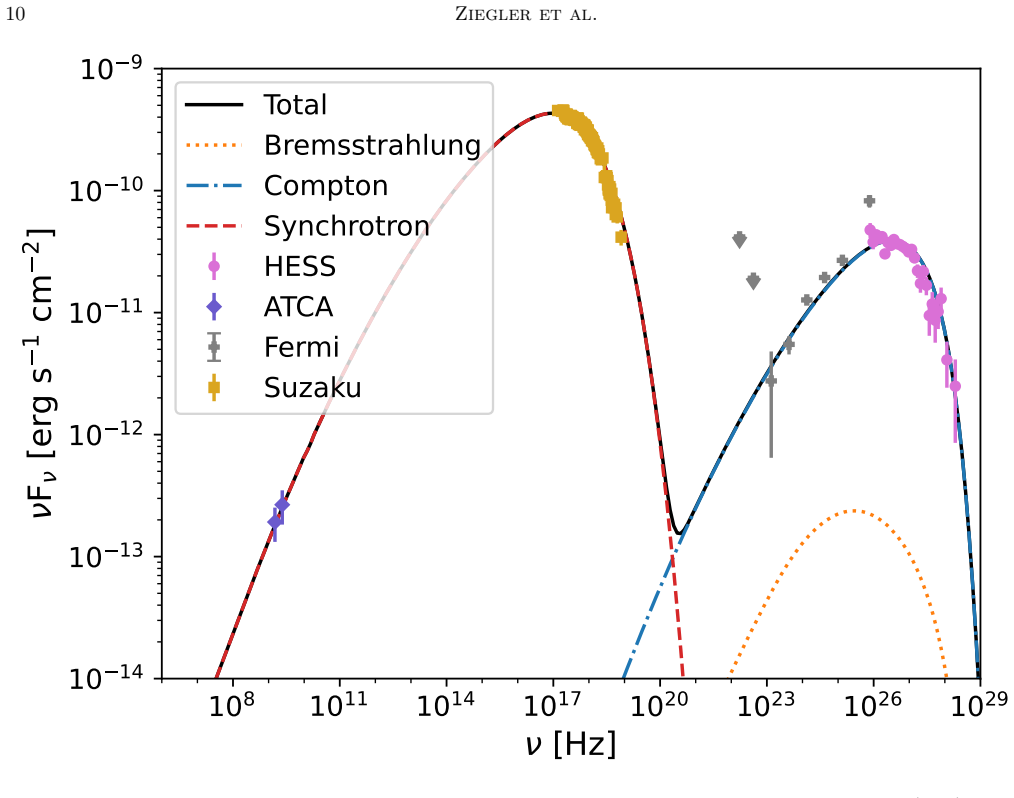
Previous work showed that energy-dependent escape can produce log-parabola particle distributions. Applied here to electrons at evolving SNR shocks, the model evolves both the electron spectrum and the emitted photon spectrum under the combined influence of remnant dynamics and radiative losses. The calculated spectra are consistent with observations of RX J1713.7-3946 and SN 1006, and remain sensitive to the precise form of the escape term despite its weak energy dependence.
What carries the argument
The energy-dependent escape term added to the electron transport equation at the SNR shock, evolved together with remnant expansion and synchrotron plus inverse-Compton losses.
If this is right
- The electron distribution and resulting photon spectra become very sensitive to small changes in the escape energy dependence.
- Both the particle spectrum and the radiation field continue to evolve as the remnant expands and electrons lose energy.
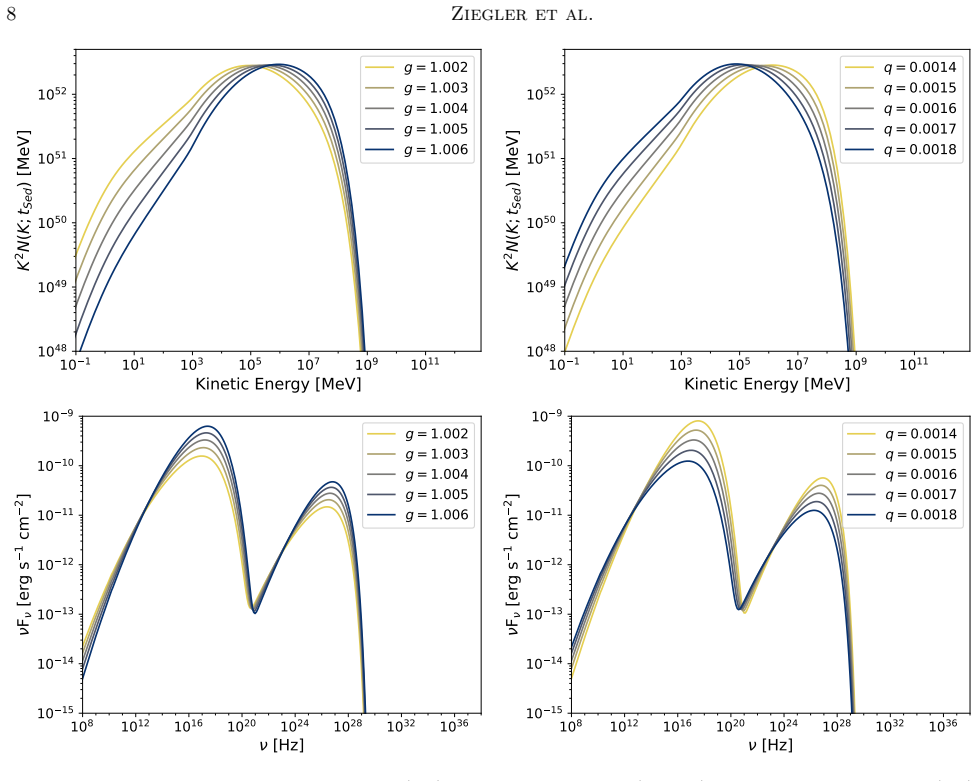
- The log-parabola parameters can be varied within the model to explore different escape scenarios while still fitting the data for the two remnants.
- This framework supplies an alternative route to curved spectra in lepton-dominated SNRs without invoking other variable parameters as the main driver.
Where Pith is reading between the lines
- The same escape modeling could be tested on additional supernova remnants to check whether the log-parabola shape appears more widely.
- Future multi-wavelength observations with improved energy resolution might directly constrain the escape energy dependence from the spectral curvature.
- Incorporating this loss process into larger-scale cosmic-ray transport calculations could alter predicted injection spectra into the interstellar medium.
Load-bearing premise
Energy-dependent escape is the dominant process setting the log-parabola shape, rather than magnetic-field variations or injection conditions controlling the spectra in the chosen remnants.
What would settle it
Higher-precision spectral measurements of RX J1713.7-3946 or SN 1006 that deviate from the time-evolved photon spectra predicted when the log-parabola electron distribution is propagated under the energy-dependent escape model.
Figures




read the original abstract
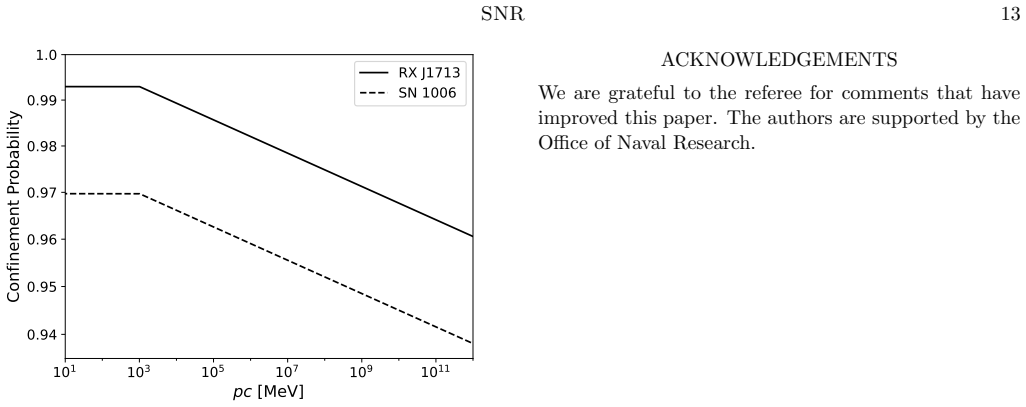
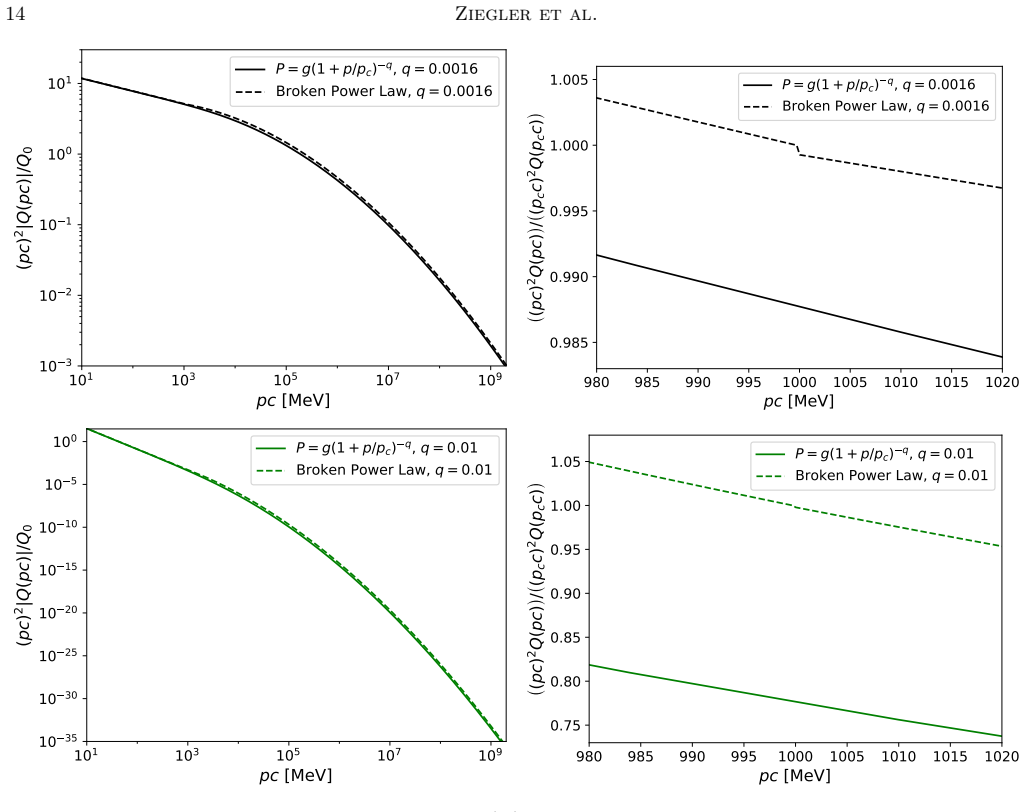
The shock fronts of supernova remnants (SNRs) are believed to be significant sites of acceleration of cosmic ray particles. Previous researchers have shown that a particle distribution similar to a log-parabola can be generated when particles have an energy-dependent escape. We explore the acceleration of electrons at SNR shock fronts, and show that modeling this energy-dependent particle escape model can produce spectral energy distributions consistent with observations of two lepton-radiation-dominated SNRs: RX J1713.7-3946 and SN 1006. The model includes the evolution of both the electron distribution and photon spectra as a result of the combined effects of the SNR evolution and electron energy loss. The electron-escape energy dependence is quite weak, but the electron distribution and photon spectra turn out to be very sensitive to changes in the electron escape. We also explore how sensitive the spectra and electron distributions are to the parameters used in the log-parabola model.
Editorial analysis
A structured set of objections, weighed in public.
Referee Report
Summary. The paper claims that incorporating an energy-dependent particle escape mechanism into models of cosmic ray electron acceleration at SNR shocks, combined with SNR evolutionary dynamics and electron energy losses, produces log-parabola electron distributions whose resulting photon SEDs are consistent with observations of the lepton-dominated remnants RX J1713.7-3946 and SN 1006. The work explores parameter sensitivity, noting that the escape dependence is weak yet the spectra are highly responsive, and demonstrates the evolution of both electron and photon spectra.
Significance. If the modeling approach holds, it offers a concrete demonstration that energy-dependent escape can contribute to the log-parabola shapes seen in specific SNRs, with explicit sensitivity tests that could guide refinements in particle acceleration theory. The inclusion of full time evolution for both particles and radiation is a positive technical feature. However, because the consistency is achieved through parameter adjustment rather than a priori prediction, the result functions more as an existence proof than a falsifiable advance, limiting its immediate impact on the field.
major comments (2)
- [Results section on photon spectra and application to the two SNRs] The central claim that the modeled SEDs are 'consistent with observations' of RX J1713.7-3946 and SN 1006 is not supported by any quantitative goodness-of-fit metric (e.g., reduced χ², residuals, or error-bar comparisons). Without these, it is impossible to judge whether the agreement is meaningful or merely visual, directly weakening the evidential basis for the result.
- [Section exploring sensitivity to electron escape energy dependence] The escape energy dependence is stated to be 'quite weak' while the electron distribution and photon spectra are described as 'very sensitive' to changes in this parameter. This tension is not resolved with explicit numerical examples from the sensitivity study, leaving unclear whether the log-parabola form is robustly produced or requires fine-tuning.
minor comments (2)
- [Abstract] The abstract refers to 'previous researchers' without a specific citation; add the relevant reference(s) for the log-parabola escape mechanism.
- [Figure captions and results figures] Figures displaying the final SEDs would be clearer if they overlaid the actual observational data points (with error bars) rather than only the model curves.
Simulated Author's Rebuttal
We thank the referee for their thorough review and constructive comments. We address each major comment point by point below.
read point-by-point responses
-
Referee: The central claim that the modeled SEDs are 'consistent with observations' of RX J1713.7-3946 and SN 1006 is not supported by any quantitative goodness-of-fit metric (e.g., reduced χ², residuals, or error-bar comparisons). Without these, it is impossible to judge whether the agreement is meaningful or merely visual, directly weakening the evidential basis for the result.
Authors: We agree that quantitative metrics strengthen the presentation. In the revised manuscript we have added reduced χ² values for the photon SED comparisons to both RX J1713.7-3946 and SN 1006, together with a residuals figure in the appendix that overlays observational error bars. These additions allow readers to assess the level of agreement directly while preserving the original emphasis on the physical origin of the log-parabola shape. revision: yes
-
Referee: The escape energy dependence is stated to be 'quite weak' while the electron distribution and photon spectra are described as 'very sensitive' to changes in this parameter. This tension is not resolved with explicit numerical examples from the sensitivity study, leaving unclear whether the log-parabola form is robustly produced or requires fine-tuning.
Authors: The wording 'quite weak' refers to the shallow power-law index of the escape probability, while 'very sensitive' describes the cumulative impact of that index on the high-energy cutoff after integration over the SNR lifetime. The revised sensitivity section now presents explicit numerical results for the electron distributions and photon spectra at several values of the escape index (fiducial value ±0.1). These examples show that the log-parabola form is maintained across the explored range, with only modest changes in curvature, indicating robustness rather than fine-tuning. revision: yes
Circularity Check
No significant circularity; consistency shown via explicit parameter exploration
full rationale
The derivation applies standard SNR evolution and electron loss equations to an energy-dependent escape ansatz taken from prior literature (not self-citation). The log-parabola form is motivated externally, and the manuscript explicitly tests sensitivity of the resulting SEDs to escape parameters and other inputs while reporting that the dependence is weak. The central claim is only that the combined model 'can produce' spectra consistent with RX J1713.7-3946 and SN 1006; this is demonstrated by forward modeling rather than by any reduction of an output to a fitted input by construction. No load-bearing step equates a prediction to its own fit or imports uniqueness via self-citation.
Axiom & Free-Parameter Ledger
free parameters (2)
- electron escape energy dependence strength
- log-parabola model parameters
axioms (2)
- domain assumption Shock fronts of supernova remnants are significant sites of cosmic ray particle acceleration
- domain assumption Energy-dependent particle escape generates a log-parabola distribution
Reference graph
Works this paper leans on
-
[1]
2018, A&A, 612, A6, doi: 10.1051/0004-6361/201629790
Abdalla, H., Abramowski, A., Aharonian, F., et al. 2018, A&A, 612, A6, doi: 10.1051/0004-6361/201629790
-
[2]
A., Ackermann, M., Ajello, M., et al
Abdo, A. A., Ackermann, M., Ajello, M., et al. 2011, ApJ, 734, 28, doi: 10.1088/0004-637X/734/1/28
-
[3]
2022, ApJS, 260, 53, doi: 10.3847/1538-4365/ac6751
Abdollahi, S., Acero, F., Baldini, L., et al. 2022, The Astrophysical Journal Supplement Series, 260, 53, doi: 10.3847/1538-4365/ac6751
-
[4]
2009, A&A, 505, 157, doi: 10.1051/0004-6361/200811556
Acero, F., Ballet, J., Decourchelle, A., et al. 2009, A&A, 505, 157, doi: 10.1051/0004-6361/200811556
-
[5]
2015, A&A, 580, A74, doi: 10.1051/0004-6361/201525932
Acero, F., Lemoine-Goumard, M., Renaud, M., et al. 2015, A&A, 580, A74, doi: 10.1051/0004-6361/201525932
-
[6]
Acero, F., Aharonian, F., Akhperjanian, A. G., et al. 2010, A&A, 516, A62, doi: 10.1051/0004-6361/200913916
-
[7]
Aharonian, F., Akhperjanian, A. G., Bazer-Bachi, A. R., et al. 2006, A&A, 449, 223, doi: 10.1051/0004-6361:20054279
-
[8]
Aharonian, F., Akhperjanian, A. G., Bazer-Bachi, A. R., et al. 2007, A&A, 464, 235, doi: 10.1051/0004-6361:20066381
-
[9]
Allen, G. E., Houck, J. C., & Sturner, S. J. 2008, ApJ, 683, 773, doi: 10.1086/589628
-
[10]
Bandiera, R., Morlino, G., Kneˇ zevi´ c, S., & Raymond, J. C. 2019, MNRAS, 483, 1537, doi: 10.1093/mnras/sty3254
-
[11]
Bell, A. R. 1978, MNRAS, 182, 147, doi: 10.1093/mnras/182.2.147
-
[12]
Benjamin, R. A., Churchwell, E., Babler, B. L., et al. 2003, PASP, 115, 953, doi: 10.1086/376696
-
[13]
Berezhko, E. G., Ksenofontov, L. T., & V¨ olk, H. J. 2012, ApJ, 759, 12, doi: 10.1088/0004-637X/759/1/12
-
[14]
Berrington, R. C., & Dermer, C. D. 2003, ApJ, 594, 709, doi: 10.1086/376981
-
[15]
Brose, R., Pohl, M., Sushch, I., Petruk, O., & Kuzyo, T. 2020, A&A, 634, A59, doi: 10.1051/0004-6361/201936567 Cassam-Chena¨ ı, G., Decourchelle, A., Ballet, J., et al. 2004, A&A, 427, 199, doi: 10.1051/0004-6361:20041154
-
[16]
2021, MNRAS, 508, 2204, doi: 10.1093/mnras/stab2380
Cristofari, P., Niro, V., & Gabici, S. 2021, MNRAS, 508, 2204, doi: 10.1093/mnras/stab2380
-
[17]
Dermer, C. D. 2012, PhRvL, 109, 091101, doi: 10.1103/PhysRevLett.109.091101
-
[18]
Ellison, D. C., & Eichler, D. 1984, ApJ, 286, 691, doi: 10.1086/162644
-
[19]
Ellison, D. C., Patnaude, D. J., Slane, P., & Raymond, J. 2010, ApJ, 712, 287, doi: 10.1088/0004-637X/712/1/287
-
[20]
2002, Nature, 416, 823, doi: 10.1038/416823a
Enomoto, R., Tanimori, T., Naito, T., et al. 2002, Nature, 416, 823, doi: 10.1038/416823a
-
[21]
Finke, J. D., & Dermer, C. D. 2012, ApJ, 751, 65, doi: 10.1088/0004-637X/751/1/65
-
[22]
2017, MNRAS, 471, 4856, doi: 10.1093/mnras/stx1833
Fraschetti, F., & Pohl, M. 2017, MNRAS, 471, 4856, doi: 10.1093/mnras/stx1833
-
[23]
2003, PASJ, 55, L61, doi: 10.1093/pasj/55.5.L61
Fukui, Y., Moriguchi, Y., Tamura, K., et al. 2003, PASJ, 55, L61, doi: 10.1093/pasj/55.5.L61
-
[24]
Gabici, S., & Aharonian, F. A. 2014, MNRAS, 445, L70, doi: 10.1093/mnrasl/slu132
-
[25]
Gardner, F. F., & Milne, D. K. 1965, AJ, 70, 754, doi: 10.1086/109813
-
[26]
Hillas, A. M. 2005, Journal of Physics G Nuclear Physics, 31, R95, doi: 10.1088/0954-3899/31/5/R02
-
[27]
Jones, F. C., & Ellison, D. C. 1991, SSRv, 58, 259, doi: 10.1007/BF01206003
-
[28]
2017, in Handbook of Supernovae, ed
Katsuda, S. 2017, in Handbook of Supernovae, ed. A. W. Alsabti & P. Murdin, 63, doi: 10.1007/978-3-319-21846-5 45
-
[29]
Katsuda, S., Petre, R., Long, K. S., et al. 2009, ApJL, 692, L105, doi: 10.1088/0004-637X/692/2/L105
-
[30]
2015, ApJ, 814, 29, doi: 10.1088/0004-637X/814/1/29
Katsuda, S., Acero, F., Tominaga, N., et al. 2015, ApJ, 814, 29, doi: 10.1088/0004-637X/814/1/29
-
[31]
Kennicutt, Jr., R. C. 1984, ApJ, 277, 361, doi: 10.1086/161702
-
[32]
Kirk, J. G. 1994, in Saas-Fee Advanced Course 24: Plasma Astrophysics, ed. J. G. Kirk, D. B. Melrose, E. R. Priest, A. O. Benz, & T. J. L. Courvoisier, 225, doi: 10.1007/3-540-31627-2 4
-
[33]
1997, PASJ, 49, L7, doi: 10.1093/pasj/49.3.L7
Koyama, K., Kinugasa, K., Matsuzaki, K., et al. 1997, PASJ, 49, L7, doi: 10.1093/pasj/49.3.L7
-
[34]
M., & Finke, J
Laming, J. M., & Finke, J. D. 2026, ApJ, submitted
2026
-
[35]
Lazendic, J. S., Slane, P. O., Gaensler, B. M., et al. 2003, ApJL, 593, L27, doi: 10.1086/378183
-
[36]
Lazendic, J. S., Slane, P. O., Gaensler, B. M., et al. 2004, ApJ, 602, 271, doi: 10.1086/380956 16Ziegler et al
-
[37]
2025, A&A, 693, A193, doi: 10.1051/0004-6361/202451944
Lemoine-Goumard, M., Acero, F., Ballet, J., & Miceli, M. 2025, A&A, 693, A193, doi: 10.1051/0004-6361/202451944
-
[38]
2004, A&A, 413, 489, doi: 10.1051/0004-6361:20031558
Massaro, E., Perri, M., Giommi, P., & Nesci, R. 2004, A&A, 413, 489, doi: 10.1051/0004-6361:20031558
-
[39]
Morlino, G., Amato, E., Blasi, P., & Caprioli, D. 2010, MNRAS, 405, L21, doi: 10.1111/j.1745-3933.2010.00851.x
-
[40]
2000, A&A, 354, L57, doi: 10.48550/arXiv.astro-ph/0001047
Muraishi, H., Tanimori, T., Yanagita, S., et al. 2000, A&A, 354, L57, doi: 10.48550/arXiv.astro-ph/0001047
work page internal anchor Pith review doi:10.48550/arxiv.astro-ph/0001047 2000
-
[41]
Porter, T. A., Moskalenko, I. V., & Strong, A. W. 2006, ApJL, 648, L29, doi: 10.1086/507770
-
[42]
Flannery, B. P. 1992, Numerical recipes in C. The art of scientific computing (Cambridge: University Press, —c1992, 2nd ed.)
1992
-
[43]
Reynolds, S. P. 1995, in International Cosmic Ray
1995
-
[44]
Reynolds, S. P. 1996, ApJL, 459, L13, doi: 10.1086/309936
-
[45]
Slane, P., Gaensler, B. M., Dame, T. M., et al. 1999, ApJ, 525, 357, doi: 10.1086/307893
-
[46]
Sturner, S. J., Skibo, J. G., Dermer, C. D., & Mattox, J. R. 1997, ApJ, 490, 619, doi: 10.1086/304894
-
[47]
Tanaka, T., Uchiyama, Y., Aharonian, F. A., et al. 2008, ApJ, 685, 988, doi: 10.1086/591020
-
[48]
2016, , 68, 108, 10.1093/pasj/psw102
Tsuji, N., & Uchiyama, Y. 2016, PASJ, 68, 108, doi: 10.1093/pasj/psw102
-
[49]
Uchiyama, Y., Aharonian, F. A., & Takahashi, T. 2003, A&A, 400, 567, doi: 10.1051/0004-6361:20021824
-
[50]
R., Qu, Q
Wang, Z. R., Qu, Q. Y., & Chen, Y. 1997, A&A, 318, L59
1997
-
[51]
2020, MNRAS, 499, 2785, doi: 10.1093/mnras/staa2989
Pais, M. 2020, MNRAS, 499, 2785, doi: 10.1093/mnras/staa2989
-
[52]
2016, ApJ, 823, 44, doi: 10.3847/0004-637X/823/1/44
Xing, Y., Wang, Z., Zhang, X., & Chen, Y. 2016, ApJ, 823, 44, doi: 10.3847/0004-637X/823/1/44
-
[53]
2017, ApJ, 834, 153, doi: 10.3847/1538-4357/834/2/153
Zeng, H., Xin, Y., Liu, S., et al. 2017, ApJ, 834, 153, doi: 10.3847/1538-4357/834/2/153
discussion (0)
Sign in with ORCID, Apple, or X to comment. Anyone can read and Pith papers without signing in.