Energy relaxation due to two-phonon scattering of electrons: Breakdown of the energy diffusion model
Reviewed by Pith2026-05-10 02:16 UTCgrok-4.3open to challenge →
The pith
Two-phonon scattering by soft transverse optical phonons dominates electron energy relaxation above the Bloch-Grüneisen temperature when single-phonon processes are forbidden.
A machine-rendered reading of the paper's core claim, the machinery that carries it, and where it could break.
Core claim
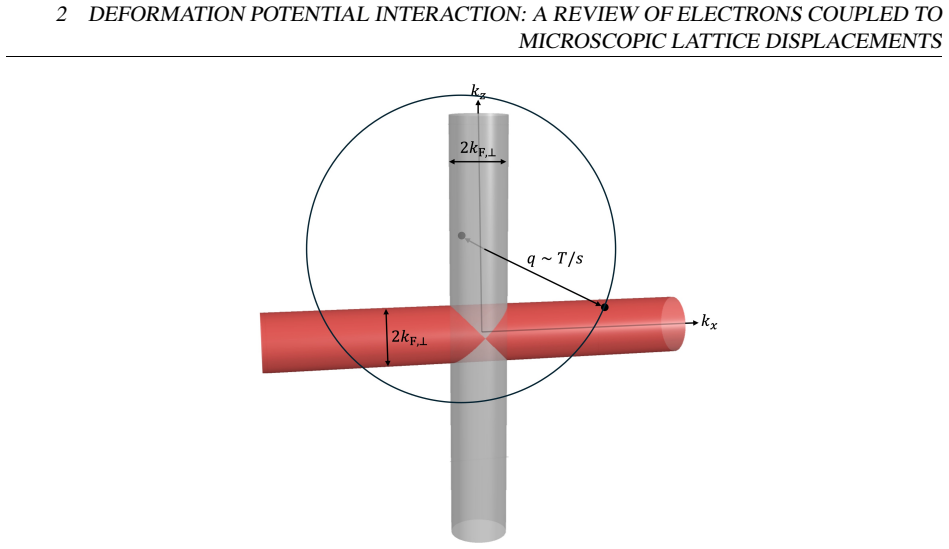
Solving the Boltzmann equation, we show that above the Bloch-Grüneisen temperature the energy relaxation rate from two soft transverse optical phonons exceeds the single-phonon one: while the latter scales as 1/T, the former is linear in T. This dominance of two-phonon scattering invalidates the usual picture of energy diffusion due to frequent scattering by subthermal phonons; instead, energy relaxes via rare scattering events involving thermal phonons. Below the Bloch-Grüneisen temperature, the energy relaxation rate scales as the single-particle rate, namely as T^3 for soft phonons. For anisotropic electron bands, an intermediate regime appears between two Bloch-Grüneisen temperatures, in
What carries the argument
The Boltzmann equation applied to electron scattering by two soft transverse optical phonons when single-phonon scattering is forbidden by symmetry or momentum conservation.
Load-bearing premise
Single-phonon scattering is strictly forbidden by symmetry or momentum conservation while two-phonon scattering remains allowed and the Boltzmann equation remains valid despite rare two-phonon events.
What would settle it
A measurement of the electron energy relaxation rate showing linear dependence on temperature above the Bloch-Grüneisen temperature in a material such as SrTiO3 where single-phonon scattering is symmetry forbidden would support the claim, while a 1/T dependence would falsify it.
Figures




read the original abstract
Recent THz spectroscopy of the quantum paraelectric SrTiO$_3$ (arXiv:2501.15771) and a high-$T_c$ cuprate (arXiv:2503.15646) has renewed interest in energy relaxation in correlated electron systems. We consider a situation in which single-phonon scattering is forbidden by symmetry or momentum conservation, while two-phonon scattering is allowed. Solving the Boltzmann equation, we show that above the Bloch-Gr\"uneisen temperature the energy relaxation rate from two soft transverse optical phonons exceeds the single-phonon one: while the latter scales as $1/T$, the former is linear in $T$. This dominance of two-phonon scattering invalidates the usual picture of energy diffusion due to frequent scattering by subthermal phonons; instead, energy relaxes via rare scattering events involving thermal phonons. Below the Bloch-Gr\"uneisen temperature, the energy relaxation rate scales as the single-particle rate, namely as $T^3$ for soft phonons. For anisotropic electron bands, an intermediate regime appears between two Bloch-Gr\"uneisen temperatures, in which both allowed single-phonon and two-phonon processes scale as $T^2$.
Editorial analysis
A structured set of objections, weighed in public.
Referee Report
Summary. The manuscript considers electron energy relaxation in systems where single-phonon scattering is forbidden by symmetry or momentum conservation while two-phonon scattering remains allowed. By explicitly evaluating the collision integrals in the Boltzmann equation for soft transverse optical phonons, the authors derive that above the Bloch-Grüneisen temperature the two-phonon energy relaxation rate scales linearly with T and exceeds the single-phonon rate (which scales as 1/T). This dominance invalidates the conventional energy diffusion picture based on frequent subthermal phonon scattering, with relaxation instead occurring via rare events involving thermal phonons. Below the Bloch-Grüneisen temperature the rate recovers the single-particle T^3 scaling for soft phonons; an intermediate T^2 regime appears for anisotropic bands between two distinct Bloch-Grüneisen temperatures.
Significance. If the derivations hold, the result is significant for interpreting recent THz spectroscopy experiments on quantum paraelectrics such as SrTiO3 and on high-Tc cuprates. It supplies a concrete mechanism that challenges the standard energy diffusion model and yields falsifiable temperature scalings. Strengths include the explicit Boltzmann collision-integral evaluation, recovery of the known low-T T^3 limit, and the absence of divergences in the perturbative treatment. The work provides a clear, testable alternative to subthermal-phonon diffusion in symmetry-constrained systems.
minor comments (3)
- The experimental motivation from arXiv:2501.15771 and arXiv:2503.15646 is stated in the abstract but should be expanded in the introduction with a short paragraph summarizing the relevant THz observations that motivate the symmetry-forbidden single-phonon assumption.
- Notation for the energy relaxation rate (distinct from the single-particle scattering rate) is introduced in the abstract and Sec. II but would benefit from an explicit equation defining the relaxation time τ_E in terms of the collision integral to prevent reader confusion.
- The high-T classical-phonon approximation and the precise location of the Bloch-Grüneisen temperature for the two-phonon channel are used throughout Sec. III; a brief remark on the size of corrections near the crossover would improve clarity without altering the central scaling claims.
Simulated Author's Rebuttal
We thank the referee for their positive assessment of our manuscript, accurate summary of the results, and recommendation for minor revision. The referee correctly identifies the key findings regarding the crossover from single-phonon to two-phonon dominated energy relaxation above the Bloch-Grüneisen temperature and the resulting breakdown of the energy diffusion model.
Circularity Check
Derivation self-contained from Boltzmann equation
full rationale
The paper derives the claimed T-linear two-phonon energy relaxation rate and 1/T single-phonon scaling by direct evaluation of the collision integrals in the semiclassical Boltzmann equation, using standard phonon occupation factors and phase-space constraints above and below the Bloch-Grüneisen temperature. The symmetry/momentum prohibition on single-phonon scattering is an explicit model input, not derived from the result itself. No parameters are fitted to data and then relabeled as predictions, no load-bearing uniqueness theorems or ansätze are imported via self-citation, and the central scalings emerge from the integrals without reduction to the paper's own prior outputs. The treatment remains perturbative and consistent with the rarity of two-phonon events.
Axiom & Free-Parameter Ledger
axioms (2)
- domain assumption Single-phonon scattering is forbidden by symmetry or momentum conservation
- domain assumption Boltzmann equation remains valid when two-phonon events are rare
Reference graph
Works this paper leans on
-
[1]
Philip B. Allen. Theory of thermal relaxation of electrons in metals.Phys. Rev. Lett., 59(13):1460–1463, 9 1987
work page 1987
-
[2]
Effects of electron-electron collisions with small energy transfers on quantum localisation.J
B L Altshuler, A G Aronov, and D E Khmelnitsky. Effects of electron-electron collisions with small energy transfers on quantum localisation.J. Phys. C: Solid State Phys., 15(36):7367–7386, 12 1982
work page 1982
-
[3]
Phonon anomalies in SrTiO3 in the quantum paraelectric regime.Phys
E Courtens, G Coddens, B Hennion, B Hehlen, J Pelous, and R Vacher. Phonon anomalies in SrTiO3 in the quantum paraelectric regime.Phys. Scr ., T49B:430–435, 1 1993
work page 1993
-
[4]
V . F.. Gantmakher and I. B.. Levinson.Carrier Scattering in Metals and Semiconductors. North-Holland Physics Publishing, a division of Elsevier Science Publishers, 1987
work page 1987
-
[5]
V .L. Ginzburg and V . P. Shabanskii. Kinetic temperature of electrons in metals and anomalous electron emission.Doklady Akademii Nauk SSSR, 100(3):445–448, 1955
work page 1955
-
[6]
M. I. Kaganov, I. M. Lifshitz, and L. V . Tanatarov. Relaxation between electrons and the crystalline lattice.Sov. Phys. JETP, 4(2):173–178, 8 1957
work page 1957
-
[7]
Stephen Dongmin Kang, Maxwell Dylla, and G. Jeffrey Snyder. Thermopower-conductivity relation for distinguishing transport mechanisms: Polaron hopping in CeO2 and band conduction in SrTiO3.Phys. Rev. B, 97(23):235201, 6 2018
work page 2018
-
[8]
Charles. Kittel and C. Y .. Fong.Quantum theory of solids. John Wiley & Sons, 1987
work page 1987
- [9]
-
[10]
Abhishek Kumar, Vladimir I. Yudson, and Dmitrii L. Maslov. Quasiparticle and Nonquasiparticle Transport in Doped Quantum Paraelectrics.Phys. Rev. Lett., 126(7):076601, 2 2021
work page 2021
-
[11]
K. Santhosh Kumar, David Barbalas, Rishi Bhandia, Dooyong Lee, Shivasheesh Varshney, Bharat Jalan, and N. P. Armitage. Absence of two-phonon quasi-elastic scattering in the normal state of doped–SrTiO3 by THz pump-probe spectroscopy.arXiv.2501.15771, 1 2025
-
[12]
R. H. Lyddane, R. G. Sachs, and E. Teller. On the Polar Vibrations of Alkali Halides.Phys. Rev., 59(8):673–676, 4 1941
work page 1941
-
[13]
Wakabayashi, Akihira Munakata, Yoshitaka Taniyasu, and Masaki Kobayashi
Yuki K. Wakabayashi, Akihira Munakata, Yoshitaka Taniyasu, and Masaki Kobayashi. Orbital-resolved anisotropic electron pockets in electron-doped SrTiO3 observed by ARPES.J. Appl. Phys., 138(11), 9 2025
work page 2025
-
[14]
Neutron Scattering and Nature of the Soft Optical Phonon in SrTiO3.J
Yasusada Yamada and Gen Shirane. Neutron Scattering and Nature of the Soft Optical Phonon in SrTiO3.J. Phys. Soc. Jpn., 26(2):396–403, 2 1969. 38
work page 1969
discussion (0)
Sign in with ORCID, Apple, or X to comment. Anyone can read and Pith papers without signing in.