Stealthy hyperuniform disorder: A new route to controlling electric states and magnetic phase transition in correlated systems
Pith reviewed 2026-05-10 02:12 UTC · model grok-4.3
The pith
Stealthy hyperuniform bond disorder in the Hubbard model produces a linear density of states and tunes the critical interaction for antiferromagnetic order.
A machine-rendered reading of the paper's core claim, the machinery that carries it, and where it could break.
Core claim
Stealthy hyperuniform disorder in the bond distribution of the interacting Hubbard model on the honeycomb lattice yields a linear density of states that is robust against the specific stealth properties, while the stealthiness significantly influences the wave functions in higher-energy regions and the density of states near the band edge; consequently, the critical interaction strength for the semimetal-to-antiferromagnet phase transition becomes sensitive to the stealth property, providing a way to control magnetism through structural correlations distinct from quasiperiodic tilings.
What carries the argument
Stealthy hyperuniform bond distribution, a point set with suppressed density fluctuations at small wavevectors, applied to nearest-neighbor bonds to control electronic wavefunctions and interaction-driven magnetism.
If this is right
- The phase transition always occurs between semimetallic and antiferromagnetically ordered states regardless of the stealth parameter.
- The critical interaction strength for the transition varies with the stealth property of the bond distribution.
- The linear density of states persists robustly, but the DOS near the band edge is modified by the stealthiness.
- Structural correlations in hyperuniform disorder produce different effects on magnetism compared to quasiperiodic honeycomb tilings.
Where Pith is reading between the lines
- Materials engineered with hyperuniform bond disorder could allow tuning of magnetic ordering temperatures without altering the average lattice geometry.
- Further studies with more advanced methods beyond Hartree approximation might reveal whether the tunability persists in the presence of quantum fluctuations.
- Similar disorder types could be explored in other lattice models to control different phases like superconductivity or charge ordering.
Load-bearing premise
The real-space Hartree approximation accurately captures the magnetic phase transition and its dependence on the stealth property in this disordered interacting system.
What would settle it
Exact diagonalization or quantum Monte Carlo simulations on finite systems with stealthy hyperuniform bond distributions would show if the critical interaction strength matches the Hartree prediction or deviates significantly.
Figures



read the original abstract
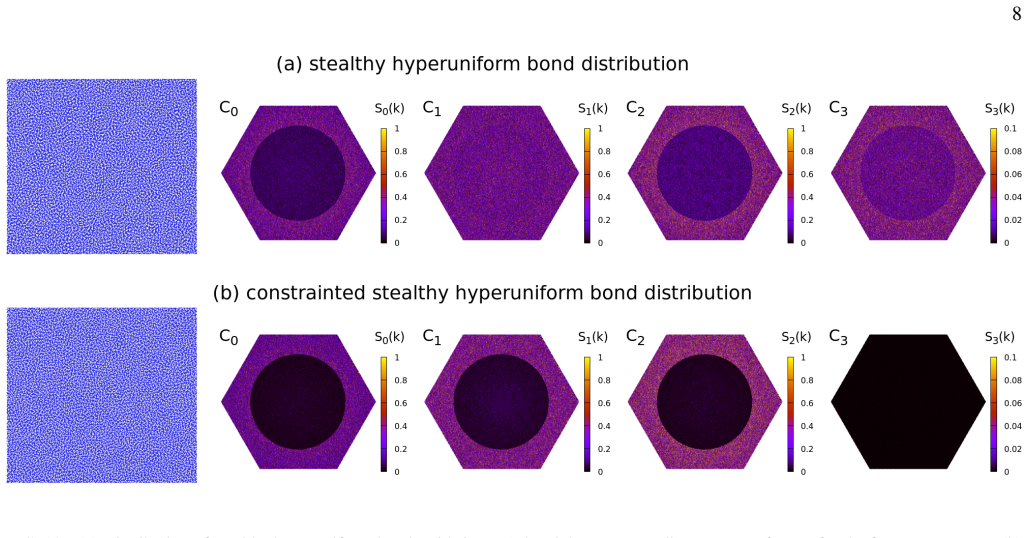
We investigate the effects of stealthy hyperuniform bond distributions on the electronic and magnetic properties of the Hubbard model on the honeycomb lattice. Hyperuniform structures, distinct from random and quasiperiodic ones, have recently attracted considerable interest due to their anomalous suppression of density fluctuations. By diagonalizing the noninteracting Hamiltonian, we show that a linear density of states (DOS) robustly emerges, while the stealth property of the bond distribution changes the wave functions in the higher-energy region extended and significantly modifies the DOS near the band edge. To clarify the impact on magnetism, we apply the real-space Hartree approximation to the Hubbard model. We find that, the phase transition always occurs between semimetallic and antiferromagnetically ordered states and its critical interaction strength is sensitive to the stealth property. A comparison with the quasiperiodic honeycomb tiling further highlights the role of structural correlations. These results demonstrate that stealthy hyperuniform disorder provides a novel route to controlling electronic states and magnetic phase transitions in correlated systems.
Editorial analysis
A structured set of objections, weighed in public.
Referee Report
Summary. The manuscript investigates stealthy hyperuniform bond disorder in the Hubbard model on the honeycomb lattice. Non-interacting properties are obtained by direct diagonalization, yielding a robust linear DOS with stealth-induced modifications to higher-energy wave functions and band-edge DOS. Interacting properties are studied via the real-space Hartree approximation, which finds a semimetal-AF transition for all distributions examined but with critical interaction strength sensitive to the stealth property; a comparison to quasiperiodic tiling is included to highlight structural correlations.
Significance. If the reported sensitivity of the magnetic transition to stealth survives beyond mean-field, the work would establish hyperuniform disorder as a distinct control parameter for correlated phases, separate from random or quasiperiodic cases. The non-interacting diagonalization results constitute a clear strength, delivering direct, parameter-free information on DOS and wave-function properties. The overall significance is reduced by the lack of validation for the interacting approximation in a 2D system where fluctuations are expected to matter.
major comments (1)
- The claim that the critical interaction strength for the semimetal-AF transition is sensitive to the stealth property rests entirely on the real-space Hartree approximation (described in the abstract and the section on the interacting Hubbard model). This static mean-field treatment neglects dynamical fluctuations and nonlocal correlations, which are known to renormalize the transition in the 2D honeycomb Hubbard model. No error bars, convergence tests, or benchmarks against exact diagonalization or quantum Monte Carlo are reported, so the quantitative sensitivity to stealth remains an uncontrolled approximation.
minor comments (1)
- The title uses 'electric states' while the abstract correctly employs 'electronic states'; this inconsistency should be corrected.
Simulated Author's Rebuttal
We thank the referee for the careful reading of our manuscript and the constructive criticism. We address the major comment on the interacting approximation below and have revised the manuscript accordingly to clarify the scope and limitations of our results.
read point-by-point responses
-
Referee: The claim that the critical interaction strength for the semimetal-AF transition is sensitive to the stealth property rests entirely on the real-space Hartree approximation (described in the abstract and the section on the interacting Hubbard model). This static mean-field treatment neglects dynamical fluctuations and nonlocal correlations, which are known to renormalize the transition in the 2D honeycomb Hubbard model. No error bars, convergence tests, or benchmarks against exact diagonalization or quantum Monte Carlo are reported, so the quantitative sensitivity to stealth remains an uncontrolled approximation.
Authors: We agree that the real-space Hartree approximation constitutes a static mean-field treatment that omits dynamical fluctuations and nonlocal correlations known to renormalize the semimetal-AF transition in the clean 2D honeycomb Hubbard model. Our calculations demonstrate that, within this approximation, the critical interaction strength remains sensitive to the stealth property of the bond disorder, while the transition itself stays between semimetallic and antiferromagnetically ordered states. We do not assert that the quantitative sensitivity survives beyond mean-field; the results are presented as findings obtained with this method, which permits treatment of large disordered systems. Benchmarks against quantum Monte Carlo or exact diagonalization for the interacting disordered case are not included, as such comparisons are computationally intensive for the relevant system sizes and ensemble averages. In the revised manuscript we will (i) qualify the abstract and the relevant sections to state explicitly that critical values are obtained within the Hartree approximation, (ii) add a dedicated paragraph discussing the expected influence of fluctuations by reference to the clean-limit literature, and (iii) report convergence tests with system size together with iteration tolerances and associated error estimates. revision: yes
Circularity Check
No significant circularity in derivation chain
full rationale
The paper derives its claims via direct numerical diagonalization of the noninteracting Hamiltonian (yielding linear DOS and stealth-dependent wavefunction/DOS modifications) followed by self-consistent real-space Hartree solution of the interacting model (yielding semimetal-AF transition with stealth-sensitive critical U). Neither step reduces by construction to a fitted input, self-definition, or load-bearing self-citation; the quantitative sensitivity emerges from the numerics rather than being imposed. Comparison to quasiperiodic tilings is external. This is a standard computational workflow with independent content, warranting score 0.
Axiom & Free-Parameter Ledger
axioms (1)
- domain assumption The real-space Hartree approximation sufficiently describes the antiferromagnetic transition in the presence of stealthy hyperuniform disorder.
Reference graph
Works this paper leans on
-
[1]
S. Torquato and F. H. Stillinger, Local density fluctuations, hyperuniformity, and order metrics, Physical Review E68, 041113 (2003)
work page 2003
-
[2]
Torquato, Hyperuniformity and its generalizations, Physical Review E94, 022122 (2016)
S. Torquato, Hyperuniformity and its generalizations, Physical Review E94, 022122 (2016)
work page 2016
-
[3]
L. Berthier, P. Chaudhuri, C. Coulais, O. Dauchot, and P. Sol- lich, Suppressed compressibility at large scale in jammed pack- ings of size-disperse spheres, Physical Review Letters106, 120601 (2011)
work page 2011
-
[4]
R. Kurita and E. R. Weeks, Incompressibility of polydisperse random-close-packed colloidal particles, Physical Review E84, 030401 (2011)
work page 2011
- [5]
-
[6]
J. B. Llorens, I. Guillamón, I. G. Serrano, R. Córdoba, J. Sesé, J. M. De Teresa, M. R. Ibarra, S. Vieira, M. Ortuño, and H. Sud- erow, Disordered hyperuniformity in superconducting vortex lattices, Physical Review Research2, 033133 (2020)
work page 2020
- [7]
-
[8]
Y . Jiao, T. Lau, H. Hatzikirou, M. Meyer-Hermann, J. C. Corbo, and S. Torquato, Avian photoreceptor patterns represent a disor- dered hyperuniform solution to a multiscale packing problem, Physical Review E89, 022721 (2014)
work page 2014
-
[9]
O. H. Philcox and S. Torquato, Disordered heterogeneous uni- verse: Galaxy distribution and clustering across length scales, Physical Review X13, 011038 (2023)
work page 2023
-
[10]
W. Man, M. Florescu, E. P. Williamson, Y . He, S. R. Hashem- izad, B. Y . C. Leung, D. R. Liner, S. Torquato, P. M. Chaikin, and P. J. Steinhardt, Isotropic band gaps and freeform waveg- 9 uides observed in hyperuniform disordered photonic solids, Proceedings of the National Academy of Sciences110, 15886 (2013)
work page 2013
-
[11]
K. Asakura, K. Yamamoto, and A. Koga, Elliptical-rod geome- tries enhance photonic band gaps in disordered stealthy hyper- uniform photonic crystals, J. Phys. Soc. Jpn.95, 024711 (2026)
work page 2026
-
[12]
A. Koga and S. Sakai, Hyperuniformity in two-dimensional pe- riodic and quasiperiodic point patterns, Physical Review E109, 044103 (2024)
work page 2024
-
[13]
A. Koga and T. Matsubara, Quasiperiodically modulated hon- eycomb lattices and their magnetic properties, Physical Review B111, 214422 (2025)
work page 2025
-
[14]
R. B. Griffiths, Nonanalytic behavior above the critical point in a random ising ferromagnet, Phys. Rev. Lett.23, 17 (1969)
work page 1969
-
[15]
S. Sorella and E. Tosatti, Semi-metal-insulator transition of the hubbard model in the honeycomb lattice, Eur. Lett.19, 699 (1992)
work page 1992
-
[16]
N. Furukawa, Antiferromagnetism of the hubbard model on a layered honeycomb lattice - is mgb2 a nearly-antiferromagnetic metal? -, J. Phys. Soc. Jpn.70, 1483 (2001)
work page 2001
-
[17]
H. Feldner, Z. Y . Meng, A. Honecker, D. Cabra, S. Wessel, and F. F. Assaad, Magnetism of finite graphene samples: Mean- field theory compared with exact diagonalization and quantum monte carlo simulations, Phys. Rev. B81, 115416 (2010)
work page 2010
-
[18]
S. Sorella, Y . Otsuka, and S. Yunoki, Absence of a spin liquid phase in the hubbard model on the honeycomb lattice, Sci. Rep. 2, 992 (2012)
work page 2012
-
[19]
F. F. Assaad and I. F. Herbut, Pinning the order: The nature of quantum criticality in the hubbard model on honeycomb lattice, Phys. Rev. X3, 031010 (2013)
work page 2013
-
[20]
M. Raczkowski, R. Peters, T. T. Phúng, N. Takemori, F. F. As- saad, A. Honecker, and J. Vahedi, Hubbard model on the hon- eycomb lattice: From static and dynamical mean-field theories to lattice quantum monte carlo simulations, Phys. Rev. B101, 125103 (2020)
work page 2020
-
[21]
J. Ostmeyer, E. Berkowitz, S. Krieg, T. A. Lähde, T. Luu, and C. Urbach, Semimetal–mott insulator quantum phase transition of the hubbard model on the honeycomb lattice, Phys. Rev. B 102, 245105 (2020)
work page 2020
-
[22]
J. Ostmeyer, E. Berkowitz, S. Krieg, T. A. Lähde, T. Luu, and C. Urbach, Antiferromagnetic character of the quantum phase transition in the hubbard model on the honeycomb lattice, Phys. Rev. B104, 155142 (2021)
work page 2021
-
[23]
K. Asakura, K. Yamamoto, and A. Koga, Impact of stealthy hyperuniform magnetic impurity configurations on bulk mag- netism in a two-dimensional heisenberg model, arXiv , 2602.22484 (2026)
discussion (0)
Sign in with ORCID, Apple, or X to comment. Anyone can read and Pith papers without signing in.