Recognition: unknown
The FASER experiment at the Large Hadron Collider
Pith reviewed 2026-05-10 01:49 UTC · model grok-4.3
The pith
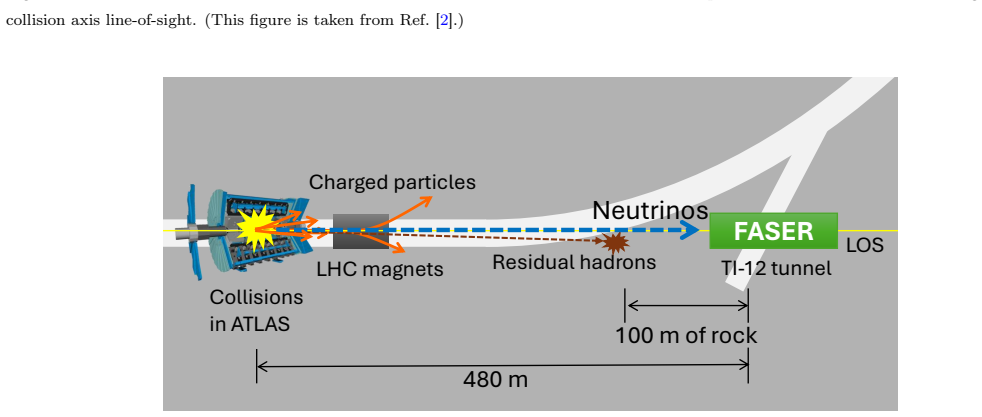
The FASER experiment, placed 480 m downstream of ATLAS at the LHC, searches for light weakly-interacting new particles and studies high-energy neutrinos of all flavors from collider collisions.
A machine-rendered reading of the paper's core claim, the machinery that carries it, and where it could break.
Core claim
FASER has been installed and operated at the LHC to search for light, weakly-interacting particles that could be produced in high-energy collisions and to study high-energy neutrinos of all three flavors originating from the ATLAS interaction point, with the detector showing the ability to identify these particles in a region 480 m downstream while managing backgrounds.
What carries the argument
The FASER detector, consisting of tracking stations, a calorimeter, and veto systems, positioned in a shielded location 480 m downstream and aligned with the beam axis to select forward-going particles from the ATLAS collisions.
If this is right
- The first collider-based measurements of high-energy neutrinos would provide new data on neutrino properties at energies far above those from other sources.
- Limits or discoveries of light new particles would constrain models of physics beyond the Standard Model in the forward region.
- The experiment demonstrates a technique for accessing particles that escape central detectors at hadron colliders.
- Upgrades installed since the start of operations will increase sensitivity in future LHC runs.
- Future plans for the experiment include expanded coverage and improved detection capabilities.
Where Pith is reading between the lines
- Successful neutrino detection could test predictions of neutrino production in proton-proton collisions and help interpret astrophysical neutrino observations.
- The forward-search approach might be adapted for other colliders to look for similar light particles.
- If new particles are found, they could relate to dark matter candidates or other extensions of the Standard Model.
Load-bearing premise
The chosen location and alignment 480 m downstream allow clean detection of particles and neutrinos from the ATLAS collision point with manageable backgrounds.
What would settle it
Failure to detect the expected flux of high-energy neutrinos from LHC collisions or observation of backgrounds that overwhelm the signal would show the location does not enable the intended measurements.
Figures









read the original abstract
The FASER experiment is located in the Large Hadron Collider (LHC) complex at CERN, 480 m downstream of the ATLAS collision point and aligned with the beam-collision-axis. The experiment was designed to search for light, weakly-interacting new-particles which could be produced in the LHC collisions, and, for the first-time, to study high-energy neutrinos of all flavours originating at a particle collider. This review article presents the status of FASER up to early-2026. This includes details of the FASER detector design, operation, performance and physics results, as well as briefly mentioning upgrades that have been installed since the start of FASER. In addition, future plans for the experiment are detailed.
Editorial analysis
A structured set of objections, weighed in public.
Referee Report
Summary. The manuscript is a review article on the FASER experiment at the LHC, located 480 m downstream of the ATLAS collision point and aligned with the beam axis. It describes the experiment's design to search for light, weakly-interacting new particles produced in LHC collisions and to perform the first studies of high-energy neutrinos of all flavours originating at a collider. The paper covers detector design, operation, performance, physics results up to early-2026, installed upgrades, and future plans.
Significance. If the factual descriptions hold, the paper provides a useful reference documenting FASER's status, including its pioneering collider-based neutrino measurements across all flavours and forward searches for new physics. The inclusion of performance metrics, background mitigation, and upgrade details strengthens its value for the experimental particle physics community.
minor comments (3)
- [Abstract] Abstract: the phrase 'up to early-2026' should specify the exact data-taking period or luminosity cutoff used for the presented physics results to avoid ambiguity about the temporal scope.
- [Detector design and operation] Detector design and operation sections: quantitative details on alignment precision (e.g., transverse offset tolerances relative to the beam axis) would strengthen the claim of clean detection with manageable backgrounds.
- [Physics results] Physics results section: all reported measurements should explicitly reference the corresponding published papers or internal notes rather than summarizing without citations.
Simulated Author's Rebuttal
We thank the referee for their positive review of the manuscript and for recommending acceptance. The report highlights the value of the paper as a reference on FASER's design, operation, performance, neutrino measurements, and future plans. No major comments were provided.
Circularity Check
No significant circularity identified
full rationale
The paper is a descriptive review article summarizing the established FASER experiment's location 480 m downstream of ATLAS, detector design, operation, performance, physics results up to early-2026, and future plans. It contains no mathematical derivations, equations, fitted parameters presented as predictions, or load-bearing self-citations that reduce claims to their own inputs by construction. All central statements are factual descriptions grounded in operational data and direct measurements rather than self-referential logic.
Axiom & Free-Parameter Ledger
Reference graph
Works this paper leans on
-
[1]
J. L. Feng, I. Galon, F. Kling, S. Trojanowski, ForwArd Search ExpeRiment at the LHC, Phys. Rev. D97 (3) (2018) 035001. arXiv:1708.09389,doi:10.1103/PhysRevD.97.035001. [2]FASERCollaboration, Technical Proposal for FASER: ForwArd Search ExpeRiment at the LHC (12 2018).arXiv:1812. 09139
-
[2]
A. Ariga, J. Boyd, F. Kling, A. De Roeck, Neutrino Experiments at the Large Hadron Collider, Ann. Rev. Nucl. Part. Sci. 75 (1) (2025) 57–81.arXiv:2501.10078,doi:10.1146/annurev-nucl-121423-101000
-
[3]
Physics Beyond Colliders Study Group. [link]. URLhttp://pbc.web.cern.ch
-
[4]
G. Acampora, et al., SND@LHC: the scattering and neutrino detector at the LHC, JINST 19 (05) (2024) P05067.arXiv: 2210.02784,doi:10.1088/1748-0221/19/05/P05067
-
[5]
Heising-Simons Foundation. [link]. URLhttps://www.hsfoundation.org/
-
[6]
Simons Foundation. [link]. URLhttps://www.simonsfoundation.org/ [8]FASERCollaboration, Letter of Intent for FASER: ForwArd Search ExpeRiment at the LHC (2018).arXiv:1811.10243
work page Pith review arXiv 2018
-
[7]
CERN Research Board Minutes (March 2019) (2019). [link]. URLhttps://cds.cern.ch/record/2668519/files/M-228.pdf [10]FASERCollaboration, First neutrino interaction candidates at the LHC, Phys. Rev. D 104 (9) (2021) L091101.arXiv: 2105.06197,doi:10.1103/PhysRevD.104.L091101. [11]FASERCollaboration, Detecting and Studying High-Energy Collider Neutrinos with F...
-
[8]
CERN Research Board Minutes (February 2020) (2022). [link]. URLhttps://cds.cern.ch/record/2703961/files/M-231.pdf [14]FASERCollaboration, FASER’s physics reach for long-lived particles, Phys. Rev. D 99 (9) (2019) 095011.arXiv:1811.12522, doi:10.1103/PhysRevD.99.095011. [15]FASERCollaboration, Neutrino rate predictions for FASER, Phys. Rev. D 110 (1) (2024...
-
[9]
EPOS LHC: Test of collective hadronization with data measured at the CERN Large Hadron Collider
T. Pierog, I. Karpenko, J. M. Katzy, E. Yatsenko, K. Werner, EPOS LHC: Test of collective hadronization with data measured at the CERN Large Hadron Collider, Phys. Rev. C92 (2015) 034906.arXiv:1306.0121,doi:10.1103/PhysRevC.92.034906
-
[10]
F. Riehn, R. Engel, A. Fedynitch, T. K. Gaisser, T. Stanev, Hadronic interaction model Sibyll 2.3d and extensive air showers, Phys. Rev. D 102 (6) (2020) 063002.arXiv:1912.03300,doi:10.1103/PhysRevD.102.063002
-
[11]
Ostapchenko, Monte Carlo treatment of hadronic interactions in enhanced Pomeron scheme: I
S. Ostapchenko, Monte Carlo treatment of hadronic interactions in enhanced Pomeron scheme: I. QGSJET-II model, Phys. Rev. D83 (2011) 014018.arXiv:1010.1869,doi:10.1103/PhysRevD.83.014018
-
[12]
M. Fieg, F. Kling, H. Schulz, T. Sjöstrand, Tuning pythia for forward physics experiments, Phys. Rev. D 109 (1) (2024) 016010. arXiv:2309.08604,doi:10.1103/PhysRevD.109.016010
-
[13]
L. Buonocore, F. Kling, L. Rottoli, J. Sominka, Predictions for neutrinos and new physics from forward heavy hadron produc- tion at the LHC, Eur. Phys. J. C 84 (4) (2024) 363.arXiv:2309.12793,doi:10.1140/epjc/s10052-024-12726-5
-
[14]
A New Method for Combining NLO QCD with Shower Monte Carlo Algorithms
P. Nason, A New method for combining NLO QCD with shower Monte Carlo algorithms, JHEP 11 (2004) 040.arXiv: hep-ph/0409146,doi:10.1088/1126-6708/2004/11/040
work page internal anchor Pith review doi:10.1088/1126-6708/2004/11/040 2004
-
[15]
Matching NLO QCD computations with Parton Shower simulations: the POWHEG method
S. Frixione, P. Nason, C. Oleari, Matching NLO QCD computations with Parton Shower simulations: the POWHEG method, JHEP 11 (2007) 070.arXiv:0709.2092,doi:10.1088/1126-6708/2007/11/070
work page internal anchor Pith review doi:10.1088/1126-6708/2007/11/070 2007
-
[16]
A general framework for implementing NLO calculations in shower Monte Carlo programs: the POWHEG BOX
S. Alioli, P. Nason, C. Oleari, E. Re, A general framework for implementing NLO calculations in shower Monte Carlo programs: the POWHEG BOX, JHEP 06 (2010) 043.arXiv:1002.2581,doi:10.1007/JHEP06(2010)043
work page internal anchor Pith review doi:10.1007/jhep06(2010)043 2010
-
[17]
Bierlich, et al., SciPost Phys
C. Bierlich, et al., A comprehensive guide to the physics and usage of PYTHIA 8.3, SciPost Phys. Codeb. 2022 (2022) 8. arXiv:2203.11601,doi:10.21468/SciPostPhysCodeb.8
-
[18]
F. Kling, L. J. Nevay, Forward neutrino fluxes at the LHC, Phys. Rev. D 104 (11) (2021) 113008.arXiv:2105.08270, doi:10.1103/PhysRevD.104.113008
-
[19]
Andreopoulos, et al., The GENIE Neutrino Monte Carlo Generator, Nucl
C. Andreopoulos, et al., The GENIE Neutrino Monte Carlo Generator, Nucl. Instrum. Meth. A 614 (2010) 87–104.arXiv: 0905.2517,doi:10.1016/j.nima.2009.12.009
-
[20]
A. Bodek, U. K. Yang, Modeling deep inelastic cross-sections in the few GeV region, Nucl. Phys. B Proc. Suppl. 112 (2002) 70–76.arXiv:hep-ex/0203009,doi:10.1016/S0920-5632(02)01755-3
-
[21]
A. Bodek, I. Park, U.-k. Yang, Improved low Q**2 model for neutrino and electron nucleon cross sections in few GeV region, Nucl. Phys. B Proc. Suppl. 139 (2005) 113–118.arXiv:hep-ph/0411202,doi:10.1016/j.nuclphysbps.2004.11.208
-
[22]
A. Bodek, U.-k. Yang, Axial and Vector Structure Functions for Electron- and Neutrino- Nucleon Scattering Cross Sections at allQ 2 using Effective Leading order Parton Distribution Functions (11 2010).arXiv:1011.6592
-
[23]
A. Candido, A. Garcia, G. Magni, T. Rabemananjara, J. Rojo, R. Stegeman, Neutrino Structure Functions from GeV to EeV Energies, JHEP 05 (2023) 149.arXiv:2302.08527,doi:10.1007/JHEP05(2023)149
-
[24]
Y. S. Jeong, M. H. Reno, Neutrino cross sections: Interface of shallow- and deep-inelastic scattering for collider neutrinos, Phys. Rev. D 108 (11) (2023) 113010.arXiv:2307.09241,doi:10.1103/PhysRevD.108.113010
-
[25]
J. M. Cruz-Martinez, M. Fieg, T. Giani, P. Krack, T. Mäkelä, T. R. Rabemananjara, J. Rojo, The LHC as a Neutrino-Ion Collider, Eur. Phys. J. C 84 (4) (2024) 369.arXiv:2309.09581,doi:10.1140/epjc/s10052-024-12665-1
-
[26]
M. Tanabashi, et al., Review of Particle Physics, Phys. Rev. D 98 (3) (2018) 030001.doi:10.1103/PhysRevD.98.030001. 53 [34]FASERCollaboration, The FASER detector, JINST 19 (05) (2024) P05066.arXiv:2207.11427,doi:10.1088/1748-0221/ 19/05/P05066. [35]FASERCollaboration, The tracking detector of the FASER experiment, Nucl. Instrum. Meth. A 1034 (2022) 166825...
-
[27]
Abdesselam, et al., The barrel modules of the ATLAS semiconductor tracker, Nucl
A. Abdesselam, et al., The barrel modules of the ATLAS semiconductor tracker, Nucl. Instrum. Meth. A 568 (2006) 642–671. doi:10.1016/j.nima.2006.08.036. [37]LHCbCollaboration, LHCb Calorimeters: Technical Design Report, CERN, Geneva, 2000. URLhttp://cds.cern.ch/record/494264 [38]FASERCollaboration, The trigger and data acquisition system of the FASER expe...
-
[28]
URLhttps://cds.cern.ch/record/2900949
ATLAS Collaboration, Preliminary analysis of the luminosity calibration for the ATLAS13.6TeV data recorded in 2023, ATL-DAPR-PUB-2024-001 (2024). URLhttps://cds.cern.ch/record/2900949
-
[29]
M.Yoshimoto, T.Nakano, R.Komatani, H.Kawahara, Hyper-trackselectornuclearemulsionreadoutsystemaimedatscanning an area of one thousand square meters, PTEP 2017 (10) (2017) 103H01.arXiv:1704.06814,doi:10.1093/ptep/ptx131
-
[30]
Hirosky, et al., Dual-readout calorimetry with homoge- neous crystals, EPJ Web Conf
S. Jakobsen, B. Petersen, T. Schneider, M. van Stenis, Y. S. Rabetsimialona, Range extension for FASER electromagnetic calorimeter, EPJ Web Conf. 320 (2025) 00057.doi:10.1051/epjconf/202532000057. [44]FASERCollaboration, The FASER W-Si High Precision Preshower Technical Proposal, Tech. rep., CERN, Geneva (2022). URLhttps://cds.cern.ch/record/2803084
- [31]
-
[32]
The ATLAS Collaboration Software and Firmware, ATL-SOFT-PUB-2021-001 (2021). URLhttps://cds.cern.ch/record/2767187 [48]ATLASCollaboration, “Athena” [software], release-22,https://zenodo.org/record/2641997#.XhWRDC2ZPyI
-
[33]
Ai, et al., A Common Tracking Software Project, Comput
X. Ai, et al., A Common Tracking Software Project, Comput. Softw. Big Sci. 6 (1) (2022) 8.arXiv:2106.13593,doi: 10.1007/s41781-021-00078-8
-
[34]
GEANT4 Collaboration, S. Agostinelli, et al.,Geant4– a simulation toolkit, Nucl. Instrum. Meth. A 506 (2003) 250. doi:10.1016/S0168-9002(03)01368-8. [51]FASERCollaboration, Search for dark photons with the FASER detector at the LHC, Phys. Lett. B 848 (2024) 138378. arXiv:2308.05587,doi:10.1016/j.physletb.2023.138378. 54 [52]FASERCollaboration, FASER Calor...
-
[35]
J. L. Feng, J. Li, X. Liao, J. Ni, J. Pei, Discovering quirks through timing at FASER and future forward experiments at the LHC, JHEP 06 (2024) 197.arXiv:2404.13814,doi:10.1007/JHEP06(2024)197
-
[36]
Asymptotic formulae for likelihood-based tests of new physics
G. Cowan, K. Cranmer, E. Gross, O. Vitells, Asymptotic formulae for likelihood-based tests of new physics, Eur. Phys. J. C 71 (2011) 1554, [Erratum: Eur.Phys.J.C 73, 2501 (2013)].arXiv:1007.1727,doi:10.1140/epjc/s10052-011-1554-0
work page internal anchor Pith review doi:10.1140/epjc/s10052-011-1554-0 2011
-
[37]
A. L. Read, Presentation of search results: TheCLs technique, J. Phys. G 28 (2002) 2693–2704.doi:10.1088/0954-3899/ 28/10/313
-
[38]
E. Izaguirre, T. Lin, B. Shuve, Searching for Axionlike Particles in Flavor-Changing Neutral Current Processes, Phys. Rev. Lett. 118 (11) (2017) 111802.arXiv:1611.09355,doi:10.1103/PhysRevLett.118.111802
- [39]
-
[40]
F. Kling, S. Trojanowski, Looking forward to test the KOTO anomaly with FASER, Phys. Rev. D 102 (1) (2020) 015032. arXiv:2006.10630,doi:10.1103/PhysRevD.102.015032
-
[41]
Beacham, et al., Physics Beyond Colliders at CERN: Beyond the Standard Model Working Group Report, J
J. Beacham, et al., Physics Beyond Colliders at CERN: Beyond the Standard Model Working Group Report, J. Phys. G 47 (1) (2020) 010501.arXiv:1901.09966,doi:10.1088/1361-6471/ab4cd2
-
[42]
D. Aloni, Y. Soreq, M. Williams, Coupling QCD-Scale Axionlike Particles to Gluons, Phys. Rev. Lett. 123 (3) (2019) 031803. arXiv:1811.03474,doi:10.1103/PhysRevLett.123.031803
-
[43]
J. L. Feng, I. Galon, F. Kling, S. Trojanowski, Axionlike particles at FASER: The LHC as a photon beam dump, Phys. Rev. D98 (5) (2018) 055021.arXiv:1806.02348,doi:10.1103/PhysRevD.98.055021. [66]FASERCollaboration, First Direct Observation of Collider Neutrinos with FASER at the LHC, Phys. Rev. Lett. 131 (3) (2023) 031801.arXiv:2303.14185,doi:10.1103/Phys...
-
[44]
Fedynitch, Cascade equations and hadronic interactions at very high energies, Ph.D
A. Fedynitch, Cascade equations and hadronic interactions at very high energies, Ph.D. thesis, KIT, Karlsruhe, Dept. Phys. (11 2015).doi:10.5445/IR/1000055433. [75]FASERCollaboration, Latest neutrino results from the FASER experiment and their implications for forward hadron pro- duction, CERN-FASER-CONF-2025-004 (2025). URLhttps://cds.cern.ch/record/2936...
- [45]
-
[46]
Abe et al., arXiv:1901.03750 (2019)
K. Abe, et al., T2K ND280 Upgrade - Technical Design Report (1 2019).arXiv:1901.03750
-
[47]
Shi, et al., Development of the CEPC analog hadron calorimeter prototype (11 2025).arXiv:2511.10377
Y. Shi, et al., Development of the CEPC analog hadron calorimeter prototype (11 2025).arXiv:2511.10377
- [48]
discussion (0)
Sign in with ORCID, Apple, or X to comment. Anyone can read and Pith papers without signing in.