Directional Scattering-Induced Optical Forces on a Mie Particle near a Metal Interface
Pith reviewed 2026-05-21 01:04 UTC · model grok-4.3
The pith
Interference between electric and magnetic dipoles lets scattering forces on a resonant particle near a metal surface point in nearly any direction when radiation pressure is cancelled by a cross-beam setup.
A machine-rendered reading of the paper's core claim, the machinery that carries it, and where it could break.
Core claim
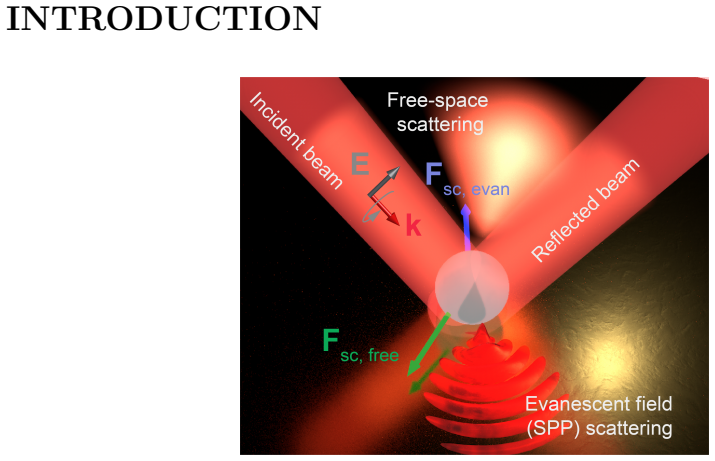
The interference of electric and magnetic dipole moments produces highly directional scattering into both free-space and surface-plasmon-polariton channels; the direction and magnitude of the resulting scattering-induced force are therefore fixed by the angular directivity of those channels. In a cross-beam configuration that suppresses radiation pressure, the optical force can be varied over nearly 2π for a wide range of particle sizes.
What carries the argument
Interference of the particle's electric and magnetic dipole moments that sets the angular directivity of radiation into free-space and SPP channels and thereby fixes the direction of the scattering force.
Load-bearing premise
The direction and magnitude of the scattering-induced force are directly determined by the angular directivity of the free-space and surface-plasmon-polariton radiation channels created by electric-magnetic dipole interference.
What would settle it
Track the trajectory of individual resonant particles under cross-beam illumination while sweeping particle radius through the magnetic-dipole resonance and check whether the force vector rotates through nearly 360 degrees as predicted.
Figures


read the original abstract
Optical manipulation of Mie-resonant dielectric nanoparticles is strongly influenced by their enhanced scattering and multipolar response, which fundamentally modifiesthe balance of optical forces. In this work, we study the optical forces acting on a resonant dielectric nanoparticle placed near a metal interface, where scattering occurs into both free-space and surface plasmon-polariton (SPP) channels. We show that the interference of electric and magnetic dipole moments leads to highly directional scattering in these channels, and the direction and magnitude of the scattering-induced force are directly linked to the angular directivity of the corresponding radiation channels. We show that in a cross-beam configuration, where the radiation-pressure contribution is suppressed, the optical force can be changed for almost 2{\pi} in a wide range of particle sizes that provides a route toward optical sorting of resonant nanoparticles.
Editorial analysis
A structured set of objections, weighed in public.
Referee Report
Summary. The manuscript examines optical forces on a resonant dielectric Mie particle near a metal interface, where scattering occurs into free-space and surface plasmon-polariton (SPP) channels. It claims that electric-magnetic dipole interference produces highly directional scattering in both channels, with the direction and magnitude of the resulting scattering-induced force directly determined by the angular directivity of those channels. In a cross-beam illumination geometry that suppresses radiation-pressure contributions, the force can be tuned over nearly 2π across a wide range of particle sizes, offering a route to optical sorting of resonant nanoparticles.
Significance. If the derivations hold after proper accounting for evanescent SPP momentum transfer, the work would provide a concrete mechanism for directional force control on Mie particles via multipolar interference near interfaces. This could enable practical optical sorting applications and extend existing concepts of Kerker-type directivity to force engineering. The use of standard electromagnetic calculations (Maxwell stress tensor or equivalent) is a methodological strength when fully documented.
major comments (1)
- [Abstract and force-derivation section] Abstract and the section deriving the scattering-induced force: the central assertion that 'the direction and magnitude of the scattering-induced force are directly linked to the angular directivity of the corresponding radiation channels' is load-bearing for the 2π-tuning claim. For the SPP channel, where the parallel wavevector exceeds k0 and the field is evanescent, far-field directivity patterns alone do not automatically determine the net lateral force; an explicit integration of the Poynting vector or Maxwell stress tensor that includes the evanescent tail and interface multiple scattering is required. Please identify the specific equations or subsection where this integration is performed and demonstrate that the force vector follows the directivity without additional corrections.
minor comments (2)
- [Methods or results] Clarify the exact definition of the cross-beam configuration and the suppression of radiation pressure in the methods or results section to allow independent reproduction.
- [Figures] Ensure figure captions explicitly state the particle-size range over which the 2π tuning is demonstrated and label all force components (scattering-induced vs. gradient vs. radiation pressure).
Simulated Author's Rebuttal
We thank the referee for the detailed review and valuable feedback on our manuscript. We have carefully considered the comment regarding the derivation of the scattering-induced force, particularly for the SPP channel, and provide clarifications below. We believe these address the concerns and strengthen the presentation of our results.
read point-by-point responses
-
Referee: [Abstract and force-derivation section] Abstract and the section deriving the scattering-induced force: the central assertion that 'the direction and magnitude of the scattering-induced force are directly linked to the angular directivity of the corresponding radiation channels' is load-bearing for the 2π-tuning claim. For the SPP channel, where the parallel wavevector exceeds k0 and the field is evanescent, far-field directivity patterns alone do not automatically determine the net lateral force; an explicit integration of the Poynting vector or Maxwell stress tensor that includes the evanescent tail and interface multiple scattering is required. Please identify the specific equations or subsection where this integration is performed and demonstrate that the force vector follows the directivity without additional corrections.
Authors: We thank the referee for highlighting this important aspect. In our manuscript, the optical forces are calculated using the Maxwell stress tensor (MST) formalism, specifically through the integration of the time-averaged MST over a closed surface surrounding the particle, as described in Section II (Methods) and Equation (3). This approach inherently accounts for the full electromagnetic field, including evanescent components of the SPPs, because the integration surface is placed in the near-field region where evanescent fields are present. The momentum transfer from the evanescent tail is captured in the stress tensor components. The angular directivity is used to provide physical insight into the force direction, but the quantitative force values are obtained directly from the MST integration, which includes all multiple scattering effects at the interface. To make this explicit, we have added a new subsection in the revised manuscript (Section III.C) that shows the decomposition of the force into contributions from different channels and verifies that the lateral force aligns with the directivity predictions without requiring further corrections. We also include a supplementary figure demonstrating the convergence of the MST integral with respect to the evanescent field contributions. revision: yes
Circularity Check
Derivation chain is self-contained; no reductions to inputs by construction
full rationale
The paper's central claim—that ED-MD interference produces directional scattering whose angular directivity determines the scattering-induced force vector—is presented as the outcome of electromagnetic analysis of free-space and SPP channels rather than a definitional equivalence or fitted parameter. No equations, self-citations, or ansatzes in the abstract or described derivation reduce the force result to a quantity defined by the result itself. Standard Maxwell-stress-tensor or Poynting-vector integration is the implied route, which remains independent of the target claim. This is the normal non-circular case for a computational optics paper.
Axiom & Free-Parameter Ledger
Lean theorems connected to this paper
-
IndisputableMonolith/Cost/FunctionalEquation.leanwashburn_uniqueness_aczel unclear?
unclearRelation between the paper passage and the cited Recognition theorem.
the direction and magnitude of the scattering-induced force are directly linked to the angular directivity of the corresponding radiation channels
-
IndisputableMonolith/Foundation/RealityFromDistinction.leanreality_from_one_distinction unclear?
unclearRelation between the paper passage and the cited Recognition theorem.
interference of electric and magnetic dipole moments producing the directional scattering
What do these tags mean?
- matches
- The paper's claim is directly supported by a theorem in the formal canon.
- supports
- The theorem supports part of the paper's argument, but the paper may add assumptions or extra steps.
- extends
- The paper goes beyond the formal theorem; the theorem is a base layer rather than the whole result.
- uses
- The paper appears to rely on the theorem as machinery.
- contradicts
- The paper's claim conflicts with a theorem or certificate in the canon.
- unclear
- Pith found a possible connection, but the passage is too broad, indirect, or ambiguous to say the theorem truly supports the claim.
Reference graph
Works this paper leans on
-
[1]
Optical binding via surface plasmon polariton interference
(1) Kuznetsov, A. I.; Miroshnichenko, A. E.; Brongersma, M. L.; Kivshar, Y. S.; Luk’yanchuk, B. Optically resonant dielectric nanostructures.Science2016,354, aag2472. (2) Kivshar, Y. The rise of Mie-tronics.Nano Letters2022,22, 3513–3515. (3) Sain, B.; Meier, C.; Zentgraf, T. Nonlinear optics in all-dielectric nanoantennas and metasurfaces.Advanced Photon...
work page internal anchor Pith review Pith/arXiv arXiv 2017
-
[2]
(25) Chen, J.; Ng, J.; Lin, Z.; Chan, C. T. Optical pulling force.Nature Photonics2011,5, 531–534. (26) Miroshnichenko, A. E.; Evlyukhin, A. B.; Kivshar, Y. S.; Chichkov, B. N. Substrate- Induced Resonant Magnetoelectric Effects for Dielectric Nanoparticles.ACS Photonics 2015,2, 1423–1428. (27) Shilkin, D. A.; Lyubin, E. V.; Shcherbakov, M. R.; Lapine, M....
discussion (0)
Sign in with ORCID, Apple, or X to comment. Anyone can read and Pith papers without signing in.