Recognition: unknown
SDSSJ110546.07+145202.4: The first long-duration radio changing-look NLS1 galaxy
Pith reviewed 2026-05-10 01:58 UTC · model grok-4.3
The pith
An accretion rate change triggered the long-duration radio jet in the NLS1 galaxy SDSSJ110546.07+145202.4.
A machine-rendered reading of the paper's core claim, the machinery that carries it, and where it could break.
Core claim
SDSSJ110546.07+145202.4 stands out as a unique radio changing-look Narrow-line Seyfert 1 galaxy that has brightened dramatically and shows an exceptionally long duration of its on phase. The X-ray spectrum is soft, line-of-sight absorption is low, the radio SED is peaked at low frequencies, and the radio outburst emission is very long-lived and roughly constant. The system is well explained by an accretion rate change that triggered the powerful radio jet emission, and its low redshift and SMBH mass offer a unique perspective on radio-jet ignition processes expected in the early Universe.
What carries the argument
Accretion-rate change igniting a radio jet in a narrow-line Seyfert 1 galaxy, as evidenced by the soft X-ray spectrum and long-lived radio emission.
If this is right
- Most alternative outburst scenarios can be excluded or are too rare.
- Similar transients of various types are expected to be detected in ongoing VLA and upcoming SKA surveys.
- The low redshift and SMBH mass provide a local view of physical processes operating around growing SMBHs in the early Universe.
- The high Eddington ratio and soft spectrum corroborate the NLS1 classification.
Where Pith is reading between the lines
- If accretion rate changes commonly ignite jets, this mechanism could explain the radio-loud phase in many AGN.
- Long-term monitoring of the radio flux could reveal when or if the jet activity declines.
- Other NLS1 galaxies with similar properties might show comparable long-duration outbursts if observed at radio frequencies.
Load-bearing premise
Alternative scenarios for the outburst such as lensing, absorption changes, binary black hole merger, or giant-star tidal disruption can be excluded or are too rare, while the accretion-rate change fits all observed properties.
What would settle it
A sudden drop in the radio emission or the detection of strong absorption in X-rays would indicate that the outburst is due to a transient event rather than a sustained change in accretion rate.
Figures


read the original abstract
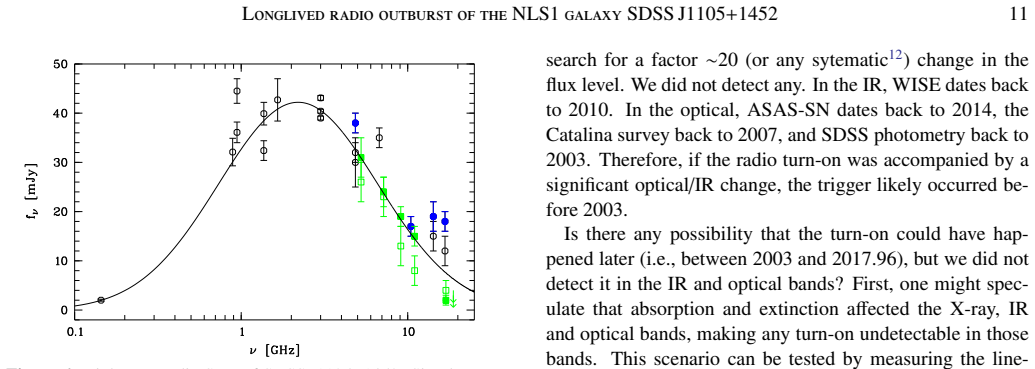
SDSSJ110546.07+145202.4 stands out as a unique radio changing-look Narrow-line Seyfert 1 (NLS1) galaxy that has brightened dramatically and shows an exceptionally long duration of its "on" phase. We present the first high-frequency radio observations, the first simultaneous radio spectral energy distributions (SEDs), the first optical--UV--X-ray SEDs, and the first X-ray monitoring and spectroscopy of this recently discovered event. Importantly for understanding the nature of the outburst, we show that the X-ray spectrum is soft with a photon index Gamma_X=2.5; line-of-sight absorption and extinction are low or absent; the radio SED is peaked at low frequencies ~2 GHz; and the radio outburst emission is very long-lived (t > 8 yr) and roughly constant. The softness of the X-ray spectrum, low supermassive black hole (SMBH) mass, and high Eddington ratio all corroborate the optical NLS1 classification. We discuss multiple outburst scenarios, including lensing, absorption, a binary SMBH merger, a long-duration giant-star tidal disruption, a newly ignited active galactic nucleus (AGN), and an accretion-rate change. While most of them can be either excluded or are deemed too rare and lack positive evidence so far, most or all types of these transients are expected to be detected in ongoing VLA and upcoming SKA surveys. SDSSJ110546.07+145202.4 itself is well explained by an accretion rate change that triggered the powerful radio jet emission. The low redshift and SMBH mass of this system offer a unique perspective of the physical processes of radio-jet ignition that are expected to operate in the early Universe around growing SMBHs.
Editorial analysis
A structured set of objections, weighed in public.
Referee Report
Summary. The paper reports multi-wavelength observations of SDSSJ110546.07+145202.4, a radio changing-look NLS1 galaxy exhibiting a dramatic, long-duration radio outburst. It presents the first high-frequency radio data, simultaneous radio SEDs, optical-UV-X-ray SEDs, and X-ray monitoring/spectroscopy, showing a soft X-ray spectrum (Gamma_X=2.5), low absorption, a radio SED peaked at ~2 GHz, and roughly constant radio emission lasting >8 years. The authors discuss alternative outburst mechanisms (lensing, absorption, binary SMBH merger, giant-star TDE, newly ignited AGN) and conclude that an accretion-rate change triggering a powerful radio jet provides the best explanation, with the low redshift and SMBH mass offering insights into jet ignition processes relevant to early-Universe SMBH growth.
Significance. If the accretion-rate change interpretation holds, the work supplies a rare, well-observed low-redshift example of radio-jet ignition in an NLS1 system, potentially analogous to processes around growing SMBHs at high redshift. The comprehensive data set (first simultaneous SEDs and long-term radio constancy) adds concrete observational constraints on AGN variability and jet formation models, and the paper correctly notes that similar events should appear in VLA and SKA surveys.
major comments (2)
- [Discussion of outburst scenarios] Discussion of outburst scenarios: the statement that most alternatives 'can be either excluded or are deemed too rare and lack positive evidence so far' is not supported by quantitative model comparisons. No calculations or predicted observables are shown demonstrating that a giant-star TDE or binary-driven jet would be incompatible with the measured Gamma_X=2.5, radio SED peak frequency, or >8 yr constancy under standard assumptions; the preference for accretion-rate change therefore rests on qualitative rarity arguments rather than direct incompatibility.
- [X-ray spectroscopy section] X-ray spectroscopy section: the photon index Gamma_X=2.5 is presented as corroborating the NLS1 classification and soft accretion state, but the manuscript provides no details on the spectral fitting procedure, background modeling, absorption column constraints, or uncertainties on Gamma_X. Without these, it is difficult to assess how uniquely the softness excludes harder-spectrum alternatives such as a newly ignited AGN or absorbed event.
minor comments (2)
- [Abstract and Introduction] The abstract and introduction repeatedly use 'the first' to describe the observations; a concise table or bullet list in the introduction summarizing the exact new data products would improve clarity and avoid repetition.
- [Radio observations] Radio light-curve constancy is described as 'roughly constant' over >8 yr; adding a quantitative upper limit on variability amplitude (with error bars from the monitoring epochs) would strengthen the claim that short-duration transients are ruled out.
Simulated Author's Rebuttal
We thank the referee for the constructive and detailed comments on our manuscript. We address each major comment below and have revised the manuscript to incorporate additional details and discussion as indicated.
read point-by-point responses
-
Referee: Discussion of outburst scenarios: the statement that most alternatives 'can be either excluded or are deemed too rare and lack positive evidence so far' is not supported by quantitative model comparisons. No calculations or predicted observables are shown demonstrating that a giant-star TDE or binary-driven jet would be incompatible with the measured Gamma_X=2.5, radio SED peak frequency, or >8 yr constancy under standard assumptions; the preference for accretion-rate change therefore rests on qualitative rarity arguments rather than direct incompatibility.
Authors: We agree that strengthening the discussion with more direct comparisons to model predictions would improve the paper. In the revised manuscript we have added a new paragraph in the outburst scenarios section that references standard model expectations from the literature. For a giant-star TDE we note that radio light-curve models predict significant decay within a few years, which is inconsistent with the observed >8 yr constancy. For a binary SMBH-driven jet we discuss how the observed radio SED peak at ~2 GHz and the soft X-ray spectrum align better with continuous accretion fueling than with a merger-triggered event. These additions move the argument beyond purely qualitative rarity while acknowledging that full hydrodynamic simulations of every scenario lie beyond the scope of the present work. revision: yes
-
Referee: X-ray spectroscopy section: the photon index Gamma_X=2.5 is presented as corroborating the NLS1 classification and soft accretion state, but the manuscript provides no details on the spectral fitting procedure, background modeling, absorption column constraints, or uncertainties on Gamma_X. Without these, it is difficult to assess how uniquely the softness excludes harder-spectrum alternatives such as a newly ignited AGN or absorbed event.
Authors: We thank the referee for pointing out this omission. In the revised manuscript we have expanded the X-ray section to include the full fitting details: spectra were modeled in XSPEC with an absorbed power-law (tbabs*powerlaw), background was extracted from source-free regions on the same chip, the intrinsic column density is constrained to N_H < 8 x 10^20 cm^{-2} (consistent with the Galactic value), and the photon index is Gamma_X = 2.48 +/- 0.12. These values confirm the soft spectrum and low absorption, thereby strengthening the exclusion of heavily absorbed or harder-state interpretations. revision: yes
Circularity Check
No circularity; purely observational interpretation with no derivation chain
full rationale
The paper reports new multi-wavelength observations of SDSSJ110546.07+145202.4 (radio SED peaked at ~2 GHz, soft X-ray Gamma_X=2.5, t>8 yr constant emission, low absorption) and qualitatively compares them to standard AGN models to favor an accretion-rate change scenario while deeming alternatives (lensing, TDE, binary merger, new AGN ignition) either excludable or too rare. No equations, parameter fits, or predictions appear in the provided text. No self-citations are invoked as load-bearing uniqueness theorems or ansatzes. The central interpretation rests on direct comparison of measured observables to external benchmarks rather than any reduction to the paper's own inputs by construction. This is a standard empirical analysis and scores as self-contained.
Axiom & Free-Parameter Ledger
axioms (2)
- domain assumption Standard optical and X-ray criteria for classifying a source as an NLS1 (low SMBH mass, high Eddington ratio, soft X-ray spectrum).
- domain assumption Radio SED peaking at low frequencies and long duration are signatures of jet emission triggered by accretion changes.
Reference graph
Works this paper leans on
-
[1]
K., & et al
Adelman-McCarthy, J. K., & et al. 2009, VizieR Online Data Catalog: The SDSS Photometric Catalog, Release 7 (Adelman-McCarthy+, 2009), VizieR On-line Data Catalog: II/294. Originally published in: 2009ApJS..182..543A
2009
-
[2]
Aller, H. D., Aller, M. F., Latimer, G. E., & Hodge, P. E. 1985, ApJS, 59, 513, doi: 10.1086/191083
-
[3]
1985, ApJ, 288, 205, doi: 10.1086/162783
Alloin, D., Pelat, D., Phillips, M., & Whittle, M. 1985, ApJ, 288, 205, doi: 10.1086/162783
-
[4]
1986, ApJ, 308, 23, doi: 10.1086/164475
Freeman, K. 1986, ApJ, 308, 23, doi: 10.1086/164475
-
[5]
2026, arXiv e-prints, arXiv:2603.21119, doi: 10.48550/arXiv.2603.21119
An, T. 2026, arXiv e-prints, arXiv:2603.21119, doi: 10.48550/arXiv.2603.21119
-
[6]
F., Margon, B., V oges, W., et al
Anderson, S. F., Margon, B., V oges, W., et al. 2007, AJ, 133, 313, doi: 10.1086/509765
-
[7]
1968, Astrophysical Letters, 1, 111
Andrillat, Y ., & Souffrin, S. 1968, Astrophysical Letters, 1, 111
1968
-
[8]
2015, A&A, 575, A55, doi: 10.1051/0004-6361/201425081
Angelakis, E., Fuhrmann, L., Marchili, N., et al. 2015, A&A, 575, A55, doi: 10.1051/0004-6361/201425081
-
[9]
Anumarlapudi, A., Dobie, D., Kaplan, D. L., et al. 2024, ApJ, 974, 241, doi: 10.3847/1538-4357/ad64d3
-
[10]
Arnaud, K. A. 1996, in Astronomical Society of the Pacific Conference Series, V ol. 101, Astronomical Data Analysis Software and Systems V , ed. G. H. Jacoby & J. Barnes, 17
1996
-
[11]
Barrows, R. S., Comerford, J. M., Stern, D., & Assef, R. J. 2021, ApJ, 922, 179, doi: 10.3847/1538-4357/ac1352
-
[12]
Bellm, E. C., Kulkarni, S. R., Graham, M. J., et al. 2019, PASP, 131, 018002, doi: 10.1088/1538-3873/aaecbe Longlived radio outburst of theNLS1galaxySDSS J1105+1452 17
-
[13]
Nesvadba, N. P. H. 2018, MNRAS, 475, 3493, doi: 10.1093/mnras/sty070
-
[14]
F., Bartel, N., Argo, M., et al
Bietenholz, M. F., Bartel, N., Argo, M., et al. 2021, ApJ, 908, 75, doi: 10.3847/1538-4357/abccd9
-
[15]
2025, arXiv e-prints, arXiv:2507.01355, doi: 10.48550/arXiv.2507.01355
Birmingham, S., Ward, C., Nyland, K., et al. 2025, arXiv e-prints, arXiv:2507.01355, doi: 10.48550/arXiv.2507.01355
-
[16]
Blandford, R. D., & Znajek, R. L. 1977, MNRAS, 179, 433, doi: 10.1093/mnras/179.3.433
-
[17]
Bloom, J. S., Giannios, D., Metzger, B. D., et al. 2011, Science, 333, 203, doi: 10.1126/science.1207150
-
[18]
Boroson, T. A. 2002, ApJ, 565, 78, doi: 10.1086/324486
-
[19]
Breeveld, A. A., Curran, P. A., Hoversten, E. A., et al. 2010, MNRAS, 406, 1687, doi: 10.1111/j.1365-2966.2010.16832.x
-
[20]
Burrows, D. N., Hill, J. E., Nousek, J. A., et al. 2005, Space Science Reviews, 120, 165, doi: 10.1007/s11214-005-5097-2
-
[21]
Campanelli, M., Lousto, C., Zlochower, Y ., & Merritt, D. 2007, ApJL, 659, L5, doi: 10.1086/516712
-
[22]
2023, MNRAS, 526, 2331, doi: 10.1093/mnras/stad2877
Cao, X., You, B., & Wei, X. 2023, MNRAS, 526, 2331, doi: 10.1093/mnras/stad2877
-
[23]
Cardelli, J. A., Clayton, G. C., & Mathis, J. S. 1989, ApJ, 345, 245, doi: 10.1086/167900 CASA Team, Bean, B., Bhatnagar, S., et al. 2022, PASP, 134, 114501, doi: 10.1088/1538-3873/ac9642
-
[24]
Cash, W. 1979, ApJ, 228, 939, doi: 10.1086/156922
-
[25]
Cavagnolo, K. W., McNamara, B. R., Nulsen, P. E. J., et al. 2010, ApJ, 720, 1066, doi: 10.1088/0004-637X/720/2/1066
-
[26]
Cendes, Y ., Berger, E., Alexander, K. D., et al. 2024, ApJ, 971, 185, doi: 10.3847/1538-4357/ad5541
-
[27]
Chen, S., Stevens, J. B., Edwards, P. G., et al. 2022, MNRAS, 512, 471, doi: 10.1093/mnras/stac530
-
[28]
Chen, Y ., Gaensler, B. M., Clarke, T., et al. 2025, ApJ, 987, 170, doi: 10.3847/1538-4357/add924
-
[29]
Condon, J. J., Cotton, W. D., Greisen, E. W., et al. 1998, AJ, 115, 1693, doi: 10.1086/300337 Dalla Bont`a, E., Peterson, B. M., Grier, C. J., et al. 2025, A&A, 696, A48, doi: 10.1051/0004-6361/202452746 de Vries, W. H., O’Dea, C. P., Barthel, P. D., et al. 2000, AJ, 120, 2300, doi: 10.1086/316825
-
[30]
Denney, K. D., De Rosa, G., Croxall, K., et al. 2014, ApJ, 796, 134, doi: 10.1088/0004-637X/796/2/134
-
[31]
Dexter, J., & Begelman, M. C. 2019, MNRAS, 483, L17, doi: 10.1093/mnrasl/sly213
-
[32]
Dey, A., Schlegel, D. J., Lang, D., et al. 2019, AJ, 157, 168, doi: 10.3847/1538-3881/ab089d
-
[33]
2025, arXiv e-prints, arXiv:2510.18445
Dong, Q., Zhang, Z.-X., Gu, W.-M., et al. 2025, arXiv e-prints, arXiv:2510.18445, doi: 10.48550/arXiv.2510.18445 D’Orazio, D. J., Haiman, Z., & MacFadyen, A. 2013, MNRAS, 436, 2997, doi: 10.1093/mnras/stt1787
-
[34]
Drake, A. J., Djorgovski, S. G., Mahabal, A., et al. 2009, ApJ, 696, 870, doi: 10.1088/0004-637X/696/1/870
-
[35]
Duchesne, S., Ross, K., Thomson, A. J. M., et al. 2025, PASA, 42, 38, doi: 10.1017/pasa.2025.2
-
[36]
Duchesne, S. W., Grundy, J. A., Heald, G. H., et al. 2024, PASA, 41, e003, doi: 10.1017/pasa.2023.60
-
[37]
Elvis, M., Wilkes, B. J., McDowell, J. C., et al. 1994, ApJS, 95, 1, doi: 10.1086/192093
-
[38]
Evans, P. A., Beardmore, A. P., Page, K. L., et al. 2007, A&A, 469, 379, doi: 10.1051/0004-6361:20077530
-
[39]
2004, ARA&A, 42, 317, doi: 10.1146/annurev.astro.42.053102.134031
Fender, R., & Belloni, T. 2004, ARA&A, 42, 317, doi: 10.1146/annurev.astro.42.053102.134031
-
[40]
Ferguson, J. W., Korista, K. T., & Ferland, G. J. 1997, ApJS, 110, 287, doi: 10.1086/312998
-
[41]
Frail, D. A., Kulkarni, S. R., Nicastro, L., Feroci, M., & Taylor, G. B. 1997, Nature, 389, 261, doi: 10.1038/38451
-
[42]
Frederick, S., Gezari, S., Graham, M. J., et al. 2019, ApJ, 883, 31, doi: 10.3847/1538-4357/ab3a38 Gab´anyi, K. ´E., Komossa, S., Kraus, A., Mez˝osi, A., & Frey, S. 2025, A&A, 702, L17, doi: 10.1051/0004-6361/202556780 Gaia Collaboration, Vallenari, A., Brown, A. G. A., et al. 2023, A&A, 674, A1, doi: 10.1051/0004-6361/202243940
-
[43]
Gaskell, C. M. 2017, MNRAS, 467, 226, doi: 10.1093/mnras/stx094
-
[44]
2023, A&A, 674, A22, doi: 10.1051/0004-6361/202244367
Gavras, P., Rimoldini, L., Nienartowicz, K., et al. 2023, A&A, 674, A22, doi: 10.1051/0004-6361/202244367
-
[45]
2004, The Astrophysical Journal, 611, 1005, doi: 10.1086/422091
Gehrels, N., Chincarini, G., Giommi, P., et al. 2004, ApJ, 611, 1005, doi: 10.1086/422091
-
[46]
Goodrich, R. W. 1989, ApJ, 342, 224, doi: 10.1086/167586
-
[47]
Gordon, Y . A., Boyce, M. M., O’Dea, C. P., et al. 2021, ApJS, 255, 30, doi: 10.3847/1538-4365/ac05c0
-
[48]
Green, P. J., Pulgarin-Duque, L., Anderson, S. F., et al. 2022, ApJ, 933, 180, doi: 10.3847/1538-4357/ac743f
-
[49]
Gregory, P. C., Scott, W. K., Douglas, K., & Condon, J. J. 1996, ApJS, 103, 427, doi: 10.1086/192282
-
[50]
2004, AJ, 127, 1799, doi: 10.1086/382516
Grupe, D. 2004, AJ, 127, 1799, doi: 10.1086/382516
-
[51]
Grupe, D., Komossa, S., Leighly, K. M., & Page, K. L. 2010, ApJS, 187, 64, doi: 10.1088/0067-0049/187/1/64
-
[52]
2015, ApJL, 803, L28, doi: 10.1088/2041-8205/803/2/L28
Grupe, D., Komossa, S., & Saxton, R. 2015, ApJL, 803, L28, doi: 10.1088/2041-8205/803/2/L28
-
[53]
2015, ApJ, 809, 166, doi: 10.1088/0004-637X/809/2/166
Guillochon, J., & Ramirez-Ruiz, E. 2015, ApJ, 809, 166, doi: 10.1088/0004-637X/809/2/166 G¨ultekin, K., Richstone, D. O., Gebhardt, K., et al. 2009, ApJ, 698, 198, doi: 10.1088/0004-637X/698/1/198
-
[54]
Guo, W.-J., Zou, H., Fawcett, V . A., et al. 2024, ApJS, 270, 26, doi: 10.3847/1538-4365/ad118a
-
[55]
2025, ApJL, 981, L8, doi: 10.3847/2041-8213/adb426
Guo, W.-J., Pan, Z., Siudek, M., et al. 2025, ApJL, 981, L8, doi: 10.3847/2041-8213/adb426
-
[56]
Hale, C. L., McConnell, D., Thomson, A. J. M., et al. 2021, PASA, 38, e058, doi: 10.1017/pasa.2021.47 18 S. Komossa et al
-
[57]
Hancock, P. J., Charlton, E. G., Macquart, J.-P., & Hurley-Walker, N. 2019, arXiv e-prints, arXiv:1907.08395, doi: 10.48550/arXiv.1907.08395
-
[58]
Hancock, P. J., Gaensler, B. M., & Murphy, T. 2013, ApJ, 776, 106, doi: 10.1088/0004-637X/776/2/106
-
[59]
Helfand, D. J., White, R. L., & Becker, R. H. 2015, ApJ, 801, 26, doi: 10.1088/0004-637X/801/1/26 HI4PI Collaboration, Ben Bekhti, N., Fl¨oer, L., et al. 2016, Astronomy & Astrophysics, 594, A116, doi: 10.1051/0004-6361/201629178
-
[60]
E., Burrows, D
Hill, J. E., Burrows, D. N., Nousek, J. A., et al. 2004, in Society of Photo-Optical Instrumentation Engineers (SPIE) Conference
2004
-
[61]
5165, X-Ray and Gamma-Ray Instrumentation for Astronomy XIII, ed
Series, V ol. 5165, X-Ray and Gamma-Ray Instrumentation for Astronomy XIII, ed. K. A. Flanagan & O. H. W. Siegmund, 217–231, doi: 10.1117/12.505728
-
[62]
2022, MNRAS, 511, 54, doi: 10.1093/mnras/stab3694
Hon, W. J., Wolf, C., Onken, C. A., Webster, R., & Auchettl, K. 2022, MNRAS, 511, 54, doi: 10.1093/mnras/stab3694
-
[63]
Hopkins, A. M., Miller, C. J., Nichol, R. C., et al. 2003, ApJ, 599, 971, doi: 10.1086/379608
-
[64]
Hurley-Walker, N., Callingham, J. R., Hancock, P. J., et al. 2017, MNRAS, 464, 1146, doi: 10.1093/mnras/stw2337
-
[65]
Huynh, M., Dempsey, J., Whiting, M. T., & Ophel, M. 2020, in Astronomical Society of the Pacific Conference Series, V ol. 522, Astronomical Data Analysis Software and Systems XXVII, ed. P. Ballester, J. Ibsen, M. Solar, & K. Shortridge, 263 Ivezi´c, ˇZ., Kahn, S. M., Tyson, J. A., et al. 2019, ApJ, 873, 111, doi: 10.3847/1538-4357/ab042c
-
[66]
Jana, A., Ricci, C., Venselaar, S. M., et al. 2025, A&A, 699, A62, doi: 10.1051/0004-6361/202554491
-
[67]
H., Cohen, M., Masci, F., et al
Jarrett, T. H., Cohen, M., Masci, F., et al. 2011, ApJ, 735, 112, doi: 10.1088/0004-637X/735/2/112 J¨arvel¨a, E., Savolainen, T., Berton, M., et al. 2024, MNRAS, 532, 3069, doi: 10.1093/mnras/stae1701
-
[68]
2025, arXiv e-prints, arXiv:2511.09626, doi: 10.48550/arXiv.2511.09626
Kaaz, N., Liska, M., Ward, C., & Davelaar, J. 2025, arXiv e-prints, arXiv:2511.09626, doi: 10.48550/arXiv.2511.09626
work page internal anchor Pith review doi:10.48550/arxiv.2511.09626 2025
- [69]
-
[70]
Kerrison, E. F., Allison, J. R., Moss, V . A., Sadler, E. M., & Rees, G. A. 2024, MNRAS, 533, 4248, doi: 10.1093/mnras/stae1796
-
[71]
Peterson, B. M. 2016, MNRAS, 460, 304, doi: 10.1093/mnras/stw975
-
[72]
Kochanek, C. S., Shappee, B. J., Stanek, K. Z., et al. 2017, PASP, 129, 104502, doi: 10.1088/1538-3873/aa80d9
-
[73]
Kollatschny, W., & Fricke, K. J. 1985, A&A, 146, L11
1985
-
[74]
2002, Reviews in Modern Astronomy, 15, 27, doi: 10.48550/arXiv.astro-ph/0209007
Komossa, S. 2002, Reviews in Modern Astronomy, 15, 27, doi: 10.48550/arXiv.astro-ph/0209007
-
[75]
2008, in Revista Mexicana de Astronomia y Astrofisica Conference Series, V ol
Komossa, S. 2008, in Revista Mexicana de Astronomia y Astrofisica Conference Series, V ol. 32, , 86–92, doi: 10.48550/arXiv.0710.3326
-
[76]
Komossa, S. 2018, in Revisiting Narrow-Line Seyfert 1 Galaxies and their Place in the Universe, POS(NLS1-2018), 15, doi: 10.22323/1.328.0015
-
[77]
2001, arXiv e-prints, astro-ph/0106422, astro, doi: 10.48550/arXiv.astro-ph/0106422
Komossa, S., & Dahlem, M. 2001, arXiv e-prints, astro-ph/0106422, astro, doi: 10.48550/arXiv.astro-ph/0106422
-
[78]
2024, Serbian Astronomical Journal, 209, 1, doi: 10.2298/SAJ2409001K
Komossa, S., & Grupe, D. 2024, Serbian Astronomical Journal, 209, 1, doi: 10.2298/SAJ2409001K
-
[79]
2006, AJ, 132, 531, doi: 10.1086/505043
Komossa, S., V oges, W., Xu, D., et al. 2006, AJ, 132, 531, doi: 10.1086/505043
-
[80]
2023, ApJ, 944, 177, doi: 10.3847/1538-4357/acaf71
Komossa, S., Kraus, A., Grupe, D., et al. 2023, ApJ, 944, 177, doi: 10.3847/1538-4357/acaf71
discussion (0)
Sign in with ORCID, Apple, or X to comment. Anyone can read and Pith papers without signing in.