Translating Ethical Frameworks Into User-Centred Anti-Social Behaviour Interventions
Pith reviewed 2026-05-10 01:28 UTC · model grok-4.3
The pith
Embedding ethical themes into QR reporting tools and awareness courses can guide anti-social behaviour interventions without replacing punishments.
A machine-rendered reading of the paper's core claim, the machinery that carries it, and where it could break.
Core claim
Translating an ethical framework built on proportionality, personalisation, and responsibility into QR-based public reporting interfaces and a preceding web-based ASB awareness course produces positive evaluations in structured interviews and surveys; these outcomes support the broader use of technological interventions that complement rather than replace punitive approaches and thereby increase public responsibility while preventing anti-social behaviour.
What carries the argument
The ethical framework (proportionality, personalisation, responsibility) extracted from public opinion research and instantiated as QR reporting interfaces plus a pre-punitive web awareness course, tested via interviews and surveys.
If this is right
- Positive user evaluations support expanding technological tools for ASB that work alongside existing punitive systems.
- The designs can increase public responsibility and help prevent incidents before escalation occurs.
- Ethical considerations can be embedded earlier in government intervention design processes.
- Digital interfaces such as QR reporting provide a user-centred alternative path that balances rather than supplants punishment.
Where Pith is reading between the lines
- Real-world trials could test whether the interfaces actually reduce escalation rates to formal penalties.
- The same ethical-translation method might extend to other community issues such as littering or neighbour disputes.
- Longer-term data collection could show whether awareness courses lower the overall volume of punitive actions needed.
Load-bearing premise
Positive feedback from interviews and surveys will translate into measurable real-world increases in public responsibility and reductions in anti-social behaviour incidents.
What would settle it
A controlled community pilot that deploys the QR interfaces and awareness course, then tracks actual changes in reported ASB incidents and responsibility indicators against matched control areas over several months.
Figures


read the original abstract
In 2025 one million Anti-Social Behaviour (ASB) cases were recorded in England & Wales, impacting community cohesion. Statutory guidance presents punitive interventions that lack technological input and does not often root ethical frameworks within government system design. This work takes a novel approach in framing ASB intervention as a human-computer interaction problem by embedding an ethical framework into two digital designs, aiming to increase public responsibility and prevent ASB. The first design is extracted from UK public opinion research, the ethical themes include punitive proportionality, personalisation, and responsibility. The second are digital interventions that present a set of QR-based public reporting interfaces and a web-based ASB awareness course that precedes punitive escalation. Our methodology involves structured interviews and online surveys. Results positively evaluated the framework and QR interfaces. Such outcomes could inform the expansion of technological intervention utilisation that does not replace existing punitive approaches, but balances them.
Editorial analysis
A structured set of objections, weighed in public.
Referee Report
Summary. The paper frames anti-social behaviour (ASB) intervention as an HCI problem by deriving an ethical framework (punitive proportionality, personalisation, responsibility) from UK public opinion research and embedding it into two digital designs: QR-based public reporting interfaces and a web-based ASB awareness course that precedes punitive escalation. It evaluates these designs via structured interviews and online surveys, reports positive results, and concludes that such outcomes can inform expansion of technological interventions that balance rather than replace existing punitive approaches.
Significance. If the positive evaluations hold and translate to measurable behavioural change, the work offers a user-centred HCI contribution to public policy by integrating ethical themes into digital tools for community issues like ASB. A strength is the explicit grounding in public opinion research and the balanced framing that positions tech as complementary to punitive systems rather than a replacement. However, the absence of quantitative metrics or outcome data currently limits its policy relevance and generalisability.
major comments (3)
- [Abstract] Abstract: The statement that 'Results positively evaluated the framework and QR interfaces' provides no sample sizes, response rates, quantitative metrics, statistical tests, or baseline comparisons. This is load-bearing for the central claim that the designs increase public responsibility and prevent ASB.
- [Methodology] Methodology section: The evaluation is described only as structured interviews and online surveys (formative qualitative methods). No deployment logs, pre/post incident data, control comparisons, or behavioural metrics are reported, leaving the assumption that positive feedback will produce real-world reductions in ASB incidents untested.
- [Results] Results and Discussion: The leap from stated approval/usability ratings to policy-relevant outcomes (increased responsibility, balanced interventions) rests on an untested causal assumption without any reported evidence of actual reporting behaviour or ASB incident changes.
minor comments (2)
- [Abstract] The abstract and introduction could more explicitly state how the three ethical themes were operationalised from the cited public opinion research.
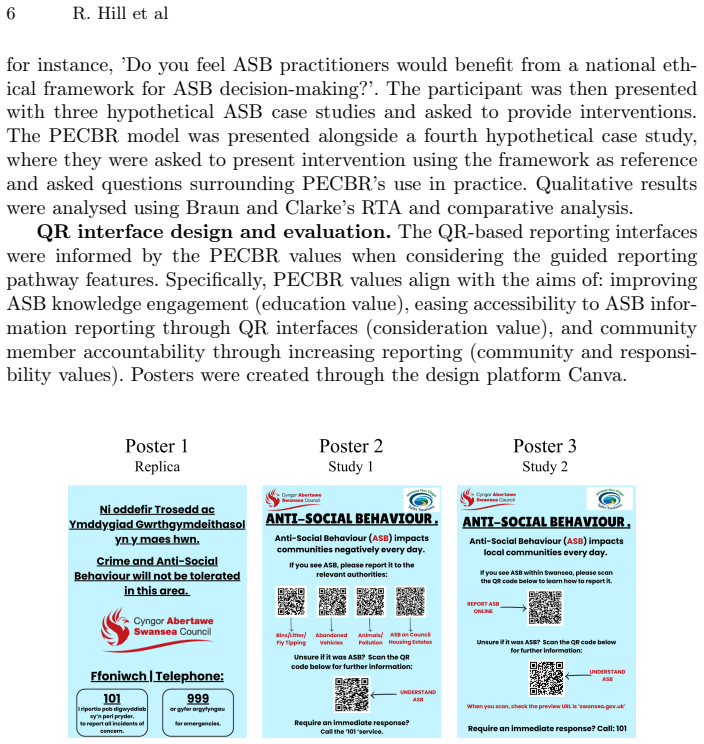
- [Design section] Figure captions or interface descriptions would benefit from clearer labels indicating which ethical theme each QR element addresses.
Simulated Author's Rebuttal
We thank the referee for the constructive feedback and the recommendation for major revision. We agree that greater specificity is needed in the abstract and methodology, and that the discussion must clearly delimit the scope of our claims. We will revise the manuscript to address these points while preserving the contribution as a formative HCI study that grounds digital designs in an ethical framework derived from public opinion research.
read point-by-point responses
-
Referee: [Abstract] Abstract: The statement that 'Results positively evaluated the framework and QR interfaces' provides no sample sizes, response rates, quantitative metrics, statistical tests, or baseline comparisons. This is load-bearing for the central claim that the designs increase public responsibility and prevent ASB.
Authors: We will revise the abstract to report the sample sizes for the structured interviews and online surveys, response rates, and key quantitative metrics (e.g., mean usability and agreement ratings) drawn from the results section. We will also explicitly note the absence of statistical tests or baseline comparisons for behavioural change, as the study did not measure these outcomes. The wording will be adjusted to state that the evaluations indicate user acceptance of the framework rather than asserting direct increases in responsibility or ASB prevention. revision: yes
-
Referee: [Methodology] Methodology section: The evaluation is described only as structured interviews and online surveys (formative qualitative methods). No deployment logs, pre/post incident data, control comparisons, or behavioural metrics are reported, leaving the assumption that positive feedback will produce real-world reductions in ASB incidents untested.
Authors: We will expand the methodology section to describe the interview protocol, survey instruments, recruitment process, participant characteristics, and analysis procedures in greater detail. We will add an explicit limitations paragraph stating that the evaluation was formative and qualitative, with no deployment logs, pre/post incident data, control groups, or behavioural metrics collected. The text will clarify that positive user feedback is presented as evidence of design viability, not as a tested predictor of real-world ASB reductions. revision: yes
-
Referee: [Results] Results and Discussion: The leap from stated approval/usability ratings to policy-relevant outcomes (increased responsibility, balanced interventions) rests on an untested causal assumption without any reported evidence of actual reporting behaviour or ASB incident changes.
Authors: We will revise the results and discussion to remove any phrasing that could be read as implying causal effects. The current conclusion uses the conditional 'could inform' rather than asserting achieved outcomes; we will reinforce this distinction by adding sentences that separate user-reported approval from unmeasured behavioural or incident-level changes. No evidence of actual reporting behaviour or ASB reductions is claimed or provided, and this will be stated plainly. revision: partial
- The manuscript contains no deployment logs, pre/post ASB incident data, or behavioural metrics because the study was designed as a formative evaluation of prototypes rather than a field trial; such data cannot be supplied without conducting additional longitudinal research.
Circularity Check
No circularity: empirical evaluation independent of design inputs
full rationale
The paper derives ethical themes (punitive proportionality, personalisation, responsibility) from external UK public opinion research, embeds them into QR reporting interfaces and a web awareness course, then reports direct results from separate structured interviews and online surveys. Positive evaluation outcomes are presented as findings from this user study rather than any equation, fitted parameter, or prediction that reduces to the inputs by construction. No self-citations, uniqueness theorems, or ansatzes appear in load-bearing positions. The forward suggestion that results 'could inform the expansion of technological intervention utilisation' is an implication, not a tautological derivation. This is a self-contained empirical HCI design-and-evaluate workflow with no reduction of outputs to inputs.
Axiom & Free-Parameter Ledger
axioms (2)
- domain assumption Public opinion research accurately captures the ethical themes (punitive proportionality, personalisation, responsibility) that should guide effective ASB interventions
- ad hoc to paper Embedding these ethical themes into digital interfaces will increase public responsibility and prevent ASB when used alongside punitive systems
Reference graph
Works this paper leans on
-
[1]
In: Adjunct Proceedings of the 30th ACM Conference on User Modeling, Adaptation and Personalization
Adaji, I., Adisa, M.: A review of the use of persuasive technologies to influence sustainable behaviour. In: Adjunct Proceedings of the 30th ACM Conference on User Modeling, Adaptation and Personalization. pp. 317–325. ACM (Jul 2022)
2022
-
[2]
In: 2021 International Confer- ence on Data and Software Engineering (ICoDSE)
Akmal, M., Niwanputri, G.S.: Spoonful: Mobile application for reducing house- hold food waste using fogg behavior model (fbm). In: 2021 International Confer- ence on Data and Software Engineering (ICoDSE). pp. 1–6. IEEE (Nov 2021). https://doi.org/10.1109/ICoDSE53690.2021.9666124
-
[3]
Balcom Raleigh, M.: Designing for value sensitiveservice in the publicsector (2020)
2020
-
[4]
Braun, V., Clarke, V., Hayfield, N., Davey, L., Jenkinson, E.: Doing reflexive the- matic analysis. In: Supporting Research in Counselling and Psychotherapy: Qual- itative, Quantitative, and Mixed Methods Research, pp. 19–38. Springer Interna- tional Publishing, Cham (2023). https://doi.org/10.1007/978-3-031-28008-4_2
-
[5]
Government Information Quarterly39(4), 101757 (2022)
Corbett, J., El Idrissi, S.C.: Persuasion, information technology, and the environ- mental citizen: An empirical study of the persuasion effectiveness of city applica- tions. Government Information Quarterly39(4), 101757 (2022)
2022
-
[6]
European Journal on Criminal Policy and Research23(1), 9–26 (2017)
Crawford, A., Lewis, S., Traynor, P.: It ain’t (just) what you do it’s (also) the way you do it: The role of procedural justice in the implementation of anti-social behaviour interventions with young people. European Journal on Criminal Policy and Research23(1), 9–26 (2017)
2017
-
[7]
In: Proceeding International Conference on Economics, Business and Information Technology
Fauzia, R.N., Dwiputrianti, S., Taryono, O., Iyoega, R.R.: Enhancing public service innovation through e-government: The case of qr code based complaint system in bandung fuel stations. In: Proceeding International Conference on Economics, Business and Information Technology. vol. 6, pp. 721–727 (2025)
2025
-
[8]
In: Proceedings of the 4th International Conference on Persuasive Technology
Fogg, B.J.: A behavior model for persuasive design. In: Proceedings of the 4th International Conference on Persuasive Technology. pp. 1–7 (2009)
2009
-
[9]
In: Proceedings of the 23rd Australian Computer- Human Interaction Conference
Foth, M., Schroeter, R., Anastasiu, I.: Fixing the city one photo at a time: mobile logging of maintenance requests. In: Proceedings of the 23rd Australian Computer- Human Interaction Conference. pp. 126–129 (2011)
2011
-
[10]
interactions3(6), 16–23 (1996)
Friedman, B.: Value-sensitive design. interactions3(6), 16–23 (1996)
1996
-
[11]
New Media & Society26(3), 1268–1289 (2024)
Goggin, G., Wilken, R.: Qr codes and automated decision-making in the covid-19 pandemic. New Media & Society26(3), 1268–1289 (2024)
2024
-
[12]
Crime Science11(1), 6 (2022)
Halford, E., Dixon, A., Farrell, G.: Anti-social behaviour in the coronavirus pan- demic. Crime Science11(1), 6 (2022)
2022
-
[13]
Punishment & Society24(3), 305–323 (2022)
Heap, V., Black, A., Rodgers, Z.: Preventive justice: Exploring the coercive power of community protection notices to tackle anti-social behaviour. Punishment & Society24(3), 305–323 (2022)
2022
-
[14]
Msc thesis, Swansea University, Swansea, UK (2023), https://www.swansea.ac.uk/media/Rachel-hill-msc-thesis-upload.pdf, ac- cessed: 2026-01
Hill, R.: Anti-Social Behaviour: researching public perceptions to inform the de- sign of technological interventions. Msc thesis, Swansea University, Swansea, UK (2023), https://www.swansea.ac.uk/media/Rachel-hill-msc-thesis-upload.pdf, ac- cessed: 2026-01
2023
-
[15]
Computers in Human Be- havior26(6), 1278–1288 (2010)
Hollender, N., Hofmann, C., Deneke, M., Schmitz, B.: Integrating cognitive load theory and concepts of human–computer interaction. Computers in Human Be- havior26(6), 1278–1288 (2010)
2010
-
[16]
statutory guidance for frontline professionals (2025)
Home Office: Asb powers. statutory guidance for frontline professionals (2025)
2025
-
[17]
Hill et al
Home Office, Clarke, Williams, Wydall, Gray, Liddle, Smith: Describing and as- sessing interventions to address anti-social behaviour (2011), retrieved January 2026 14 R. Hill et al
2011
-
[18]
Home Office, Ministry of Justice: Crime and policing bill: Anti-social behaviour factsheet (2025), retrieved January 2026
2025
-
[19]
Cartographic Perspectives (58), 61–67 (2007)
Jenny, B., Kelso, N.V.: Color design for the color vision impaired. Cartographic Perspectives (58), 61–67 (2007)
2007
-
[20]
In: Interna- tional Conference on Human-Computer Interaction
Khan, M.Z., Erhan, H.: An interactive multi-modal online platform for support- ing data-informed design discourse on developing built environments. In: Interna- tional Conference on Human-Computer Interaction. pp. 175–194. Springer Nature Switzerland, Cham (2025)
2025
-
[21]
Local Government Association: Anti-social behaviour: Survey of councils, october 2024 (2024), retrieved January 2026
2024
-
[22]
https://doi.org/10.1016/j.giq.2013.05.025
Lorenzi, D., Vaidya, J., Chun, S., Shafiq, B., Atluri, V.: Enhancing the government serviceexperiencethroughQRcodesonmobileplatforms.GovernmentInformation Quarterly31(1), 6–16 (2014). https://doi.org/10.1016/j.giq.2013.05.025
-
[23]
In: Securing an Urban Renaissance, pp
Millie, A.: Tackling anti-social behaviour and regenerating neighbourhoods. In: Securing an Urban Renaissance, pp. 107–124. Policy Press (2007)
2007
-
[24]
International Journal of Technology in Emerging Research1, 274–289 (2025)
Musa,B.B.,Bahago,A.A.,Muhammad,N.A.,Jamal,F.:Emergingtrendsinphish- ing: A look at smishing, vishing, quishing. International Journal of Technology in Emerging Research1, 274–289 (2025)
2025
-
[25]
Office for National Statistics: Crime in england and wales: Year ending september
-
[26]
https://www.ons.gov.uk/peoplepopulationandcommunity/crimeandjustice (2023), published 25 January 2024
2023
-
[27]
Office for National Statistics: Crime in england and wales: Year ending december
-
[28]
anti-social behaviour (2024), retrieved January 2026
2024
-
[29]
Office for National Statistics: Crime in england and wales: Year ending september 2025 (2026), published 29 January 2026
2025
-
[30]
Communications of the Association for Information Systems24(1), 28 (2009)
Oinas-Kukkonen, H., Harjumaa, M.: Persuasive systems design: Key issues, process model, and system features. Communications of the Association for Information Systems24(1), 28 (2009)
2009
-
[31]
Rys, M., Šlusarek, A., Zieliński, K.: Caught off guard: When experts fall for quish- ing, is awareness enough? Security and Privacy8(1), e486 (2025)
2025
-
[32]
Sustainability13(11), 6240 (2021)
Sapraz, M., Han, S.: Implicating human values for designing a digital government collaborative platform for environmental issues: A value sensitive design approach. Sustainability13(11), 6240 (2021)
2021
-
[33]
Legislation (2014)
UK Government: Anti-social behaviour, crime and policing act 2014: Meaning of ‘anti-social behaviour’, section 2(1)(a,b,c). Legislation (2014)
2014
-
[34]
UK Parliament: Use of ai in government — committees — uk parliament (2025)
2025
-
[35]
Welsh Government: Create and use qr codes (2026), accessed: 2026-01
2026
-
[36]
Welsh Government: Traffic signs and road markings (2026), accessed: 2026-01
2026
-
[37]
Welsh Government: Welsh language standards: Communication and marketing guidelines (2026), accessed: 2026-01
2026
discussion (0)
Sign in with ORCID, Apple, or X to comment. Anyone can read and Pith papers without signing in.