Ion wake-mediated dust interactions under PK-4 conditions: a generalized and compact potential formulation
Pith reviewed 2026-05-10 00:50 UTC · model grok-4.3
The pith
A compact potential model with few coefficients from simulations captures ion wake effects on dust particles for multiple distances under PK-4 conditions.
A machine-rendered reading of the paper's core claim, the machinery that carries it, and where it could break.
Core claim
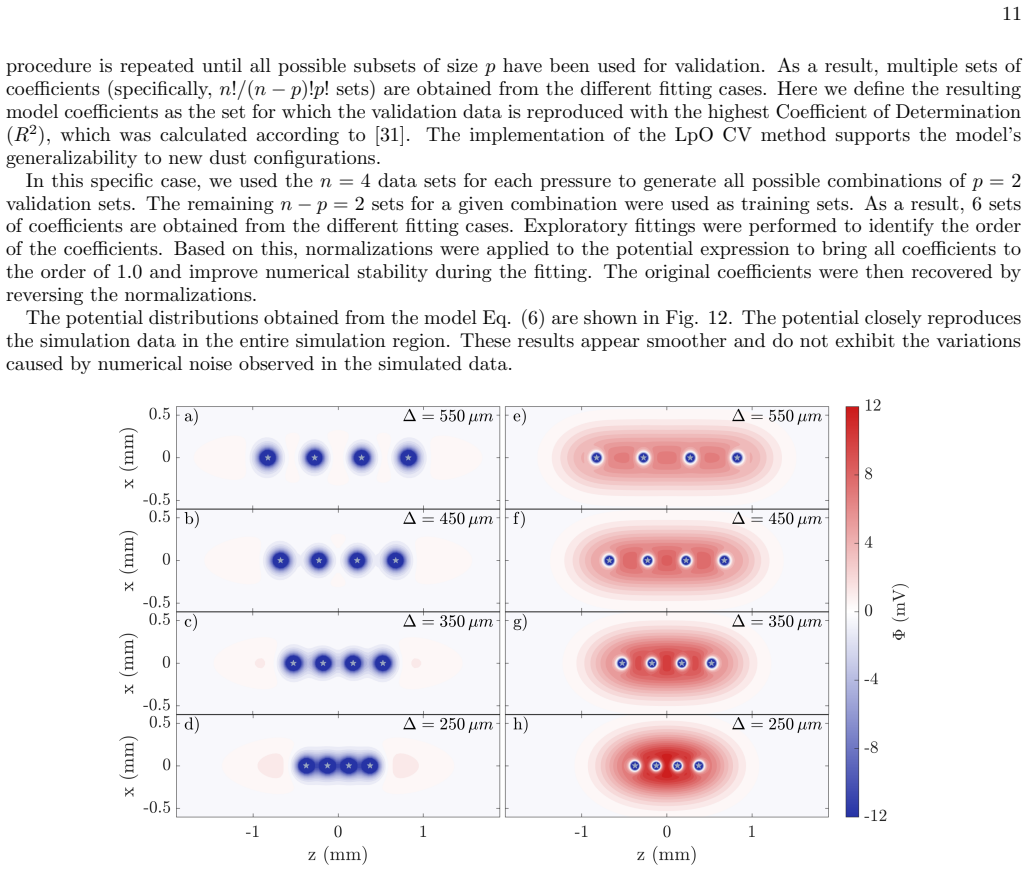
The authors present a robust and general potential model for dust and ion wake systems under PK-4-like conditions. Using a small set of coefficients determined from molecular dynamics simulations, the model captures the potential distributions for multiple interparticle distances. Its application to test cases and implementation in a small scale dust dynamics simulation demonstrates its applicability to a wide range of dust arrangements beyond string-like configurations.
What carries the argument
The generalized and compact potential formulation, parameterized by a small set of coefficients fitted from molecular dynamics simulations of streaming ions past charged dust grains.
If this is right
- The model reproduces potential distributions at multiple interparticle distances without separate tuning for each distance.
- It can be inserted directly into small-scale dust dynamics simulations for practical calculations.
- The same coefficients support dust arrangements other than linear strings.
- Test cases confirm the formulation works across the range of spacings examined in the molecular dynamics data.
Where Pith is reading between the lines
- The fixed-coefficient approach could reduce computational cost when simulating larger numbers of dust particles or longer time scales.
- Similar fitting procedures might be tested in other dusty-plasma devices with different electric-field strengths or neutral-gas pressures.
- If the coefficients prove stable, they could serve as input for analytic derivations of wake forces in simplified plasma models.
- Researchers might apply the model to predict how ionization waves interact with dust wakes to form time-dependent structures.
Load-bearing premise
The small set of coefficients determined from molecular dynamics simulations will be applicable to a wide range of dust arrangements beyond string-like configurations under PK-4 conditions.
What would settle it
Molecular dynamics or experimental measurements of the potential around dust particles in non-string arrangements under PK-4 conditions that deviate from the model's predictions without requiring new coefficient values would falsify the claimed generality.
Figures




read the original abstract
Dusty plasmas, composed of electrons, ions, neutral particles, and charged dust grains, exhibit self-organization phenomena such as string-like structures observed in microgravity experiments. The formation of these structures is influenced by ion wakes generated by streaming ions under external electric fields, as well as by time-evolving plasma inhomogeneities such as ionization waves. Existing ion wake models, such as point charge and Gaussian-based representations, often rely on configuration-specific parameters, limiting their general applicability. In this work, we present a robust and general potential model for dust and ion wake systems under PK-4-like conditions. Using a small set of coefficients determined from molecular dynamics simulations, the model captures the potential distributions for multiple interparticle distances. Its application to test cases and implementation in a small scale dust dynamics simulation demonstrates its applicability to a wide range of dust arrangements beyond string-like configurations.
Editorial analysis
A structured set of objections, weighed in public.
Referee Report
Summary. The manuscript presents a generalized and compact potential formulation for ion wake-mediated dust interactions under PK-4-like conditions in dusty plasmas. It determines a small set of coefficients from molecular dynamics (MD) simulations to capture potential distributions across multiple interparticle distances, applies the model to test cases, and implements it in small-scale dust dynamics simulations, claiming robustness and applicability to a wide range of dust arrangements beyond string-like configurations.
Significance. If validated, the work offers a practical, low-parameter model that could improve simulations of self-organization in microgravity dusty plasma experiments such as PK-4 by addressing limitations of configuration-specific wake models. The MD-based fitting and dynamics implementation provide a bridge between microscopic ion dynamics and larger-scale grain motion.
major comments (2)
- [Abstract] Abstract: The claim that the model applies 'to a wide range of dust arrangements beyond string-like configurations' rests on unquantified 'test cases.' No L2 error, force accuracy, or other metric comparing the fitted potential against independent MD runs for 2-D clusters or 3-D aggregates is reported, leaving the transferability of the single coefficient set unverified.
- [Methods/Results] Methods/Results: The potential is constructed from coefficients fitted to MD data whose generating geometries are not specified (e.g., whether the training set included only linear chains or varied symmetries). This omission makes it impossible to evaluate whether the compact form embeds wake shapes or screening lengths specific to string-like symmetry, as required for the generality assertion.
minor comments (1)
- [Abstract] The abstract states the model 'captures the potential distributions' but provides no quantitative validation details or error analysis; adding a brief table of fit residuals or cross-validation errors would strengthen the presentation.
Simulated Author's Rebuttal
We thank the referee for their careful reading and constructive comments, which help clarify the presentation of our results. We address the major comments point by point below and will incorporate revisions to provide the requested quantitative support and methodological details.
read point-by-point responses
-
Referee: [Abstract] Abstract: The claim that the model applies 'to a wide range of dust arrangements beyond string-like configurations' rests on unquantified 'test cases.' No L2 error, force accuracy, or other metric comparing the fitted potential against independent MD runs for 2-D clusters or 3-D aggregates is reported, leaving the transferability of the single coefficient set unverified.
Authors: We agree that explicit quantitative metrics are needed to substantiate the generality claim. In the revised manuscript we will add L2 error norms, force accuracy comparisons, and related metrics between the fitted potential and independent MD runs for 2-D clusters and 3-D aggregates. These additions will directly quantify the transferability of the single coefficient set and strengthen the abstract statement. revision: yes
-
Referee: [Methods/Results] Methods/Results: The potential is constructed from coefficients fitted to MD data whose generating geometries are not specified (e.g., whether the training set included only linear chains or varied symmetries). This omission makes it impossible to evaluate whether the compact form embeds wake shapes or screening lengths specific to string-like symmetry, as required for the generality assertion.
Authors: The referee correctly identifies that the geometries of the MD simulations used for coefficient fitting are not explicitly stated. We will revise the Methods section to describe the training set in detail, specifying that it encompasses linear chains together with 2-D and 3-D configurations of varying symmetries. This information will enable readers to assess whether the compact form is free of string-specific biases. revision: yes
Circularity Check
No significant circularity; empirical model fitting with external validation steps
full rationale
The paper determines a small set of coefficients from molecular dynamics simulations to construct a compact potential model that reproduces potential distributions across multiple interparticle distances under PK-4-like conditions. It then applies this model to separate test cases and a small-scale dust dynamics simulation to demonstrate broader applicability beyond string-like configurations. This sequence follows standard data-driven modeling: parameters are extracted from one set of simulations and evaluated on distinct test geometries. No equations are shown that define the output potential directly in terms of itself, no fitted quantity is relabeled as an independent prediction by construction, and no load-bearing steps reduce to self-citations or imported uniqueness theorems. The derivation chain therefore retains independent content from the underlying MD data and the functional form chosen for the potential.
Axiom & Free-Parameter Ledger
free parameters (1)
- small set of coefficients
axioms (2)
- domain assumption The plasma conditions are similar to those in the PK-4 experiment, including external electric fields and ionization waves.
- domain assumption Molecular dynamics simulations accurately represent the ion wake and dust interactions.
Reference graph
Works this paper leans on
-
[1]
These waves have a frequency of the order of 10 kHz and a phase velocity in the range of 500-1200 m/s. Although these timescales are much faster than the dust response time, these temporal variations in the plasma parameters have been shown to influence the dust ordering and ion wake features [14], [23]. FIG. 4. Representative segment of the time-evolving...
work page 2000
-
[2]
Melzeret al.,Physics of Dusty Plasmas, Vol
A. Melzeret al.,Physics of Dusty Plasmas, Vol. 962 (Springer, 2019)
work page 2019
- [3]
-
[4]
M. Pustylnik, B. Klumov, M. Rubin-Zuzic, A. Lipaev, V. Nosenko, D. Erdle, A. Usachev, A. Zobnin, V. Molotkov, G. Joyce, et al., Three-dimensional structure of a string-fluid complex plasma, Physical Review Research2, 033314 (2020)
work page 2020
- [5]
- [6]
- [7]
-
[8]
V. Fortov, G. Morfill, O. Petrov, M. Thoma, A. Usachev, H. Hoefner, A. Zobnin, M. Kretschmer, S. Ratynskaia, M. Fink, et al., The project ‘plasmakristall-4’(pk-4)—a new stage in investigations of dusty plasmas under microgravity conditions: First results and future plans, Plasma Physics and Controlled Fusion47, B537 (2005)
work page 2005
- [9]
-
[10]
A. V. Ivlev, P. C. Brandt, G. E. Morfill, C. Rath, H. M. Thomas, G. Joyce, V. E. Fortov, A. M. Lipaev, V. I. Molotkov, and O. F. Petrov, Electrorheological complex plasmas, IEEE Transactions on Plasma Science38, 733 (2010)
work page 2010
- [11]
-
[12]
L. Cou¨ edel, V. Nosenko, M. Rubin-Zuzic, S. Zhdanov, Y. Elskens, T. Hall, and A. Ivlev, Full melting of a two-dimensional complex plasma crystal triggered by localized pulsed laser heating, Physical Review E97, 043206 (2018)
work page 2018
-
[13]
L. Cou¨ edel, S. Zhdanov, A. Ivlev, V. Nosenko, H. Thomas, and G. Morfill, Wave mode coupling due to plasma wakes in two-dimensional plasma crystals: In-depth view, Physics of Plasmas18(2011)
work page 2011
-
[14]
P. Hartmann, M. Rosenberg, Z. Juhasz, L. S. Matthews, D. L. Sanford, K. Vermillion, J. Carmona-Reyes, and T. W. Hyde, Ionization waves in the pk-4 direct current neon discharge, Plasma Sources Science and Technology29, 115014 (2020)
work page 2020
-
[15]
L. Matthews, K. Vermillion, P. Hartmann, M. Rosenberg, S. Rostami, E. Kostadinova, T. Hyde, M. Pustylnik, A. Lipaev, A. Usachev, A. Zobnin, M. Thoma, O. Petrov, H. Thomas, and O. Novitskiy, Effect of ionization waves on dust chain formation in a dc discharge, Journal of Plasma Physics87, 10.1017/s0022377821001215 (2021)
-
[16]
V. Schweigert, I. Schweigert, A. Melzer, A. Homann, and A. Piel, Alignment and instability of dust crystals in plasmas, Physical Review E54, 4155 (1996)
work page 1996
-
[17]
L. S. Matthews, D. L. Sanford, E. G. Kostadinova, K. S. Ashrafi, E. Guay, and T. W. Hyde, Dust charging in dynamic ion wakes, Physics of Plasmas27(2020)
work page 2020
-
[18]
K. Qiao, J. Kong, E. V. Oeveren, L. S. Matthews, and T. W. Hyde, Mode couplings and resonance instabilities in dust clusters, Physical Review E—Statistical, Nonlinear, and Soft Matter Physics88, 043103 (2013)
work page 2013
- [19]
-
[20]
O. Ishihara, S. Vladimirov, and N. Cramer, Effect of a dipole moment on the wake potential of a dust grain in a flowing plasma, Physical Review E61, 7246 (2000)
work page 2000
-
[21]
T. R¨ ocker, A. Ivlev, R. Kompaneets, and G. Morfill, Mode coupling in two-dimensional plasma crystals: Role of the wake model, Physics of Plasmas19(2012)
work page 2012
-
[22]
Kompaneets,Complex plasmas: Interaction potentials and non-Hamiltonian dynamics, Ph.D
R. Kompaneets,Complex plasmas: Interaction potentials and non-Hamiltonian dynamics, Ph.D. thesis, LMU (2007)
work page 2007
-
[23]
K. Vermillion, R. Banka, A. Mendoza, B. Wyatt, L. Matthews, and T. Hyde, Interacting dust grains in complex plasmas: Ion wake formation and the electric potential, Physics of Plasmas31(2024)
work page 2024
-
[24]
A. Mendoza, D. Jim´ enez Mart´ ı, L. S. Matthews, B. Rodr´ ıguez Saenz, P. Hartmann, E. Kostadinova, M. Rosenberg, and T. W. Hyde, Ion density waves driving the formation of filamentary dust structures, Physics of Plasmas32, 10.1063/5.0241139 (2025)
-
[25]
M. Pustylnik, M. Fink, V. Nosenko, T. Antonova, T. Hagl, H. Thomas, A. Zobnin, A. Lipaev, A. Usachev, V. Molotkov, et al., Plasmakristall-4: New complex (dusty) plasma laboratory on board the international space station, Review of Scientific Instruments87(2016)
work page 2016
- [26]
- [27]
- [28]
-
[29]
I. H. Hutchinson, Ion collection by a sphere in a flowing plasma: I. quasineutral, Plasma Physics and Controlled Fusion 44, 1953–1977 (2002)
work page 1953
-
[30]
MathWorks, Overfitting (2025)
work page 2025
-
[31]
J. N. K. Steven L. Brunton,Data-Driven Science and Engineering. Machine Learning, Dynamical Systems, and Control (Cambridge University Press, 2002)
work page 2002
-
[32]
MathWorks, Coefficient of determination (r-squared) (2025)
work page 2025
discussion (0)
Sign in with ORCID, Apple, or X to comment. Anyone can read and Pith papers without signing in.