Analytical properties of q-metallic numbers
Pith reviewed 2026-05-10 01:43 UTC · model grok-4.3
The pith
The Taylor coefficients of q-metallic numbers satisfy recurrences or differential equations, with closed forms for small cases and explicit asymptotics.
A machine-rendered reading of the paper's core claim, the machinery that carries it, and where it could break.
Core claim
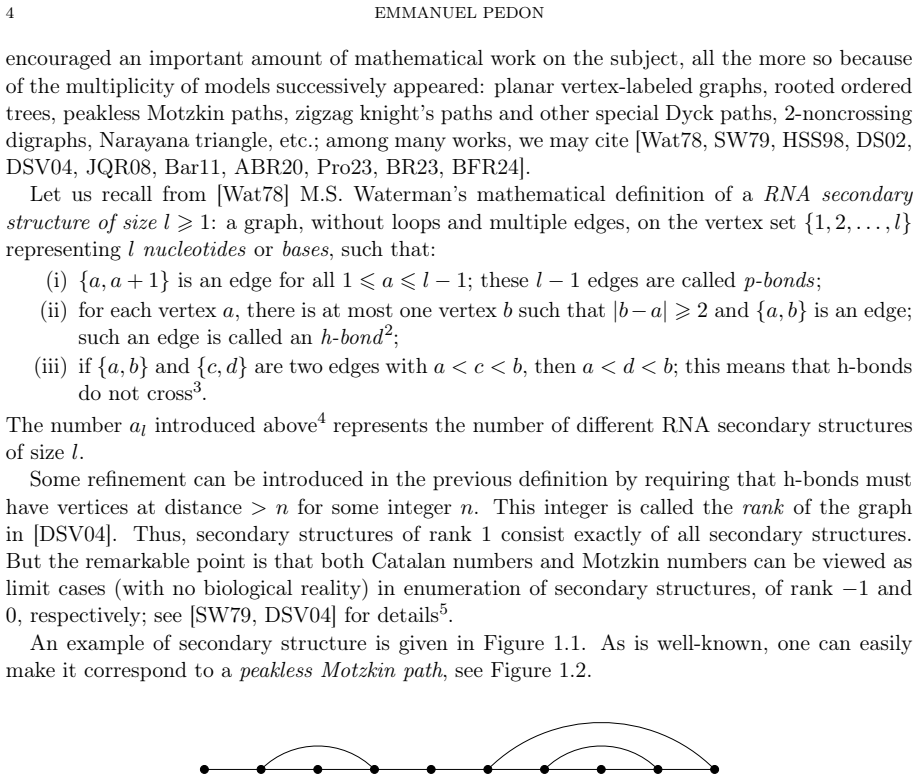
For each integer n greater than or equal to 1, the q-deformation [phi_n]_q of the metallic number phi_n = (n + sqrt(n^2 + 4))/2 expands as a power series sum kappa_l(phi_n) q^l with integral coefficients. These coefficients are characterized by recurrences or by differential equations satisfied by the generating function. Closed forms are obtained explicitly when n=1,2,3, and the asymptotic behavior of kappa_l(phi_n) as l tends to infinity is established. The modular group induces remarkable identities among the series, while the golden-ratio case links to RNA secondary structures as a signed analogue.
What carries the argument
The sequence of Taylor coefficients (kappa_l(phi_n))_{l >= 0} extracted from the power series of the q-deformation [phi_n]_q, characterized via recurrences or differential equations on its generating function.
If this is right
- The ordinary generating function for the coefficients kappa_l(phi_n) obeys a linear differential equation derived from the continued-fraction definition.
- Explicit closed forms for n=1,2,3 permit direct evaluation of any individual coefficient without recurrence iteration.
- Asymptotic formulas give the precise leading-term growth rate of kappa_l as l increases.
- The action of PSL(2,Z) produces functional identities that relate the series for different values of n.
- The signed correspondence between [phi_1]_q and RNA secondary structures supplies a combinatorial interpretation for the signs of the coefficients.
Where Pith is reading between the lines
- The recurrence characterization may extend directly to q-deformations of other quadratic irrationals beyond the metallic family.
- The experimentally observed logarithmic behavior could point to the presence of a natural boundary on the unit circle for the generating function.
- Similar analytic-combinatorial analysis might apply to q-analogues of other continued-fraction expansions arising in enumeration problems.
- The RNA link raises the possibility that signed versions of other q-numbers count oriented or signed combinatorial objects.
Load-bearing premise
The q-deformation of each metallic number admits a power series expansion around q=0 with integral coefficients to which analytic combinatorics techniques apply directly without convergence or integrality obstructions.
What would settle it
Explicit computation of the first several coefficients for n=4 followed by direct verification that they fail to satisfy the proposed recurrence, or numerical mismatch between the predicted asymptotic formula and computed growth for large l.
Figures

read the original abstract
For an integer $n\geq 1$, consider the $n$-th metallic number $\phi_n=\frac{n+\sqrt{n^2+4}}{2}$ (e.g. $\phi_1$ is the golden number) and denote by $[\phi_n]_q$ its $q$-deformation in the sense of S. Morier-Genoud and V. Ovsienko. This is an algebraic continued fraction which admits an expansion into a power series $[\phi_n]_q =\sum_{l=0}^{+\infty} \kappa_l(\phi_n) q^l$ around $q=0$, with integral coefficients. By using techniques from analytic combinatorics, we establish several properties of the sequence $( \kappa_l(\phi_n))_{l\geq 0}$ of Taylor coefficients: characterisation by recurrences or by differential equations, closed-form expressions when $n=1,2,3$, and asymptotics. We also present some remarkable identities induced by the action of the modular group $PSL(2,Z)$ and address, mainly through computer experimentations, the question of the logarithmic behaviour of the sequence $( \kappa_l(\phi_n))_{l\geq 0}$. A particular accent is put on the comparison between the $q$-deformation $[\phi_1]_q$ of the golden ratio and RNA secondary structures, the former being actually a signed version of the latter. By doing so, we would be pleased to bring the interest of combinatoricians to the newly discovered world of $q$-numbers.
Editorial analysis
A structured set of objections, weighed in public.
Referee Report
Summary. The paper defines q-deformations [φ_n]_q of the metallic numbers φ_n via the Morier-Genoud–Ovsienko continued-fraction construction, expands them as power series ∑ κ_l(φ_n) q^l with integer coefficients around q=0, and applies analytic combinatorics to obtain recurrences or differential equations for the coefficient sequences, closed forms for n=1,2,3, asymptotic growth, and identities induced by the PSL(2,ℤ) action. Particular emphasis is placed on the case n=1, where [φ_1]_q is identified as a signed analogue of the generating function for RNA secondary structures, with logarithmic behaviour of the coefficients investigated primarily through numerical experiments.
Significance. If the asymptotic claims hold, the work supplies explicit analytic tools for a family of q-analogues that interpolate between algebraic numbers and combinatorial generating functions, including a signed variant of the RNA enumeration series. The modular-group identities and the differential-equation characterisations are concrete contributions that could be reused in other q-deformed continued-fraction settings. The explicit comparison with RNA structures opens a potential bridge between q-series and combinatorial enumeration, though the signed coefficients introduce technical subtleties for singularity analysis.
major comments (1)
- [Asymptotics section] Asymptotics section (the paragraph following the closed-form results and the subsequent numerical discussion): the extraction of asymptotic growth for κ_l(φ_n) invokes standard singularity-analysis techniques from analytic combinatorics. Because the coefficients are signed for n=1 (explicitly stated as a signed version of the RNA generating function) and the paper notes that logarithmic behaviour is addressed “mainly through computer experimentations,” it is necessary to prove that the dominant singularity lies on the positive real axis and is not superseded by a complex singularity of smaller modulus. Without such a justification or an explicit radius-of-convergence argument, the asymptotic statements rest on an unverified assumption.
minor comments (2)
- The definition of the q-deformation [φ_n]_q is introduced via reference to Morier-Genoud–Ovsienko; a self-contained one-paragraph recap of the continued-fraction construction would improve readability for readers outside that literature.
- In the RNA comparison paragraph, the precise sign pattern (which terms receive minus signs) should be stated explicitly rather than left implicit.
Simulated Author's Rebuttal
We thank the referee for the careful reading of the manuscript and for identifying the need for a rigorous justification of the dominant singularity in the asymptotics. We address the major comment below and will revise the manuscript to incorporate the required arguments.
read point-by-point responses
-
Referee: [Asymptotics section] Asymptotics section (the paragraph following the closed-form results and the subsequent numerical discussion): the extraction of asymptotic growth for κ_l(φ_n) invokes standard singularity-analysis techniques from analytic combinatorics. Because the coefficients are signed for n=1 (explicitly stated as a signed version of the RNA generating function) and the paper notes that logarithmic behaviour is addressed “mainly through computer experimentations,” it is necessary to prove that the dominant singularity lies on the positive real axis and is not superseded by a complex singularity of smaller modulus. Without such a justification or an explicit radius-of-convergence argument, the asymptotic statements rest on an unverified assumption.
Authors: We agree that the current presentation relies on an implicit assumption regarding the location of the dominant singularity and that this requires explicit justification, particularly for the signed case n=1. In the revised version we will add a dedicated paragraph establishing the radius of convergence. For n=2 and n=3 the closed-form expressions are algebraic and the singularities can be located exactly by solving the minimal polynomials; direct computation shows that the singularity of smallest modulus is the unique positive real root. For n=1 the generating function satisfies a linear differential equation derived from the continued-fraction recurrence; we will prove that all singularities in the complex plane lie outside the disk determined by the positive real singularity by combining the recurrence for the coefficients with a Pringsheim-type argument adapted to the signed setting and by verifying that the radius is given by the growth rate already obtained from the recurrence. Once the dominant singularity is rigorously located, the logarithmic behaviour will be derived analytically from the singularity-analysis transfer theorems rather than left to numerical observation. revision: yes
Circularity Check
No circularity; claims rest on external q-deformation and standard analytic combinatorics
full rationale
The paper takes the q-deformation [φ_n]_q and its power series expansion with integral coefficients as given from the external reference Morier-Genoud–Ovsienko, then applies off-the-shelf analytic combinatorics tools (recurrences, DEs, singularity analysis) to extract properties of the coefficients κ_l(φ_n). No equation or claim reduces by construction to a fitted parameter, self-citation chain, or renamed input; the computer experiments on logarithmic behavior are explicitly supplementary and do not support any load-bearing derivation. The derivation chain is therefore self-contained against external benchmarks.
Axiom & Free-Parameter Ledger
axioms (2)
- domain assumption The q-deformation of metallic numbers is an algebraic continued fraction admitting a power series expansion with integral coefficients around q=0.
- domain assumption Techniques from analytic combinatorics can be applied to extract recurrences, differential equations, closed forms, and asymptotics from the continued-fraction definition.
Reference graph
Works this paper leans on
-
[1]
Generating functions for lattice paths with several forbidden patterns.Sém
[ABR20] A.Asinowski, C.Banderier, and V.Roitner. Generating functions for lattice paths with several forbidden patterns.Sém. Lothar. Combin.84B(2020), Art. 95,
work page 2020
-
[2]
[AL25] J.Avaland S.Labbé.q-analogs of rational numbers: from Ostrowski numeration systems to perfect matchings. arXiv:2511.11290,
-
[3]
On a generalization of the Narayana triangle.J
[Bar11] P.Barry. On a generalization of the Narayana triangle.J. Integer Seq.14(2011), Article 11.4.5,
work page 2011
-
[4]
M.Licata.q-deformed rational numbers and the 2-Calabi-Yau category of typeA2.Forum Math
[BBL23] A.Bapat, L.Becker, and A. M.Licata.q-deformed rational numbers and the 2-Calabi-Yau category of typeA2.Forum Math. Sigma11(2023), Paper No. e47,
work page 2023
-
[5]
[BFR24] J.-L.Baril, R.Flórez, andJ.L.Ramírez.SymmetriesinDyckpathswithairpockets.Aequationes mathematicae98, 5 (2024), 1235–1264. [BR23] J.-L.Bariland J. L.Ramírez. Knight’s paths towards Catalan numbers.Discrete Math.346, 6 (2023), 113372. [CO23] C. H.Conleyand V.Ovsienko. Shadows of rationals and irrationals: supersymmetric continued fractions and the s...
work page 2024
-
[6]
[DS02] E.Deutschand L.Shapiro. A bijection between ordered trees and 2-Motzkin paths and its many consequences.Discrete Math.256, 3 (2002), 655–670. [DSV04] T.Došlić, D.Svrtan, and D.Veljan. Enumerative aspects of secondary structures.Discrete Math.285, 1 (2004), 67–82. [Eti25] P.Etingof. Onq-real andq-complex numbers. arXiv:2508.08440,
- [7]
- [8]
-
[9]
[HSS98] I.Hofacker, P.Schuster, and P. F.Stadler. Combinatorics of RNA secondary structures. Discrete Appl. Math.88, 1 (1998), 207–237. [Jou] P.Jouteur. q_numbers.ipynb: jupyter notebook available atperso.eleves.ens-rennes.fr/ people/perrine.jouteur/recherche.html. [Jou25a] P.Jouteur. Burau representation ofB 4 and quantization of the rational projective ...
-
[10]
[JQ26] P.Jouteurand H.Queffélec.q-Rationals, link invariants and webs. arXiv:2602.09426,
-
[11]
[JQR08] E. Y.Jin, J.Qin, and C. M.Reidys. Combinatorics of RNA Structures with Pseudoknots.Bulletin of Mathematical Biology70, 1 (2008), 45–67. [JR08] E.Jinand C.Reidys. Asymptotic Enumeration of RNA Structures with Pseudoknots.Bull. Math. Biol.70(2008), 951–970. [KMR+25] T.Kogiso, K.Miyamoto, X.Ren, M.Wakui, and K.Yanagawa. Arithmetic onq-deformed ration...
work page 2008
-
[12]
34 EMMANUEL PEDON [LMG21] L.Leclereand S.Morier-Genoud.q-deformations in the modular group and of the real quadratic irrational numbers.Adv. in Appl. Math.130(2021), Paper No. 102223, 28 pages. [LMGOV24] L.Leclere, S.Morier-Genoud, V.Ovsienko, and A. P.Veselov. On radius of convergence of q-deformed real numbers.Mosc. Math. J.24, 1 (2024), 1–19. [MGO20] S...
-
[13]
Hyperbinary partitions and q-deformed rationals
[MGOV24] S.Morier-Genoud, V.Ovsienko, and A. P.Veselov. Burau representation of braid groups and q-rationals.Int. Math. Res. Not. IMRN(2024), 8618–8627. [MO24] J.Machacekand N.Ovenhouse.q-rational andq-real binomial coefficients.Adv. in Appl. Math. 153(2024), Paper No. 102618, 27 pages. [MPS25] T.McConville, J.Propp, and B.Sagan. Hyperbinary partitions an...
-
[14]
[OP25] V.Ovsienkoand E.Pedon. Continued fractions forq-deformed real numbers,{−1,0,1}-Hankel determinants, and Somos-Gale-Robinson sequences.Adv. in Appl. Math.162(2025), Paper No. 102788, 37 pages. [O’S22] C.O’Sullivan. De Moivre and Bell polynomials.Expo. Math.40, 4 (2022), 870–893. [Ove23] N.Ovenhouse.q-rationals and Finite Schubert Varieties.C. R. Mat...
-
[15]
Peakless Motzkin paths of bounded height
[Pro23] H.Prodinger. Peakless Motzkin paths of bounded height. arXiv:2308.03080. To appear in Bull. Inst. Combin. Appl.,
-
[16]
On radiuses of convergence ofq-metallic numbers and relatedq-rational numbers.Res
[Ren22] X.Ren. On radiuses of convergence ofq-metallic numbers and relatedq-rational numbers.Res. Number Theory8, 3 (2022), Paper No. 37, 14 pages. [Ren23] X.Ren. Corrigendum to: On radiuses of convergence ofq-metallic numbers and relatedq-rational numbers.Res. Number Theory9, 2 (2023), Paper No. 39, 4 pages. [Sta24] R. P.Stanley.Enumerative Combinatorics, Volume
work page 2022
-
[17]
[SW79] P.Steinand M.Waterman. On some new sequences generalizing the Catalan and Motzkin num- bers.Discrete Math.26, 3 (1979), 261–272. [Tho24] A.Thomas. Infinitesimal modular group:q-deformedsl 2 and Witt algebra.SIGMA Symmetry Integrability Geom. Methods Appl.20(2024), Paper No. 053, 16 pages. [Wat78] M.Waterman. Secondary structure of single-stranded n...
work page 1979
discussion (0)
Sign in with ORCID, Apple, or X to comment. Anyone can read and Pith papers without signing in.