Recognition: unknown
From Hidden Profiles to Governable Personalization: Recommender Systems in the Age of LLM Agents
Pith reviewed 2026-05-10 00:00 UTC · model grok-4.3
The pith
LLM agents shift recommender systems from hidden platform profiles to inspectable, revisable, and portable user representations.
A machine-rendered reading of the paper's core claim, the machinery that carries it, and where it could break.
Core claim
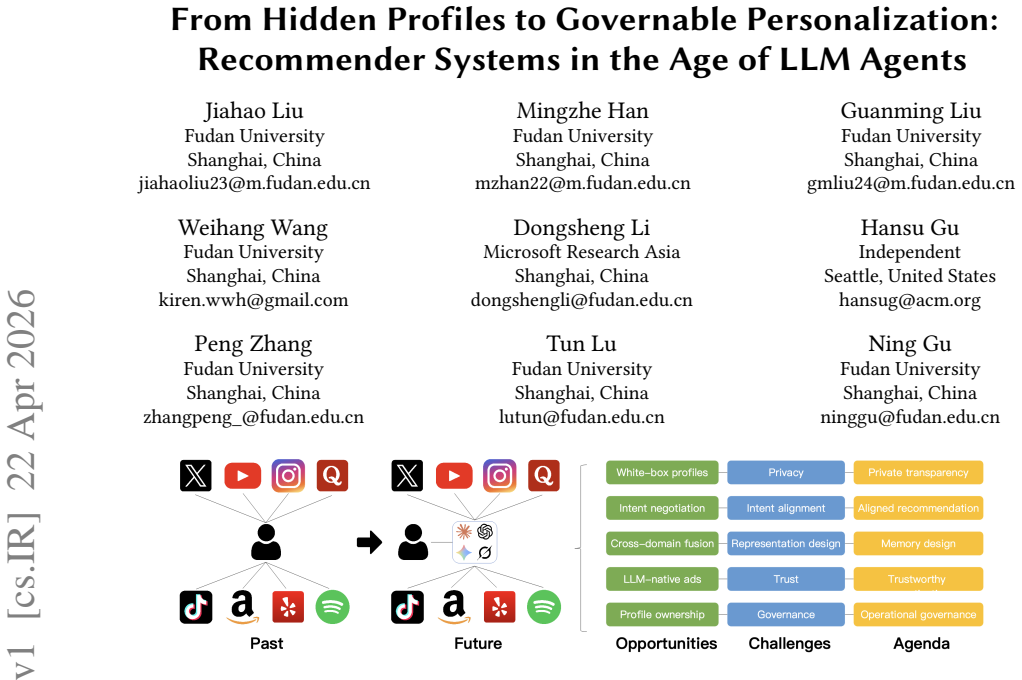
The key issue is not simply that large language models can enhance recommendation quality, but that they reconfigure where and how user representations are produced, exposed, and acted upon. The paper proposes a shift from hidden platform profiling toward governable personalization, where user representations may become more inspectable, revisable, portable, and consequential across services. Building on this view, it identifies five research fronts for recommender systems: transparent yet privacy-preserving user modeling, intent translation and alignment, cross-domain representation and memory design, trustworthy commercialization in assistant-mediated environments, and operational机制 for 权,
What carries the argument
LLM agents acting as intermediaries between users and digital platforms, which move user representation production outside isolated platform models and toward forms that can be inspected and governed by users.
Load-bearing premise
LLM-based assistants will increasingly mediate search, shopping, travel, and content access, thereby reconfiguring user representations away from platform-specific models toward more governable forms.
What would settle it
If major LLM assistants deploy at scale yet user representations remain hidden inside individual platforms with no measurable increase in user access, revision rights, or cross-service portability.
Figures
read the original abstract
Personalization has traditionally depended on platform-specific user models that are optimized for prediction but remain largely inaccessible to the people they describe. As LLM-based assistants increasingly mediate search, shopping, travel, and content access, this arrangement may be giving way to a new personalization stack in which user representation is no longer confined to isolated platforms. In this paper, we argue that the key issue is not simply that large language models can enhance recommendation quality, but that they reconfigure where and how user representations are produced, exposed, and acted upon. We propose a shift from hidden platform profiling toward governable personalization, where user representations may become more inspectable, revisable, portable, and consequential across services. Building on this view, we identify five research fronts for recommender systems: transparent yet privacy-preserving user modeling, intent translation and alignment, cross-domain representation and memory design, trustworthy commercialization in assistant-mediated environments, and operational mechanisms for ownership, access, and accountability. We position these not as isolated technical challenges, but as interconnected design problems created by the emergence of LLM agents as intermediaries between users and digital platforms. We argue that the future of recommender systems will depend not only on better inference, but on building personalization systems that users can meaningfully understand, shape, and govern.
Editorial analysis
A structured set of objections, weighed in public.
Referee Report
Summary. The paper argues that as LLM-based assistants increasingly mediate search, shopping, travel, and content access, recommender systems will shift from relying on hidden, platform-specific user profiles to a paradigm of governable personalization in which user representations become more inspectable, revisable, portable, and consequential across services. It identifies five interconnected research fronts—transparent yet privacy-preserving user modeling, intent translation and alignment, cross-domain representation and memory design, trustworthy commercialization in assistant-mediated environments, and operational mechanisms for ownership, access, and accountability—as the key design problems created by this reconfiguration.
Significance. If the premise about LLM-agent mediation materializes, the paper could meaningfully redirect recommender-systems research from isolated accuracy improvements toward socio-technical questions of user governance and control. It merits explicit credit for framing the five fronts as interconnected rather than standalone and for offering a clear, forward-looking research agenda without unsubstantiated technical claims.
minor comments (2)
- [Abstract] The abstract introduces the term 'governable personalization' and its four attributes without a concise, one-sentence definition; supplying one would help readers immediately grasp the central proposal.
- [the section outlining the five research fronts] The interconnections among the five research fronts are asserted but not illustrated with even a brief concrete example (e.g., how intent translation might interact with cross-domain memory); adding one short scenario would strengthen the claim that the fronts are not isolated.
Simulated Author's Rebuttal
We thank the referee for the positive and constructive review. We appreciate the recognition that the paper frames the shift toward governable personalization as a socio-technical reconfiguration and positions the five research fronts as interconnected rather than isolated. The recommendation for minor revision is noted, and we remain open to any editorial adjustments.
Circularity Check
No significant circularity in conceptual proposal
full rationale
The paper is a forward-looking position piece that argues LLM agents will reconfigure user representations from hidden platform profiles to more inspectable and governable forms, then enumerates five interconnected research fronts. It contains no equations, derivations, data fitting, parameter estimation, or self-citations that reduce any claim to its own inputs by construction. The central premise about increasing mediation by assistants is stated explicitly as an assumption rather than derived from prior results within the paper, leaving the analysis self-contained.
Axiom & Free-Parameter Ledger
axioms (1)
- domain assumption LLM-based assistants will increasingly mediate search, shopping, travel, and content access.
Reference graph
Works this paper leans on
-
[1]
Gediminas Adomavicius and Alexander Tuzhilin. 2005. Toward the next gen- eration of recommender systems: A survey of the state-of-the-art and possible extensions.IEEE transactions on knowledge and data engineering17, 6 (2005), 734–749
2005
- [2]
-
[3]
Maria Luisa Chiarella. 2023. Digital markets act (DMA) and digital services act (DSA): New rules for the EU digital environment.Athens JL9 (2023), 33
2023
-
[4]
Honglin Deng, Weiquan Wang, and Kai Hin Lim. 2016. Reducing user avoidance of sponsored search results: The effects of social influence cues. (2016)
2016
-
[5]
Benjamin Edelman and Michael Ostrovsky. 2007. Strategic bidder behavior in sponsored search auctions.Decision support systems43, 1 (2007), 192–198
2007
- [6]
- [7]
-
[8]
Shengkang Gu, Jiahao Liu, Dongsheng Li, Guangping Zhang, Mingzhe Han, Hansu Gu, Peng Zhang, Ning Gu, Li Shang, and Tun Lu. 2026. LLM Agent-based Shilling Attack on Recommender Systems. InProceedings of the Nineteenth ACM International Conference on Web Search and Data Mining. 163–173
2026
-
[9]
Mingzhe Han, Dongsheng Li, Jiafeng Xia, Jiahao Liu, Hansu Gu, Peng Zhang, Ning Gu, and Tun Lu. 2025. FedCIA: Federated collaborative information aggregation for privacy-preserving recommendation. InProceedings of the 48th International ACM SIGIR Conference on Research and Development in Information Retrieval. 1687–1696
2025
- [10]
-
[11]
Chen He, Denis Parra, and Katrien Verbert. 2016. Interactive recommender systems: A survey of the state of the art and future research challenges and opportunities.Expert Systems with Applications56 (2016), 9–27
2016
-
[12]
Balázs Hidasi, Alexandros Karatzoglou, Linas Baltrunas, and Domonkos Tikk
-
[13]
Session-based recommendations with recurrent neural networks.arXiv preprint arXiv:1511.06939(2015)
work page internal anchor Pith review arXiv 2015
-
[14]
Yassine Himeur, Shahab Saquib Sohail, Faycal Bensaali, Abbes Amira, and Mamoun Alazab. 2022. Latest trends of security and privacy in recommender systems: a comprehensive review and future perspectives.Computers & Security 118 (2022), 102746
2022
-
[15]
Dietmar Jannach, Ahtsham Manzoor, Wanling Cai, and Li Chen. 2021. A survey on conversational recommender systems.ACM Computing Surveys (CSUR)54, 5 (2021), 1–36
2021
-
[16]
Dietmar Jannach, Sidra Naveed, and Michael Jugovac. 2016. User control in recommender systems: Overview and interaction challenges. InInternational Conference on Electronic Commerce and Web Technologies. Springer, 21–33
2016
-
[17]
Mathias Jesse and Dietmar Jannach. 2021. Digital nudging with recommender systems: Survey and future directions.Computers in Human Behavior Reports3 (2021), 100052
2021
-
[18]
Yehuda Koren, Robert Bell, and Chris Volinsky. 2009. Matrix factorization tech- niques for recommender systems.Computer42, 8 (2009), 30–37
2009
-
[19]
Jianghao Lin, Xinyi Dai, Yunjia Xi, Weiwen Liu, Bo Chen, Hao Zhang, Yong Liu, Chuhan Wu, Xiangyang Li, Chenxu Zhu, et al . 2025. How can recommender systems benefit from large language models: A survey.ACM Transactions on Information Systems43, 2 (2025), 1–47
2025
-
[20]
Jiahao Liu, Shengkang Gu, Dongsheng Li, Guangping Zhang, Mingzhe Han, Hansu Gu, Peng Zhang, Tun Lu, Li Shang, and Ning Gu. 2025. AgentCF++: Memory-enhanced LLM-based Agents for Popularity-aware Cross-domain Rec- ommendations. InProceedings of the 48th International ACM SIGIR Conference on Research and Development in Information Retrieval. 2566–2571
2025
- [21]
-
[22]
Jiahao Liu, Dongsheng Li, Hansu Gu, Tun Lu, Peng Zhang, and Ning Gu. 2022. Parameter-free dynamic graph embedding for link prediction.Advances in Neural Information Processing Systems35 (2022), 27623–27635
2022
-
[23]
Jiahao Liu, Dongsheng Li, Hansu Gu, Tun Lu, Peng Zhang, Li Shang, and Ning Gu. 2023. Personalized graph signal processing for collaborative filtering. In Proceedings of the ACM web conference 2023. 1264–1272
2023
-
[24]
Jiahao Liu, Dongsheng Li, Hansu Gu, Tun Lu, Peng Zhang, Li Shang, and Ning Gu. 2023. Triple structural information modelling for accurate, explainable and interactive recommendation. InProceedings of the 46th International ACM SIGIR Conference on Research and Development in Information Retrieval. 1086–1095
2023
-
[25]
Jiahao Liu, Dongsheng Li, Hansu Gu, Peng Zhang, Tun Lu, Li Shang, and Ning Gu. 2025. Unbiased Collaborative Filtering with Fair Sampling. InProceedings of the 48th International ACM SIGIR Conference on Research and Development in Information Retrieval. 2555–2559
2025
- [26]
-
[27]
Jiahao Liu, Yiyang Shao, Peng Zhang, Dongsheng Li, Hansu Gu, Chao Chen, Longzhi Du, Tun Lu, and Ning Gu. 2025. Filtering discomforting recommenda- tions with large language models. InProceedings of the ACM on Web Conference
2025
-
[28]
Jiahao Liu, Xueshuo Yan, Dongsheng Li, Guangping Zhang, Hansu Gu, Peng Zhang, Tun Lu, Li Shang, and Ning Gu. 2025. Improving LLM-powered Recom- mendations with Personalized Information. InProceedings of the 48th International ACM SIGIR Conference on Research and Development in Information Retrieval. 2560–2565
2025
-
[29]
Sijia Liu, Jiahao Liu, Hansu Gu, Dongsheng Li, Tun Lu, Peng Zhang, and Ning Gu
-
[30]
InPro- ceedings of the 32nd ACM international conference on information and knowledge management
Autoseqrec: Autoencoder for efficient sequential recommendation. InPro- ceedings of the 32nd ACM international conference on information and knowledge management. 1493–1502
-
[31]
Essam Mansour, Andrei Vlad Sambra, Sandro Hawke, Maged Zereba, Sarven Capadisli, Abdurrahman Ghanem, Ashraf Aboulnaga, and Tim Berners-Lee. 2016. A demonstration of the solid platform for social web applications. InProceedings of the 25th international conference companion on world wide web. 223–226. Conference acronym ’XX, June 03–05, 2018, Woodstock, NY...
2016
-
[32]
Charles Packer, Vivian Fang, Shishir_G Patil, Kevin Lin, Sarah Wooders, and Joseph_E Gonzalez. 2023. MemGPT: towards LLMs as operating systems. (2023)
2023
-
[33]
Joon Sung Park, Joseph O’Brien, Carrie Jun Cai, Meredith Ringel Morris, Percy Liang, and Michael S Bernstein. 2023. Generative agents: Interactive simulacra of human behavior. InProceedings of the 36th annual acm symposium on user interface software and technology. 1–22
2023
-
[34]
Pearl Pu and Li Chen. 2008. User-involved preference elicitation for product search and recommender systems.AI magazine29, 4 (2008), 93–93
2008
-
[35]
Protection Regulation. 2016. Regulation (EU) 2016/679 of the European Parliament and of the Council.Regulation (eu)679, 2016 (2016), 10–3
2016
-
[36]
Timo Schick, Jane Dwivedi-Yu, Roberto Dessì, Roberta Raileanu, Maria Lomeli, Eric Hambro, Luke Zettlemoyer, Nicola Cancedda, and Thomas Scialom. 2023. Toolformer: Language models can teach themselves to use tools.Advances in neural information processing systems36 (2023), 68539–68551
2023
-
[37]
Nava Tintarev and Judith Masthoff. 2007. A survey of explanations in recom- mender systems. In2007 IEEE 23rd international conference on data engineering workshop. IEEE, 801–810
2007
- [38]
-
[39]
Daricia Wilkinson, Moses Namara, Karishma Patil, Lijie Guo, Apoorva Manda, and Bart P Knijnenburg. 2021. The Pursuit of Transparency and Control: A Classification of Ad Explanations in Social Media.. InHICSS. 1–10
2021
- [40]
-
[41]
Likang Wu, Zhi Zheng, Zhaopeng Qiu, Hao Wang, Hongchao Gu, Tingjia Shen, Chuan Qin, Chen Zhu, Hengshu Zhu, Qi Liu, et al . 2024. A survey on large language models for recommendation.World Wide Web27, 5 (2024), 60
2024
-
[42]
Jiafeng Xia, Dongsheng Li, Hansu Gu, Jiahao Liu, Tun Lu, and Ning Gu. 2022. FIRE: Fast incremental recommendation with graph signal processing. InProceedings of the ACM web conference 2022. 2360–2369
2022
- [43]
-
[44]
Shunyu Yao, Jeffrey Zhao, Dian Yu, Nan Du, Izhak Shafran, Karthik R Narasimhan, and Yuan Cao. 2022. React: Synergizing reasoning and acting in language models. InThe eleventh international conference on learning representations
2022
-
[45]
Guangping Zhang, Peng Zhang, Jiahao Liu, Zhuoheng Li, Dongsheng Li, Hansu Gu, Tun Lu, and Ning Gu. 2025. EvalAgent: Towards Evaluating News Rec- ommender Systems with LLM-based Agents. InProceedings of the 34th ACM International Conference on Information and Knowledge Management. 4086–4095
2025
-
[46]
Yongfeng Zhang and Xu Chen. 2020. Explainable recommendation: A survey and new perspectives.Foundations and Trends®in Information Retrieval14, 1 (2020), 1–101
2020
-
[47]
Zeyu Zhang, Quanyu Dai, Xiaohe Bo, Chen Ma, Rui Li, Xu Chen, Jieming Zhu, Zhenhua Dong, and Ji-Rong Wen. 2025. A survey on the memory mechanism of large language model-based agents.ACM Transactions on Information Systems 43, 6 (2025), 1–47
2025
-
[48]
Zihuai Zhao, Wenqi Fan, Jiatong Li, Yunqing Liu, Xiaowei Mei, Yiqi Wang, Zhen Wen, Fei Wang, Xiangyu Zhao, Jiliang Tang, et al. 2024. Recommender systems in the era of large language models (llms).IEEE Transactions on Knowledge and Data Engineering36, 11 (2024), 6889–6907
2024
discussion (0)
Sign in with ORCID, Apple, or X to comment. Anyone can read and Pith papers without signing in.