Odor Maps from the LLM-derived similarity scores
Pith reviewed 2026-05-09 23:46 UTC · model grok-4.3
The pith
Large language models derive odor similarity scores that align with human data enough to map essential oils by group.
A machine-rendered reading of the paper's core claim, the machinery that carries it, and where it could break.
Core claim
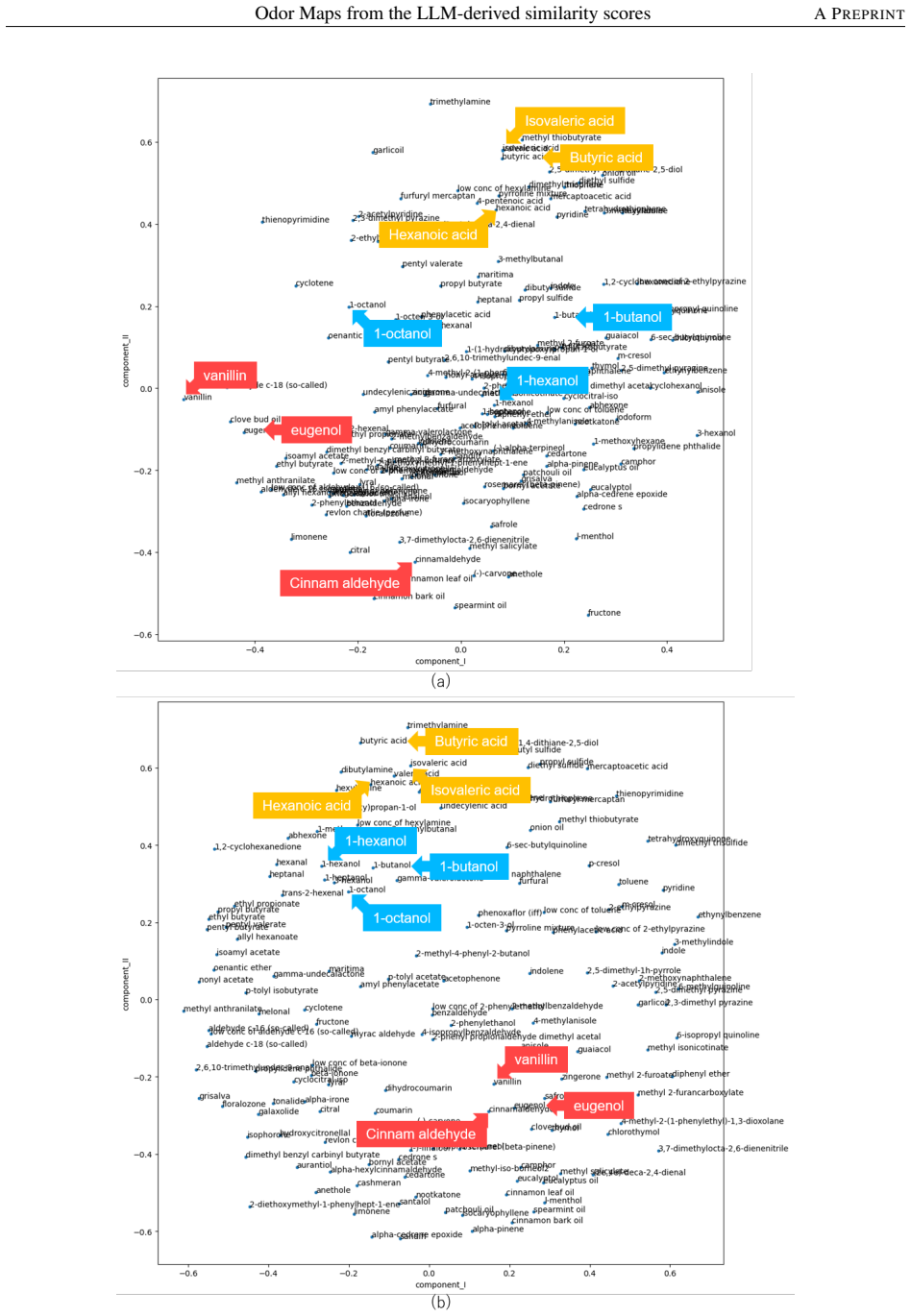
Statistical comparison revealed that LLMs can infer odor similarity to some degree, suggesting the potential of odor maps generated from these similarity data. Applying this approach, we generated an odor map of essential oils. It demonstrates that essential oils within the same group are closely located in the odor map, suggesting that the proximity in the odor map corresponds to human evaluation.
What carries the argument
LLM-derived pairwise distances between odor descriptors or names, used as proxies to embed odors into a map where spatial closeness reflects similarity.
If this is right
- Any new collection of odor names can be placed on a map using only language-model queries without additional human testing.
- Clustering of same-group items on the map can serve as an initial screen for whether a set of odors matches expected human categories.
- The method supplies a scalable starting point for exploring smell spaces before committing to full sensory panels.
Where Pith is reading between the lines
- If the maps prove stable, they could be used to suggest fragrance substitutions by recommending oils that sit near a target on the map.
- The same distance technique might be applied to text descriptions of individual chemical compounds to link molecular names to perceived smells.
- The approach invites direct comparison with maps built from other data sources such as gas-chromatography profiles or molecular descriptors.
Load-bearing premise
Agreement between LLM distances and the Dravnieks human dataset is strong enough that the resulting map of essential oils will match new human judgments of those same oils.
What would settle it
A new experiment that collects fresh human similarity ratings for pairs of the essential oils and checks whether map distances predict those ratings at a level clearly above chance.
Figures
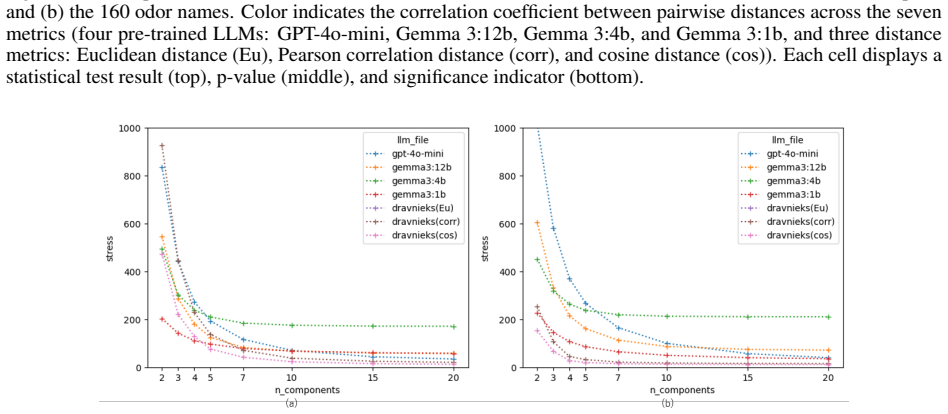
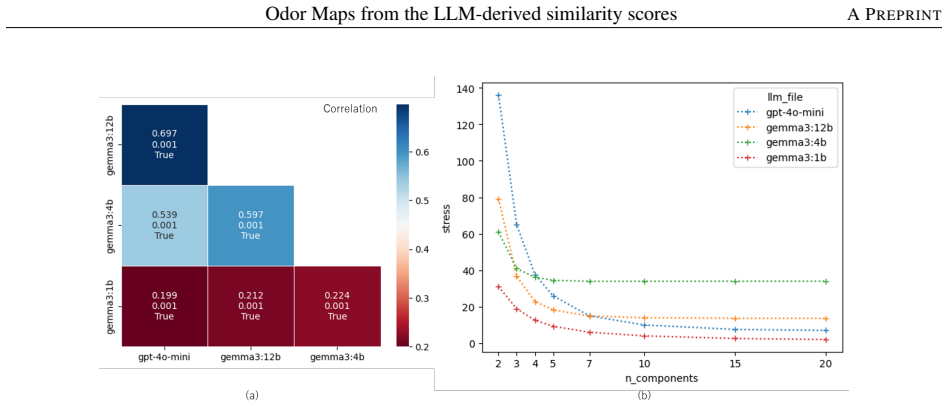
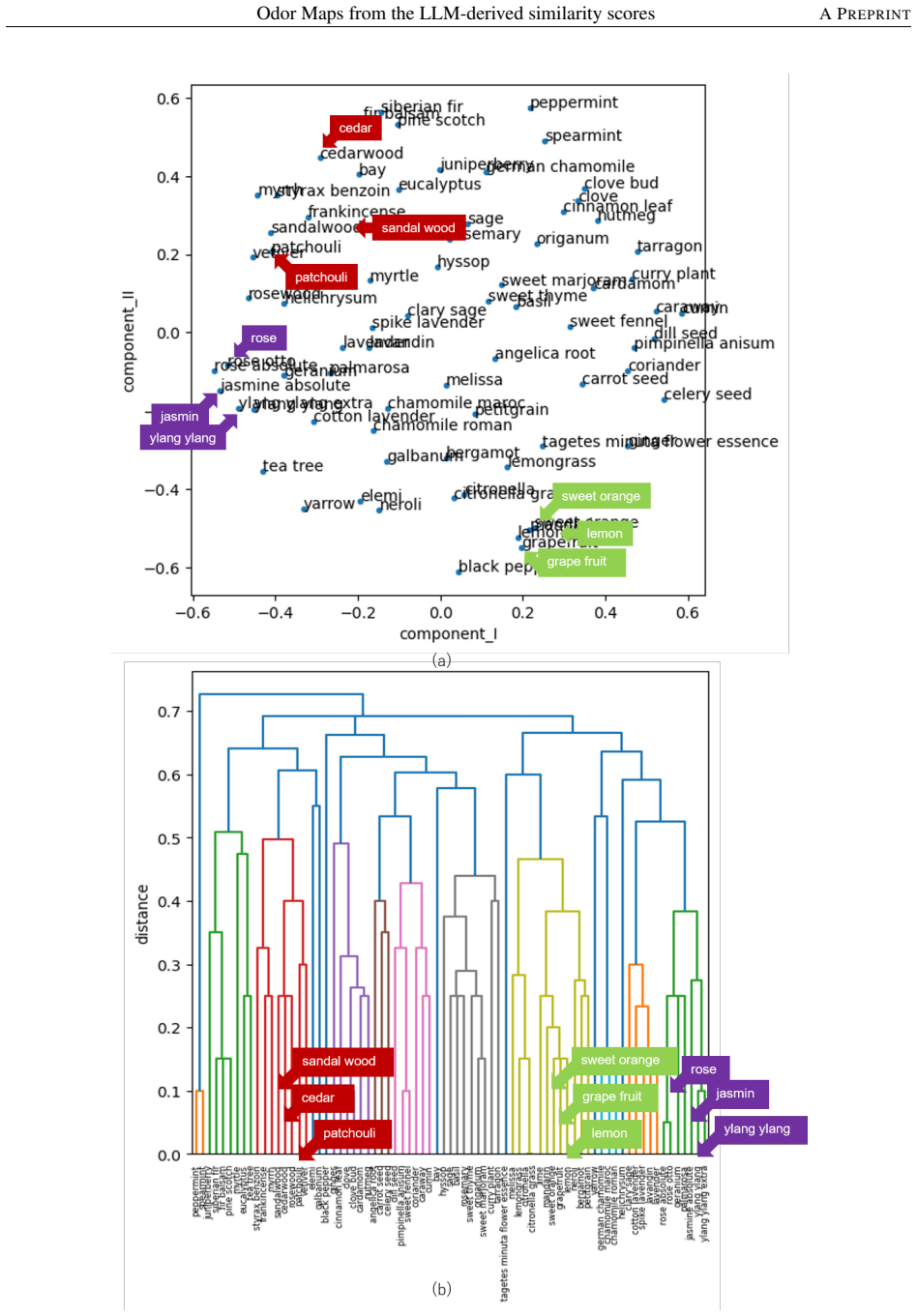
read the original abstract
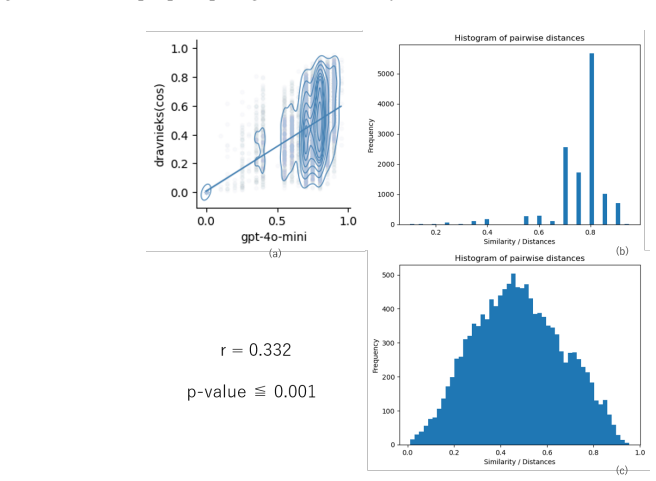
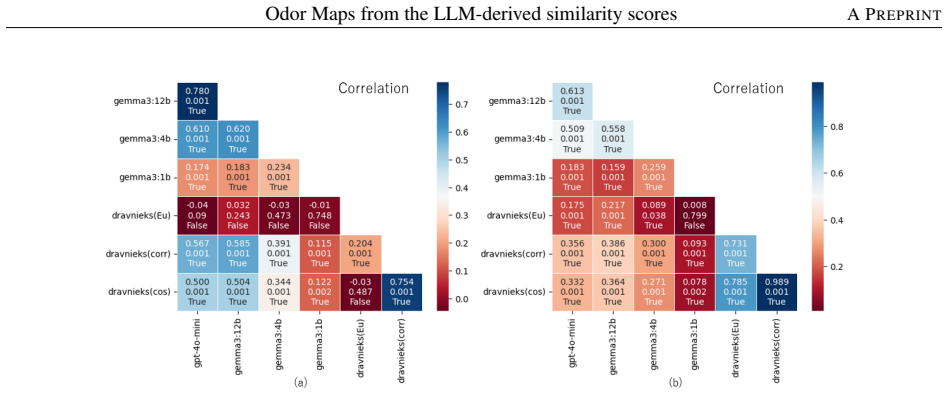
The application of large language models (LLMs) to OdorSpace analysis attracts growing interest. Recent studies have explored the comparison of sensory evaluation spaces derived from LLMs with odor character profiles in the Dravnieks' dataset. In this study, we calculated pairwise distances of odor descriptors using three distance measures and statistically compared these LLM-derived similarities with distances derived from the original data. Next, we extended this approach to odor names (ingredients). Statistical comparison revealed that LLMs can infer odor similarity to some degree, suggesting the potential of odor maps generated from these similarity data. Applying this approach, we generated an odor map of essential oils. It demonstrates that essential oils within the same group are closely located in the odor map, suggesting that the proximity in the odor map corresponds to human evaluation.
Editorial analysis
A structured set of objections, weighed in public.
Referee Report
Summary. The paper explores using LLMs to derive pairwise similarity scores for odor descriptors via three distance measures, statistically comparing these to human distances in the Dravnieks dataset. It extends the method to odor ingredients and generates an odor map of essential oils, where oils from the same predefined groups cluster closely, interpreted as indicating that map proximity corresponds to human perceptual evaluation.
Significance. If the LLM-derived similarities prove to reliably match human perceptual distances and the map distances predict held-out human judgments, this could enable scalable, low-cost generation of odor maps for applications in perfumery, food science, and sensory research, reducing reliance on large human panels.
major comments (3)
- [Abstract] Abstract: The claim that 'statistical comparison revealed that LLMs can infer odor similarity to some degree' provides no quantitative results (e.g., correlation coefficients, effect sizes, p-values, sample sizes, or details on the three distance measures and multiple-testing corrections), which is load-bearing for assessing whether the agreement with Dravnieks data is strong enough to support downstream claims.
- [Results] Results (odor map of essential oils): The observation that 'essential oils within the same group are closely located' does not establish that proximity corresponds to human evaluation, because the groups are not shown to be defined by independent human perceptual data, and no held-out human similarity ratings for the oils are collected to test whether Euclidean distances on the map predict those ratings.
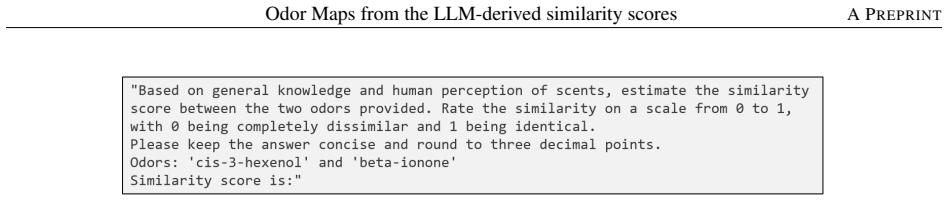
- [Methods] Methods: The manuscript does not specify the LLM model, prompt templates, exact similarity computation from LLM outputs, or the embedding algorithm used to generate the odor map (e.g., MDS parameters), preventing assessment of reproducibility and potential confounds in the distance measures.
minor comments (1)
- [Abstract] Abstract: The phrasing 'odor names (ingredients)' is unclear without examples or a definition of how ingredients differ from descriptors in the analysis.
Simulated Author's Rebuttal
We thank the referee for their constructive feedback on our manuscript. We have carefully considered each comment and provide point-by-point responses below, along with indications of revisions to be made in the updated version.
read point-by-point responses
-
Referee: [Abstract] Abstract: The claim that 'statistical comparison revealed that LLMs can infer odor similarity to some degree' provides no quantitative results (e.g., correlation coefficients, effect sizes, p-values, sample sizes, or details on the three distance measures and multiple-testing corrections), which is load-bearing for assessing whether the agreement with Dravnieks data is strong enough to support downstream claims.
Authors: We concur that quantitative metrics are necessary to substantiate the claim in the abstract. The revised manuscript will include the relevant statistical details, including correlation coefficients, p-values, sample sizes, and specifics on the distance measures and any corrections applied for multiple comparisons. revision: yes
-
Referee: [Results] Results (odor map of essential oils): The observation that 'essential oils within the same group are closely located' does not establish that proximity corresponds to human evaluation, because the groups are not shown to be defined by independent human perceptual data, and no held-out human similarity ratings for the oils are collected to test whether Euclidean distances on the map predict those ratings.
Authors: The groups are based on standard classifications from the perfumery literature that reflect human sensory consensus. We will expand the text to cite the origins of these groupings and note their perceptual basis. We agree that held-out validation would strengthen the claim but note that our study did not collect new human data for the oils; we will add a discussion of this as a limitation and direction for future research. revision: partial
-
Referee: [Methods] Methods: The manuscript does not specify the LLM model, prompt templates, exact similarity computation from LLM outputs, or the embedding algorithm used to generate the odor map (e.g., MDS parameters), preventing assessment of reproducibility and potential confounds in the distance measures.
Authors: We appreciate this feedback on reproducibility. The revised methods section will detail the LLM model, full prompt templates, the procedure for extracting similarity scores and computing distances, and the MDS embedding parameters including dimensionality and optimization criteria. revision: yes
- Collecting new held-out human similarity ratings for the essential oils to directly validate map distances would require a separate human study, which we cannot undertake as part of this revision.
Circularity Check
No significant circularity detected
full rationale
The paper derives LLM pairwise distances on odor descriptors, compares them statistically to an external human dataset (Dravnieks), then re-uses the LLM distance method on essential-oil names to produce an embedding map. Predefined groups are observed to cluster, but this is an empirical observation rather than a fitted prediction or self-referential definition. No parameters are tuned on the essential-oil data itself, no self-citations carry the central claim, and the chain does not reduce to its own inputs by construction. The process is therefore self-contained against external benchmarks.
Axiom & Free-Parameter Ledger
Reference graph
Works this paper leans on
-
[1]
Andreas Keller, Richard C Gerkin, Yuanfang Guan, Amit Dhurandhar, Gabor Turu, Bence Szalai, Joel D Mainland, Yusuke Ihara, Chung Wen Yu, Russ Wolfinger, et al. Predicting human olfactory perception from chemical features of odor molecules.Science, 355(6327):820–826, 2017
work page 2017
-
[2]
Rehan M Khan, Chung-Hay Luk, Adeen Flinker, Amit Aggarwal, Hadas Lapid, Rafi Haddad, and Noam Sobel. Predicting odor pleasantness from odorant structure: pleasantness as a reflection of the physical world.Journal of Neuroscience, 27(37):10015–10023, 2007
work page 2007
-
[3]
E Darío Gutiérrez, Amit Dhurandhar, Andreas Keller, Pablo Meyer, and Guillermo A Cecchi. Predicting natural language descriptions of mono-molecular odorants.Nature communications, 9(1):4979, 2018
work page 2018
-
[4]
Kobi Snitz, Adi Yablonka, Tali Weiss, Idan Frumin, Rehan M Khan, and Noam Sobel. Predicting odor perceptual similarity from odor structure.PLoS computational biology, 9(9):e1003184, 2013
work page 2013
-
[5]
A measure of smell enables the creation of olfactory metamers.Nature, 588(7836):118–123, 2020
Aharon Ravia, Kobi Snitz, Danielle Honigstein, Maya Finkel, Rotem Zirler, Ofer Perl, Lavi Secundo, Christophe Laudamiel, David Harel, and Noam Sobel. A measure of smell enables the creation of olfactory metamers.Nature, 588(7836):118–123, 2020
work page 2020
-
[6]
Vahid Satarifard, Laura Sisson, Yikun Han, Pedro Ilídio, Matej Hladiš, Maxence Lalis, Xuebo Song, Wenjie Yin, Aharon Ravia, CiCi Xingyu Zheng, et al. High-fidelity tuning of olfactory mixture distances in the perceptual space of smell through a community effort.biorxiv, pages 2025–12, 2025
work page 2025
-
[7]
Kenji Yokoyama and Fumihiro Ebisawa. Detection and evaluation of fragrances by human reactions using a chemical sensor based on adsorbate detection.Analytical chemistry, 65(6):673–677, 1993
work page 1993
-
[8]
Shinichi Hanaki, Takamichi Nakamoto, and Toyosaka Moriizumi. Artificial odor-recognition system using neural network for estimating sensory quantities of blended fragrance.Sensors and Actuators A: Physical, 57(1):65–71, 1996
work page 1996
-
[9]
Juan Guo, Yu Cheng, Dehan Luo, Kin-Yeung Wong, Kevin Hung, and Xin Li. Odrp: A deep learning framework for odor descriptor rating prediction using electronic nose.IEEE Sensors Journal, 21(13):15012–15021, 2021. 8 Odor Maps from the LLM-derived similarity scoresA PREPRINT
work page 2021
-
[10]
Odor impression prediction from mass spectra.PLoS One, 11(6):e0157030, 2016
Yuji Nozaki and Takamichi Nakamoto. Odor impression prediction from mass spectra.PLoS One, 11(6):e0157030, 2016
work page 2016
-
[11]
Yuji Nozaki and Takamichi Nakamoto. Correction: Predictive modeling for odor character of a chemical using machine learning combined with natural language processing.Plos one, 13(12):e0208962, 2018
work page 2018
-
[12]
Automatic scent creation by cheminformatics method.Scientific Reports, 14(1):31284, 2024
Manuel Aleixandre, Dani Prasetyawan, and Takamichi Nakamoto. Automatic scent creation by cheminformatics method.Scientific Reports, 14(1):31284, 2024
work page 2024
-
[13]
Generative diffusion network for creating scents.IEEE Access, 2025
Manuel Aleixandre, Dani Prasetyawan, and Takamichi Nakamoto. Generative diffusion network for creating scents.IEEE Access, 2025
work page 2025
-
[14]
Representations of smells: The next frontier for language models?Cognition, 264:106243, 2025
Murathan Kurfalı, Pawel Herman, Stephen Pierzchajlo, Jonas Olofsson, and Thomas Hörberg. Representations of smells: The next frontier for language models?Cognition, 264:106243, 2025
work page 2025
-
[15]
Visual-olfactory display using olfactory sensory map
Aiko Nambu, Takuji Narumi, Kunihiro Nishimura, Tomohiro Tanikawa, and Michitaka Hirose. Visual-olfactory display using olfactory sensory map. In2010 IEEE Virtual Reality Conference (VR), pages 39–42. IEEE, 2010
work page 2010
-
[16]
Manuel Zarzo and David T Stanton. Understanding the underlying dimensions in perfumers’ odor perception space as a basis for developing meaningful odor maps.Attention, Perception, & Psychophysics, 71(2):225–247, 2009
work page 2009
-
[17]
William R Dillon and Matthew Goldstein.Multivariate analysis: Methods and applications. John Wiley & Sons, 1984
work page 1984
-
[18]
Andrew Dravnieks.Atlas of Odor Character Profiles. ASTM International, 02 1992. ISBN 978-0-8031-0456-3. doi:10.1520/DS61-EB. URLhttps://doi.org/10.1520/DS61-EB
-
[19]
Pyrfume: A window to the world’s olfactory data.bioRxiv, pages 2022–09, 2022
Jason B Castro, Travis J Gould, Robert Pellegrino, Zhiwei Liang, Liyah A Coleman, Famesh Patel, Derek S Wallace, Tanushri Bhatnagar, Joel D Mainland, and Richard C Gerkin. Pyrfume: A window to the world’s olfactory data.bioRxiv, pages 2022–09, 2022
work page 2022
-
[20]
Pyrfume Project. Pyrfume repository, 2020. URLhttps://github.com/
work page 2020
-
[21]
URL https://scikit-learn.org/stable/modules/generated/sklearn
scikit-learn developers, 2007. URL https://scikit-learn.org/stable/modules/generated/sklearn. manifold.MDS.html
work page 2007
-
[22]
URL https://docs.scipy.org/doc/scipy/reference/cluster.hierarchy
SciPy community, 2008. URL https://docs.scipy.org/doc/scipy/reference/cluster.hierarchy. html
work page 2008
-
[23]
URLhttps://pypi.org/project/langchain/
Python Software Foundation, 2026. URLhttps://pypi.org/project/langchain/
work page 2026
-
[24]
URL https://scikit.bio/docs/dev/generated/skbio.stats
scikit-bio development team., 2014. URL https://scikit.bio/docs/dev/generated/skbio.stats. distance.mantel.html
work page 2014
-
[25]
Takamichi Nakamoto.Digital Technologies in Olfaction: Fundamentals to Applications. Elsevier, 2025. 9
work page 2025
discussion (0)
Sign in with ORCID, Apple, or X to comment. Anyone can read and Pith papers without signing in.