Blossom VI: A Practical Minimum Weight Perfect Matching Algorithm
Pith reviewed 2026-05-09 23:45 UTC · model grok-4.3
The pith
A new Blossom VI algorithm for minimum weight perfect matching achieves almost-linear runtime on tested instance families by shrinking cherry blossoms into shallower supernodes.
A machine-rendered reading of the paper's core claim, the machinery that carries it, and where it could break.
Core claim
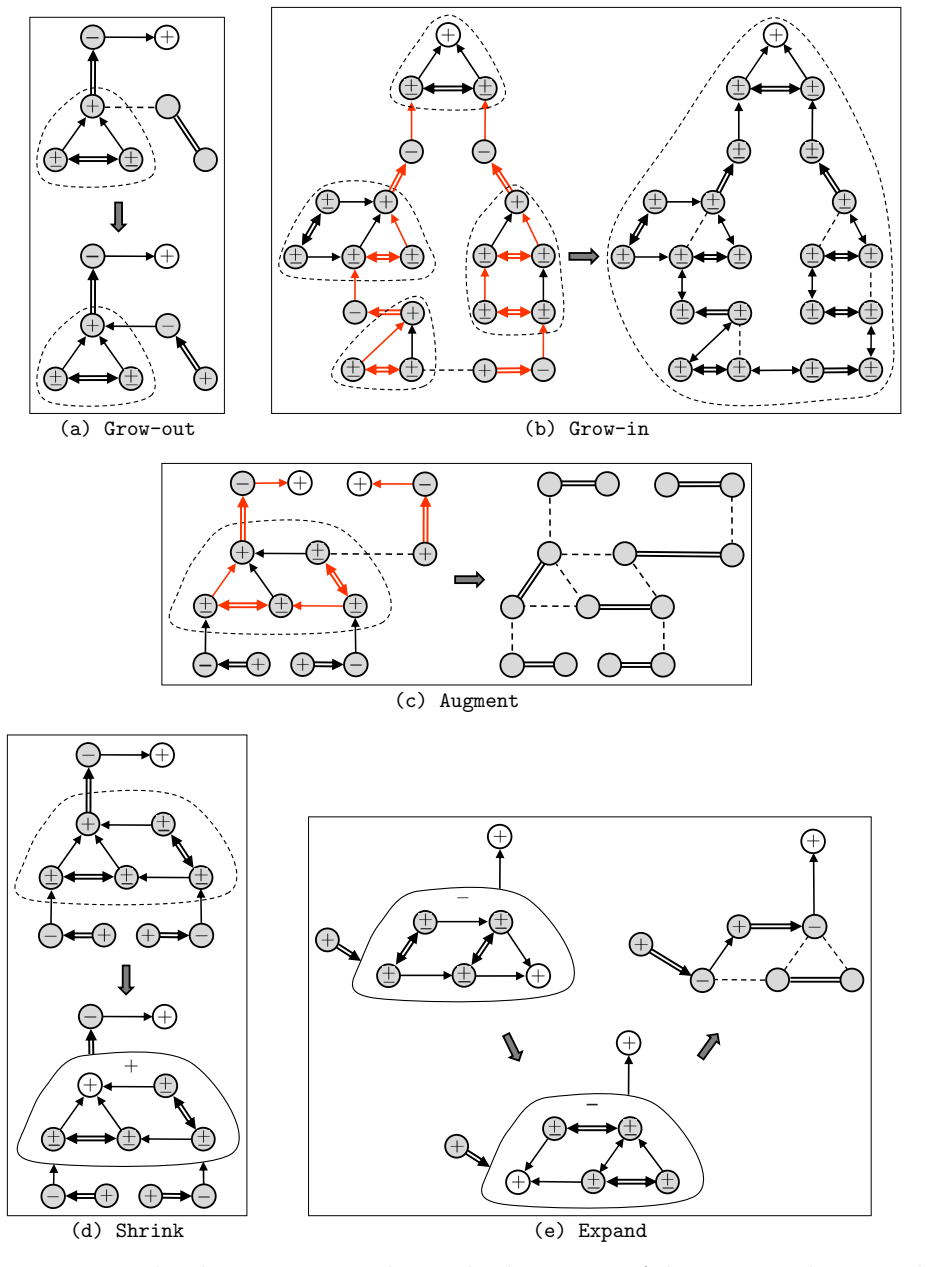
Blossom VI solves the minimum weight perfect matching problem by repeatedly solving maximum-cardinality unweighted matching subproblems during the primal phase. It employs cherry trees and cherry blossoms in place of alternating trees and blossoms, shrinking the cherry blossoms into supernodes. This strategy keeps supernode hierarchies much shallower than in previous implementations, yielding almost-linear runtime on every family of instances tested and significantly better performance than Blossom V on those families where the prior method exhibits superlinear behavior.
What carries the argument
Cherry blossoms shrunk into supernodes, which replace traditional blossoms to produce shallower hierarchies while the algorithm solves a sequence of unweighted matching subproblems.
If this is right
- Minimum weight perfect matching instances that previously triggered superlinear slowdowns can now be solved more quickly.
- Larger graphs become feasible to process because the runtime stays close to linear on the tested families.
- The primal phase can rely on calls to an unweighted maximum-cardinality matcher without incurring extra asymptotic cost.
- Shallower supernodes reduce the depth of the search structures used during augmentation and dual updates.
Where Pith is reading between the lines
- The cherry-blossom shrinking technique could be adapted to other matching variants that currently use traditional blossoms.
- If the almost-linear behavior persists on new families, it may encourage replacing older blossom codes in production solvers.
- Hybrid implementations that combine this primal approach with existing dual heuristics become easier to test.
Load-bearing premise
The families of graphs tested so far are representative of the instances that arise in practical use.
What would settle it
A graph family on which the implementation either exhibits superlinear runtime or is slower than Blossom V across the board would show the practical claims do not hold.
Figures

read the original abstract
We implement an algorithm for solving the minimum weight perfect matching problem. Our code significantly outperforms the current state-of-the-art Blossom V algorithm on those families of instances where Blossom V takes superlinear time. In practice, our implementation shows almost-linear runtime on every family of instances on which we have tested it. Our algorithm relies on solving the maximum-cardinality unweighted matching problems during its primal phase. Following the state-of-the-art cherry blossom algorithm, we use cherry trees instead of traditional alternating trees and cherry blossoms instead of traditional blossoms. We shrink cherry blossoms rather than traditional blossoms into supernodes. This strategy allows us to deal with much shallower supernodes.
Editorial analysis
A structured set of objections, weighed in public.
Referee Report
Summary. The manuscript presents Blossom VI, a practical algorithm and implementation for the minimum weight perfect matching problem. It refines the Blossom framework by using cherry trees in place of alternating trees and cherry blossoms in place of traditional blossoms, shrinking the latter into shallower supernodes. This enables solving a sequence of maximum-cardinality unweighted matching problems in the primal phase. The central empirical claim is that the implementation significantly outperforms Blossom V on families where the latter exhibits superlinear runtime and achieves almost-linear runtime on every tested family of instances.
Significance. If the empirical performance claims hold under broader testing, the work offers a meaningful practical improvement for solving minimum-weight perfect matching instances that arise in optimization and combinatorial applications. The engineering refinement of cherry structures is a direct, scoped extension of prior Blossom variants and does not rely on new theoretical runtime bounds or untested assumptions beyond the reported instance families.
minor comments (2)
- Abstract: the performance claims (outperformance on superlinear families and almost-linear runtime on all tested families) are stated without any reference to specific instance families, benchmark tables, or statistical measures; adding a short clause pointing to the experimental section would improve immediate readability.
- The manuscript would benefit from an explicit statement in the introduction or experimental section confirming that all reported runtimes were measured on the same hardware and with identical termination criteria as the Blossom V baseline.
Simulated Author's Rebuttal
We thank the referee for their careful reading and positive assessment of the manuscript. The recommendation for minor revision is appreciated, and we are glad that the practical improvements and engineering refinements are viewed as a meaningful contribution. No major comments were raised in the report.
Circularity Check
No significant circularity; empirical runtime claims are scoped to tested instances
full rationale
The paper describes a forward engineering refinement of the Blossom framework (cherry trees, shallower supernodes, reduction to unweighted cardinality matching in the primal phase) and reports measured runtimes on specific families. These observations are presented as experimental results rather than derived predictions or theorems. No equation or claim reduces by construction to a fitted parameter, self-definition, or self-citation chain; prior-work references are external and non-load-bearing for the scoped empirical statement. The central claim remains falsifiable on new instances and does not import uniqueness or ansatz via self-citation.
Axiom & Free-Parameter Ledger
axioms (1)
- domain assumption Input graphs admit perfect matchings or the algorithm correctly handles cases without them.
Reference graph
Works this paper leans on
-
[1]
Solving large-scale matching problems
David L Applegate and William J Cook. Solving large-scale matching problems. InNetwork flows and matching, pages 557–576, 1991
work page 1991
-
[2]
M. L. Balinski. Labelling to obtain a maximum matching. In R. C. Bose and T. A. Dowling, editors,Combinatorial Mathematics and Its Applications, pages 585–602. University of North Carolina Press, Chapel Hill, NC, 1969
work page 1969
-
[3]
Norbert Blum. Maximum matching in general graphs without explicit consideration of blos- soms revisited.CoRR, abs/1509.04927, 2015
-
[4]
Computing minimum-weight perfect matchings.INFORMS journal on computing, 11(2):138–148, 1999
William Cook and Andre Rohe. Computing minimum-weight perfect matchings.INFORMS journal on computing, 11(2):138–148, 1999
work page 1999
-
[5]
A primal algorithm for optimum matching
William H Cunningham and Alfred B Marsh. A primal algorithm for optimum matching. In Polyhedral Combinatorics: Dedicated to the memory of DR Fulkerson, pages 50–72. Springer, 2009
work page 2009
-
[6]
Ulrich Derigs and Achim Metz. On the use of optimal fractional matchings for solving the (integer) matching problem.Computing, 36(3):263–270, 1986
work page 1986
-
[7]
Bal´ azs Dezs˝ o, Alp´ ar J¨ uttner, and P´ eter Kov´ acs. LEMON — an open source C++ graph template library.Electronic notes in theoretical computer science, 264(5):23–45, 2011
work page 2011
-
[8]
Michael B. Dillencourt. Toughness and Delaunay triangulations.Discrete Comput. Geom., 5(6):575–601, December 1990
work page 1990
-
[9]
Shrinking trees not blossoms: A recursive maximum matching approach
Andre Droschinsky, Petra Mutzel, and Erik Thordsen. Shrinking trees not blossoms: A recursive maximum matching approach. In2020 Proceedings of the Twenty-Second Workshop on Algorithm Engineering and Experiments (ALENEX), pages 146–160. SIAM, 2020
work page 2020
-
[10]
Jack Edmonds. Maximum matching and a polyhedron with 0, 1-vertices.Journal of research of the National Bureau of Standards B, 69(125-130):55–56, 1965
work page 1965
-
[11]
Paths, trees, and flowers.Canadian Journal of mathematics, 17:449–467, 1965
Jack Edmonds. Paths, trees, and flowers.Canadian Journal of mathematics, 17:449–467, 1965. 17
work page 1965
-
[12]
Jack Edmonds, Ellis L Johnson, and Scott C Lockhart. Blossom I: a computer code for the matching problem.IBM TJ Watson Research Center, Yorktown Heights, New York, 294, 1969
work page 1969
-
[13]
Dayi Fan, Rubao Lee, and Xiaodong Zhang. X-blossom: Massive parallelization of graph maximum matching.Proceedings of the VLDB Endowment, 18(10):3339–3353, 2025
work page 2025
-
[14]
Harold N Gabow. An efficient implementation of Edmonds’ algorithm for maximum matching on graphs.Journal of the ACM (JACM), 23(2):221–234, 1976
work page 1976
-
[15]
A scaling algorithm for weighted matching on general graphs
Harold N Gabow. A scaling algorithm for weighted matching on general graphs. In26th Annual Symposium on Foundations of Computer Science (sfcs 1985), pages 90–100. IEEE, 1985
work page 1985
-
[16]
Efficient implementation of graph algorithms using contraction
Harold N Gabow, Zvi Galil, and Thomas H Spencer. Efficient implementation of graph algorithms using contraction. In25th Annual Symposium onFoundations of Computer Science, 1984., pages 347–357. IEEE, 1984
work page 1984
-
[17]
Harold N Gabow and Robert E Tarjan. Faster scaling algorithms for general graph matching problems.Journal of the ACM (JACM), 38(4):815–853, 1991
work page 1991
-
[18]
Harold Neil Gabow.Implementation of algorithms for maximum matching on nonbipartite graphs.Stanford University, 1974
work page 1974
-
[19]
Zvi Galil, Silvio Micali, and Harold Gabow. AnO(EVlogV) algorithm for finding a maximal weighted matching in general graphs.SIAM Journal on Computing, 15(1):120–130, 1986
work page 1986
-
[20]
Frank Hadlock. Finding a maximum cut of a planar graph in polynomial time.SIAM Journal on Computing, 4(3):221–225, 1975
work page 1975
-
[21]
Chien-Chung Huang and Telikepalli Kavitha. New algorithms for maximum weight matching and a decomposition theorem.Mathematics of Operations Research, 42(2):411–426, 2017
work page 2017
-
[22]
Vladimir Kolmogorov. Blossom V: a new implementation of a minimum cost perfect matching algorithm.Mathematical Programming Computation, 1(1):43–67, 2009
work page 2009
-
[23]
Kurt Mehlhorn and Guido Sch¨ afer. Implementation ofO(nmlogn) weighted matchings in general graphs: the power of data structures.Journal of Experimental Algorithmics (JEA), 7:4, 2002
work page 2002
-
[24]
AnO( p |V||E|) algoithm for finding maximum matching in general graphs
Silvio Micali and Vijay V Vazirani. AnO( p |V||E|) algoithm for finding maximum matching in general graphs. In21st Annual symposium on foundations of computer science (Sfcs 1980), pages 17–27. IEEE, 1980
work page 1980
-
[25]
Maximum matchings via Gaussian elimination
Marcin Mucha and Piotr Sankowski. Maximum matchings via Gaussian elimination. In45th Annual IEEE Symposium on Foundations of Computer Science, pages 248–255. IEEE, 2004
work page 2004
-
[26]
Andre Rohe.https://www.math.uwaterloo.ca/tsp/vlsi/index.html
-
[27]
Alexander Schrijver et al.Combinatorial optimization: polyhedra and efficiency, volume 24. Springer, 2003
work page 2003
-
[28]
Jeremy G Siek, Lie-Quan Lee, and Andrew Lumsdaine.The Boost Graph Library: User Guide and Reference Manual, The. Pearson Education, 2001. 18
work page 2001
-
[29]
Vijay V Vazirani. A theory of alternating paths and blossoms for proving correctness of the general graph maximum matching algorithm.Combinatorica, 14(1):71–109, 1994
work page 1994
-
[30]
A proof of the MV matching algorithm.arXiv preprint arXiv:2012.03582, 2020
Vijay V Vazirani. A proof of the MV matching algorithm.arXiv preprint arXiv:2012.03582, 2020
-
[31]
C. Witzgall and C. T. Zahn, Jr. Modification of Edmonds’ maximum matching algorithm. Journal of Research of the National Bureau of Standards–B. Mathematics and Mathematical Physics, 69B(1–2):91–98, 1965. 19
work page 1965
discussion (0)
Sign in with ORCID, Apple, or X to comment. Anyone can read and Pith papers without signing in.