Mid-infrared JWST spectra of carbon stars in the Large Magellanic Cloud
Pith reviewed 2026-05-09 22:42 UTC · model grok-4.3
The pith
C3 molecule produces strong absorption at 5.2 microns in carbon stars of the Large Magellanic Cloud
A machine-rendered reading of the paper's core claim, the machinery that carries it, and where it could break.
Core claim
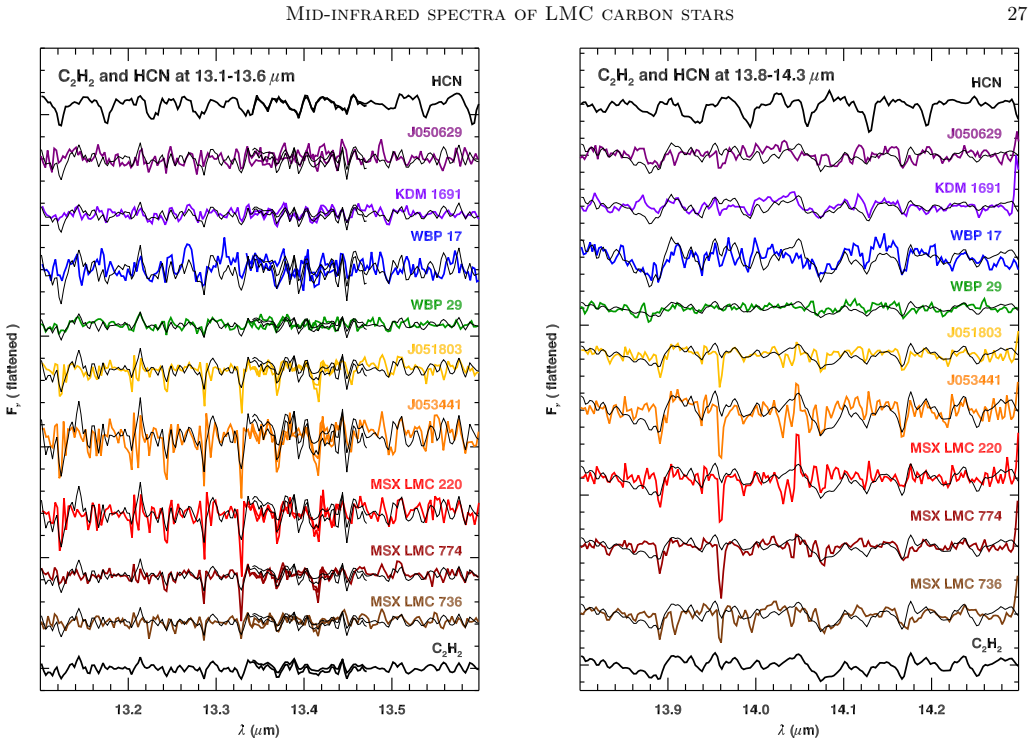
High-resolution mid-infrared spectra reveal that the C3 molecule is responsible for a strong absorption band centered at 5.2 um in carbon stars. CS appears in stars with less dust, and HCN may be present as well. Spectral changes between Spitzer and JWST epochs are mostly attributable to the pulsation cycle. A dip at about 10 um, possibly from an unknown carrier or variable molecular emission, together with the C2H2 band at 14 um, indicates that some prior detections of weak SiC dust emission could be spurious.
What carries the argument
Comparison of JWST Medium Resolution Spectrometer spectra with prior Spitzer Infrared Spectrograph data to isolate molecular absorption bands such as C3 and evaluate dust features like SiC.
If this is right
- More accurate modeling of molecular chemistry in carbon-rich stellar envelopes.
- Reassessment of dust composition in carbon stars based on clearer separation of molecular and dust contributions.
- Improved understanding of how pulsation affects observed spectra in these variable stars.
- Potential revision of dust production rates derived from earlier mid-IR observations.
Where Pith is reading between the lines
- This work could lead to better predictions of infrared spectra for carbon stars in other low-metallicity environments.
- Distinguishing the 10 um feature might require phase-resolved observations across the pulsation cycle.
- The findings highlight the value of JWST for resolving ambiguities in Spitzer data for evolved stars.
Load-bearing premise
The 10-micron dip is not produced by any known molecular or dust feature already included in the analysis, and the observed changes between observation epochs are driven mainly by stellar pulsation rather than other forms of variability.
What would settle it
Laboratory spectra or atmospheric models that reproduce the exact shape of the 10 um dip using only known molecules and dust species would show that the dip does not undermine previous SiC detections.
Figures



read the original abstract
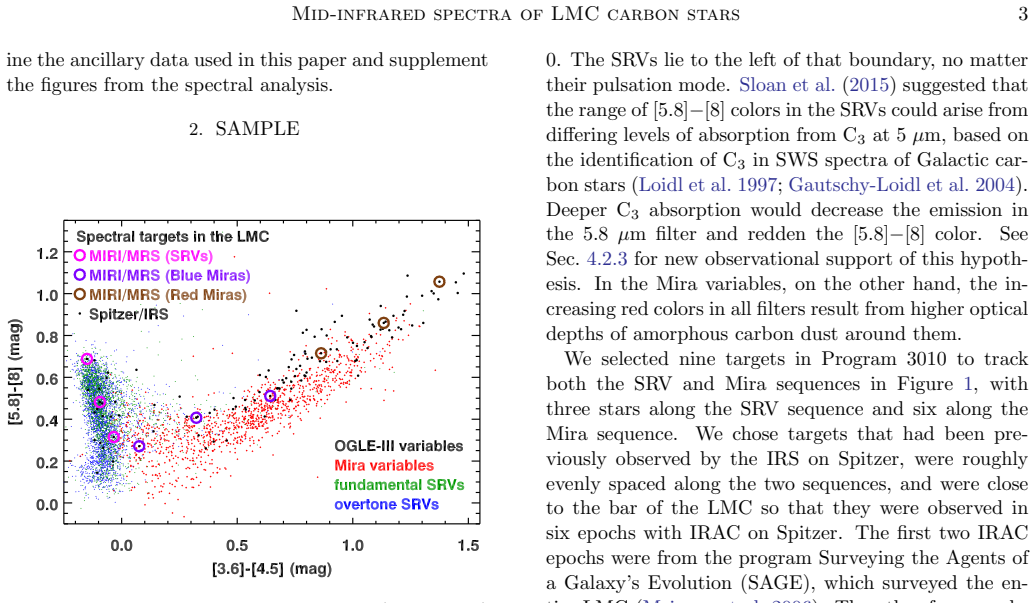
Mid-infrared spectra from the Medium Resolution Spectrometer on the James Webb Space Telescope have revealed the molecular chemistry of carbon stars in the Large Magellanic Cloud with better resolution and sensitivity than previously possible. Our sample spans a range of dust-production rates and includes three relatively dust-free semiregular variables and six dustier Mira variables. All were observed 15-20 yr earlier with the Infrared Spectrograph on the Spitzer Space Telescope at lower spectral resolution. The new spectra show that the C3 molecule is responsible for a strong absorption band centered at 5.2 um. CS is clearly present in some of the sample, especially the stars with less dust. HCN also appears to be present. Some of the spectra have changed significantly between the Spitzer epoch and the MRS observations in 2023 and 2024, and in most cases these changes can be attributed to the stellar pulsation cycle. One exception is the disappearance of a dust emission feature at ~18 um in one of the Miras. The new spectra reveal a dip centered at ~10 um, which could arise either from an unknown carrier or from variable molecular emission to the red and blue. The presence of this spectral structure on the short-wavelength side of the SiC dust emission feature at ~11.3 um along with the broad C2H2 band centered at 14 um raise the possibility that some previously reported detections of weak SiC dust emission in other carbon stars may not be real.
Editorial analysis
A structured set of objections, weighed in public.
Axiom & Free-Parameter Ledger
axioms (1)
- standard math Laboratory and theoretical wavelengths for C3, CS, HCN, C2H2, and SiC are accurate enough for identification in stellar spectra
Reference graph
Works this paper leans on
-
[1]
Allamandola, L. J., Tielens, A. G. G. M., & Barker, J. R. 1989, ApJS, 71, 733
work page 1989
- [2]
- [3]
-
[4]
Aringer, B., Girardi, L., Nowotny, W., et al. 2016, MNRAS, 457, 3611
work page 2016
-
[5]
Aringer, B., Marigo, P., Nowotny, W., et al. 2019, MNRAS, 487, 2133
work page 2019
-
[6]
Barber, R. J., Strange, J. K., Hill, C., et al. 2014, MNRAS, 437, 1828
work page 2014
- [7]
-
[8]
Bladh, S., Eriksson, K., Marigo, P., et al. 2019, A&A, 623, L119
work page 2019
- [9]
- [10]
- [11]
-
[12]
L., Srinivasan, S., Riebel, D., et al
Boyer, M. L., Srinivasan, S., Riebel, D., et al. 2012, ApJ, 748, 40
work page 2012
- [13]
- [14]
-
[15]
Choudhury, S., Subramaniam, A., & Cole, A. A. 2016, MNRAS, 455, 1855
work page 2016
-
[16]
L, Tennyson, J., & Yurchenko, S
Chubb, K. L, Tennyson, J., & Yurchenko, S. N. 2020, MNRAS, 493, 1531
work page 2020
-
[17]
L., Clementini, G., Girardi, L., et al
Cioni, M.-R. L., Clementini, G., Girardi, L., et al. 2011, A&A, 527, 116
work page 2011
- [18]
-
[19]
Cioni, M.-R. L., Loup, C., Habing, H. J., et al. A&AS, 114, 235 de Graauw, T., Haser, L. N., Beintema, D. A., et al. 1996, A&A, 315, L49
work page 1996
-
[20]
Dwek, E., Galliano, F., & Jones, A. P. 2007, ApJ, 662, 927
work page 2007
- [21]
- [22]
- [23]
-
[24]
Fraser, O. J., Hawley, S. L, Cook, K. H., & Keller, S. C. 2005, AJ, 129, 768
work page 2005
-
[25]
Frenklach, M., & Feigelson, E. D. 1989, ApJ, 341, 372 Gaia Collaboration, Prusti, T., de Bruijne J. H. H., et al 2016, A&A, 595, 1 Gaia Collaboration, Brown, A. G. A., Vallenari, A., et al. 2021, A&A, 649, 1 Gaia Collaboration, Vallenari, A., Brown, A. G. A., et al. 2023, A&A, 674, 1
work page 1989
-
[26]
Gardner, J. P., Mather, J. C., Abbot, R., et al. 2023, PASP, 135, 68001
work page 2023
-
[27]
Gautschy-Loidl, R., H¨ ofner, S., Jorgensen, U. G., & Hron, J. 2004, A&A, 422, 289
work page 2004
-
[28]
Groenewegen, M. A. T. 2004, A&A, 425, 595
work page 2004
-
[29]
Groenewegen, M. A. T. 2022, A&A, 659, 145
work page 2022
-
[30]
Groenewegen, M. A. T., Nanni, A., Cioni, M.-R. L., et al. 2020, A&A, 636, 48
work page 2020
-
[31]
Petersen, E. A. 2009, A&A, 506, 1277
work page 2009
-
[32]
Groenewegen, M. A. T., & Sloan, G. C. 2018, A&A, 609, 114
work page 2018
-
[33]
Groenewegen, M. A. T., Wood, P. R., & Sloan, G. C. 2007, MNRAS, 376, 313
work page 2007
-
[34]
Habing, H. J. 1996, A&A Rv, 7, 97
work page 1996
-
[35]
Harris, G. J., Larner, F. C., Tennyson, J., et al. 2008, MNRAS, 390, 143
work page 2008
-
[36]
Helton, J. M., Morrison, J. E., Hainline, K. N., et al. 2026, ApJL, submitted (arXiv 2512.19695)
-
[37]
2004, ApJS, 155, 651 H¨ ofner, S., Bladh, S., Aringer, B., & Ahuja, R
Herwig, F. 2004, ApJS, 155, 651 H¨ ofner, S., Bladh, S., Aringer, B., & Ahuja, R. 2016, A&A, 594, 108 H¨ ofner, S. & Olofsson, H. 2018, A&A Rv, 26, 1
work page 2004
-
[38]
Houck, J. R., Roellig, T. L., & van Cleve, J., et al. 2004, ApJS, 154, 18
work page 2004
- [39]
-
[40]
Ita, Y., Tanab´ e, T., Matsunaga, N., et al. 2004, MNRAS, 353, 705
work page 2004
- [41]
-
[42]
Kato, D., Nagashima, C., Nagayama, T., et al. 2007, PASJ, 59, 615
work page 2007
-
[43]
Kessler, M., Anderegg, M. E., Clavel, J., et al. 1996, A&A, 315, L27
work page 1996
- [44]
-
[45]
Kim, D.-W., Protopapas, P., Bailer-Jones, C. A. L., et al. 2014, A&A, 566, 43
work page 2014
-
[46]
Kloppenborg, B. K. 2025, Observations from the AAVSO International Database (https://www.aavso.org)
work page 2025
- [47]
-
[48]
Lallement, R., Vergely, J. L., Babusiaux, C., & Cos, N. L. J. 2022, A&A, 661, 147
work page 2022
-
[49]
Law, D. R., Argyriou, I., Gordon, K. D., et al. 2024, AJ, in press (arXiv 2409.15435) 30Sloan et al
- [50]
-
[51]
Leisenring, J., Kemper, F., & Sloan, G. C. 2008, ApJ, 681, 1557
work page 2008
- [52]
-
[53]
Liljegren, S., H¨ ofner, S., Nowotny, W., & Eriksson, K. 2016, A&A, 589, 130
work page 2016
- [54]
-
[55]
E., Polyansky, L., Tennyson, J., et al
Lynas-Gray, A. E., Polyansky, L., Tennyson, J., et al. 2024, MNRAS, 535, 1439
work page 2024
- [56]
-
[57]
Maiolino, R., Schneider, R., Oliva, E., et al. 2004, Nature, 431, 533
work page 2004
- [58]
-
[59]
Matsuura, M., Barlow, M. J., Zijlstra, A. A. et al. 2009, MNRAS, 396, 918
work page 2009
- [60]
- [61]
- [62]
- [63]
-
[64]
McDonald, I., Srinivasan, S., Scicluna, P., et al. 2025, MNRAS, 541, 516
work page 2025
- [65]
- [66]
-
[67]
Meixner, M., Gordon, K. D., Indebetouw, R., et al. 2006, AJ, 132, 2268
work page 2006
-
[68]
Naidu, R. P., Oesch, P. A., Brammer, G., et al. 2026, OJAp, in press (arXiv 2505.11263)
-
[69]
Onken, C. A., Wolf, C., Bessell, M. S., et al. 2024, PASA, 41, 61
work page 2024
- [70]
-
[71]
Ochsenbein, F., et al. 2000, “The VizieR database of astronomical catalogues,” DOI: 10.26093/cds/vizier
-
[72]
Paulose, G., Barton, E. J., Yurchenko, S. N., & Tennyson, J. 2015, MNRAS, 454, 1931
work page 2015
-
[73]
Piatti, A. E., & Geisler, D. 2013, AJ, 145, 17 Pietrzy´ nski, G., Graczyk, D., Gallenne , A., et al. 2019, Nature, 567, 200
work page 2013
-
[74]
M., Salyk, C., Banzatti, A., et al
Pontoppidan, K. M., Salyk, C., Banzatti, A., et al. 2024, ApJ, 963, 158
work page 2024
- [75]
-
[76]
Riebel, D., Boyer, M. L., Srinivasan, S., et al. 2015, ApJ, 807, 1
work page 2015
- [77]
-
[78]
Salpeter, E. E. 1952, ApJ, 115, 326
work page 1952
-
[79]
Samus, N. N., Kazarovets, E. V., Durlevich, O. V., et al. 2017, ARep, 61, 1
work page 2017
-
[80]
Sanford, R. F. 1944, ApJ, 99, 145
work page 1944
discussion (0)
Sign in with ORCID, Apple, or X to comment. Anyone can read and Pith papers without signing in.