Recognition: unknown
A 260-Liter Test Stand for Liquid Argon R&D
Pith reviewed 2026-05-09 22:30 UTC · model grok-4.3
The pith
A 260-liter liquid argon test stand reaches 0.5 ms electron lifetime with pump-free purification and completes full cycles in 7 days.
A machine-rendered reading of the paper's core claim, the machinery that carries it, and where it could break.
Core claim
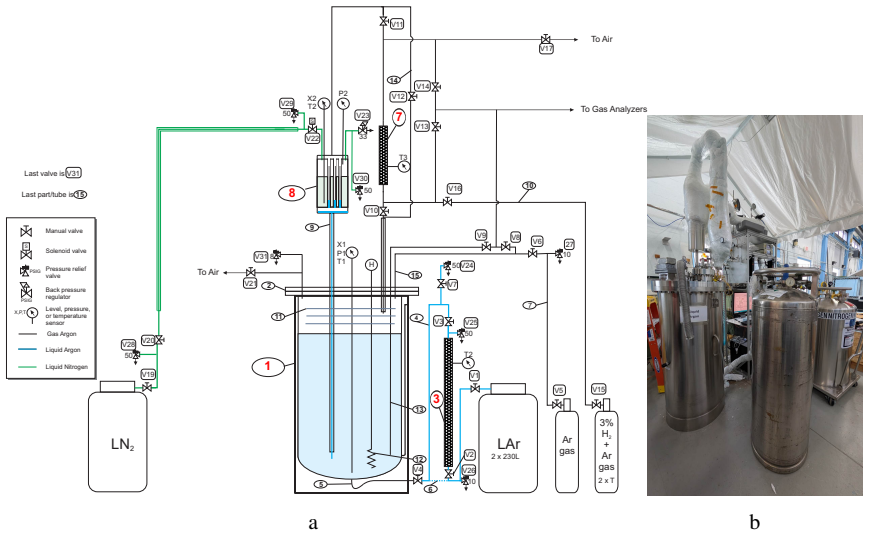
The 260-liter test stand employs gas-phase argon purification with continuous pump-free circulation, in which boil-off gas is purified, recondensed, and returned to the cryostat by gravity, together with a condenser whose effective thermal contact area is 13 times larger than in the earlier 20-liter system; an installed liquid argon purity monitor measures electron lifetime directly in the liquid, yielding 0.5 ms under the reported operating conditions, and the entire facility is engineered so that full operational cycles can be completed within seven days.
What carries the argument
Gas-phase argon purification loop with pump-free gravity-driven circulation and recondensation, combined with a liquid argon purity monitor that measures electron lifetime in situ.
If this is right
- Detector components can be iterated through full cryogenic cycles in one week instead of longer campaigns.
- Medium-scale liquid volume plus in-situ purity monitoring enables quantitative charge-attenuation studies before scaling to larger detectors.
- The pump-free circulation approach removes one mechanical failure point while still achieving the reported purity level.
Where Pith is reading between the lines
- The same fast-cycle approach could be adapted to test alternative purification materials or new sensor designs on short notice.
- If the 0.5 ms lifetime holds across multiple fills, the facility offers a practical benchmark for purity targets in next-generation LArTPCs.
- The 13-fold increase in condenser area suggests a scalable thermal-design principle worth checking in larger volumes.
Load-bearing premise
The purity monitor gives an accurate, unbiased reading of electron lifetime and the gas-phase loop maintains stable purity without introducing new contaminants or flow problems.
What would settle it
A direct measurement of electron lifetime well below 0.5 ms under the same fill and purification settings, or an operational cycle that requires more than seven days, would falsify the reported performance.
Figures


read the original abstract
We describe the design and performance of a 260-liter liquid argon (LAr) cryogenic test stand for liquid argon detector research and development at BNL. The system uses gas-phase argon purification with continuous pump-free circulation, in which boil-off argon gas is purified, recondensed, and returned to the cryostat by gravity without a mechanical recirculation pump; it also incorporates an upgraded condenser that increases the effective thermal contact area by a factor of 13 relative to the previously developed 20-liter system reported perviously. A liquid argon purity monitor is installed to measure the electron lifetime directly in LAr, enabling quantitative characterization of charge attenuation due to electronegative impurities. Under the operating conditions reported here, the demonstrated electron lifetime is 0.5 ms. The system is designed to enable rapid iteration of detector components in complete operational cycles, including pump-down, leak verification, cryogenic fill, stable operation, and warm-up, which can be completed within 7 days. Such a fast turnaround time, together with the medium-scale liquid volume and direct purity diagnostics, makes the facility well suited for testing and refining detector designs in support of large liquid argon time projection chamber (LArTPC) experiments.
Editorial analysis
A structured set of objections, weighed in public.
Referee Report
Summary. The manuscript describes the design and performance of a 260-liter liquid argon cryogenic test stand at BNL for LAr detector R&D. It features gas-phase argon purification via pump-free boil-off/recondensation/gravity circulation, an upgraded condenser with 13x increased thermal contact area relative to a prior 20 L system, and an in-situ purity monitor. The reported performance includes a demonstrated electron lifetime of 0.5 ms and the ability to complete full operational cycles (pump-down, leak check, fill, stable run, warm-up) in 7 days, making the facility suitable for rapid iteration of components in support of large LArTPC experiments.
Significance. If the quantitative performance claims hold under scrutiny, the work provides a practical medium-scale LAr test platform with direct purity diagnostics and fast turnaround. This addresses a clear need for accessible R&D infrastructure to support development and validation of detector elements for next-generation LArTPCs.
major comments (2)
- [Abstract] Abstract: The central performance claim of a 0.5 ms electron lifetime is presented without error bars, calibration details for the purity monitor, data selection criteria, or any cross-check (e.g., multi-point sampling or controlled dopant injection) that the monitor reading represents bulk LAr purity under the gravity-driven loop. This measurement is load-bearing for both the quantitative demonstration and the assertion of suitability for rapid R&D.
- [Abstract] Abstract and performance description: The gas-phase purification loop is asserted to maintain stable purity without introducing new contaminants or flow instabilities, yet no validation data (uniformity tests, stability over multiple cycles, or comparison to a second monitor) are referenced. If this assumption fails, the reported lifetime and 7-day cycle claim are undermined.
minor comments (2)
- [Abstract] Abstract: Typo 'perviously' should read 'previously'.
- The manuscript would benefit from explicit section headings and a dedicated methods subsection describing purity monitor operation, data acquisition, and analysis to allow independent assessment of the lifetime result.
Simulated Author's Rebuttal
We thank the referee for the careful and constructive review of our manuscript on the 260-liter LAr test stand. The comments correctly identify areas where the abstract and performance claims would benefit from greater transparency and supporting references. We address each point below and have prepared revisions to the manuscript accordingly.
read point-by-point responses
-
Referee: [Abstract] Abstract: The central performance claim of a 0.5 ms electron lifetime is presented without error bars, calibration details for the purity monitor, data selection criteria, or any cross-check (e.g., multi-point sampling or controlled dopant injection) that the monitor reading represents bulk LAr purity under the gravity-driven loop. This measurement is load-bearing for both the quantitative demonstration and the assertion of suitability for rapid R&D.
Authors: We agree that the abstract would be improved by including additional context for this key result. In the revised manuscript we have added error bars to the reported lifetime and a concise statement summarizing the purity monitor calibration procedure and data selection criteria. The multi-point sampling measurements that support the bulk purity interpretation under gravity-driven flow are already described in the main text; we have added an explicit cross-reference in the abstract. A controlled dopant injection cross-check was not performed in this study, and we have added a brief note acknowledging this limitation while explaining why the existing operational data are sufficient to support the claim. revision: partial
-
Referee: [Abstract] Abstract and performance description: The gas-phase purification loop is asserted to maintain stable purity without introducing new contaminants or flow instabilities, yet no validation data (uniformity tests, stability over multiple cycles, or comparison to a second monitor) are referenced. If this assumption fails, the reported lifetime and 7-day cycle claim are undermined.
Authors: The stability of the gas-phase purification loop is evidenced by the sustained electron lifetime and successful repetition of full 7-day operational cycles. In the revised manuscript we have added explicit references in both the abstract and the performance section to the uniformity tests (multiple sensor locations) and time-series stability data already shown in the results. No second monitor was deployed, but the single monitor's readings remained consistent with the expected performance of the upgraded condenser and gravity return loop; we have expanded the text to clarify the design features that prevent introduction of new contaminants or flow instabilities. revision: yes
- A controlled dopant injection cross-check to independently confirm that the purity monitor reading represents bulk LAr purity was not performed and cannot be added without new experimental work.
Circularity Check
No circularity: hardware description with no derivations or self-referential predictions
full rationale
The paper is a technical description of a cryogenic test stand, its design features (gas-phase purification loop, upgraded condenser, purity monitor), and measured performance (0.5 ms electron lifetime under reported conditions). No equations, model fits, predictions, or first-principles derivations appear in the provided text. The central claims are empirical performance metrics and operational cycle times, not quantities derived from prior results or self-citations. The mention of a previously reported 20-liter system is historical context only and does not load-bear any quantitative claim. The reader's assessment of zero circularity is confirmed; the work is self-contained against external benchmarks as a straightforward instrumentation report.
Axiom & Free-Parameter Ledger
Reference graph
Works this paper leans on
-
[4]
Measurement of Longtudinal Electron Diffusion in Liquid Argon
Yichen Li and others. Measurement of Longtudinal Electron Diffusion in Liquid Argon. 2015. arXiv:xxxx.xxx
2015
-
[5]
Measurement of Longitudinal Electron Diffusion in Liquid Argon
Li, Yichen and others. Measurement of Longitudinal Electron Diffusion in Liquid Argon. 2015. arXiv:1508.07059
-
[6]
L. G. Christophorou and others , title =. Nuclear Instruments and Methods , volume =
-
[7]
Adams, C. and others. The Long-Baseline Neutrino Experiment: Exploring Fundamental Symmetries of the Universe. 2013. arXiv:1307.7335
-
[8]
Antonello, M. and others. A Proposal for a Three Detector Short-Baseline Neutrino Oscillation Program in the Fermilab Booster Neutrino Beam. 2015. arXiv:1503.01520
-
[9]
W. J. Willis and V. Radeka , title=. Nuclear Instruments and Methods , volume =
-
[10]
Adams, C. and Alonso, J.R. and Ankowski, A.M. and Asaadi, J.A. and Ashenfelter, J. and others. The Intermediate Neutrino Program. 2015. arXiv:1503.06637
-
[11]
Amerio, et al., Design, construction and tests of the ICARUS T600 detector, Nucl
Amerio, S. and others. Design, construction and tests of the ICARUS T600 detector. Nucl.Instrum.Meth. 2004. doi:10.1016/j.nima.2004.02.044
-
[12]
Anderson, C. and others. First Measurements of Inclusive Muon Neutrino Charged Current Differential Cross Sections on Argon. Phys.Rev.Lett. 2012. doi:10.1103/PhysRevLett.108.161802. arXiv:1111.0103
-
[13]
V. M. Atrazhev and I. V. Timoshkin , title =. IEEE Trans. Dielectrics and Electrical Insulation , volume =
-
[14]
Alexander, T. and others. DarkSide search for dark matter. JINST. 2013. doi:10.1088/1748-0221/8/11/C11021
-
[15]
A. Zani. The WArP Experiment: A Double-Phase Argon Detector for Dark Matter Searches. Adv.High Energy Phys. 2014. doi:10.1155/2014/205107
-
[16]
Physical Review A , volume=
Ratio of diffusion coefficient to mobility for electrons in liquid argon , author=. Physical Review A , volume=. 1979 , publisher=
1979
-
[18]
Bonetti, S. and Braggiotti, A. and Buckley, E. and Campanella, M. and Carugno, G. and others. A Study of the Electron Image Due to Ionizing Events in a Two-dimensional Liquid Argon TPC With a 24- CM Drift Gap. Nucl.Instrum.Meth. 1990. doi:10.1016/0168-9002(90)90215-R
-
[19]
Bell System Technical Journal , volume=
Motion of gaseous ions in strong electric fields , author=. Bell System Technical Journal , volume=. 1953 , publisher=
1953
-
[20]
R. E. Robson , title = ". Australian Journal of Physics , year = 1972, month = dec, volume = 25, pages =
1972
-
[21]
Journal of applied physics , volume=
Electron transport measurements in methane using an improved pulsed Townsend technique , author=. Journal of applied physics , volume=. 1986 , publisher=
1986
-
[22]
Japanese Journal of Applied Physics , volume=
Electron mobility and longitudinal diffusion coefficient in high-density gaseous xenon , author=. Japanese Journal of Applied Physics , volume=. 2012 , publisher=
2012
-
[23]
Journal of Applied Physics , volume=
Measurements of swarm parameters and derived electron collision cross sections in methane , author=. Journal of Applied Physics , volume=. 1989 , publisher=
1989
-
[24]
Journal of Physics D: Applied Physics , volume=
Drift velocity and longitudinal diffusion coefficient of electrons in pure ethene , author=. Journal of Physics D: Applied Physics , volume=. 2011 , publisher=
2011
-
[25]
Physics Procedia , volume=
Designs of Large Liquid Argon TPCs—from MicroBooNE to LBNE LAr40 , author=. Physics Procedia , volume=. 2012 , publisher=
2012
-
[26]
Journal of Physics: Conference Series , volume=
Towards GLACIER, an underground giant liquid argon neutrino detector , author=. Journal of Physics: Conference Series , volume=. 2012 , organization=
2012
-
[27]
, Journal =
Camilleri, L. , Journal =. MicroBooNE , Volume =
-
[28]
The motion of electrons in argon , author=
LXX. The motion of electrons in argon , author=. The London, Edinburgh, and Dublin Philosophical Magazine and Journal of Science , volume=. 1922 , publisher=
1922
-
[29]
Theory of electron diffusion parallel to electric fields. I. Theory , author=. Physical Review , volume=. 1969 , publisher=
1969
-
[30]
Physical Review Letters , volume=
Mean free path of photoexcited electrons in Au , author=. Physical Review Letters , volume=. 1962 , publisher=
1962
-
[31]
The Journal of Physical Chemistry , volume=
Emergence of photoelectrons from a metal surface into liquid argon: a Monte Carlo treatment , author=. The Journal of Physical Chemistry , volume=. 1984 , publisher=
1984
-
[32]
Canadian Journal of Chemistry , volume=
Photoelectric determination of V 0 values and electron ranges in some cryogenic liquids , author=. Canadian Journal of Chemistry , volume=. 1977 , publisher=
1977
-
[33]
Physical review , volume=
Photoemissive, photoconductive, and optical absorption studies of alkali-antimony compounds , author=. Physical review , volume=. 1958 , publisher=
1958
-
[34]
Physical Review Special Topics-Accelerators and Beams , volume=
Quantum efficiency and thermal emittance of metal photocathodes , author=. Physical Review Special Topics-Accelerators and Beams , volume=. 2009 , publisher=
2009
-
[35]
Drift Velocities of Slow Electrons in Helium, Neon, Argon, Hydrogen, and Nitrogen , author =. Phys. Rev. , volume =. 1961 , month =. doi:10.1103/PhysRev.121.798 , url =
-
[36]
Pack, J. L. and Voshall, R. E. and Phelps, A. V. and Kline, L. E. Longitudinal electron diffusion coefficients in gases: Noble gases. Journal of Applied Physics. 1992
1992
-
[37]
J. L. Hern\'andez-\'Avila and E. Basurto and J. de Urquijo , title=. Journal of Physics D: Applied Physics , volume=
-
[38]
Wagner,K.H. , pages=. Zeitschrift f\"ur Physik , volume=. 1964 , issn=. doi:10.1007/BF01375484 , title=
-
[39]
Brambring, J\"org , pages=. Zeitschrift f\"ur Physik , volume=. 1964 , issn=. doi:10.1007/BF01380827 , title=
-
[40]
Wagner, E. B. and Davis, F. J. and Hurst, G. S. Time‐of‐Flight Investigations of Electron Transport in Some Atomic and Molecular Gases. The Journal of Chemical Physics. 1967. doi:http://dx.doi.org/10.1063/1.1712365
-
[41]
Australian Journal of Physics , volume=
Drift velocities of low energy electrons in argon at 293 and 90 K , author=. Australian Journal of Physics , volume=. 1977 , publisher=
1977
-
[42]
H. N. Kucukarpaci and J. Lucas , title=. Journal of Physics D: Applied Physics , volume=
-
[43]
Nakamura and M
Y. Nakamura and M. Kurachi , title=. Journal of Physics D: Applied Physics , volume=
-
[44]
Electron swarm parameters in pure N2O and in dilute N2O-Ar mixtures and electron collision cross sections of N2O molecule , author=. Proc. \ 28th ICPIG , pages=
-
[45]
D. W. Swan , title=. Proceedings of the Physical Society , volume=
-
[46]
Electron Mobilities in Liquid Argon , author =. Phys. Rev. Lett. , volume =. 1965 , month =. doi:10.1103/PhysRevLett.15.187 , url =
-
[47]
Free-Carrier Drift-Velocity Studies in Rare-Gas Liquids and Solids , author =. Phys. Rev. , volume =. 1967 , month =. doi:10.1103/PhysRev.164.1138 , url =
-
[48]
L.S. Miller and W.E. Spear. Charge transport in solid and liquid argon. Physics Letters A. 1967. doi:http://dx.doi.org/10.1016/0375-9601(67)90188-0
-
[49]
Drift Velocity and Energy of Electrons in Liquid Argon , author =. Phys. Rev. , volume =. 1967 , month =. doi:10.1103/PhysRev.156.351 , url =
-
[50]
Zero-Field Mobility of an Excess Electron in Fluid Argon , author =. Phys. Rev. A , volume =. 1971 , month =. doi:10.1103/PhysRevA.3.734 , url =
-
[51]
Effect of molecular solutes on the electron drift velocity in liquid Ar, Kr, and Xe , author =. Phys. Rev. A , volume =. 1976 , month =. doi:10.1103/PhysRevA.14.438 , url =
-
[52]
Electron transport in gaseous and liquid argon: Effects of density and temperature , author =. Phys. Rev. A , volume =. 1981 , month =. doi:10.1103/PhysRevA.24.714 , url =
-
[53]
Aprile, E. , pages=. Il Nuovo Cimento C , volume=. 1986 , issn=. doi:10.1007/BF02514880 , title=
-
[54]
Electron–ion recombination rate constants in gaseous, liquid, and solid argon
Shinsaka, Kyoji and Codama, Mitsufumi and Srithanratana, Tipaporn and Yamamoto, Motohiko and Hatano, Yoshihiko. Electron–ion recombination rate constants in gaseous, liquid, and solid argon. The Journal of Chemical Physics. 1988. doi:http://dx.doi.org/10.1063/1.454317
-
[55]
Buckley, E. and Campanella, M. and Carugno, G. and Cattadori, C. and Gonidec, A. and others. A Study of Ionization Electrons Drifting Over Large Distances in Liquid Argon. Nucl.Instrum.Meth. 1989. doi:10.1016/0168-9002(89)90710-9
-
[56]
and Kalinin, A.M
Gonidec, A. and Kalinin, A.M. and Potrebenikov, Yu K and Schinzel, D. Temperature and Electric Field Strength Dependence of Electron Drift Velocity in Liquid Argon. 1996
1996
-
[57]
Drift velocity of free electrons in liquid argon
Walkowiak, W. Drift velocity of free electrons in liquid argon. Nucl.Instrum.Meth. 2000. doi:10.1016/S0168-9002(99)01301-7
-
[58]
Amoruso, S. and Antonello, M. and Aprili, P. and Arneodo, F. and Badertscher, A. and others. Analysis of the liquid argon purity in the ICARUS T600 TPC. Nucl.Instrum.Meth. 2004. doi:10.1016/j.nima.2003.07.043
-
[59]
Derenzo, S.E. and Kirschbaum, A.R. and Eberhard, P.H. and Ross, R.R. and Solmitz, F.T. Test of a Liquid Argon Chamber with 20-Micrometer RMS Resolution. Nucl.Instrum.Meth. 1974. doi:10.1016/0029-554X(74)90495-9
-
[60]
Cennini, P. and Cittolin, S. and Revol, J.P. and Rubbia, C. and Tian, W.H. and others. Performance of a 3-ton liquid argon time projection chamber. Nucl.Instrum.Meth. 1994. doi:10.1016/0168-9002(94)90996-2
-
[61]
Gushchin and A.A
E.M. Gushchin and A.A. Kruglov and A.N. Lebedev and I.M. Obodovskii , title=. Journal of Experimental and Theoretical PHysics , volume=
-
[62]
Journal of Instrumentation , volume=
K Mavrokoridis and R G Calland and J Coleman and P K Lightfoot and N McCauley and K J McCormick and C Touramanis , title=. Journal of Instrumentation , volume=
-
[63]
Y. Giomataris and Ph. Rebourgeard and J.P. Robert and G. Charpak. MICROMEGAS: a high-granularity position-sensitive gaseous detector for high particle-flux environments. Nuclear Instruments and Methods in Physics Research Section A: Accelerators, Spectrometers, Detectors and Associated Equipment. 1996. doi:http://dx.doi.org/10.1016/0168-9002(96)00175-1
-
[64]
Y. Li et al. , title =. Journal of Instrumentation , abstract =. 2016 , month =. doi:10.1088/1748-0221/11/06/T06001 , url =
-
[65]
Acciarri, R and et al. , title =. Journal of Instrumentation , abstract =. 2010 , month =. doi:10.1088/1748-0221/5/06/P06003 , url =
-
[66]
Abbaslu, S. and et al. , title =. Journal of Instrumentation , abstract =. 2025 , month =. doi:10.1088/1748-0221/20/09/P09008 , url =
-
[67]
Acciarri, R. et al. , title =. Journal of Instrumentation , abstract =. 2015 , month =. doi:10.1088/1748-0221/10/07/T07006 , url =
-
[68]
W.J. Willis and V. Radeka , abstract =. Liquid-argon ionization chambers as total-absorption detectors , journal =. 1974 , issn =. doi:https://doi.org/10.1016/0029-554X(74)90039-1 , url =
-
[69]
Journal of Instrumentation , abstract =
Adamowski, M and Carls, B and Dvorak, E and Hahn, A and Jaskierny, W and Johnson, C and Jostlein, H and Kendziora, C and Lockwitz, S and Pahlka, B and Plunkett, R and Pordes, S and Rebel, B and Schmitt, R and Stancari, M and Tope, T and Voirin, E and Yang, T , title =. Journal of Instrumentation , abstract =. 2014 , month =. doi:10.1088/1748-0221/9/07/P07...
-
[70]
R. Andrews and W. Jaskierny and H. Jöstlein and C. Kendziora and S. Pordes and T. Tope , keywords =. A system to test the effect of materials on electron drift lifetime in liquid argon and the effect of water , journal =. 2009 , issn =. doi:https://doi.org/10.1016/j.nima.2009.07.024 , url =
-
[71]
Journal of Instrumentation , abstract =
A Ereditato and C C Hsu and S Janos and I Kreslo and M Messina and C Rudolf von Rohr and B Rossi and T Strauss and M S Weber and M Zeller , title =. Journal of Instrumentation , abstract =. 2013 , month =. doi:10.1088/1748-0221/8/07/P07002 , url =
discussion (0)
Sign in with ORCID, Apple, or X to comment. Anyone can read and Pith papers without signing in.