Recognition: unknown
Enhanced Reconstruction of Sub-GeV Neutrinos Charged Current Interactions in LArTPC
Pith reviewed 2026-05-09 22:24 UTC · model grok-4.3
The pith
Combining charge and light signals in LArTPCs separates electron neutrinos from antineutrinos with 70% efficiency and improves direction reconstruction.
A machine-rendered reading of the paper's core claim, the machinery that carries it, and where it could break.
Core claim
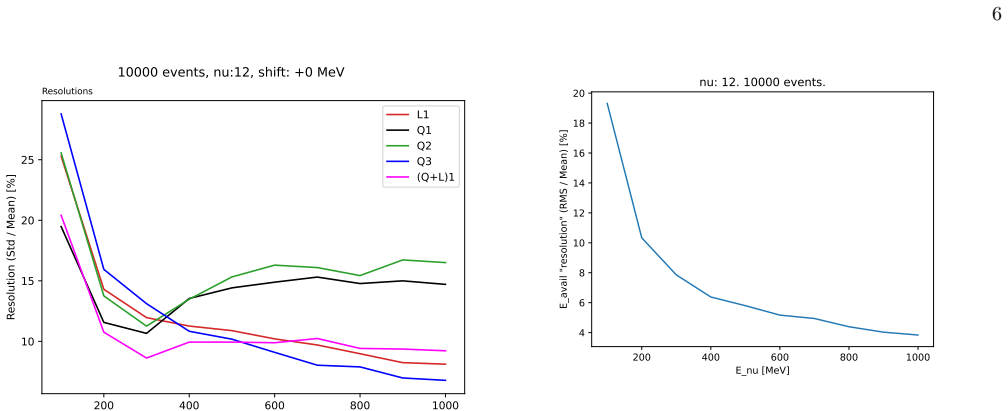
Traditional charge-based calorimetry is fundamentally limited at sub-GeV scales by recombination fluctuations and missing hadronic energy. Energy reconstruction using scintillation light partially benefits from the self-compensating light effect, and at neutrino energies above 400 MeV the light-only reconstruction outperforms charge-only methods that can separate EM and hadronic objects. Using the energy-deposit information from both detector signals achieves 70% efficiency in separating electron neutrinos and antineutrinos. By using a proximity-based algorithm coupled with a geometric lepton-exclusion cone, neutron-induced energy depositions can be isolated from background, enabling an ant
What carries the argument
The self-compensating light effect together with a proximity-based neutron isolation algorithm coupled to a geometric lepton-exclusion cone.
If this is right
- Light-only reconstruction outperforms charge-only above 400 MeV while remaining comparable below 300 MeV.
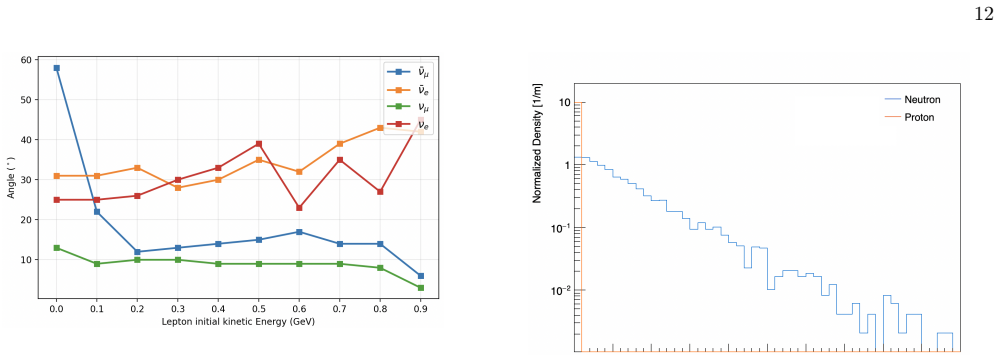
- Neutron isolation via proximity and exclusion cone sharpens antineutrino direction resolution by about 20 degrees.
- Combined signals make neutrino-antineutrino separation feasible at sub-GeV energies.
- The approach extends the physics capabilities of LArTPC atmospheric neutrino analyses.
Where Pith is reading between the lines
- These reconstruction methods could be validated directly on existing LArTPC datasets to check real-world performance.
- If the gains hold, they may improve sensitivity to low-energy oscillation parameters or atmospheric neutrino flux measurements.
- The neutron isolation technique might extend to other interaction channels or detector technologies where neutral particles produce localized deposits.
Load-bearing premise
The self-compensating light effect and the proximity-based neutron isolation algorithm with lepton-exclusion cone will translate from simulation to real detector data without significant degradation from unmodeled effects such as impurities or field non-uniformities.
What would settle it
Applying the combined-signal separation and neutron-isolation methods to real LArTPC data and measuring a neutrino-antineutrino separation efficiency well below 70% or direction improvement much less than 20 degrees would falsify the performance claims.
Figures






read the original abstract
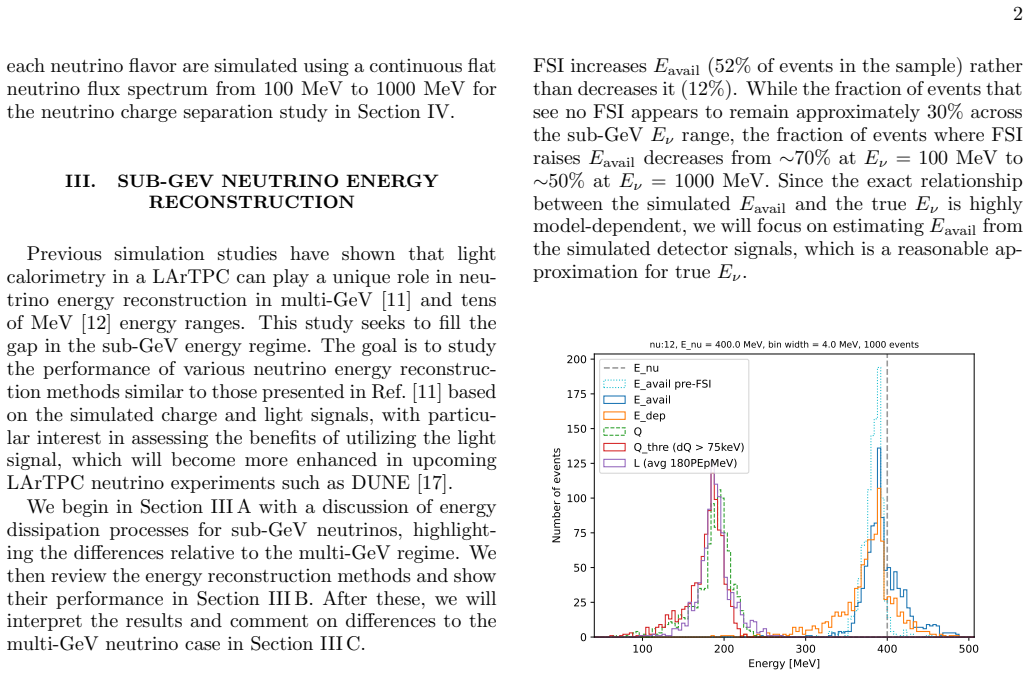
This paper presents a comprehensive study of the reconstruction of sub-GeV neutrino charged-current interactions within a Liquid Argon Time Projection Chamber (LArTPC). We demonstrate that traditional charge-based calorimetry is fundamentally limited at sub-GeV scales by significant recombination fluctuations and missing hadronic energy. We show that energy reconstruction using energy deposited as scintillation light (L) partially benefits from the previously reported self-compensating light effect. At neutrino energies above 400 MeV, the light-only reconstruction still outperforms charge-only methods that can separate EM and hadronic objects. The performance of the two remains comparable below 300 MeV. Using the energy-deposit information from both detector signals, we demonstrate a 70% efficiency in separating electron neutrinos and antineutrinos. By using a proximity-based algorithm coupled with a geometric lepton-exclusion cone, we also demonstrate the ability to isolate neutron-induced energy depositions from background. This enables an improvement of sub-GeV direction reconstruction by about 20 degrees for antineutrinos. This study provides new insights into how to enhance the physics reach of future LArTPC atmospheric neutrino analyses.
Editorial analysis
A structured set of objections, weighed in public.
Referee Report
Summary. This paper presents a simulation-based study of sub-GeV neutrino charged-current interactions in LArTPCs. It argues that charge-based calorimetry is limited by recombination fluctuations and missing hadronic energy, that scintillation light reconstruction benefits from a self-compensating effect and outperforms charge-only methods above 400 MeV, and that combined charge+light information yields 70% efficiency for separating electron neutrinos from antineutrinos. A proximity-based neutron isolation algorithm using a lepton-exclusion cone is shown to improve sub-GeV direction reconstruction by ~20° for antineutrinos, with the goal of enhancing future atmospheric neutrino analyses.
Significance. If the reported simulation improvements prove robust, the combined calorimetry and neutron-tagging techniques could meaningfully advance energy and angular resolution for low-energy neutrinos in LArTPCs, thereby increasing the reach of oscillation and atmospheric neutrino measurements in experiments such as DUNE.
major comments (2)
- [Abstract] Abstract: The headline quantitative claims (70% νe/ν̄e separation efficiency and ~20° direction improvement) are stated without error bars, baseline comparisons to standard reconstruction, Monte Carlo details, or selection criteria, preventing assessment of whether the enhancements are statistically significant or method-dependent.
- [Neutron isolation algorithm] Neutron isolation algorithm: The proximity-based tagging with lepton-exclusion cone depends on tunable parameters (cone angle and proximity threshold) whose optimization is not shown to be stable against unmodeled LArTPC effects such as impurities, space-charge distortions, or field non-uniformities; because the central claim is an enhancement applicable to real data analyses, this omission is load-bearing.
minor comments (1)
- [Abstract] The abstract refers to the 'previously reported self-compensating light effect' without providing a citation to the original literature.
Simulated Author's Rebuttal
We thank the referee for the careful and constructive review of our manuscript. The comments highlight important areas for improving clarity and robustness, and we address each major point below with plans for revision.
read point-by-point responses
-
Referee: [Abstract] Abstract: The headline quantitative claims (70% νe/ν̄e separation efficiency and ~20° direction improvement) are stated without error bars, baseline comparisons to standard reconstruction, Monte Carlo details, or selection criteria, preventing assessment of whether the enhancements are statistically significant or method-dependent.
Authors: We agree that the abstract would benefit from greater context to support the quantitative claims. In the revised manuscript, we will update the abstract to report statistical uncertainties on the 70% νe/ν̄e separation efficiency and the ~20° direction improvement, include brief descriptions of the Monte Carlo simulation details (e.g., event generator and sample size), outline the key selection criteria, and add explicit comparisons to standard charge-only reconstruction baselines. These changes will enable readers to better evaluate statistical significance and method dependence. revision: yes
-
Referee: [Neutron isolation algorithm] Neutron isolation algorithm: The proximity-based tagging with lepton-exclusion cone depends on tunable parameters (cone angle and proximity threshold) whose optimization is not shown to be stable against unmodeled LArTPC effects such as impurities, space-charge distortions, or field non-uniformities; because the central claim is an enhancement applicable to real data analyses, this omission is load-bearing.
Authors: The parameters of the proximity-based neutron isolation algorithm, including the lepton-exclusion cone angle and proximity threshold, were optimized within our idealized simulation framework to achieve the reported improvement in direction reconstruction. In the revised manuscript, we will add a dedicated subsection detailing the optimization procedure and demonstrating the stability of the ~20° improvement against reasonable variations in these parameters. Our study is performed in simulation without full modeling of real LArTPC effects such as impurities, space-charge distortions, or field non-uniformities; we will explicitly note this as a limitation of the current work and identify a more complete detector simulation incorporating these effects as a direction for future studies. This maintains the paper's focus on establishing the algorithmic potential while acknowledging the path to real-data applicability. revision: partial
Circularity Check
No significant circularity; reconstruction metrics are direct simulation outputs
full rationale
The paper evaluates distinct reconstruction algorithms (charge-only calorimetry, light-only using the self-compensating effect, combined charge+light, and proximity-based neutron isolation with lepton-exclusion cone) on Monte Carlo samples of sub-GeV neutrino interactions. Performance figures such as 70% νe/ν̄e separation efficiency and ~20° angular improvement are reported as direct results of applying these methods to simulated energy deposits, without any reduction by construction to fitted parameters, self-referential definitions, or load-bearing self-citations. The derivation chain consists of standard simulation-based comparisons that remain independent of the target metrics.
Axiom & Free-Parameter Ledger
free parameters (2)
- lepton-exclusion cone angle
- proximity threshold for neutron tagging
axioms (2)
- domain assumption Liquid argon charge and light response models including recombination fluctuations
- domain assumption Self-compensating light effect as previously reported
Reference graph
Works this paper leans on
-
[1]
Fukudaet al.(Super-Kamiokande Collaboration), Ev- idence for oscillation of atmospheric neutrinos, Phys
Y. Fukudaet al.(Super-Kamiokande Collaboration), Ev- idence for oscillation of atmospheric neutrinos, Phys. Rev. Lett.81, 1562 (1998)
1998
-
[2]
Q. R. Ahmadet al.(SNO Collaboration), Measurement of the rate ofν e+d→p+p+e − interactions produced by 8bsolar neutrinos at the sudbury neutrino observatory, Phys. Rev. Lett.87, 071301 (2001)
2001
-
[3]
Q. R. Ahmadet al.(SNO Collaboration), Direct evidence for neutrino flavor transformation from neutral-current interactions in the sudbury neutrino observatory, Phys. Rev. Lett.89, 011301 (2002)
2002
-
[4]
Ashieet al.(The Super-Kamiokande Collaboration), Evidence for an oscillatory signature in atmospheric neu- trino oscillations, Phys
Y. Ashieet al.(The Super-Kamiokande Collaboration), Evidence for an oscillatory signature in atmospheric neu- trino oscillations, Phys. Rev. Lett.93, 101801 (2004)
2004
-
[5]
Ashieet al.(Super-Kamiokande Collaboration), Mea- surement of atmospheric neutrino oscillation parameters by super-kamiokande i, Phys
Y. Ashieet al.(Super-Kamiokande Collaboration), Mea- surement of atmospheric neutrino oscillation parameters by super-kamiokande i, Phys. Rev. D71, 112005 (2005)
2005
-
[6]
Abeet al.(Super-Kamiokande Collaboration), Atmo- spheric neutrino oscillation analysis with external con- straints in super-kamiokande i-iv, Phys
K. Abeet al.(Super-Kamiokande Collaboration), Atmo- spheric neutrino oscillation analysis with external con- straints in super-kamiokande i-iv, Phys. Rev. D97, 072001 (2018)
2018
-
[7]
Westeret al.(The Super-Kamiokande Collabora- tion), Atmospheric neutrino oscillation analysis with neu- tron tagging and an expanded fiducial volume in super- kamiokande i–v, Phys
T. Westeret al.(The Super-Kamiokande Collabora- tion), Atmospheric neutrino oscillation analysis with neu- tron tagging and an expanded fiducial volume in super- kamiokande i–v, Phys. Rev. D109, 072014 (2024)
2024
-
[8]
Abeet al.(Super-Kamiokande Collaboration and T2K Collaboration), First joint oscillation analysis of super- kamiokande atmospheric and t2k accelerator neutrino data, Phys
K. Abeet al.(Super-Kamiokande Collaboration and T2K Collaboration), First joint oscillation analysis of super- kamiokande atmospheric and t2k accelerator neutrino data, Phys. Rev. Lett.134, 011801 (2025)
2025
-
[9]
K. J. Kelly, P. A. N. Machado, I. Martinez-Soler, S. J. Parke, and Y. F. Perez-Gonzalez, Sub-gev atmospheric neutrinos andcpviolation in dune, Phys. Rev. Lett.123, 081801 (2019)
2019
-
[10]
B. Abiet al.(DUNE), Deep Underground Neutrino Ex- periment (DUNE), Far Detector Technical Design Re- port, Volume II: DUNE Physics (2020), arXiv:2002.03005 [hep-ex]
-
[11]
X. Ning, W. Shi, C. Zhang, C. Riccio, and J. H. Jo, Self- compensating light calorimetry with liquid argon time projection chamber for gev neutrino physics, Phys. Rev. D111, 032007 (2025)
2025
-
[12]
W. Shi, X. Ning, D. Pershey, F. Marinho, A. Fleuri, C. Riccio, J. H. Jo, C. Zhang, and F. Cavanna, Physics prospects with mev neutrino-argon charged current inter- actions using enhanced photon detection in future lart- pcs, Phys. Rev. D112, 012019 (2025)
2025
-
[13]
S. Abbasluet al.(DUNE), Reconstruction of atmospheric neutrinos in DUNE’s horizontal-drift far-detector module 17 (2026), arXiv:2601.05697 [hep-ex]
-
[14]
Gwonet al., Neutron detection and application with a novel 3d-projection scintillator tracker in the future long- baseline neutrino oscillation experiments, Phys
S. Gwonet al., Neutron detection and application with a novel 3d-projection scintillator tracker in the future long- baseline neutrino oscillation experiments, Phys. Rev. D 107, 032012 (2023)
2023
-
[15]
M. H. Morquecho, B. Littlejohn, P. Sala, and L. Wan, Neutron Reconstruction via Blips in Liquid Argon Time Projection Chambers (2026), arXiv:2604.11774 [hep-ex]
work page internal anchor Pith review Pith/arXiv arXiv 2026
-
[16]
Dolanet al., DUNE Baseline Model and Uncertainties (2026)
S. Dolanet al., DUNE Baseline Model and Uncertainties (2026)
2026
- [17]
-
[18]
M. A. Hernandez-Morquechoet al.(LArIAT Collabora- tion), Measurements of pion and muon nuclear capture at rest on argon in the lariat experiment, Phys. Rev. Lett. 134, 131801 (2025)
2025
-
[19]
Pedregosaet al., Scikit-learn: Machine learning in Python, Journal of Machine Learning Research12, 2825 (2011)
F. Pedregosaet al., Scikit-learn: Machine learning in Python, Journal of Machine Learning Research12, 2825 (2011)
2011
-
[20]
Chang and C.-J
C.-C. Chang and C.-J. Lin, LIBSVM: A library for sup- port vector machines, ACM Transactions on Intelligent Systems and Technology2, 27:1 (2011)
2011
-
[21]
A. Friedland and S. W. Li, Understanding the energy resolution of liquid argon neutrino detectors, Phys. Rev. D99, 036009 (2019), arXiv:1811.06159 [hep-ph]
-
[22]
Abratenkoet al.(MicroBooNE), Eur
P. Abratenkoet al.(MicroBooNE), Demonstration of neutron identification in neutrino interactions in the Mi- croBooNE liquid argon time projection chamber, Eur. Phys. J. C84, 1052 (2024), arXiv:2406.10583 [hep-ex]
- [23]
- [24]
-
[25]
W. Foremanet al.(LArIAT), Calorimetry for low- energy electrons using charge and light in liquid ar- gon, Phys. Rev. D101, 012010 (2020), arXiv:1909.07920 [physics.ins-det]
-
[26]
20, 2017
Particle Data Group, Atomic and nuclear prop- erties of liquid argon (Ar), PDG Atomic and Nuclear Properties (2012),http://pdg.lbl.gov/ 2012/AtomicNuclearProperties/MUON_ELOSS_TABLES/ muonloss_289.pdf, retrieved Feb. 20, 2017
2012
-
[27]
A. Paudelet al., Modeling Light Signals Using Data from the First Pulsed Neutron Source Program at the DUNE Vertical Drift ColdBox Test Facility at CERN Neutrino Platform (2025), arXiv:2512.10790 [hep-ex]
work page internal anchor Pith review Pith/arXiv arXiv 2025
discussion (0)
Sign in with ORCID, Apple, or X to comment. Anyone can read and Pith papers without signing in.