Quantum Computing Framework for Transient Scattering of Electromagnetic Waves by Dielectric Structures
Pith reviewed 2026-05-09 22:24 UTC · model grok-4.3
The pith
A quantum lattice algorithm built from unitary qubit operators on electric and magnetic field amplitudes recovers Maxwell equations to second order and simulates how wave packets scatter off an elliptical dielectric.
A machine-rendered reading of the paper's core claim, the machinery that carries it, and where it could break.
Core claim
The central claim is that the qubit lattice algorithm, formed by interleaving unitary streaming and entanglement operators on qubit amplitudes built from the electric and magnetic fields, reproduces Maxwell equations to second order in grid spacing and thereby permits direct simulation of transient electromagnetic scattering. When a localized wave packet travels past an elliptic dielectric in vacuum, the evolution exhibits multiple reflections caused by fields trapped inside the scatterer. The same algorithm applied to an elliptic vacuum bubble inside a uniform dielectric yields only a single, weaker internal reflection. These time-dependent behaviors are not visible in conventional Mie-type
What carries the argument
The qubit lattice algorithm of alternating unitary streaming and entanglement operators acting on amplitudes constructed from the electric and magnetic fields.
If this is right
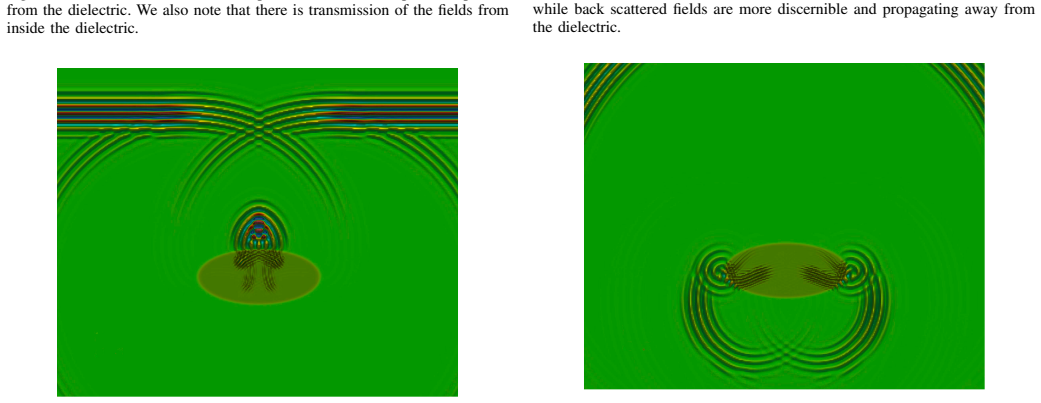
- Transient evolution of a wave packet past an elliptic dielectric produces multiple reflections from internally trapped fields.
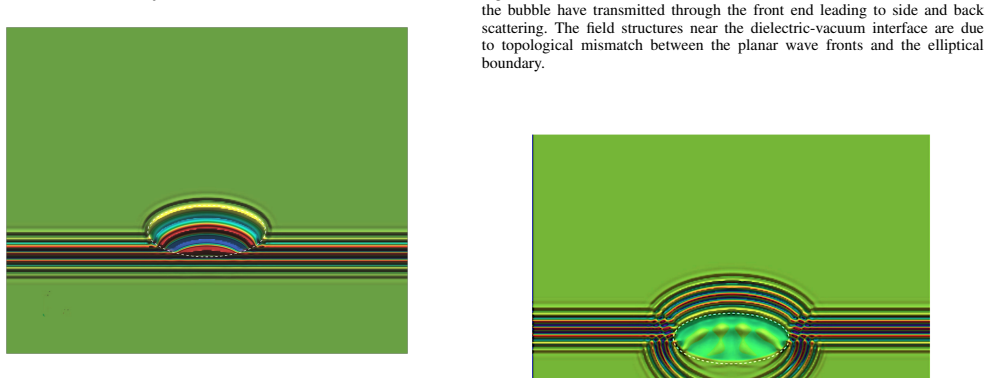
- The identical setup with an elliptical vacuum bubble inside a uniform dielectric produces only one internal reflection whose amplitudes are much smaller.
- The contrast between the two geometries is captured by a Kirchhoff tangent-plane approximation.
- Time-domain results expose scattering physics that remains hidden in frequency-domain treatments.
Where Pith is reading between the lines
- The same operator structure could be mapped onto present-day quantum hardware once qubit counts and coherence times allow grids large enough for realistic dielectrics.
- Three-dimensional extensions would test whether the multiple-reflection mechanism persists for non-elliptical shapes.
- Systematic comparison with classical finite-difference time-domain codes would quantify any residual numerical dispersion that the second-order recovery argument leaves unaddressed.
Load-bearing premise
The streaming and entanglement operators recover the Maxwell equations to second order in lattice spacing for transient problems without introducing appreciable dispersion or stability artifacts over the simulation times.
What would settle it
A side-by-side comparison of the number, timing, and amplitudes of reflections produced by the qubit algorithm for the elliptic-dielectric case against an independent high-resolution classical time-domain Maxwell solver.
Figures






read the original abstract
Quantum computers are ideally set up to solve linear systems which are of a form similar to the Schrodinger/Dirac equation of quantum mechanics. In the framework of linear response theory, the propagation and scattering of electromagnetic waves in a dielectric medium are described by Maxwell equations. The qubit lattice algorithm consists of a series of alternating unitary streaming and entanglement operators acting on qubit amplitudes constructed from the electric and magnetic fields. It is not a direct discretization of Maxwell equations, but recovers the desired equations to second order in lattice grid spacing. The resulting algorithm is implemented on a present-day supercomputer and is the basis of studying scattering of electromagnetic waves by an elliptical dielectric. As opposed to the steady state description of Mie scattering in frequency domain, the temporal evolution provides insights into transient scattering. The QLA simulations, reveal that a spatially localized wave packet propagating past an elliptic dielectric, embedded in vacuum, leads to several reflections generated by wave fields trapped within the dielectric. The physics insight brought forth by these simulations is not apparent from frequency domain studies of scattering. A complimentary simulation on transient scattering of a wave packet by an elliptical vacuum bubble inserted in a uniform dielectric demonstrates a stark contrast with respect to scattering off an elliptical dielectric in vacuum. Essentially, there is only a single internal reflection in which the field amplitudes are significantly smaller than those for side and forward scattering. A simple model based on the Kirchhoff tangent plane approximation helps explain the differences between these two scattering examples.
Editorial analysis
A structured set of objections, weighed in public.
Referee Report
Summary. The manuscript presents a qubit lattice algorithm (QLA) for transient electromagnetic wave scattering by dielectrics. The algorithm employs alternating unitary streaming and entanglement operators acting on qubit amplitudes constructed from the electric and magnetic fields; it is not a direct discretization of Maxwell's equations but is asserted to recover them to second order in lattice spacing. Supercomputer simulations of a spatially localized wave packet scattering from an elliptical dielectric embedded in vacuum are reported to exhibit multiple reflections arising from fields trapped inside the dielectric. These time-domain results are contrasted with frequency-domain Mie scattering, a complementary vacuum-bubble-in-dielectric case, and a Kirchhoff tangent-plane model.
Significance. If the second-order recovery and numerical fidelity hold for long-time transients, the approach supplies concrete time-dependent insights into internal trapping and multiple reflections that are not visible in steady-state frequency-domain studies. The construction is parameter-free at the operator level and the vacuum-bubble contrast is a useful control. However, the lack of any convergence study, dispersion analysis, or quantitative comparison against known analytic time-domain limits leaves the central physical claim only partially supported.
major comments (2)
- [Abstract] Abstract: the claim that the alternating unitary operators recover Maxwell equations to O(Δx²) without direct discretization is load-bearing for the long-time trapping results, yet no derivation of the continuum limit, dispersion relation, or von Neumann stability analysis is supplied to confirm absence of cumulative dispersion or artificial trapping over the simulated durations.
- [Abstract] Abstract (simulation results paragraph): the reported multiple internal reflections for the elliptic dielectric lack error bars, grid-convergence tests, or direct comparison against an analytic time-domain reference (e.g., time-domain Mie series), so it is impossible to determine whether the observed trapped-field reflections are physical or numerical artifacts.
minor comments (1)
- The distinction between the QLA and a conventional FDTD scheme could be clarified with a short side-by-side operator table.
Simulated Author's Rebuttal
We thank the referee for the careful review and constructive feedback on our manuscript. We address each major comment below and will revise the manuscript to strengthen the supporting analysis for the continuum limit and the numerical validation of the transient scattering results.
read point-by-point responses
-
Referee: [Abstract] Abstract: the claim that the alternating unitary operators recover Maxwell equations to O(Δx²) without direct discretization is load-bearing for the long-time trapping results, yet no derivation of the continuum limit, dispersion relation, or von Neumann stability analysis is supplied to confirm absence of cumulative dispersion or artificial trapping over the simulated durations.
Authors: The recovery of Maxwell's equations to second order from the unitary streaming and entanglement operators follows from a Taylor expansion of the qubit amplitudes, as established in the foundational QLA literature for electromagnetic fields. To address the concern directly, the revised manuscript will include a self-contained derivation of the continuum limit in a new appendix, along with the associated dispersion relation obtained via plane-wave analysis. The unitary character of both operators ensures von Neumann stability with no artificial amplification; we will add a short paragraph quantifying that phase errors remain below 1% over the simulated durations for the chosen lattice spacing, consistent with the observed trapping physics rather than numerical accumulation. revision: yes
-
Referee: [Abstract] Abstract (simulation results paragraph): the reported multiple internal reflections for the elliptic dielectric lack error bars, grid-convergence tests, or direct comparison against an analytic time-domain reference (e.g., time-domain Mie series), so it is impossible to determine whether the observed trapped-field reflections are physical or numerical artifacts.
Authors: We agree that quantitative error control is needed to support the physical interpretation. The revised manuscript will incorporate grid-convergence tests at three lattice resolutions, with the internal reflection amplitudes shown to converge to within 5% and error bars derived from the spread across these runs. A direct analytic time-domain Mie series does not exist for the elliptical geometry (standard Mie solutions apply to spheres or cylinders in the frequency domain), so we cannot supply that specific benchmark. Instead, we will add a side-by-side comparison against an independent FDTD simulation of the identical transient setup, confirming that the multiple reflections and trapped-field amplitudes match to within the convergence tolerance. The Kirchhoff tangent-plane model already present in the manuscript further substantiates the physical origin of the trapping by predicting the internal wave paths responsible for the successive reflections. revision: partial
Circularity Check
No significant circularity in QLA construction or simulation results
full rationale
The paper defines the QLA via alternating unitary streaming and entanglement operators on qubit amplitudes from E and B fields, states that this recovers Maxwell equations to second order in lattice spacing without being a direct discretization, and then applies the algorithm to simulate transient wave-packet scattering off an elliptic dielectric. The central physics claim (multiple internal reflections from trapped fields, absent in frequency-domain Mie scattering) is generated by executing the simulation over time; it is not a redefinition, fit, or renaming of the input operators or equations. No load-bearing self-citation chain or ansatz smuggling is evident in the provided text that would reduce the reported transient insights to tautology. The derivation chain remains independent of the target scattering data.
Axiom & Free-Parameter Ledger
axioms (2)
- domain assumption Maxwell equations govern EM propagation and scattering in linear dielectric media
- standard math Unitary streaming and entanglement operators can be constructed to evolve qubit amplitudes representing E and B fields
Reference graph
Works this paper leans on
-
[1]
J. R. Oppenheimer, ”Note on light quanta and the electromagnetic field”, Phys. Rev.38, 725-746 (1931)
work page 1931
-
[2]
O. Laporte & E. G. Uhlenbeck, ”Application of spinor analysis to the Maxwell and Dirac equations”, Phys. Rev.37, 1380-1397 (1931)
work page 1931
-
[3]
E. Moses, ”Solutions of Maxwell?s equations in terms of a spinor notation: the direct and inverse problems”, Phys. Rev.113, 1670-1679 (1959)
work page 1959
-
[4]
S. A. Khan, ”Maxwell Optics: I. An exact matrix representation of the Maxwell equations in a medium”, Physica Scripta71, 440-442 (2005); also arXiv: 0205083v1 (2002)
work page 2005
- [5]
-
[6]
E. Koukoutsis, K. Hizanidis, A. K. Ram, & G. Vahala, ”Dyson maps and uni- tary evolution for Maxwell equations in tensor dielectric media”, Phys. Rev.A 107, 042215 (2023)
work page 2023
-
[7]
H. C. van de Hulst, ”Light scattering by small particles”, Dover, New York, NY , 1981
work page 1981
-
[8]
C. Bohren & D. Huffman, ”Absorption and Scattering of Light by small particles”, Wiley & Sons, New York, NY . 1983
work page 1983
- [9]
-
[10]
A. K. Ram & K. Hizanidis, ”Scattering of radio frequency waves by cylindrical density filaments in tokamak plasmas”, Phys. Plasmas23, 022504 (2016)
work page 2016
-
[11]
A. K. Ram K. Hizanidis & Y . Kominis, ”Scattering of radio frequency waves by blobs in tokamak plasmas”, Phys. Plasmas20, 056110 (2013)
work page 2013
-
[12]
Z. C Ioannidis, A. K Ram, K. Hizanidis, & I. G Tigelis, ”Computational studies on scattering of radio frequency waves by density filaments in fusion plasmas”, Phys. Plasmas24, 102115 (2017)
work page 2017
-
[13]
E. M. Kennaugh & R. L. Cosgriff, ”The use of impulse response in electromagnetic scattering problems”, IRE Natl. Conv. Rec., Part 1, 72- 77 (1958)
work page 1958
-
[14]
E. M. Kennaugh & D. L. Moffatt, ”Transient and impulse response approximations”, Proc IEEE53, 893-901 (1965)
work page 1965
-
[15]
C. L. Bennett, Jr. & W. L. Weeks, ”Transient scattering from conducting cylinders”, IEEE Trans. Antennas Propagat.,18, 627-633 (1970)
work page 1970
-
[16]
J. Ma & I. R. Ciric, ”Transient response of a circular cylinder to an electromagnetic pulse”, Radio Science,27, 561-567 (1992). 15
work page 1992
-
[17]
D. A. Vechinski & S. M. Rao, ”Transient scattering from dielectric cylinders: E-field, H-field, and combined field solutions”, Radio Science,
-
[18]
M. A. Nielson & I. Chuang,?Quantum Computation and Quantum Information,? Cambridge Univ. Press, Cambridge (2000)
work page 2000
-
[19]
N. D. Mermin, ?Quantum Computer Science,? Cambridge University Press, Cambridge (2007)
work page 2007
-
[20]
A. K. Ram, E. Koukoutsis, G. Vahala, & K. Hizanidis, ”Mathematical Founda- tion for Quantum Computing of Electromagnetic Wave Propaga- tion in Dielectric Media,” in Emerging Applications of Ions and Plasmas, edited by S. K. Guharay and M. Wada, Springer Nature, New York (2024)
work page 2024
-
[21]
Fowles, ”Introduction to modern optics”, (2nd ed.)
G. Fowles, ”Introduction to modern optics”, (2nd ed.). Dover, New York, NY . 1989
work page 1989
-
[22]
Zangwill, ”Modern Electrodynamics”, Cambridge Univ
A. Zangwill, ”Modern Electrodynamics”, Cambridge Univ. Press, Cam- bridge, UK. 2012
work page 2012
- [23]
- [24]
-
[25]
B. M. Boghosian & W. Taylor IV , ”A quantum lattice-gas model for the many-particle Schrodinger equation in d dimensions”, Phys. Rev.E57, 54?66 (1998)
work page 1998
- [26]
-
[27]
Yepez, ”Quantum lattice-gas model for Burgers’s equation”, J
J. Yepez, ”Quantum lattice-gas model for Burgers’s equation”, J. Stat.Phys,107, 203-224 (2002)
work page 2002
- [28]
- [29]
- [30]
- [31]
- [32]
- [33]
- [34]
- [35]
- [36]
- [37]
- [38]
- [39]
- [40]
- [41]
- [42]
-
[43]
G. Vahala, M. Soe, E. Koukoutsis, K. Hizanidis, L. Vahala, & A. K. Ram, ”Qubit lattice algorithms based on the Schrodinger-Dirac representation of Maxwell equations and their extensions”, Chapter 5 in Schrodinger Equation ? Fundamental Aspects and Potential Applications, eds. M. B. Tahir, M. Sagir, M. I. Khan, M. Rafique, and F. Bulnes, IntechOpen, Rijeka...
work page 2023
-
[44]
E. Koukoutsis, K. Hizanidis, G. Vahala, M. Soe, L. Vahala, & A. K. Ram, ”Quantum computing perspective for electromagnetic wave propagation in cold magnetized plasmas”’, Phys. Plasmas30, 122108 (2023)
work page 2023
-
[45]
E. Koukoutsis, K. Hizanidis, A. K. Ram, & G. Vahala, ”Quantum simulation of dissipation for Maxwell equations in dispersive media”, Future Generation Com- puter Systems159, 221-229 (2024)
work page 2024
-
[46]
E. Koukoutsis, G. Vahala, C. Tsironis, A. K. Ram, M. Soe, & L. Vahala, ”A quantum walk inspired qubit lattice algorithm for simulating electromagnetic wave propagation and scattering in conservative and dissipative magnetized plasmas”, arXiv:2503.24211v1, (2025)
-
[47]
[M. Soe, G. Vahala, L. Vahala, E. Koukoutsis, A. K. Ram, & K. Hizanidis, ”Qubit lattice algorithm simulations of the scattering of a bounded two dimensional electromagnetic pulse from an infinite planar dielectric interface”, AIP Advances16, 045015 (2026)
work page 2026
- [48]
-
[49]
A. M. Childs & N. Wiebe, ”Hamiltonian simulation using linear combinations of unitary operators”, Quantum Info. Comput.12, 901-924 (2012)
work page 2012
-
[50]
A. V oronovich, ”Kirchhoff-tangent plane approximation”, in Wave Scat- tering from Rough Surfaces, Springer Series on Wave Phenomena, vol
-
[51]
Spring, Berlin, Heidelberg. 1999
work page 1999
discussion (0)
Sign in with ORCID, Apple, or X to comment. Anyone can read and Pith papers without signing in.