StarLoc: Pinpointing Transmitting LEO Satellites from a Single Passive Array
Pith reviewed 2026-05-09 22:36 UTC · model grok-4.3
The pith
StarLoc locates transmitting LEO satellites in three dimensions using three antennas arranged in a flat plane by exploiting orbital dynamics.
A machine-rendered reading of the paper's core claim, the machinery that carries it, and where it could break.
Core claim
StarLoc is a system that combines orbital modeling with interferometric angle-of-arrival estimation to geolocate transmitting satellites in low Earth orbits. The design rests on the observation that satellite motion follows orbital dynamics and therefore traces a two-dimensional manifold inside three-dimensional space. This constraint lowers the degrees of freedom so that three antennas lying in a single plane can recover the full three-dimensional location and track the satellite. Evaluation on signals from eighty-one Starlink satellites shows that the system achieves angular accuracy of 0.7 degrees and range accuracy of 5 kilometers.
What carries the argument
The orbital-dynamics constraint that confines satellite motion to a 2D manifold in 3D space, which allows three planar antennas to solve for full 3D position via interferometric angle-of-arrival.
If this is right
- A passive ground station can track and identify individual LEO satellites without active cooperation from the satellites.
- Spectrum regulators gain a practical tool to attribute specific transmissions to particular satellites.
- Navigation and positioning services obtain an independent ground-based method that can verify or supplement GPS data in orbit.
- Hardware cost and complexity drop because a small flat array replaces the need for a full three-dimensional antenna configuration.
Where Pith is reading between the lines
- The same manifold-reduction principle could apply to other objects whose paths follow predictable geometric constraints, such as certain aircraft routes.
- Networks of these low-cost arrays might provide scalable monitoring coverage as the number of LEO satellites grows.
- Feeding the derived range estimates back into orbital models could iteratively improve long-term position predictions.
Load-bearing premise
Satellite motion is governed by orbital dynamics and therefore lies on a two-dimensional surface inside three-dimensional space.
What would settle it
Collecting simultaneous angle measurements from three antennas during known Starlink satellite passes and finding that the reconstructed positions fall outside the predicted orbital manifold or exceed 0.7 degrees angular error and 5 km range error.
Figures


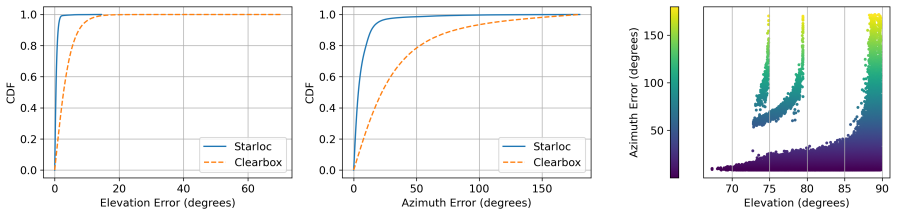
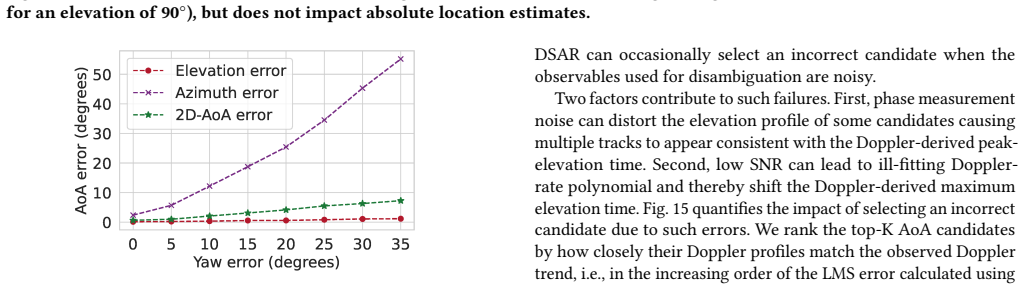
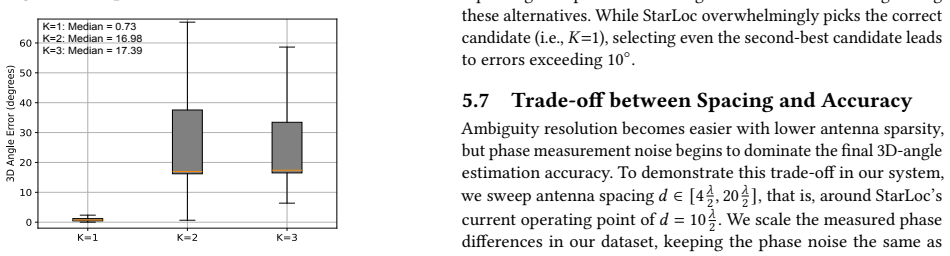

read the original abstract
This paper focuses on 3D localization of transmitting satellites in low Earth orbits (LEO). 3D localization of transmitters in low orbits is an important emerging problem for many applications such as spectrum management, orbit determination, and backup for GPS failures in orbit. We present StarLoc -- a system to geolocate transmitters in space using a combination of orbital modeling and a new interferometric 3D angle-of-arrival estimation technique. StarLoc's design relies on a unique insight -- the motion of satellites is governed by orbital dynamics and is therefore along a 2D manifold in a 3D space. This reduces the degrees of freedom in satellite motion and allows us to 3D-locate and track a satellite with just three antennas in a 2D plane. We evaluate the system using signal transmissions from 81 Starlink satellites. Our results show that StarLoc can estimate the 3D-angle of a satellite within 0.7 degrees and the orbital range within 5 km. Our dataset and implementation are available at: https://connectedsystemslab.github.io/starloc.
Editorial analysis
A structured set of objections, weighed in public.
Referee Report
Summary. The paper presents StarLoc, a passive 3D localization system for transmitting LEO satellites (e.g., Starlink) that uses a single planar array of three antennas. It combines interferometric angle-of-arrival (AoA) estimation over time with orbital dynamics modeling, exploiting the fact that satellite trajectories lie on a 2D manifold in 3D space to reduce degrees of freedom and recover full position from planar measurements. Evaluation on 81 real Starlink transmissions reports 0.7° accuracy in 3D angle and 5 km accuracy in orbital range, with code and data released.
Significance. If the central results hold, StarLoc demonstrates a hardware-minimal approach to passive satellite geolocation that could support spectrum management, orbit determination, and GPS augmentation. The real-world evaluation on actual Starlink signals supplies external grounding that strengthens the claims relative to simulation-only studies; the orbital-manifold reduction is a clean insight if shown to be robust.
major comments (2)
- [Evaluation and orbital-fitting sections] The headline accuracies (0.7° 3D-angle, 5 km range) rest on the orbital-manifold constraint supplying the missing degree of freedom for range and out-of-plane elements. The manuscript does not include a sensitivity analysis or condition-number study of the fitting procedure with respect to observation length or geometry (e.g., near-zenith passes), leaving open whether angular-rate diversity is always sufficient to avoid degeneracy.
- [Results and evaluation] No explicit error propagation, exclusion criteria for the 81 passes, or breakdown by pass duration/geometry is provided to support the reported performance numbers. This makes it difficult to verify that the 5 km range figure is not driven by a subset of favorable trajectories.
minor comments (2)
- [System design] Clarify the exact antenna spacing, carrier frequency, and sampling parameters used for the interferometric AoA measurements.
- [Abstract and reproducibility statement] The dataset release link should indicate whether raw I/Q captures or only derived AoA time series are included to support independent reproduction.
Simulated Author's Rebuttal
We thank the referee for the constructive comments on our manuscript. The suggestions will help strengthen the evaluation and clarify the robustness of our results. We address each major comment below and commit to revisions that incorporate the requested analyses and details.
read point-by-point responses
-
Referee: The headline accuracies (0.7° 3D-angle, 5 km range) rest on the orbital-manifold constraint supplying the missing degree of freedom for range and out-of-plane elements. The manuscript does not include a sensitivity analysis or condition-number study of the fitting procedure with respect to observation length or geometry (e.g., near-zenith passes), leaving open whether angular-rate diversity is always sufficient to avoid degeneracy.
Authors: We agree that a sensitivity analysis of the orbital fitting procedure is valuable for demonstrating robustness. In the revised manuscript, we will add a dedicated subsection in the evaluation that includes a condition-number study of the manifold-constrained solver. This analysis will vary observation length, pass geometry (including near-zenith cases), and quantify the angular-rate diversity provided by the 2D orbital manifold. We will show that degeneracy is avoided for the trajectory durations and geometries present in our 81-pass dataset, thereby supporting that the reported accuracies are not artifacts of the constraint alone. revision: yes
-
Referee: No explicit error propagation, exclusion criteria for the 81 passes, or breakdown by pass duration/geometry is provided to support the reported performance numbers. This makes it difficult to verify that the 5 km range figure is not driven by a subset of favorable trajectories.
Authors: We acknowledge the need for greater transparency in the results section. We will expand the evaluation to include: (1) an explicit error-propagation derivation for both the 3D angle and range estimates under the manifold model; (2) the precise exclusion criteria applied to the 81 Starlink passes (e.g., minimum duration, SNR thresholds, and data-quality filters); and (3) a breakdown of localization errors stratified by pass duration and geometry (elevation angle, azimuth diversity). These additions will allow readers to confirm that the 5 km range accuracy is representative across the dataset rather than driven by a favorable subset. revision: yes
Circularity Check
No circularity: physical orbital constraint and real-data evaluation are independent
full rationale
The paper's core derivation uses the external physical fact that LEO satellite motion is constrained to a 2D manifold by orbital dynamics (an established prior, not derived from measurements or self-citation). This reduces DOF to enable 3D localization from a planar 3-antenna array via interferometry plus orbital fitting. Performance claims (0.7° angle, 5 km range) come from direct evaluation on 81 real Starlink transmissions, supplying external grounding. No self-definitional loops, fitted inputs renamed as predictions, load-bearing self-citations, uniqueness theorems imported from authors, or ansatzes smuggled via prior work are present in the abstract or described chain. The result does not reduce to its inputs by construction.
Axiom & Free-Parameter Ledger
axioms (1)
- domain assumption Satellite motion is governed by orbital dynamics and therefore lies along a 2D manifold in 3D space.
Reference graph
Works this paper leans on
-
[1]
https://celestrak.org/ Accessed March 2026
Celestrak. https://celestrak.org/ Accessed March 2026
work page 2026
-
[2]
https://celestrak .org/NORAD/elements/supplemental/ Accessed March 2026
Supplemental GPEs. https://celestrak .org/NORAD/elements/supplemental/ Accessed March 2026
work page 2026
-
[3]
Technical Report NASA/SP-20230002470 (Rev
2023.NASA Spacecraft Conjunction Assessment and Collision A voidance Best Practices Handbook. Technical Report NASA/SP-20230002470 (Rev. 1). National Aeronautics and Space Administration. https://nodis3 .gsfc.nasa.gov/OCE_docs/ OCE_51.pdf
work page 2023
-
[4]
Akram Al-Hourani. 2024. In-orbit space situational awareness using doppler frequency shift.IEEE Trans. Aerospace Electron. Systems60, 5 (2024), 7542–7547
work page 2024
-
[5]
I. Ali, N. Al-Dhahir, and J.E. Hershey. 1998. Doppler characterization for LEO satellites.IEEE Transactions on Communications46, 3 (1998), 309–313. https: //doi.org/10.1109/26.662636
-
[6]
Philip Arnold, Jochen Moll, and Viktor Krozer. 2017. Design of a sparse antenna array for radar-based structural health monitoring of wind turbine blades.IET Radar, Sonar & Navigation11, 8 (2017), 1259–1265
work page 2017
-
[7]
Aditya Arun, Shunsuke Saruwatari, Sureel Shah, and Dinesh Bharadia. 2023. XRLoc: Accurate UWB localization to realize XR deployments. InProceedings of the 21st ACM Conference on Embedded Networked Sensor Systems. 459–473
work page 2023
-
[8]
2015.Antenna theory: analysis and design
Constantine A Balanis. 2015.Antenna theory: analysis and design. John wiley & sons
work page 2015
-
[9]
Yifeng Cao, Ashutosh Dhekne, and Mostafa Ammar. 2021. ITrackU: Tracking a pen-like instrument via UWB-IMU fusion. InProceedings of the 19th Annual International Conference on Mobile Systems, Applications, and Services. 453–466
work page 2021
-
[10]
Starlink breaks space traffic safety rules and China may follow: study
Stephen Chen. 2022. “Starlink breaks space traffic safety rules and China may follow: study”.South China Morning Post(29 nov 2022). https://www.scmp.com/news/china/science/article/3201365/starlink-breaks- space-traffic-safety-rules-and-china-may-follow-study
-
[11]
Vincent Cruz. 2023. LEO, MEO & GEO Satellite Systems: A Comparison. (2023). https://durofy.com/leo-meo-geo-satellite-systems/ Accessed: 2024-12-10
work page 2023
-
[12]
Epsilon3. 2025. Products. (2025). https://www.epsilon3.io/products
work page 2025
-
[13]
European Space Policy Institute. 2023. ESPI Space Spectrum Policy Report, Version 5. https://www .espi.or.at/wp-content/uploads/2023/10/ESPI-Space- Spectrum-Policy-Report_v5.pdf (Oct. 2023)
work page 2023
-
[14]
Tim Flohrer, Holger Krag, and Heiner Klinkrad. 2008. Assessment and catego- rization of TLE orbit errors for the US SSN catalogue.risk8, 9 (2008), 10–11
work page 2008
- [15]
-
[16]
Benjamin Fuchs. 2012. Synthesis of sparse arrays with focused or shaped beam- pattern via sequential convex optimizations.IEEE Transactions on Antennas and Propagation60, 7 (2012), 3499–3503. 12
work page 2012
-
[17]
Vic Gardner and Andre Candido. 2023. Coverage of the Southern Hemisphere is critical for Space Domain Awareness. Here’s why. (2023). https://leolabs.space/ article/southern-hemisphere-coverage/ Accessed: 2024-12-10
work page 2023
-
[18]
Feng Ge and Yuan Shen. 2021. Single-anchor ultra-wideband localization system using wrapped PDoA.IEEE Transactions on Mobile Computing21, 12 (2021), 4609–4623
work page 2021
-
[19]
Jean-Francois Guimond, Simon Henault, and Kathia Levis. 2022. One-way Doppler and interferometry: Space domain awareness. In2022 16th European Conference on Antennas and Propagation (EuCAP). IEEE, 1–5
work page 2022
-
[20]
Anant Gupta, Upamanyu Madhow, Amin Arbabian, and Ali Sadri. 2019. Design of large effective apertures for millimeter wave systems using a sparse array of subarrays.IEEE Transactions on Signal Processing67, 24 (2019), 6483–6497
work page 2019
-
[21]
Joseph A Haimerl and Gregory P Fonder. 2015. Space fence system overview. InProceedings of the Advanced Maui Optical and Space Surveillance Technology Conference. Curran Associates, Inc, 1–3
work page 2015
-
[22]
B Hazra, AJ Roffel, S Narasimhan, and MD Pandey. 2010. Modified cross- correlation method for the blind identification of structures.Journal of En- gineering Mechanics136, 7 (2010), 889–897
work page 2010
-
[23]
Steven Siying Hong and Sachin Rajsekhar Katti. 2011. DOF: a local wireless information plane. InProceedings of the ACM SIGCOMM 2011 Conference. 230– 241
work page 2011
-
[24]
Todd E. Humphreys, Peter A. Iannucci, Zacharias M. Komodromos, and An- drew M. Graff. 2023. Signal Structure of the Starlink Ku-Band Downlink. IEEE Trans. Aerospace Electron. Systems(2023), 1–16. https://doi .org/10.1109/ TAES.2023.3268610
-
[25]
Mohd Noor Islam, Tim Spitzer, Jeremy Hallett, and Md Asikuzzaman. 2020. Doppler estimation for passive RF sensing method in space domain awareness. In2020 Military Communications and Information Systems Conference (MilCIS). IEEE, 1–4
work page 2020
-
[26]
Mohd Noor Islam, Thomas Q Wang, Samuel Wade, Travis Bessell, Tim Spitzer, and Jeremy Hallett. 2021. Doppler and angle of arrival estimation from digitally modulated satellite signals in passive RF space domain awareness. InAdvanced Maui Optical and Space Surveillance Technologies Conference
work page 2021
-
[27]
N. Jardak and Ronan Adam. 2023. Practical Use of Starlink Downlink Tones for Positioning.Sensors (Basel, Switzerland)23 (2023), null. https://doi .org/10.3390/ s23063234
work page 2023
-
[28]
Kiran Joshi, Steven Hong, and Sachin Katti. 2013. {PinPoint}: Localizing In- terfering Radios. In10th USENIX Symposium on Networked Systems Design and Implementation (NSDI 13). 241–253
work page 2013
-
[29]
T. S. Kelso. 2025. Space Surveillance. (27 Jan 2025). https://celestrak.org/columns/ v04n01/
work page 2025
-
[30]
Nadim Khairallah and Zaher M Kassas. 2021. Ephemeris closed-loop tracking of LEO satellites with pseudorange and Doppler measurements. InProceedings of the 34th international technical meeting of the satellite division of the Institute of Navigation (ION GNSS+ 2021). 2544–2555
work page 2021
-
[31]
Nadim Khairallah and Zaher M Kassas. 2023. Ephemeris tracking and error prop- agation analysis of LEO satellites with application to opportunistic navigation. IEEE Trans. Aerospace Electron. Systems60, 2 (2023), 1242–1259
work page 2023
-
[32]
Sharbel Kozhaya, Haitham Kanj, and Zaher M. Kassas. 2023. Multi-Constellation Blind Beacon Estimation, Doppler Tracking, and Opportunistic Positioning with OneWeb, Starlink, Iridium NEXT, and Orbcomm LEO Satellites. In2023 IEEE/ION Position, Location and Navigation Symposium (PLANS). IEEE, Monterey, CA, USA, 1184–1195. https://doi.org/10.1109/PLANS53410.2...
-
[33]
Kratos Defense & Security Solutions. 2025. Tracking & Maneuver — Space Domain Awareness. (2025). https://www .kratosspace.com/defense-and- government/space-domain-awareness/tracking-and-maneuver
work page 2025
-
[34]
LeoLabs. 2023. LeoLabs Expands Southern Hemisphere Coverage. (2023). https: //leolabs.space/article/southern-hemisphere-coverage/
work page 2023
-
[35]
Yi Li, Hanying Zhao, Yiman Liu, Tianyu Wang, Jincheng Yu, and Yuan Shen
-
[36]
In 2024 IEEE/RSJ International Conference on Intelligent Robots and Systems (IROS)
High-Accuracy 2-D AoA Estimation Using Lightweight UWB Arrays. In 2024 IEEE/RSJ International Conference on Intelligent Robots and Systems (IROS). IEEE, 3312–3317
work page 2024
-
[37]
Wei Liu, Yuanjie Li, Jingyi Lan, Hewu Li, Yimei Chen, Lixin Liu, Jiabo Yang, Xi Long, Li Ouyang, Minghao Tang, et al . 2025. Direct-to-Cell Satellite Net- work without Satellite Navigation. InProceedings of the ACM SIGCOMM 2025 Conference. 932–947
work page 2025
-
[38]
Mini-Circuits. 2024. RC-4SPDT-A18 Absorptive SPDT, Mechanical Switch, DC - 18000 MHz, 50Ω. https://www .minicircuits.com/WebStore/ dashboard.html?model=RC-4SPDT-A18 (2024)
work page 2024
-
[39]
Mini-Circuits. 2024. ZN4PD-4R722+ 4 Ways DC Pass Power Splitter, 400 - 7200 MHz, 50Ω. https://www .minicircuits.com/WebStore/dashboard.html?model= ZN4PD-4R722%2B (2024)
work page 2024
-
[40]
Movella. 2024. Xsens MTi-670 GNSS/INS. https://www .movella.com/products/ sensor-modules/xsens-mti-670-gnss-ins (2024)
work page 2024
-
[41]
NASA Earth Observatory. 2024. Catalog of Earth Satellite Orbits. (2024). https: //earthobservatory.nasa.gov/features/OrbitsCatalog Accessed: 2024-12-04
work page 2024
-
[42]
Mengguan Pan, Jinlong Hu, Jinhong Yuan, Jianfeng Liu, and Yongtao Su. 2020. An efficient blind Doppler shift estimation and compensation method for LEO satellite communications. In2020 IEEE 20th International Conference on Commu- nication Technology (ICCT). IEEE, 643–648
work page 2020
-
[43]
Pasternack. 2024. WR-75 Waveguide Antenna, 10-15 GHz Frequency Range, 15 dBi Gain. https://www .pasternack.com/wr-75-waveguide-gain-horn-antenna- 15db-square-flange-pewan075-15-p.aspx (2024)
work page 2024
-
[44]
Jason Rainbow. 2024. Connecting the Dots | Incoming illegal NGSO service crackdown. https://spacenews.com/connecting-the-dots-incoming-illegal-ngso- service-crackdown/ (2024)
work page 2024
-
[45]
Ettus Research. 2024. OctoClock CDA-2990. https://ettus .com/all-products/ octoclock/ (2024)
work page 2024
-
[46]
Ettus Research. 2024. UBX 10-6000 MHz Rx/Tx (160 MHz, X Series only). https: //ettus.com/all-products/ubx160/ (2024)
work page 2024
-
[47]
Ettus Research. 2024. USRP N210. https://www .ettus.com/all-products/un210- kit/ (2024)
work page 2024
-
[48]
Ettus Research. 2024. USRP X310. https://www .ettus.com/all-products/x310-kit/ (2024)
work page 2024
-
[49]
Orbital Research. 2024. 5400X Off-the-Shelf External Reference Ku-Band LNB. https://orbitalresearch .net/product/ku-band-lnb-external-reference-off- the-shelf/ (2024)
work page 2024
-
[50]
Orbital Research. 2024. Orbital Research “Mux Tee” (MT-25/40). https:// orbitalresearch.net/product/orbital-mt2540-mux-tee/ (2024)
work page 2024
-
[51]
David Richmond and Katrina Raichle. 2018. Doppler curves in satellite track- ing and characterization. InThe Advanced Maui Optical and Space Surveillance Technologies Conference. 58
work page 2018
-
[52]
Hossein Rouzegar, Mehrzad Nasirian, and Mohammad Ghanbarisabagh. 2017. Novel algorithm for tracking LEO satellites using doppler frequency shift tech- nique.Wireless Personal Communications96, 2 (2017), 2161–2178
work page 2017
-
[53]
Satellite Wiki, IIT Bombay. 2018. Beacon. (2018). https://www .aero.iitb.ac.in/ satelliteWiki/index.php/Beacon
work page 2018
-
[54]
SatNOGS DB. 2025. FOSSASAT-2. (2025). https://db.satnogs.org/satellite/TMYM- 1828-3150-9512-1217
work page 2025
-
[55]
Vaibhav Singh, Tusher Chakraborty, Suraj Jog, Om Chabra, Deepak Vasisht, and Ranveer Chandra. 2024. Spectrumize: spectrum-efficient satellite networks for the internet of things. In21st USENIX Symposium on Networked Systems Design and Implementation (NSDI 24). 825–840
work page 2024
-
[56]
SpaceX. 2025. Satellite Operators. https://starlink .com/satellite-operators (2025). Accessed: 2025-11-26
work page 2025
-
[57]
R. Sridharan and Antonio F. Pensa. 1998. U.S. Space Surveillance Network capabilities.Proceedings of SPIE3434 (1998), 1–12. https://doi .org/10.1117/ 12.331225
work page 1998
-
[58]
Orbit Communication Systems. 2025. Orbit Communication Systems. (2025). https://orbit-cs.com/
work page 2025
-
[59]
David Vallado, Paul Crawford, Ricahrd Hujsak, and TS Kelso. 2006. Revisiting spacetrack report# 3. InAIAA/AAS Astrodynamics Specialist Conference and Exhibit. 6753
work page 2006
-
[60]
Jue Wang, Deepak Vasisht, and Dina Katabi. 2014. RF-IDraw: virtual touch screen in the air using RF signals. InProceedings of the 2014 ACM conference on SIGCOMM. Chicago Illinois USA, 235–246. https://doi.org/10.1145/2619239.2626330
-
[61]
Bo-Heng Yeh, Jen-Ming Wu, and Ronald Y Chang. 2024. Efficient doppler com- pensation for LEO satellite downlink OFDMA systems.IEEE Transactions on Vehicular Technology(2024)
work page 2024
-
[62]
Xiaodong Zhuge and Alexander G Yarovoy. 2012. Study on two-dimensional sparse MIMO UWB arrays for high resolution near-field imaging.IEEE transac- tions on antennas and propagation60, 9 (2012), 4173–4182. A Deriving the 2D Angle of Arrival The 2D angle of arrival can also be calculated using the phase dif- ferences received by three antennas, with the cal...
work page 2012
discussion (0)
Sign in with ORCID, Apple, or X to comment. Anyone can read and Pith papers without signing in.