Ultra-low-noise supercontinuum in normal-dispersion ZBLAN fibres pumped at 1.85 μm
Pith reviewed 2026-05-09 21:27 UTC · model grok-4.3
The pith
Normal-dispersion ZBLAN fibres generate supercontinuum spanning 650 nm with relative intensity noise as low as 0.22 percent.
A machine-rendered reading of the paper's core claim, the machinery that carries it, and where it could break.
Core claim
The central claim is that normal-dispersion PM ZBLAN fibres pumped by femtosecond pulses from an all-PM thulium amplifier yield ultra-low-noise supercontinuum for the first time, with the smaller-core fibre (6.7 × 2.7 μm) spanning 1.537-2.196 μm at 0.22 percent minimum RIN and the larger-core fibre (8.9 × 4.1 μm) spanning 1.507-2.250 μm at 0.36 percent minimum RIN.
What carries the argument
The key machinery is the normal-dispersion elliptical-core PM ZBLAN fibre combined with an all-PM thulium chirped-pulse amplifier that delivers 58 fs pulses at 1.85 μm and 210 mW average power at 40 MHz, seeded by a portion of an ultra-low-noise ANDi SC for precise control.
If this is right
- The demonstrated RIN levels establish that normal-dispersion PM fluoride fibres can maintain ultra-low noise under femtosecond pumping.
- The all-PM thulium amplifier architecture provides an alignment-free pump source that preserves seed stability into the fibre.
- The measured spectra and noise values confirm a practical path to scale the same approach to longer mid-infrared wavelengths.
- Applications needing stable broadband sources near 2 μm gain a fibre-based alternative without active noise reduction.
Where Pith is reading between the lines
- The same normal-dispersion PM fibre strategy could be tested in other fluoride glass compositions to push the long-wavelength edge further.
- Low-noise output in the normal-dispersion regime may simplify mid-infrared spectroscopy setups that currently rely on separate noise-suppression stages.
- The reported dispersion cut-offs of 3.77 μm and 3.25 μm set quantitative targets for designing next-generation fibres that keep the entire SC band normal.
Load-bearing premise
The experimentally measured normal dispersion profiles remain accurate over the entire generated spectrum and the all-PM amplifier plus seed control fully suppress all noise sources without hidden instabilities.
What would settle it
Detection of relative intensity noise above 1 percent across the supercontinuum band or direct measurement showing anomalous dispersion in any part of the 1.5-2.25 μm range would falsify the low-noise normal-dispersion claim.
Figures
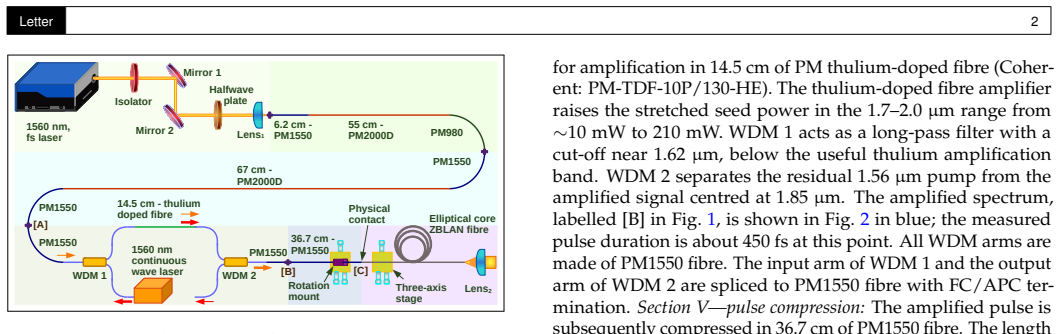


read the original abstract
We demonstrate, for the first time to our knowledge, ultra-low-noise supercontinuum (SC) generation in normal-dispersion fluoride fibres pumped by femtosecond (fs) pulses. We have investigated two elliptical-core polarisation-maintaining (PM) ZBLAN fibres with core dimensions 6.7$\times$2.7 $\mu$m and 8.9$\times$4.1 $\mu$m, experimentally measured to have normal dispersion up to 3.77 $\mu$m and 3.25 $\mu$m, respectively; the smaller-core fibre yields ultra-low-noise SC spanning 1.537-2.196 $\mu$m with a minimum relative-intensity noise (RIN) of 0.22% at 1.7 $\mu$m, and the larger-core fibre yields 1.507-2.250 $\mu$m with 0.36% at 2.0 $\mu$m. To aid the generation of low-noise SC, we developed an all-PM thulium chirped-pulse amplifier delivering 58 fs pulses at 1.85 $\mu$m, 210 mW average power at 40 MHz, with 0.41% RIN, seeded by a part of an ultra-low-noise SC using a 1.55 $\mu$m fs laser and an all-normal-dispersion (ANDi) silica fibre for precise seed control. These results establish a robust, alignment-free pathway to extend ultra-low-noise ANDi-fibre SC towards the mid-infrared using PM fluoride fibres.
Editorial analysis
A structured set of objections, weighed in public.
Referee Report
Summary. The paper reports the first demonstration of ultra-low-noise supercontinuum generation in normal-dispersion elliptical-core polarization-maintaining ZBLAN fibers pumped at 1.85 μm by 58 fs pulses from an all-PM thulium chirped-pulse amplifier. Two fibers (core dimensions 6.7×2.7 μm and 8.9×4.1 μm) were experimentally characterized to exhibit normal dispersion up to 3.77 μm and 3.25 μm, respectively, yielding SC spectra spanning 1.537–2.196 μm (min RIN 0.22% at 1.7 μm) and 1.507–2.250 μm (min RIN 0.36% at 2.0 μm), with pump RIN of 0.41%. The amplifier is seeded from an ultra-low-noise ANDi SC generated in silica fiber for precise control.
Significance. If the measured dispersion profiles and RIN values hold under the reported conditions, this establishes a practical, alignment-free route to extend low-noise all-normal-dispersion supercontinuum sources into the mid-infrared using PM fluoride fibers. The experimental verification of normal dispersion well beyond the SC bandwidth and the use of an all-PM pump chain are strengths that support robustness for applications such as spectroscopy and sensing.
major comments (2)
- [Experimental characterization of fibers] The dispersion measurement procedure, including the technique used, wavelength range details, and any error bars or uncertainty quantification on the dispersion curves, is not described with sufficient specificity to confirm that the normal-dispersion regime is maintained across the full generated SC bandwidth without local anomalous regions.
- [Noise characterization and results] The RIN measurements lack reported error analysis, integration bandwidth, number of averages, or comparison to a reference detector noise floor; without these, it is difficult to assess whether the reported minima of 0.22% and 0.36% (versus pump 0.41%) robustly demonstrate suppression of noise sources.
minor comments (2)
- [Abstract and setup description] Fiber lengths, input pulse energies or peak powers, and output average powers after the ZBLAN fibers are not stated, which are needed to evaluate the nonlinear length scales and reproducibility.
- [Introduction] Prior literature on ZBLAN supercontinuum generation should be briefly cited in the introduction to better contextualize the claimed novelty of the ultra-low-noise ANDi regime.
Simulated Author's Rebuttal
We thank the referee for their careful reading of the manuscript and constructive comments. We address each major comment below and confirm that revisions will be made to incorporate additional experimental details as requested.
read point-by-point responses
-
Referee: The dispersion measurement procedure, including the technique used, wavelength range details, and any error bars or uncertainty quantification on the dispersion curves, is not described with sufficient specificity to confirm that the normal-dispersion regime is maintained across the full generated SC bandwidth without local anomalous regions.
Authors: We agree that the original manuscript did not provide sufficient detail on the dispersion characterization. In the revised version, we will add a dedicated paragraph describing the white-light interferometry technique employed, the full wavelength range covered (1.2–4.0 μm), the fiber sample preparation, and the uncertainty quantification obtained from repeated measurements (error bars represent one standard deviation). These additions will explicitly verify that both fibers exhibit strictly normal dispersion throughout the generated SC bandwidths with no local anomalous regions. revision: yes
-
Referee: The RIN measurements lack reported error analysis, integration bandwidth, number of averages, or comparison to a reference detector noise floor; without these, it is difficult to assess whether the reported minima of 0.22% and 0.36% (versus pump 0.41%) robustly demonstrate suppression of noise sources.
Authors: We acknowledge that the RIN section requires expanded methodological reporting. The revised manuscript will include the requested information: error analysis via standard deviation across 100 independent acquisitions, an integration bandwidth of 10 kHz–1 MHz, explicit comparison to the measured detector noise floor (0.05%), and confirmation that the SC RIN values remain well above this floor. These details will strengthen the demonstration of noise suppression relative to the pump. revision: yes
Circularity Check
Pure experimental demonstration with no circularity
full rationale
The paper is a first-demonstration experimental report on ultra-low-noise supercontinuum generation in PM ZBLAN fibers. All load-bearing quantities (dispersion profiles measured to 3.77 μm and 3.25 μm, RIN values of 0.22 % / 0.36 %, pump RIN of 0.41 %, pulse duration of 58 fs) are directly measured experimental results rather than outputs of any derivation, fit, or prediction. No equations, ansatzes, uniqueness theorems, or self-citations appear as load-bearing steps in the provided material; the central claim rests on laboratory measurements and does not reduce to its inputs by construction.
Axiom & Free-Parameter Ledger
axioms (1)
- domain assumption Normal dispersion in the fibers suppresses noise during supercontinuum generation
Reference graph
Works this paper leans on
-
[1]
A. M. Heidt, J. Opt. Soc. Am. B27, 550 (2010)
work page 2010
-
[2]
A. M. Heidt, J. S. Feehan, J. H. V. Price, and T. Feurer, J. Opt. Soc. Am. B34, 764 (2017)
work page 2017
-
[3]
S. Rao D. S., R. D. Engelsholm, I. B. Gonzalo,et al., Opt. Lett.44, 2216 (2019)
work page 2019
- [4]
-
[5]
A. M. Heidt, A. Hartung, G. W. Bosman,et al., Opt. Express19, 3775 (2011)
work page 2011
-
[6]
L. E. Hooper, P . J. Mosley, A. C. Muir,et al., in7th International Work- shop on Fibre and Optical Passive Components (WFOPC), IEEE, pp. 1–4 (2011)
work page 2011
-
[7]
H. Wang, C. P . Fleming, and A. M. Rollins, Opt. Express15, 3085 (2007)
work page 2007
-
[8]
Y . Liu, Y . Zhao, J. Lyngsø,et al., J. Light. Technol.33, 1814 (2015)
work page 2015
- [9]
-
[10]
K. K. Chow, Y . Takushima, C. Lin,et al., Electron. Lett.42, 989 (2006)
work page 2006
- [11]
-
[12]
K. Tarnowski, T. Martynkien, P . Mergo,et al., Opt. Express25, 27452 (2017)
work page 2017
-
[13]
S. Demmler, J. Rothhardt, A. M. Heidt,et al., Opt. Express19, 20151 (2011)
work page 2011
-
[14]
S. Rao D. S., M. Jensen, L. Grüner-Nielsen,et al., Light. Sci. & Appl. 10, 1 (2021)
work page 2021
-
[15]
K. J. Kaltenecker, S. Rao D. S., M. Rasmussen,et al., APL Photonics 6, 066106 (2021)
work page 2021
- [16]
- [17]
-
[18]
I. B. Gonzalo, R. D. Engelsholm, M. P . Sørensen, and O. Bang, Sci. Reports8, 1 (2018)
work page 2018
- [19]
-
[20]
S. Rao D. S., T. Karpate, A. N. Ghosh,et al., Opt. Lett.47, 2550 (2022)
work page 2022
- [21]
-
[22]
M. Klimczak, D. Michalik, G. St˛ epniewski,et al., J. Opt. Soc. Am. B36, A112 (2019)
work page 2019
-
[23]
Y . Wang, S. Dai, G. Li,et al., Opt. Lett.42, 3458 (2017)
work page 2017
-
[24]
S. Xing, S. Kharitonov, J. Hu, and C.-S. Brès, Opt. Express26, 19627 (2018)
work page 2018
- [25]
-
[26]
C. L. Hagen, J. W. Walewski, and S. T. Sanders, IEEE Photonics Technol. Lett.18, 91 (2006)
work page 2006
-
[27]
C. Xia, M. Kumar, O. P . Kulkarni,et al., Opt. Lett.31, 2553 (2006)
work page 2006
-
[28]
W. Gao, K. Ogawa, X. Xue,et al., Opt. Lett.38, 2566 (2013)
work page 2013
-
[29]
N. M. Israelsen, C. R. Petersen, A. Barh,et al., Light. Sci. & Appl.8, 01 (2019)
work page 2019
- [30]
-
[31]
K. L. Corwin, N. R. Newbury, J. M. Dudley,et al., Phys. Rev. Lett.90, 113904 (2003)
work page 2003
-
[32]
N. R. Newbury, B. R. Washburn, K. L. Corwin, and R. S. Windeler, Opt. Lett.28, 944 (2003)
work page 2003
-
[33]
L. E. Nelson, E. P . Ippen, and H. A. Haus, Appl. Phys. Lett.67, 19 (1995)
work page 1995
-
[34]
R. C. Sharp, D. E. Spock, N. Pan, and J. Elliot, Opt. Lett.21, 881 (1996)
work page 1996
- [35]
-
[36]
P . Ci ˛ a´cka, A. Rampur, A. Heidt,et al., J. Opt. Soc. Am. B35, 1301 (2018)
work page 2018
- [37]
-
[38]
P . Hlubina, M. Kadulová, and D. Ciprian, J. Eur. Opt. Soc. - Rapid Publ. 7, 12017 (2012)
work page 2012
-
[39]
S. Rao D. S., C. R. Petersen, A. Rampur,et al.,Measured group birefringence and group velocity dispersion of elliptical-core ZBLAN fibres for mid-infrared supercontinuum generation,arXiv (2026)
work page 2026
-
[40]
J. Hult, J. Light. Technol.25, 3770 (2007)
work page 2007
- [41]
-
[42]
C. Petersen, S. Dupont, C. Agger,et al., J. Opt. Soc. Am. B28, 2310 (2011)
work page 2011
- [43]
-
[44]
A. M. Heidt, J. M. Hodasi, A. Rampur,et al., Sci. Reports10, 1 (2020)
work page 2020
- [45]
discussion (0)
Sign in with ORCID, Apple, or X to comment. Anyone can read and Pith papers without signing in.