On the role of inertia and self-sustaining mechanism in two-dimensional elasto-inertial turbulence
Pith reviewed 2026-05-09 21:06 UTC · model grok-4.3
The pith
In elasto-inertial turbulence, the peak nonlinear elastic shear stress scales as the square root of the friction Reynolds number, resembling Newtonian turbulence and indicating altered momentum transfer.
A machine-rendered reading of the paper's core claim, the machinery that carries it, and where it could break.
Core claim
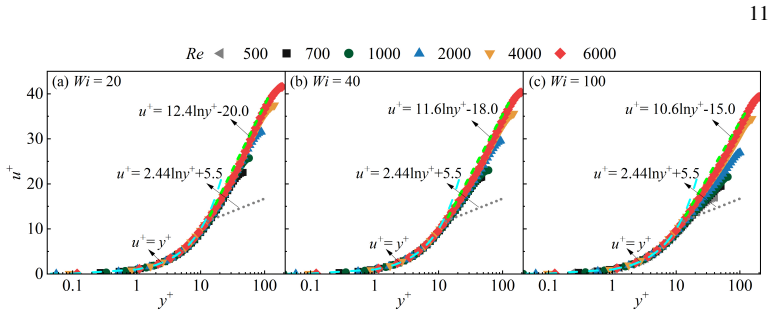
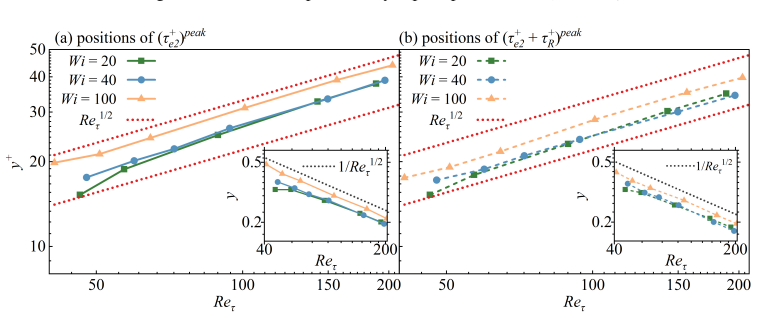
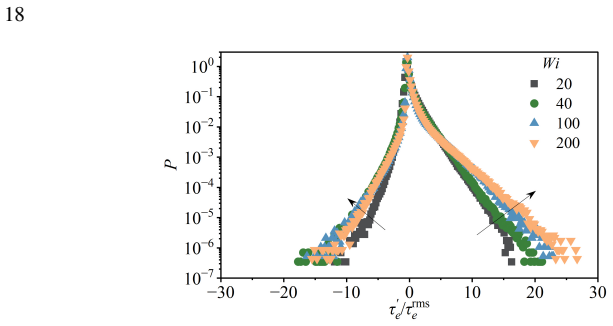
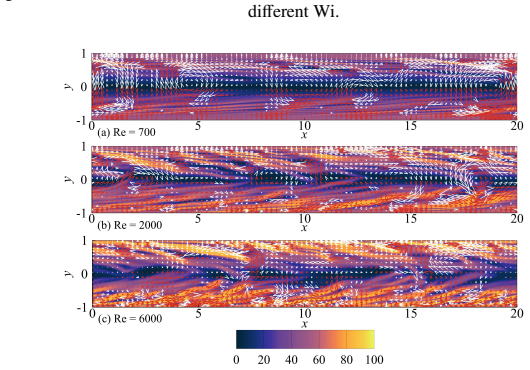
In two-dimensional simulations of elasto-inertial turbulence in channel flow, increasing Reynolds number intensifies fluctuations and polymer extension, fragments large-scale structures, and drives them toward the wall. The peak of nonlinear elastic shear stress follows the scaling y^+ ∝ Re_τ^{1/2}, similar to Reynolds shear stress in Newtonian turbulence and suggesting a shift in momentum transfer. Energy conversion peaks show weaker migration with y^+ ∝ Re_τ^{0.1} and remain near the wall. PDFs of velocity and elastic stress fluctuations at the energy-conversion peak collapse across Reynolds numbers, showing statistical self-similarity, while wall-normal components display exponential hea
What carries the argument
The scaling of the nonlinear elastic shear stress peak location with y^+ ∝ Re_τ^{1/2} and the collapse of PDFs of fluctuations at the energy conversion peak, which together establish the role of inertia in modulating but not disrupting the self-sustaining mechanism.
If this is right
- Inertia enhances dynamic amplitudes and drives core structures wallward.
- Inertia intensifies fluctuations and fragments large-scale structures.
- Nonlinear elastic shear stress peak scales as y^+ ∝ Re_τ^{1/2}, changing momentum transfer.
- Energy conversion peak migrates weakly as y^+ ∝ Re_τ^{0.1} but stays near-wall.
- PDFs collapse showing self-similarity, with heavy tails in wall-normal components.
Where Pith is reading between the lines
- If these 2D findings extend to 3D, elasto-inertial turbulence may share core momentum transfer features with Newtonian turbulence at high Reynolds numbers.
- The exponential heavy tails in PDFs suggest intermittent intense events that sustain the turbulence cycle.
- Testing the scalings at even higher Reynolds numbers could reveal whether the self-similarity breaks or continues.
- Similar analyses in other polymer flows might show if this inertia role is general.
Load-bearing premise
That two-dimensional direct numerical simulations capture the self-sustaining mechanisms and scaling behaviors of three-dimensional elasto-inertial turbulence without major qualitative differences from the missing spanwise direction.
What would settle it
Three-dimensional simulations at comparable Reynolds numbers that either reproduce the y^+ ∝ Re_τ^{1/2} scaling for elastic shear stress peak and the PDF collapse, or show clear deviations in the peak locations or distribution shapes.
Figures







read the original abstract
Elasto-inertial turbulence (EIT) is primarily driven by polymer elasticity, yet the modulating role of fluid inertia is non-negligible and remains largely unexplored. To investigate the effect of inertia, we perform direct numerical simulations of two-dimensional EIT in channel flow over a wide range of Reynolds numbers ($Re$). We show that increasing inertia promotes both the enhancement of dynamic amplitudes and the wallward migration of core structures. Specifically, inertia intensifies the turbulent fluctuations, facilitates the fragmentation of large-scale structures, and amplifies statistical quantities such as the root-mean-square of velocity fluctuations and polymer extension. The peak location of nonlinear elastic shear stress follows a scaling law $y^+ \propto Re_\tau^{1/2}$, closely resembling that of Reynolds shear stress in Newtonian turbulence, indicating a change of the momentum transfer mechanism. Meanwhile, the peak location of energy conversion between elastic and turbulent kinetic energies exhibits a $y^+ \propto Re_\tau^{0.1}$ scaling law migration, remaining mostly confined to the near-wall region. Remarkably, despite the inertial modulation, the probability density functions (PDFs) of velocity and elastic stress fluctuations extracted at the energy-conversion peak collapse convincingly over the range of $Re$ investigated. This reveals a robust statistical self-similarity across a wide range of inertia magnitude. Furthermore, the PDFs of wall-normal velocity and elastic stress fluctuations exhibit pronounced exponential heavy tails.
Editorial analysis
A structured set of objections, weighed in public.
Referee Report
Summary. The paper performs direct numerical simulations of two-dimensional elasto-inertial turbulence in a channel flow over a wide range of Reynolds numbers. It reports that increasing inertia enhances dynamic amplitudes, fragments large-scale structures, and causes wallward migration of core structures. The peak location of the nonlinear elastic shear stress scales as y^+ ∝ Re_τ^{1/2}, resembling the Reynolds shear stress peak in Newtonian turbulence and suggesting a change in momentum transfer. The energy conversion peak between elastic and turbulent kinetic energies scales as y^+ ∝ Re_τ^{0.1} and stays near the wall. PDFs of velocity and elastic stress fluctuations at the energy-conversion peak collapse across the Re range, indicating statistical self-similarity, and some PDFs exhibit exponential heavy tails.
Significance. If these results hold, the work demonstrates a significant modulating effect of inertia on 2D EIT, with a shift towards Newtonian-like momentum transport and robust self-similar statistics despite varying inertia. The PDF collapse is a strong feature supporting self-similarity. However, because the study is confined to two dimensions, its implications for the self-sustaining mechanisms in three-dimensional EIT are uncertain, as 3D effects like spanwise instabilities are absent. This could affect the broader relevance to polymer drag reduction and EIT literature.
major comments (3)
- The description of the direct numerical simulations lacks essential details such as grid resolution, computational domain sizes, time integration parameters, and any grid convergence or resolution studies. Since the reported scalings (e.g., y^+ ∝ Re_τ^{1/2}) and PDF collapses are quantitative results extracted from these simulations, the absence of these checks makes it challenging to verify the accuracy and reliability of the findings.
- The claim that the y^+ ∝ Re_τ^{1/2} scaling of the nonlinear elastic shear stress peak 'indicates a change of the momentum transfer mechanism' is load-bearing for the interpretation. However, without a direct comparison to the Newtonian Reynolds stress peak location or quantitative measures of similarity, and without error bars on the scaling, this interpretation remains suggestive rather than conclusive.
- The title refers to the 'self-sustaining mechanism' in two-dimensional EIT, but the provided results emphasize statistical scalings and PDF properties rather than explicitly identifying or analyzing the self-sustaining cycle. Given that two-dimensional turbulence does not support the standard three-dimensional self-sustaining process involving lift-up, streak breakdown, and regeneration, a clearer discussion of what constitutes the self-sustaining mechanism in this 2D context is needed to support the title's claim.
minor comments (2)
- The abstract states 'over a wide range of Reynolds numbers (Re)' but does not specify the actual range or values of Re_τ, which would help readers assess the scope of the inertia variation.
- Some notation such as Re_τ and y^+ should be explicitly defined in the abstract or early in the text for clarity.
Simulated Author's Rebuttal
We thank the referee for the constructive and detailed comments. We address each major comment point by point below, providing clarifications and indicating revisions to the manuscript where needed.
read point-by-point responses
-
Referee: The description of the direct numerical simulations lacks essential details such as grid resolution, computational domain sizes, time integration parameters, and any grid convergence or resolution studies. Since the reported scalings (e.g., y^+ ∝ Re_τ^{1/2}) and PDF collapses are quantitative results extracted from these simulations, the absence of these checks makes it challenging to verify the accuracy and reliability of the findings.
Authors: We agree that the original manuscript omitted key numerical details required for full reproducibility and validation of the quantitative results. In the revised version, we have added a comprehensive 'Numerical Setup' subsection detailing the grid resolutions (Δx^+ and Δy^+ for each Re_τ), streamwise and wall-normal domain sizes, time integration method with CFL constraints, and explicit grid convergence tests confirming that the reported scalings and PDF collapses remain unchanged under refinement. revision: yes
-
Referee: The claim that the y^+ ∝ Re_τ^{1/2} scaling of the nonlinear elastic shear stress peak 'indicates a change of the momentum transfer mechanism' is load-bearing for the interpretation. However, without a direct comparison to the Newtonian Reynolds stress peak location or quantitative measures of similarity, and without error bars on the scaling, this interpretation remains suggestive rather than conclusive.
Authors: We accept that the interpretation requires stronger quantitative support. The revised manuscript now includes a direct comparison of the observed elastic shear stress peak scaling against the established Re_τ-dependent location of the Reynolds shear stress peak in Newtonian channel flow from the literature, along with error bars derived from the fitting procedure across the simulated Re range. While the two-dimensional setting precludes an identical Newtonian counterpart, the close resemblance in scaling supports the suggested shift toward Newtonian-like momentum transfer. revision: partial
-
Referee: The title refers to the 'self-sustaining mechanism' in two-dimensional EIT, but the provided results emphasize statistical scalings and PDF properties rather than explicitly identifying or analyzing the self-sustaining cycle. Given that two-dimensional turbulence does not support the standard three-dimensional self-sustaining process involving lift-up, streak breakdown, and regeneration, a clearer discussion of what constitutes the self-sustaining mechanism in this 2D context is needed to support the title's claim.
Authors: The title emphasizes inertia's role in modulating the self-sustaining dynamics of 2D EIT, as manifested through structure persistence and statistical self-similarity. To address the concern, the revised manuscript adds an explicit discussion clarifying that the 2D self-sustaining mechanism relies on the continuous regeneration of elastic stresses and coherent structures via polymer-turbulence coupling, distinct from the 3D lift-up cycle. This is tied directly to the observed wallward migration, fragmentation, and PDF collapse, which demonstrate how inertia modulates the cycle without disrupting its statistical robustness. revision: yes
Circularity Check
No circularity: all results are direct empirical extractions from DNS data
full rationale
The manuscript contains no analytic derivation chain, no parameter fitting, and no predictions that reduce to their own inputs by construction. Reported scalings (e.g., y^+ ∝ Re_τ^{1/2} for the nonlinear elastic shear-stress peak) and PDF collapses are stated as observations extracted directly from the 2D DNS database across the simulated Re range. No self-definitional loops, fitted-input predictions, or load-bearing self-citation chains appear; the central claims remain independent empirical findings from the simulation output.
Axiom & Free-Parameter Ledger
free parameters (1)
- Reynolds number range
axioms (1)
- standard math Incompressible flow governed by Navier-Stokes equations augmented by polymer conformation tensor evolution
Reference graph
Works this paper leans on
-
[1]
Beneitez, M., Page, J., & Kerswell, R. R. 2023 Polymer diffusive instability leading to elastic turbulence in plane Couette flow . Phys. Rev. Fluids 8 , L101901
work page 2023
-
[2]
Beneitez, M., Page, J., Dubief, Y., & Kerswell, R. R. 2024 Multistability of elasto-inertial two-dimensional channel flow . J. Fluid Mech. 981 , A30
work page 2024
- [3]
-
[4]
2008 Two-dimensional elastic turbulence
Berti, S., Bistagnino, A., Boffetta, G., Celani, A., & Musacchio, S. 2008 Two-dimensional elastic turbulence . Phys. Rev. E 77 (5), 055306
work page 2008
-
[5]
2019 Elasto-inertial wall mode instabilities in viscoelastic plane Poiseuille flow
Chaudhary, I., Garg, P., Shankar, V., & Subramanian, G. 2019 Elasto-inertial wall mode instabilities in viscoelastic plane Poiseuille flow . J. Fluid Mech. 881 , 119-163
work page 2019
- [6]
-
[7]
Choueiri, G. H., Lopez, J. M., & Hof, B. 2018 Exceeding the Asymptotic Limit of Polymer Drag Reduction . Phys. Rev. Lett. 120 , 124501
work page 2018
- [8]
-
[9]
Couchman, M. M. P., Beneitez, M., Page, J., & Kerswell, R. R. 2024 Inertial enhancement of the polymer diffusive instability . J. Fluid Mech. 981 , A2
work page 2024
-
[10]
Dubief, Y., White, C., Shaqfeh, E. S. G., & Terrapon, V. E. 2010 Polymer Maximum Drag Reduction: A Unique Transitional State . In Annual Research Briefs , pp. 395–404. Stanford, CA: Cent. Turbul. Res
work page 2010
-
[11]
2011 Elastic turbulence in high Reynolds number polymer drag reduced flows
Dubief, Y., & White, C. 2011 Elastic turbulence in high Reynolds number polymer drag reduced flows . Abstract presented at APS Division of Fluid Dynamics Meeting, Baltimore, MD, Nov. 20–22, Abstr. M8–002
work page 2011
-
[12]
Dubief, Y., Terrapon, V. E., & Julio, S. 2013 On the mechanism of elasto-inertial turbulence . Phys. Fluids 25 , 110817
work page 2013
-
[13]
R., Terrapon, V.E., & Steinberg, V
Dubief, Y., Page, J., Kerswell, R. R., Terrapon, V.E., & Steinberg, V. 2022 First coherent structure in elasto-inertial turbulence . Phys. Rev. Fluids 7 , 073301
work page 2022
-
[14]
Dubief, Y., Terrapon, V. E., & Hof, B. 2023 Elasto-inertial turbulence . Annu. Rev. Fluid Mech. 55 , 675-705
work page 2023
-
[15]
Foggi Rota, G., Amor, C., & Rosti, M. E. 2024 Unified view of elastic and elasto-inertial turbulence in channel flows at low and moderate Reynolds numbers . Phys. Rev. Fluids 9 , L122602
work page 2024
-
[16]
2003 Spectra of turbulence in dilute polymer solutions
Fouxon, A., & Lebedev, V. 2003 Spectra of turbulence in dilute polymer solutions . Phys. Fluids 15 , 2060-2072
work page 2003
-
[17]
Garg, P., Chaudhary, I., Khalid, M., Shankar, V. & Subramanian, G. 2018 Viscoelastic pipe flow is linearly unstable . Phys. Rev. Lett. 121 , 024502
work page 2018
-
[18]
Gillissen, J. J. J. 2019 Two-dimensional decaying elastoinertial turbulence . Phys. Rev. Lett. 123 (14), 144502
work page 2019
-
[19]
Graham, M. D. 2014 Drag reduction and the dynamics of turbulence in simple and complex fluids . Phys. Fluids 26 (10), 101301
work page 2014
-
[20]
2000 Elastic turbulence in a polymer solution flow
Groisman, A., & Steinberg, V. 2000 Elastic turbulence in a polymer solution flow . Nature 405 (6782), 53–55
work page 2000
-
[21]
2004 Elastic turbulence in curvilinear flows of polymer solutions
Groisman, A., & Steinberg, V. 2004 Elastic turbulence in curvilinear flows of polymer solutions . New J. Phys. 6 (1), 29
work page 2004
-
[22]
Guan, X. L., Yao, S. Y., & Jiang, N. 2013 A study on coherent structures and drag-reduction in the wall turbulence with polymer additives by TRPIV. Acta Mech Sin. 29 , 485–493
work page 2013
-
[23]
2011 The maximum drag reduction asymptote
Hof, B., Samanta, D., & Wagner C. 2011 The maximum drag reduction asymptote. Abstract presented at APS Division of Fluid Dynamics Meeting, Baltimore, MD, Nov. 20-22, Abstr. M8-005
work page 2011
-
[24]
Khalid, M., Chaudhary, I., Garg, P., Shankar, V. & Subramanian, G. 2021 The centre-mode instability of viscoelastic plane Poiseuille flow. J. Fluid Mech. 915 , A43
work page 2021
-
[25]
Lee, M., & Moser, R. D. 2015 Direct numerical simulation of turbulent channel flow up to Re_ 5200 . J. Fluid Mech. 774 , 395-415
work page 2015
-
[26]
Lu, S. S., & Willmarth, W. W. 1973 Measurements of the structure of the Reynolds stress in a turbulent boundary layer . J. Fluid Mech. 60 (3), 481–511
work page 1973
-
[27]
Min, T., Choi, H., & Yoo, J. Y. 2003 Maximum drag reduction in a turbulent channel flow by polymer additives . J. Fluid Mech. 492 , 91-100
work page 2003
-
[28]
1926 Ueber die Viskosität kolloider Lösungen im Struktur-, Laminar- und Turbulenzgebiet
Ostwald, W., & Auerbach, R. 1926 Ueber die Viskosität kolloider Lösungen im Struktur-, Laminar- und Turbulenzgebiet . Kolloid-Zeitschrift , 38 , 261-280
work page 1926
-
[29]
Page, J., Dubief, Y., & Kerswell, R. R. 2020 Exact travelling wave solutions in viscoelastic channel flow . Phys. Rev. Lett. 125 , 154501
work page 2020
-
[30]
Pope, S. B. 2000 Turbulent Flows . Cambridge University Press
work page 2000
-
[31]
Ptasinski, P. K., Boersma, B. J., Nieuwstadt, F. T. M., Hulsen, M. A., Van den Brule, B. H. A. A., & Hunt, J. C. R. 2003 Turbulent Channel Flow near Maximum Drag Reduction: Simulations, Experiments and Mechanisms . J. Fluid Mech. 490 , 251-291
work page 2003
-
[32]
Samanta, D., Dubief, Y., Holzner, M., Schafer, C., Morozov, A. N., Wagner, C., & Hof, B. 2013 Elasto-inertial turbulence . Proc. Natl Acad. Sci. 110 , 10557
work page 2013
-
[33]
Shekar, A., Mcmullen, R. M., Wang, S. N., Mckeon, B.J., & Graham, M. D. 2019 Critical-layer structures and mechanisms in elastoinertial turbulence . Phys. Rev. Lett. 122 , 124503
work page 2019
-
[34]
2020 Self-sustained elastoinertial Tollmien–Schlichting waves
Shekar, A., Mcmullen, R., Mckeon, B.& Graham, M. 2020 Self-sustained elastoinertial Tollmien–Schlichting waves . J. Fluid Mech. 897 , A3
work page 2020
-
[35]
Shekar, A., Mcmullen, R .M., Mckeon, B. J. & Graham, M. D. 2021 Tollmien–Schlichting route to elastoinertial turbulence in channel flow. Rev. Fluids . 6 , 093301
work page 2021
-
[36]
Shu, C. W. 1998 Essentially non-oscillatory and weighted essentially non-oscillatory schemes for hyperbolic conservation laws. In Advanced Numerical Approximation of Nonlinear Hyperbolic Equations (ed. A. Quarteroni), pp. 325-432. Springer
work page 1998
-
[37]
Sid, S., Terrapon V. E., & Dubief, Y. 2018 Two-dimensional dynamics of elasto-inertial turbulence and its role in polymer drag reduction . Phys. Rev. Fluids , 3 , 011301
work page 2018
-
[38]
2021 Elastic turbulence: An experimental view on inertialess random flow
Steinberg, V. 2021 Elastic turbulence: An experimental view on inertialess random flow . Annu. Rev. Fluid Mech. . 53 , 27-58
work page 2021
-
[39]
Terrapon, V. E., Dubief, Y., & Soria, J. 2021 On the role of pressure in elasto-inertial turbulence . J. Turbul. 16 (1), 26-43
work page 2021
-
[40]
Toms, B.A. 1949 Some observations on the flow of linear polymer solutions through straight tubes at large Reynolds numbers . In Proc. 1st International Congress on Rheology , vol. 2, pp. 135–141. North-Holland
work page 1949
-
[41]
Virk, P.S., Mickley, H. S., & Smith, K. A. 1970 The ultimate asymptote and mean flow structure in Toms’ phenomenon . ASME. J. Appl. Mech. 37 (2), 488-493
work page 1970
-
[42]
Wang, S.M., Zhang, W.H., Wang, X.Y., Li, X.B., Zhang, H.N., &Li. F.C. 2023 Maximum drag reduction state of viscoelastic turbulent channel flow: marginal inertial turbulence or elasto-inertial turbulence . J. Fluid Mech . 960 , A12
work page 2023
-
[43]
Wang, S. N., Shekar, A., & Graham, M. D. 2017 Spatiotemporal dynamics of viscoelastic turbulence in transitional channel flow . J. Non-Newtonian Fluid Mech. 244 , 104-122
work page 2017
-
[44]
Warholic, M. D., Massah, H., & Hanratty, T. J. 1999 Influence of drag-reducing polymers on turbulence: effects of Reynolds number, concentration and mixing . Experiments in Fluids , 27 (5), 461-472
work page 1999
-
[45]
2024 Local flow topology of a polymer-laden turbulent boundary layer
Warwaruk, L., & Ghaemi, S. 2024 Local flow topology of a polymer-laden turbulent boundary layer . J. Fluid Mech. 983 , A22
work page 2024
-
[46]
White, C. M., & Mungal, M. G. 2008 Mechanics and prediction of turbulent drag reduction with polymer additives . Annu. Rev. Fluid Mech. , 40 , 235-256
work page 2008
-
[47]
Xi, L., & Graham, M. D. 2010a Turbulent drag reduction and multistage transitions in viscoelastic minimal flow units . J. Fluid Mech , 647 , 421-452
-
[48]
XI, L., & Graham, M. D. 2010b Active and Hibernating Turbulence in Minimal Channel Flow of Newtonian and Polymeric Fluids . Phys. Rev. Lett , 104 , 218301
-
[49]
2016 Marginal turbulent state of viscoelastic flfluids: A polymer drag reduction perspective
XI, L., & BAI, X. 2016 Marginal turbulent state of viscoelastic flfluids: A polymer drag reduction perspective . Phys. Rev. E . 93 , 043118
work page 2016
-
[50]
Yamani,S., Keshavarz,B., Raj, Y., Zaki, T. A., McKinley, G. H., & Bischofberger, I. 2021 Spectral Universality of Elastoinertial Turbulence . Phys. Rev. Lett . 127 , 074501
work page 2021
-
[51]
Yin G., Huang W. X., & Xu C. X. 2018 Prediction of near-wall turbulence using minimal flow unit . J. Fluid Mech. , 841 , 654-673
work page 2018
-
[52]
Zhang, W. H., Zhang, H. N., Li, Y. K., Yu, B., & Li, F. C. 2021a Role of elasto-inertial turbulence in viscoelastic drag-reducing turbulence . Phys. Fluids 33 , 081706
-
[53]
Zhang, W. H., Shao, Q. Q., Li, Y. K., Ma, Y., Zhang, H. N., & Li, F.,C. 2021b On the mechanisms of sheet-like extension structures formation and self-sustaining process in elasto-inertial turbulence . Phys. Fluids . 33 , 085107
-
[54]
Zhang, W. H., Zhang, H. N., Wang, Z. M., Li, Y. K., Yu, B., & LI F. C. 2022 Repicturing viscoelastic drag-reducing turbulence by introducing dynamics of elasto-inertial turbulence . J. Fluid Mech. 940 , A31
work page 2022
-
[55]
Zhang, H. N., Zhang, W. H., Wang X. Y., Li, Y. S., Ma, Y., Li, X. B., & LI, F.,C. 2023 On the role of tensor interpolation in solving high-WI viscoelastic fluid flow . Phys. Fluids 35 , 031708
work page 2023
-
[56]
Zhang, H. N., Cheng, H. T., Wang, S. M., Zhang, W. H., Li, X. B., & Li, F. C. 2024 The minimal flow unit and origin of two-dimensional elasto-inertial turbulence . J. Fluid Mech . 999 , A82
work page 2024
-
[57]
B., Li, L., Fan, Y., Su, J., Xi, H
Zhang, Y. B., Li, L., Fan, Y., Su, J., Xi, H. D., & Sun, C. 2025 Experimental evidence for the continuous transition between elastic and elastoinertial turbulence . Proc. Natl. Acad. Sci. USA 122 , e2505007122
work page 2025
-
[58]
2021 Nonasymptotic elastoinertial turbulence for asymptotic drag reduction
Zhu, L.,& Xi, L. 2021 Nonasymptotic elastoinertial turbulence for asymptotic drag reduction . Phys. Rev. Fluids 6 , 014601
work page 2021
- [59]
-
[60]
T. Barker and D. G. Schaeffer and P. Boh\'orquez and J. M. N. T. Gray , title =. J. Fluid. Mech. , year =
- [61]
-
[62]
A. V. Briukhanov and S. S. Grigorian and S. M. Miagkov and M. Y. Plam and I. E. Shurova and M. E. Eglit and Y. L. Yakimov , title =. Physics of Snow and Ice, Proceedings of the International Conference on Low Temperature Science , volume =
- [63]
- [64]
-
[65]
S.C.R. Dennis , title =. Ninth Intl Conf. on Numerical Methods in Fluid Dynamics , publisher =. 1985 , editor =
work page 1985
-
[66]
Formation of levees, troughs and elevated channels by avalanches on erodible slopes , author =. J. Fluid Mech. , volume =
- [67]
-
[68]
and Saut, Jean Claude , title =
Joseph, Daniel D. and Saut, Jean Claude , title =. Theoretical and Computational Fluid Dynamics , publisher=
-
[69]
M.G. Worster , title =. Interactive dynamics of convection and solidification , publisher =. 1992 , editor =
work page 1992
- [70]
- [71]
-
[72]
C.M. Linton and D.V. Evans , title =. Phil.\ Trans.\ R. Soc.\ Lond. , year =
- [73]
- [74]
- [75]
-
[76]
On the oscillations Near and at resonance in open pipes , year =
L. On the oscillations Near and at resonance in open pipes , year =. J. Engng Maths , volume =
- [77]
-
[78]
Camera Calibration Toolbox for Matlab , howpublished =
Bouguet, J.-Y , year=. Camera Calibration Toolbox for Matlab , howpublished =
discussion (0)
Sign in with ORCID, Apple, or X to comment. Anyone can read and Pith papers without signing in.