Iterative Receiver Processing at Relays in PNC-Enabled Multi-Hop Underwater Acoustic Networks
Pith reviewed 2026-05-08 13:41 UTC · model grok-4.3
The pith
Iterative receiver processing at relays improves BER performance in PNC-enabled multi-hop underwater acoustic networks
A machine-rendered reading of the paper's core claim, the machinery that carries it, and where it could break.
Core claim
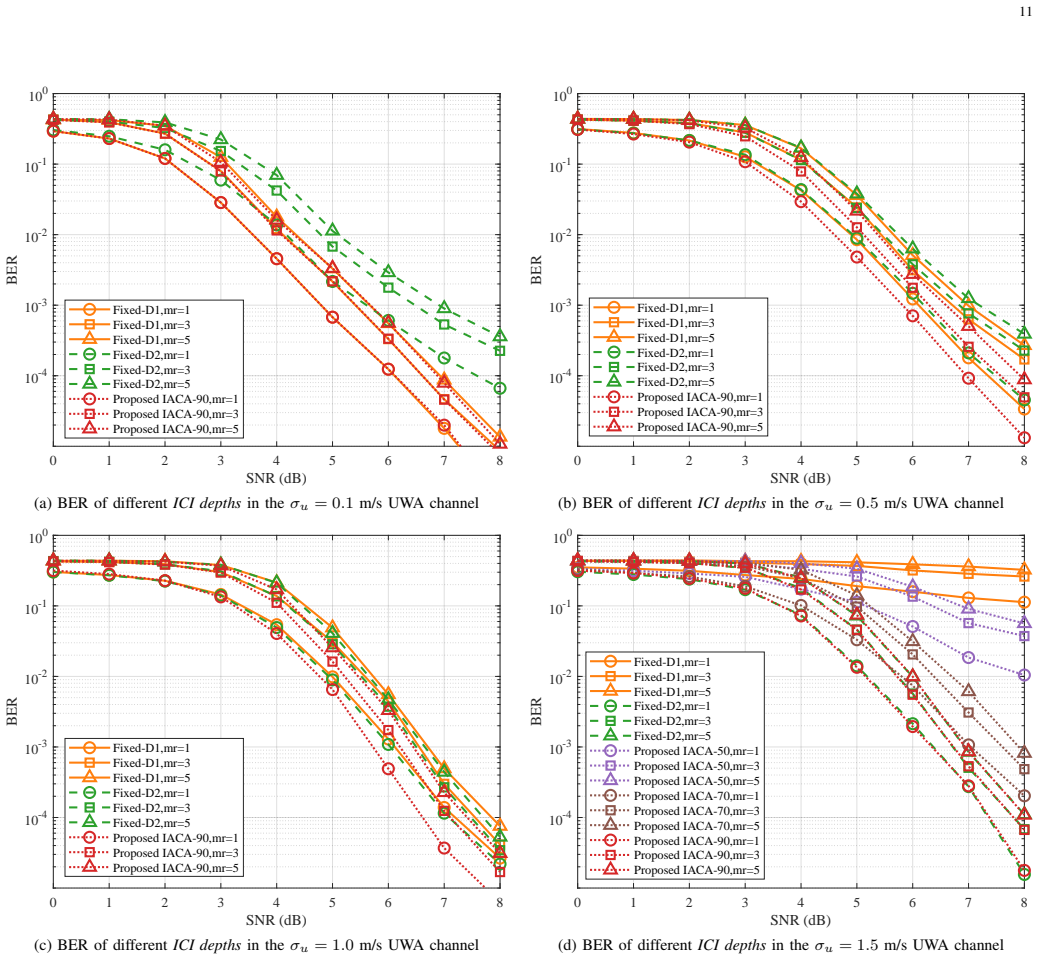
The authors introduce iterative receiver algorithms for relays in PNC-enabled multi-hop UWA networks. These integrate an adaptive channel-aware factor graph detection algorithm for time-varying channels, a parity-check-constrained soft-information refinement algorithm, and an LMMSE detection algorithm on a superimposed model. The adaptive method achieves BERs around 10^{-5} at 1.5 m/s relative velocity and 8 dB SNR in simulations, while lake experiments and sea trials in the Taiwan Strait demonstrate superior BER performance compared to baseline schemes under practical conditions.
What carries the argument
The iterative receiver processing strategy that integrates adaptive channel-aware factor graph detection, parity-check-constrained soft-information refinement, and LMMSE detection based on a superimposed model for handling PNC at relays.
If this is right
- The adaptive detection algorithm can achieve bit error rates on the order of 10^{-5} at a relative velocity of 1.5 m/s and 8 dB SNR.
- Error accumulation across multiple relay nodes is reduced, enabling more reliable end-to-end transmission.
- The LMMSE-based scheme offers a low-complexity alternative while maintaining performance gains.
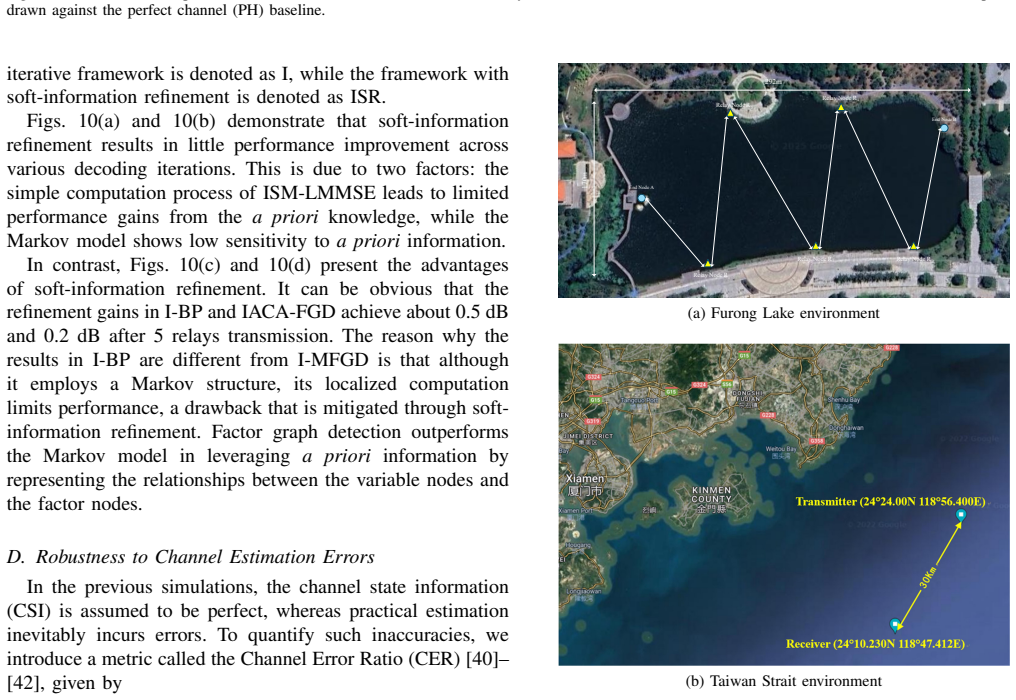
- The algorithms prove robust in real-world underwater acoustic channels as shown by lake and sea trial results.
Where Pith is reading between the lines
- This strategy could support longer multi-hop chains in underwater networks by further limiting error propagation.
- Similar iterative approaches might improve performance in other high-mobility or multipath wireless systems.
- Optimizing the algorithms for lower power consumption could enhance their use in battery-limited underwater devices.
Load-bearing premise
The channel estimation and models used accurately represent the time-varying UWA channels, and the iterative processing converges reliably under practical conditions.
What would settle it
A field experiment in the sea at higher relative velocities or lower SNRs where the BER fails to reach the order of 10^{-5} would disprove the performance claims.
Figures






read the original abstract
Physical-layer network coding (PNC) can increase end-to-end throughput in bi-directional multi-hop underwater acoustic (UWA) networks. However, multipath delay spread and Doppler-induced inter-carrier interference (ICI) in UWA channels can degrade the reliability of PNC transmission in a three-node relay configuration. More critically, error accumulation across multiple relay nodes leads to a pronounced increase in the end-to-end bit error rate (BER) in multi-hop networks. To address this issue, we develop an iterative detection and decoding processing strategy for relay nodes within a PNC-enabled multi-hop UWA network based on orthogonal frequency division multiplexing (OFDM) modulation. The proposed design integrates three key algorithms: (i) an adaptive channel-aware factor graph detection algorithm that is suited for time-varying UWA channels; (ii) a parity-check-constrained soft-information refinement algorithm that improves the accuracy of the information feedback from the decoder to the detector; and (iii) a linear minimum mean square error (LMMSE) detection algorithm based on a superimposed model, which offers low computational complexity as an alternative scheme. Extensive simulation results demonstrate that the adaptive detection algorithm achieves BERs on the order of $10^{-5}$ at a relative velocity of 1.5 m/s UWA channel and a signal-to-noise (SNR) of 8~dB. Both lake experiments and sea trials in the Taiwan Strait confirm that the proposed iterative receiver algorithms outperform baseline schemes in terms of BER performance under practical UWA channel conditions, showing their robustness and applicability in real multi-hop deployments.
Editorial analysis
A structured set of objections, weighed in public.
Referee Report
Summary. The paper proposes an iterative detection and decoding strategy for relay nodes in physical-layer network coding (PNC) enabled multi-hop underwater acoustic (UWA) networks using OFDM modulation. It introduces three algorithms: (i) an adaptive channel-aware factor graph detector suited to time-varying channels, (ii) a parity-check-constrained soft-information refinement algorithm, and (iii) an LMMSE detector based on a superimposed model for lower complexity. Simulations claim BERs on the order of 10^{-5} at 1.5 m/s relative velocity and 8 dB SNR for the adaptive detector, while lake experiments and sea trials in the Taiwan Strait are reported to show outperformance over baseline schemes under practical UWA conditions, addressing error accumulation across hops.
Significance. If the central claims hold, the work addresses a practically important problem in UWA communications by mitigating error propagation in multi-hop PNC setups, which could improve end-to-end reliability and throughput in challenging environments with multipath and Doppler effects. The combination of simulation results with lake and sea trial data provides external validation beyond self-referential fitting, strengthening potential applicability, though the absence of detailed convergence and estimation-error metrics limits the strength of the robustness claims.
major comments (2)
- [Abstract and experimental results sections] The headline performance claims (BER ~10^{-5} at 1.5 m/s and 8 dB SNR, plus experimental outperformance) rest on the assumptions that the adaptive factor-graph detector plus LMMSE superimposed model accurately tracks Doppler/multipath-induced ICI without mismatch and that the iterative loop converges reliably to avoid error accumulation across hops. The manuscript provides end-to-end BER results but lacks quantitative checks such as convergence curves, channel-estimation MSE versus ground truth, or multi-hop error-propagation measurements in the experimental sections, which are load-bearing for confirming no model mismatch under Taiwan Strait conditions.
- [Algorithm description (parity-check refinement)] The description of the parity-check-constrained soft-information refinement algorithm does not include analysis or bounds on how feedback accuracy improves across iterations in the presence of residual ICI, which is central to the claim that the overall iterative receiver prevents pronounced BER increase in multi-hop settings.
minor comments (2)
- [Abstract] The abstract states 'multi-hop' but does not specify the number of hops used in simulations or experiments; this should be clarified for reproducibility.
- [LMMSE algorithm subsection] Notation for the superimposed model in the LMMSE detector could be made more explicit with a dedicated equation reference to distinguish it from the factor-graph approach.
Simulated Author's Rebuttal
We thank the referee for the constructive comments, which help clarify the validation of our iterative receiver design. We address each major comment below, indicating planned revisions where appropriate.
read point-by-point responses
-
Referee: [Abstract and experimental results sections] The headline performance claims (BER ~10^{-5} at 1.5 m/s and 8 dB SNR, plus experimental outperformance) rest on the assumptions that the adaptive factor-graph detector plus LMMSE superimposed model accurately tracks Doppler/multipath-induced ICI without mismatch and that the iterative loop converges reliably to avoid error accumulation across hops. The manuscript provides end-to-end BER results but lacks quantitative checks such as convergence curves, channel-estimation MSE versus ground truth, or multi-hop error-propagation measurements in the experimental sections, which are load-bearing for confirming no model mismatch under Taiwan Strait conditions.
Authors: We agree that explicit convergence curves and channel-estimation error metrics would provide stronger support for the claims regarding reliable iteration and ICI tracking. The reported end-to-end BER results in multi-hop simulations and field trials already show that the proposed algorithms prevent the expected BER increase from error propagation, with the adaptive detector maintaining performance at the stated operating points. In the revised manuscript we will add simulation convergence plots illustrating BER reduction over iterations. For the lake and sea trial sections we will expand the discussion of hop-by-hop BER stability as indirect evidence of convergence under real conditions, while noting that ground-truth channel estimates are unavailable in field deployments. We will also add a short clarification on the modeling assumptions for Doppler-induced ICI. revision: partial
-
Referee: [Algorithm description (parity-check refinement)] The description of the parity-check-constrained soft-information refinement algorithm does not include analysis or bounds on how feedback accuracy improves across iterations in the presence of residual ICI, which is central to the claim that the overall iterative receiver prevents pronounced BER increase in multi-hop settings.
Authors: The parity-check refinement exploits the LDPC code structure to correct inconsistent soft values before feeding them back to the factor-graph detector, as described in the algorithm section. While the manuscript does not supply theoretical bounds on accuracy gain under residual ICI, the iterative improvement is validated by the simulation BER curves and the multi-hop experimental results. We will revise the description to include a more explicit step-by-step explanation of how parity checks suppress residual interference effects, accompanied by additional simulation results showing the evolution of soft-information quality across iterations. revision: partial
- Derivation of theoretical bounds on the improvement of feedback accuracy for the parity-check refinement in the presence of residual ICI, as providing such bounds would require a separate analytical study outside the scope of the present work.
Circularity Check
No significant circularity; performance claims rest on external simulations and trials
full rationale
The paper presents three iterative receiver algorithms (adaptive factor-graph detector, parity-check refinement, LMMSE superimposed model) as explicit design choices for handling time-varying UWA channels in PNC multi-hop OFDM setups. BER results (order 10^{-5} at 1.5 m/s and 8 dB SNR) and outperformance claims are obtained from independent Monte-Carlo simulations plus lake/sea trial measurements; these are not obtained by fitting parameters to the target metric and then renaming the fit as a prediction. No self-citation chain, uniqueness theorem, or ansatz-smuggling is invoked to justify the central claims. The derivation chain therefore remains self-contained against external benchmarks.
Axiom & Free-Parameter Ledger
axioms (1)
- domain assumption OFDM modulation and PNC principles apply to UWA channels with multipath and Doppler effects
Reference graph
Works this paper leans on
-
[1]
Underwater acoustic communica- tions,
Z. Li, M. Chitre, and M. Stojanovic, “Underwater acoustic communica- tions,”Nature Reviews Electrical Engineering, vol. 2, no. 2, pp. 83–95, 2025
2025
-
[2]
Review of underwater acoustic ommunication and network technology,
J. Yang, J. Wang, G. Qiao, S. Liu, L. Ma, and P. He, “Review of underwater acoustic ommunication and network technology,”Journal of Electronics & Information Technology, vol. 46, no. 1, pp. 1–21, 2024
2024
-
[3]
AS-MAC: An adaptive scheduling mac protocol for reducing the end-to-end delay in AUV-assisted underwater acoustic networks,
J. Guo, S. Song, J. Liu, M. Pan, J.-H. Cui, and G. Han, “AS-MAC: An adaptive scheduling mac protocol for reducing the end-to-end delay in AUV-assisted underwater acoustic networks,”IEEE Transactions on Mobile Computing, vol. 24, no. 2, pp. 1197–1211, 2025
2025
-
[4]
An architecture for using autonomous underwater vehicles in wireless sensor networks for underwater pipeline monitoring,
I. Jawhar, N. Mohamed, J. Al-Jaroodi, and S. Zhang, “An architecture for using autonomous underwater vehicles in wireless sensor networks for underwater pipeline monitoring,”IEEE transactions on industrial informatics, vol. 15, no. 3, pp. 1329–1340, 2019
2019
-
[5]
Hot topic: Physical-layer network coding,
S. Zhang, S. C. Liew, and P. P. Lam, “Hot topic: Physical-layer network coding,” inProceedings of the 12th Annual International Conference on Mobile Computing and Networking, Sep. 2006, pp. 358–365
2006
-
[6]
Reliable physical-layer network coding supporting real applications,
L. You, S. C. Liew, and L. Lu, “Reliable physical-layer network coding supporting real applications,”IEEE Transactions on Mobile Computing, vol. 16, no. 8, pp. 2334–2350, 2017
2017
-
[7]
Layered SEMS decoding for non-binary LDPC-coded pnc systems,
C. Su, P. Kang, P. Chen, and Y . Fang, “Layered SEMS decoding for non-binary LDPC-coded pnc systems,”IEEE Wireless Communications Letters, vol. 14, no. 3, pp. 866–870, 2025
2025
-
[8]
PiPNC: Piggybacking physical layer network coding for multihop wireless networks,
H. Zhang, L. Zheng, and L. Cai, “PiPNC: Piggybacking physical layer network coding for multihop wireless networks,” in2015 IEEE International Conference on Communications (ICC). IEEE, 2015, pp. 6211–6216
2015
-
[9]
Throughput capacity of IEEE 802.11 many-to/from- one bidirectional networks with physical-layer network coding,
S. Lin and L. Fu, “Throughput capacity of IEEE 802.11 many-to/from- one bidirectional networks with physical-layer network coding,”IEEE Transactions on Wireless Communications, vol. 15, no. 1, pp. 217–231, 2015
2015
-
[10]
A framework for evaluating physical-layer network coding gains in multi- hop wireless networks,
R. Naves, H. Khalif ´e, G. Jakllari, V . Conan, and A.-L. Beylot, “A framework for evaluating physical-layer network coding gains in multi- hop wireless networks,”IEEE Transactions on Mobile Computing, vol. 18, no. 12, pp. 2725–2739, 2018
2018
-
[11]
Design and analysis of hierarchical physical layer network coding,
H. Zhang, L. Zheng, and L. Cai, “Design and analysis of hierarchical physical layer network coding,”IEEE Transactions on Wireless Com- munications, vol. 16, no. 12, pp. 7966–7981, 2017. 17
2017
-
[12]
Bi-directional multi-hop wireless pipeline using physical-layer network coding,
H. Zhang and L. Cai, “Bi-directional multi-hop wireless pipeline using physical-layer network coding,”IEEE Transactions on Wireless Com- munications, vol. 16, no. 12, pp. 7950–7965, 2017
2017
-
[13]
Multi-flow scheduling in multi-hop underwater acoustic networks,
Z. Wang, X. Xu, and C. Wang, “Multi-flow scheduling in multi-hop underwater acoustic networks,” inOCEANS 2016-Shanghai. IEEE, 2016, pp. 1–6
2016
-
[14]
A hybrid physical-layer network coding approach for bidirectional underwater acoustic networks,
J. Ma and S. Yang, “A hybrid physical-layer network coding approach for bidirectional underwater acoustic networks,” inOCEANS 2019- Marseille. IEEE, 2019, pp. 1–8
2019
-
[15]
Interference-constrained scheduling of a cogni- tive multihop underwater acoustic network,
C. Peng and U. Mitra, “Interference-constrained scheduling of a cogni- tive multihop underwater acoustic network,”IEEE Journal of Oceanic Engineering, vol. 49, no. 2, pp. 507–521, 2024
2024
-
[16]
Statistical characterization and com- putationally efficient modeling of a class of underwater acoustic com- munication channels,
P. Qarabaqi and M. Stojanovic, “Statistical characterization and com- putationally efficient modeling of a class of underwater acoustic com- munication channels,”IEEE Journal of Oceanic Engineering, vol. 38, no. 4, pp. 701–717, 2013
2013
-
[17]
Propagation and scattering effects in underwater acoustic communication channels,
P. A. van Walree, “Propagation and scattering effects in underwater acoustic communication channels,”IEEE Journal of Oceanic Engineer- ing, vol. 38, no. 4, pp. 614–631, 2013
2013
-
[18]
Cyclostationarity of communication signals in under- water acoustic channels,
F.-X. Socheleau, “Cyclostationarity of communication signals in under- water acoustic channels,”IEEE Journal of Oceanic Engineering, vol. 50, no. 2, pp. 425–447, 2025
2025
-
[19]
Iterative receiver processing for ofdm modulated physical-layer network coding in underwater acous- tic channels,
Z. Wang, J. Huang, S. Zhou, and Z. Wang, “Iterative receiver processing for ofdm modulated physical-layer network coding in underwater acous- tic channels,”IEEE Transactions on Communications, vol. 61, no. 2, pp. 541–553, 2013
2013
-
[20]
CDMA-based analog network coding for underwater acoustic sensor networks,
H. Kulhandjian, T. Melodia, and D. Koutsonikolas, “CDMA-based analog network coding for underwater acoustic sensor networks,”IEEE Transactions on Wireless Communications, vol. 14, no. 11, pp. 6495– 6507, 2015
2015
-
[21]
Multi-scale multi-lag channel estimation using low rank approximation for OFDM,
S. Beygi and U. Mitra, “Multi-scale multi-lag channel estimation using low rank approximation for OFDM,”IEEE Transactions on Signal Processing, vol. 63, no. 18, pp. 4744–4755, 2015
2015
-
[22]
OFDM modulated PNC in V2X communications: An ICI-aware approach against CFOs and time-frequency-selective channels,
Z. Situ, I. W.-H. Ho, T. Wang, S. C. Liew, and S. C.-K. Chau, “OFDM modulated PNC in V2X communications: An ICI-aware approach against CFOs and time-frequency-selective channels,”IEEE Access, vol. 7, pp. 4880–4897, 2018
2018
-
[23]
Factor graph-based equal- ization for two-way relaying with general multi-carrier transmissions,
M. Woltering, D. W ¨ubben, and A. Dekorsy, “Factor graph-based equal- ization for two-way relaying with general multi-carrier transmissions,” IEEE Transactions on Wireless Communications, vol. 17, no. 2, pp. 1212–1225, 2017
2017
-
[24]
Channel-coded physical-layer network coding with OFDM modulation,
L. F. Xie, I. W.-H. Ho, Z. H. Situ, L. Lu, and W. Lu, “Channel-coded physical-layer network coding with OFDM modulation,”IEEE Access, vol. 6, pp. 22 267–22 280, 2018
2018
-
[25]
Frequency–time domain turbo equalization for underwater acoustic communications,
J. Xi, S. Yan, L. Xu, Z. Zhang, and D. Zeng, “Frequency–time domain turbo equalization for underwater acoustic communications,”IEEE Jour- nal of Oceanic Engineering, vol. 45, no. 2, pp. 665–679, 2019
2019
-
[26]
An enhanced iterative receiver based on vector approximate message passing for deep-sea vertical underwater acoustic communications,
D. Li, Y . Wu, M. Zhu, and J. Tao, “An enhanced iterative receiver based on vector approximate message passing for deep-sea vertical underwater acoustic communications,”The Journal of the Acoustical Society of America, vol. 149, no. 3, pp. 1549–1558, 2021
2021
-
[27]
Delay-doppler domain turbo equalization for single-carrier underwater acoustic communications,
T. Zheng, C. He, L. Jing, and Q. Yan, “Delay-doppler domain turbo equalization for single-carrier underwater acoustic communications,” IEEE Journal of Oceanic Engineering, vol. 50, no. 2, pp. 1500–1517, 2025
2025
-
[28]
Zhou and Z
S. Zhou and Z. Wang,OFDM for underwater acoustic communications. John Wiley & Sons, 2014
2014
-
[29]
Multicarrier communication over underwater acoustic channels with nonuniform doppler shifts,
B. Li, S. Zhou, M. Stojanovic, L. Freitag, and P. Willett, “Multicarrier communication over underwater acoustic channels with nonuniform doppler shifts,”IEEE Journal of Oceanic Engineering, vol. 33, no. 2, pp. 198–209, 2008
2008
-
[30]
Advances and trends in channel codes for underwater acoustic communications,
Y . Zhao, S. Hao, F. Tong, Y . Zhou, and D. Chen, “Advances and trends in channel codes for underwater acoustic communications,”Journal of Marine Science and Engineering, vol. 11, no. 12, pp. 198–209, 2023
2023
-
[31]
Decoding strategies at the relay with physical-layer network coding,
U. Bhat and T. M. Duman, “Decoding strategies at the relay with physical-layer network coding,”IEEE Transactions on Wireless Com- munications, vol. 11, no. 12, pp. 4503–4513, 2012
2012
-
[32]
Channel coding and decoding in a relay system operated with physical-layer network coding,
S. Zhang and S.-C. Liew, “Channel coding and decoding in a relay system operated with physical-layer network coding,”IEEE Journal on Selected Areas in Communications, vol. 27, no. 5, pp. 788–796, 2009
2009
-
[33]
Generalized sum-product algorithm for joint channel decoding and physical-layer network coding in two-way relay systems,
D. W ¨ubben and Y . Lang, “Generalized sum-product algorithm for joint channel decoding and physical-layer network coding in two-way relay systems,” in2010 IEEE Global Telecommunications Conference GLOBECOM 2010. IEEE, 2010, pp. 1–5
2010
-
[34]
LLR refinement strategies for iterative detection and decoding schemes in cell-free massive MIMO networks,
T. Ssettumba, Z. Shao, L. T. Landau, M. S. Facina, P. B. da Silva, and R. C. de Lamare, “LLR refinement strategies for iterative detection and decoding schemes in cell-free massive MIMO networks,” in2023 57th Asilomar Conference on Signals, Systems, and Computers. IEEE, 2023, pp. 358–362
2023
-
[35]
Iterative detection and decoding for multiuser systems based on MMSE refinements with active or passive RIS,
R. C. Porto, R. C. de Lamareet al., “Iterative detection and decoding for multiuser systems based on MMSE refinements with active or passive RIS,”IEEE Wireless Communications Letters, vol. 14, no. 1, p. 5, 2025
2025
-
[36]
On calibration of modern neural networks,
C. Guo, G. Pleiss, Y . Sun, and K. Q. Weinberger, “On calibration of modern neural networks,” inInternational conference on machine learning. PMLR, 2017, pp. 1321–1330
2017
-
[37]
Accurate uncertainties for deep learning using calibrated regression,
V . Kuleshov, N. Fenner, and S. Ermon, “Accurate uncertainties for deep learning using calibrated regression,” inInternational conference on machine learning. PMLR, 2018, pp. 2796–2804
2018
-
[38]
Revisiting the calibration of modern neural networks,
M. Minderer, J. Djolonga, R. Romijnders, F. Hubis, X. Zhai, N. Houlsby, D. Tran, and M. Lucic, “Revisiting the calibration of modern neural networks,”Advances in neural information processing systems, vol. 34, pp. 15 682–15 694, 2021
2021
-
[39]
Turbo equalization: Principles and new results,
M. Tuchler, R. Koetter, and A. C. Singer, “Turbo equalization: Principles and new results,”IEEE transactions on communications, vol. 50, no. 5, pp. 754–767, 2002
2002
-
[40]
Sparse channel estimation for OFDM-based underwater acoustic systems in rician fading with a new OMP-MAP algorithm,
E. Panayirci, M. T. Altabbaa, M. Uysal, and H. V . Poor, “Sparse channel estimation for OFDM-based underwater acoustic systems in rician fading with a new OMP-MAP algorithm,”IEEE Transactions on Signal Processing, vol. 67, no. 6, pp. 1550–1565, 2019
2019
-
[41]
New results on joint channel and impulsive noise estimation and tracking in underwater acoustic OFDM systems,
S. Wang, Z. He, K. Niu, P. Chen, and Y . Rong, “New results on joint channel and impulsive noise estimation and tracking in underwater acoustic OFDM systems,”IEEE Transactions on Wireless Communica- tions, vol. 19, no. 4, pp. 2601–2612, 2020
2020
-
[42]
Adaptive coding and bit-power loading algorithms for underwater acoustic transmissions,
R. Zhang, X. Ma, D. Wang, F. Yuan, and E. Cheng, “Adaptive coding and bit-power loading algorithms for underwater acoustic transmissions,” IEEE Transactions on Wireless Communications, vol. 20, no. 9, pp. 5798–5811, 2021. PLACE PHOTO HERE Gewei Zhangreceived the BE degree in commu- nication engineering from Huaqiao University, Xia- men, China, in 2024. He...
2021
discussion (0)
Sign in with ORCID, Apple, or X to comment. Anyone can read and Pith papers without signing in.