Guaranteed inf-sup bounds and existence verification for semilinear elliptic problems via nonconforming finite elements
Pith reviewed 2026-05-09 20:38 UTC · model grok-4.3
The pith
Nonconforming finite elements provide a guaranteed lower bound on the continuous inf-sup constant, enabling a posteriori verification of unique solutions for semilinear elliptic problems.
A machine-rendered reading of the paper's core claim, the machinery that carries it, and where it could break.
Core claim
A Newton--Kantorovich-type argument enables the a posteriori existence verification of a unique regular root near a computed approximation, purely from computable data. This framework allows for non-selfadjoint problems and extends the existing verification theory to nonconforming discretisations. A key ingredient is a guaranteed lower bound on the continuous inf-sup constant from a quasi-optimal nonconforming discretisation that enables a novel a priori error estimator. All quantities are obtained by post-processing a single discretisation; convergence rates are proved. The theory is applied to a fourth-order formulation of the stationary two-dimensional Navier--Stokes equations.
What carries the argument
Quasi-optimal nonconforming discretisation that yields a guaranteed lower bound on the continuous inf-sup constant and supports a novel a priori error estimator for the verification procedure.
Load-bearing premise
The Newton-Kantorovich-type argument must apply and the nonconforming discretisation must be quasi-optimal to produce the guaranteed inf-sup lower bound.
What would settle it
A concrete case in which the computed inf-sup lower bound is positive yet no unique regular solution exists near the approximation, or in which the nonconforming scheme fails to deliver a positive bound on a known well-posed problem.
Figures



read the original abstract
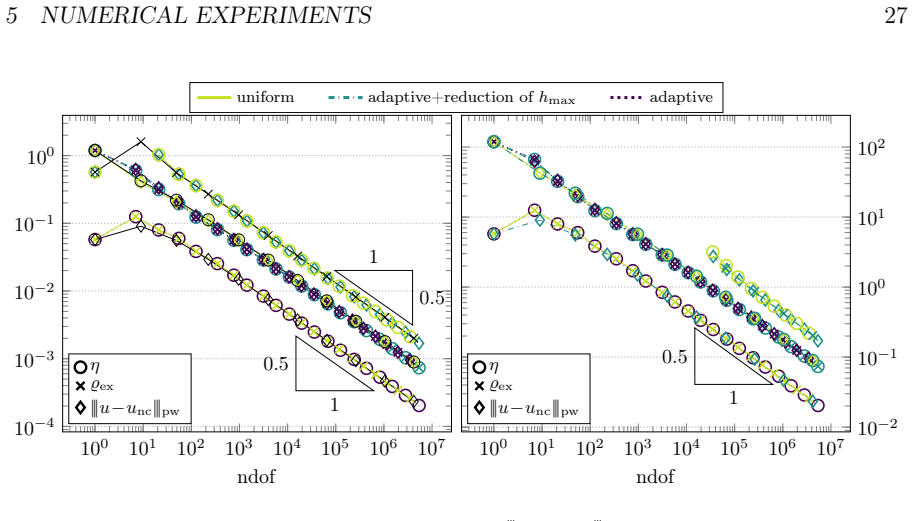
A Newton--Kantorovich-type argument enables the a posteriori existence verification of a unique regular root near a computed approximation, purely from computable data. This framework allows for non-selfadjoint problems and extends the existing verification theory to nonconforming discretisations. A key ingredient is a guaranteed lower bound on the continuous inf-sup constant from a quasi-optimal nonconforming discretisation that enables a novel a priori error estimator. All quantities are obtained by post-processing a single discretisation; convergence rates are proved. The theory is applied to a fourth-order formulation of the stationary two-dimensional Navier--Stokes equations and illustrated by numerical experiments.
Editorial analysis
A structured set of objections, weighed in public.
Referee Report
Summary. The paper develops a Newton-Kantorovich-type a posteriori framework for verifying existence and uniqueness of a unique regular root for semilinear elliptic problems near a computed approximation, using only computable quantities. A central ingredient is a guaranteed lower bound on the continuous inf-sup constant extracted from a quasi-optimal nonconforming finite element discretization; this bound also produces a novel a priori error estimator. The theory extends prior verification results to non-selfadjoint operators and nonconforming spaces, proves convergence rates, and is applied to a fourth-order formulation of the stationary two-dimensional Navier-Stokes equations with supporting numerical experiments.
Significance. If the derivations hold, the work supplies a practical, computable route to rigorous existence verification for nonlinear problems where conforming methods are inconvenient or unavailable. The explicit construction of the inf-sup lower bound from a single discretization, the mesh-regularity hypotheses that guarantee positivity independent of mesh size, and the proved convergence rates under those hypotheses are concrete strengths that enhance reliability in applications such as fluid dynamics.
minor comments (3)
- [§2.2] §2.2, definition of the nonconforming space: the quasi-optimality statement would be easier to verify if the precise mesh-regularity assumption (e.g., shape-regularity constant) were stated explicitly rather than referenced to an external lemma.
- [Table 1] Table 1 (Navier-Stokes example): the reported inf-sup lower bounds decrease slightly with refinement; a short remark explaining whether this is consistent with the proved mesh-independent positivity would prevent reader confusion.
- [Abstract / Introduction] The abstract claims 'convergence rates are proved' but does not indicate the norms or the order; adding one sentence in the introduction summarizing the rates would improve accessibility.
Simulated Author's Rebuttal
We thank the referee for the positive assessment of our manuscript, the accurate summary of its contributions, and the recommendation for minor revision. The referee's description correctly identifies the key elements: the Newton-Kantorovich a posteriori verification framework, the guaranteed inf-sup lower bound from a nonconforming discretization, the extension to non-selfadjoint operators, the convergence rates, and the application to the stationary Navier-Stokes equations.
Circularity Check
No significant circularity; derivation self-contained
full rationale
The paper obtains a guaranteed lower bound on the continuous inf-sup constant via post-processing of a single quasi-optimal nonconforming discretization, then applies a Newton-Kantorovich argument for a posteriori existence verification of a unique regular root. Both steps rest on explicitly stated mesh-regularity hypotheses, standard functional-analytic estimates, and proved a priori error bounds that are independent of the target existence result. No equation or claim reduces by construction to a fitted parameter, self-definition, or self-citation chain; the cited verification theory is extended rather than presupposed, and the Navier-Stokes example satisfies the stated regularity without internal inconsistency.
Axiom & Free-Parameter Ledger
axioms (2)
- domain assumption The continuous problem satisfies the conditions for the Newton-Kantorovich theorem to apply near the approximation.
- domain assumption The nonconforming discretization is quasi-optimal for the inf-sup constant.
Reference graph
Works this paper leans on
-
[1]
T. Aubin. Probl \`e mes isop \'e rim \'e triques et espaces de Sobolev . J. Differential Geom. , 11(4), January 1976
work page 1976
-
[2]
F. Bertrand, C. Carstensen, B. Gr \"a le, and N. T. Tran. Stabilization-free HHO a posteriori error control. Numer. Math. , 154(3-4):369--408, August 2023
work page 2023
-
[3]
A. Bespalov, A. Haberl, and D. Praetorius. Adaptive FEM with coarse initial mesh guarantees optimal convergence rates for compactly perturbed elliptic problems. Comput. Methods Appl. Mech. Eng. , 317:318--340, April 2017
work page 2017
-
[4]
S. C. Brenner, M. Neilan, A. Reiser, and L.-Y. Sung. A C ^0 interior penalty method for a von K \'a rm \'a n plate. Numer. Math. , 135(3):803--832, March 2017
work page 2017
-
[5]
D. Braess. Finite Elements : Theory , Fast Solvers , and Applications in Elasticity Theory . Cambridge University Press, Cambridge, 3 edition, 2007
work page 2007
-
[6]
S. C. Brenner and L. R. Scott. The Mathematical Theory of Finite Element Methods , volume 15 of Texts in Applied Mathematics . Springer New York, New York, NY, 2008
work page 2008
-
[7]
C. Carstensen and D. Gallistl. Guaranteed lower eigenvalue bounds for the biharmonic equation. Numer. Math. , 126(1):33--51, January 2014
work page 2014
-
[8]
C. Carstensen and B. Gr \"a le. Rate-optimal higher-order adaptive conforming FEM for biharmonic eigenvalue problems on polygonal domains. Comput. Methods Appl. Mech. Eng. , 425:116931, May 2024
work page 2024
-
[9]
C. Carstensen and B. Gr \"a le. Adaptive Morley FEM for 2D stationary Navier-Stokes . Math. Comp. , 95(358):613--645, March 2025
work page 2025
-
[10]
C. Carstensen and B. Gr \"a le. Optimal convergence rates of adaptive WOPSIP from superclose nonconforming FEM . Math. Comp. , March 2025
work page 2025
-
[11]
P. G. Ciarlet, L. Gratie, and S. Kesavan. On the generalized von Karman equations and their approximation. Math. Models Methods Appl. Sci. , 17(04):617--633, April 2007
work page 2007
-
[12]
C. Carstensen, B. Gr \"a le, and N. Nataraj. A posteriori error control for fourth-order semilinear problems with quadratic nonlinearity. SIAM J. Numer. Anal. , 62(2):919--945, April 2024
work page 2024
-
[13]
C. Carstensen, B. Gr \"a le, and N. Nataraj. Unifying a posteriori error analysis of five piecewise quadratic discretisations for the biharmonic equation. J. Numer. Math. , 32(1):77--109, 2024
work page 2024
-
[14]
P. G. Ciarlet. The Finite Element Method for Elliptic Problems . Classics in Applied Mathematics . Society for Industrial and Applied Mathematics , January 2002
work page 2002
-
[15]
P. G. Ciarlet and C. Mardare. On the Newton-Kantorovich theorem. Anal. Appl. , 10(03):249--269, July 2012
work page 2012
-
[16]
C. Carstensen, G. Mallik, and N. Nataraj. A priori and a posteriori error control of discontinuous Galerkin finite element methods for the von K \'a rm \'a n equations. IMA J. Numer. Anal. , 39:167--200, 2019
work page 2019
-
[17]
C. Carstensen, G. Mallik, and N. Nataraj. Nonconforming finite element discretization for semilinear problems with trilinear nonlinearity. IMA J. Numer. Anal. , 41(1):164--205, January 2021
work page 2021
-
[18]
M. Cayco and R. Nicolaides. Analysis of nonconforming stream function and pressure finite element spaces for the Navier-Stokes equations. Comput. Math. Appl. , 18(8):745--760, 1989
work page 1989
-
[19]
C. Carstensen and N. Nataraj. A priori and a posteriori error analysis of the Crouzeix -- Raviart and Morley FEM with original and modified right-hand sides. Comput. Methods Appl. Math. , 21(2):289--315, 2021
work page 2021
-
[20]
C. Carstensen and N. Nataraj. Lowest-order equivalent nonstandard finite element methods for biharmonic plates. ESAIM: M2AN , 56(1):41--78, January 2022
work page 2022
-
[21]
C. Carstensen, N. Nataraj, G. C. Remesan, and D. Shylaja. Unified a priori analysis of four second-order FEM for fourth-order quadratic semilinear problems. Numer. Math. , 154(3-4):323--368, August 2023
work page 2023
-
[22]
C. Foias and G. Prodi. Sur le comportement global des solutions non-stationnaires des \'e quations de Navier-Stokes en dimension 2 . Rend. Semin. Mat. Univ. Padova , 39:1--34, 1967
work page 1967
-
[23]
C. Foias and R. Temam. Structure of the set of stationary solutions of the Navier - Stokes equations. Comm. Pure Appl. Math. , 30(2):149--164, March 1977
work page 1977
- [24]
-
[25]
K. Geba. The Leray-Schauder degree and framed bordism. Th \'e orie Points Fixes Ses Appl. \`A L'analyse , 1975
work page 1975
-
[26]
V. Girault and P.-A. Raviart. Finite Element Methods for Navier-Stokes Equations : Theory and Algorithms . Number 5 in Springer series in computational mathematics. Springer, Berlin, softcover reprint of the hardcover 1. ed. 1986 edition, 1986
work page 1986
- [27]
- [28]
-
[29]
J. Haegeman. KrylovKit (v0.7.1). https://doi.org/10.5281/zenodo.10884302, 2024
-
[30]
P. Jamet and P. A. Raviart. Numerical solution of the stationary Navier-Stokes equations by finite element methods. In Computing Methods in Applied Sciences and Engineering Part 1 , volume 10, pages 193--223. Springer Berlin Heidelberg, Berlin, Heidelberg, 1974
work page 1974
-
[31]
G. H. Knightly. An existence theorem for the von K \'a rm \'a n equations. Arch. Ration. Mech. Anal. , 27(3):233--242, 1967
work page 1967
-
[32]
X. Liu, M. T. Nakao, and S. Oishi. Computer-assisted proof for the stationary solution existence of the Navier -- Stokes equation over 3D domains. Commun. Nonlinear Sci. Numer. Simul. , 108:106223, May 2022
work page 2022
- [33]
-
[34]
S.-K. Liao, Y.-C. Shu, and X. Liu. Optimal estimation for the Fujino -- Morley interpolation error constants. Japan J. Indust. Appl. Math. , 36(2):521--542, July 2019
work page 2019
-
[35]
R. Ma. The constants for the L ^2 error estimates of the interpolation of Morley-Wang-Xu elements . Research seminar talk at Humboldt-Universit \"a t zu Berlin, 2021
work page 2021
-
[36]
G. Mallik and N. Nataraj. A nonconforming finite element approximation for the von Karman equations. ESAIM: M2AN , 50(2):433--454, March 2016
work page 2016
-
[37]
M. T. Nakao. A numerical approach to the proof of existence of solutions for elliptic problems. Japan J. Appl. Math. , 5(2):313--332, June 1988
work page 1988
-
[38]
M. T. Nakao, K. Hashimoto, and Y. Watanabe. A numerical method to verify the invertibility of linear elliptic operators with applications to nonlinear problems. Computing , 75(1):1--14, July 2005
work page 2005
-
[39]
M. T. Nakao, M. Plum, and Y. Watanabe. Numerical Verification Methods and Computer-Assisted Proofs for Partial Differential Equations , volume 53 of Springer Series in Computational Mathematics . Springer Singapore, Singapore, 2019
work page 2019
-
[40]
M. Plum. Computer-assisted proofs for semilinear elliptic boundary value problems. Japan J. Indust. Appl. Math. , 26(2-3):419--442, October 2009
work page 2009
-
[41]
a t zu Berlin, Mathematisch-Naturwissenschaftliche Fakult \
S. L. Puttkammer. Direct Guaranteed Lower Eigenvalue Bounds with Quasi-Optimal Adaptive Mesh-Refinement . PhD thesis, Humboldt-Universit \"a t zu Berlin, Mathematisch-Naturwissenschaftliche Fakult \"a t, 2024
work page 2024
-
[42]
F. Quinn and A. Sard. Hausdorff conullity of critical images of Fredholm maps. Amer. J. Math. , 94(4):1101, October 1972
work page 1972
-
[43]
S. Smale. An infinite dimensional version of Sard 's theorem. Amer. J. Math. , 87(4):861--866, 1965
work page 1965
-
[44]
J. Saut and R. Temam. Generic properties of nonlinear boundary value problems. Commun. Partial Differ. Equ. , 4(3):293--319, January 1979
work page 1979
-
[45]
D. B. Szyld. The many proofs of an identity on the norm of oblique projections. Numer. Algorithms , 42(3-4):309--323, November 2006
work page 2006
-
[46]
G. Talenti. Best constant in Sobolev inequality. Ann. Mat. Pura Appl. , 110(1):353--372, December 1976
work page 1976
-
[47]
R. Temam. Navier-- Stokes Equations and Nonlinear Functional Analysis : Second Edition . Society for Industrial and Applied Mathematics , January 1995
work page 1995
-
[48]
A. Takayasu, X. Liu, and S. Oishi. Verified computations to semilinear elliptic boundary value problems on arbitrary polygonal domains. NOLTA , 4(1):34--61, 2013
work page 2013
-
[49]
A. Veeser and P. Zanotti. Quasi-optimal nonconforming methods for symmetric elliptic problems. II---overconsistency and classical nonconforming elements. SIAM J. Numer. Anal. , 57(1):266--292, January 2019
work page 2019
-
[50]
Y. Watanabe, M. T. Nakao, and K. Nagatou. On the compactness of a nonlinear operator related to stream function-vorticity formulation for the Navier-Stokes equations. JSIAM Letters , 9(0):77--80, 2017
work page 2017
-
[51]
E. Zeidler. Nonlinear Functional Analysis and Its Applications . 1: Fixed-point Theorems . Springer, New York Berlin Heidelberg, corr. 2. print edition, 1992
work page 1992
-
[52]
E. Zeidler. Nonlinear Functional Analysis and Its Applications . 4: Applications to Mathematical Physics . Springer, New York Berlin Heidelberg, corr. 2. print edition, 1997
work page 1997
discussion (0)
Sign in with ORCID, Apple, or X to comment. Anyone can read and Pith papers without signing in.