Recognition: no theorem link
Not Another EHR: Reimagining Physician Information Needs with Generative AI Technology
Pith reviewed 2026-05-15 00:02 UTC · model grok-4.3
The pith
Generative AI can power adaptive interfaces that help physicians navigate and synthesize complex patient data in real time.
A machine-rendered reading of the paper's core claim, the machinery that carries it, and where it could break.
Core claim
By interviewing physicians about their information needs and AI conceptualizations, the paper establishes that generative AI can support clinician-centered workflows through dynamic interactions with patient data, moving beyond the limitations of traditional EHR systems.
What carries the argument
Generative user interfaces that use large language models to enable adaptive, query-driven synthesis of patient data based on physicians' diagnostic workflows and trust expectations.
If this is right
- Clinicians could query patient records in natural language to receive synthesized summaries tailored to the current diagnostic step.
- Interfaces would adapt dynamically as the physician's focus shifts during a case.
- Designs informed by mental models could increase appropriate reliance on AI outputs.
- Overall cognitive load from data review would decrease, allowing more time for direct patient care.
Where Pith is reading between the lines
- These generative interfaces might be generalized across different healthcare systems if they rely on common data standards.
- Integration with existing EHR platforms could face technical hurdles related to data privacy and model accuracy.
- Further studies in varied clinical environments would be needed to validate the interview findings.
Load-bearing premise
Findings from interviews with a small number of internal Microsoft physicians will generalize to other clinical settings and translate into practical, effective generative interface designs.
What would settle it
A controlled study in which physicians using generative AI interfaces show no reduction in time spent on data review or no improvement in diagnostic accuracy compared to using conventional EHRs.
Figures

read the original abstract
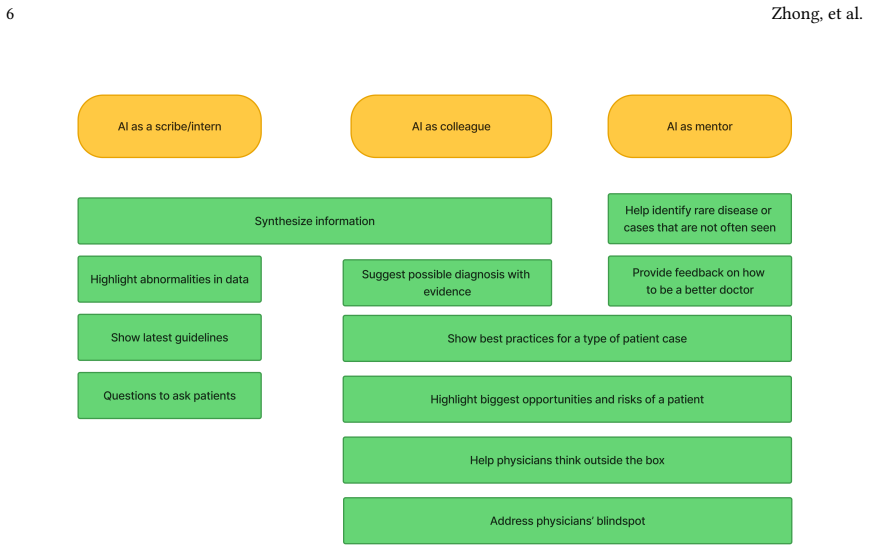
Electronic health records (EHRs) have improved data accessibility but have also introduced cognitive burden for physicians, given the sheer volume and complexity of the data involved. Advances in large language models (LLMs) create new opportunities to rethink how clinicians interact with medical data through dynamic, adaptive interfaces. In this position paper, we explore how generative AI can support physicians' information needs by enabling more dynamic interactions with patient data. Through semi-structured interviews with internal physicians at Microsoft, we identify key challenges in data navigation and synthesis, and characterize clinicians' information needs during diagnostic workflows. We further examine how physicians conceptualize AI can help their work process and how these mental models shape expectations for interaction and trust. Based on these insights, we discuss design considerations for generative user interfaces that support clinician-centered workflows.
Editorial analysis
A structured set of objections, weighed in public.
Referee Report
Summary. This position paper argues that advances in large language models enable a rethinking of physician interactions with electronic health records through dynamic, adaptive generative AI interfaces. Based on semi-structured interviews with internal Microsoft physicians, it identifies challenges in data navigation and synthesis during diagnostic workflows, characterizes clinicians' information needs and mental models of AI assistance, and proposes design considerations for generative user interfaces that support clinician-centered processes.
Significance. If the interview-derived insights prove robust and generalizable, the work could meaningfully inform HCI and health informatics research by shifting focus from incremental EHR improvements to generative AI-driven interfaces that reduce cognitive load and better align with clinical mental models. The position-paper format usefully surfaces forward-looking design considerations and trust-related expectations, providing a foundation for future empirical studies on AI-augmented clinical tools.
major comments (2)
- [Abstract/Methods] Abstract and Methods: The semi-structured interviews with internal Microsoft physicians are the sole empirical basis for identifying information needs, mental models, and design considerations, yet no sample size, recruitment criteria, interview protocol, saturation details, or analysis method are reported. This absence directly affects the ability to evaluate the validity and scope of the central claims.
- [Discussion] Discussion: The paper does not explicitly address potential biases or limits to generalizability arising from sampling only internal Microsoft physicians, who may differ systematically from academic, community, or international clinicians in technology exposure, workflow constraints, and institutional context. This is load-bearing for translating the insights into broadly applicable generative UI proposals.
minor comments (1)
- [Abstract] The abstract would benefit from explicitly labeling the work as a position paper and briefly noting the qualitative synthesis approach to set reader expectations.
Simulated Author's Rebuttal
We thank the referee for the constructive feedback on our position paper. The comments highlight important issues of methodological transparency and scope that we will address through revision. We respond to each major comment below.
read point-by-point responses
-
Referee: [Abstract/Methods] Abstract and Methods: The semi-structured interviews with internal Microsoft physicians are the sole empirical basis for identifying information needs, mental models, and design considerations, yet no sample size, recruitment criteria, interview protocol, saturation details, or analysis method are reported. This absence directly affects the ability to evaluate the validity and scope of the central claims.
Authors: We agree that the current manuscript lacks sufficient detail on the interview methodology. Although the work is framed as a position paper in which the interviews primarily serve to inform forward-looking design considerations rather than to generate generalizable empirical results, we will revise the manuscript to add a dedicated Methods subsection. This subsection will report the sample size, recruitment criteria, interview protocol, thematic analysis procedure, and any steps taken toward saturation. revision: yes
-
Referee: [Discussion] Discussion: The paper does not explicitly address potential biases or limits to generalizability arising from sampling only internal Microsoft physicians, who may differ systematically from academic, community, or international clinicians in technology exposure, workflow constraints, and institutional context. This is load-bearing for translating the insights into broadly applicable generative UI proposals.
Authors: We agree that the sampling frame introduces potential biases and constrains generalizability, and that these issues should be stated explicitly. In the revised manuscript we will expand the Discussion to include a dedicated limitations subsection that addresses differences in technology exposure, institutional context, and workflow constraints relative to academic, community, and international settings. We will also note the implications for the proposed design considerations and suggest avenues for future validation with broader clinician populations. revision: yes
Circularity Check
No significant circularity in interview-driven position paper
full rationale
The paper is a position paper that draws insights from semi-structured interviews with internal Microsoft physicians to characterize information needs and discuss design considerations for generative AI interfaces. There are no equations, derivations, fitted parameters, or self-citations that form a load-bearing chain reducing claims to inputs by construction. The central claims rest on external interview data rather than self-referential modeling, making the derivation self-contained against external benchmarks.
Axiom & Free-Parameter Ledger
Reference graph
Works this paper leans on
-
[1]
Md Manjurul Ahsan, Shahana Akter Luna, and Zahed Siddique. 2022. Machine-learning-based disease diagnosis: A comprehensive review. In Healthcare, Vol. 10. MDPI, 541
work page 2022
-
[2]
Abidemi O Akinrinmade, Temitayo M Adebile, Chioma Ezuma-Ebong, Kafayat Bolaji, Afomachukwu Ajufo, Aisha O Adigun, Majed Mohammad, Juliet C Dike, and Okelue E Okobi. 2023. Artificial intelligence in healthcare: perception and reality.Cureus15, 9 (2023). Manuscript submitted to ACM 4 Zhong, et al
work page 2023
-
[3]
AR Bakker. 2007. The need to know the history of the use of digital patient data, in particular the EHR.International Journal of Medical Informatics 76, 5-6 (2007), 438–441
work page 2007
-
[4]
Mohsen Bayati, Mark Braverman, Michael Gillam, Karen M Mack, George Ruiz, Mark S Smith, and Eric Horvitz. 2014. Data-driven decisions for reducing readmissions for heart failure: General methodology and case study.PloS one9, 10 (2014), e109264
work page 2014
- [5]
-
[6]
Nur Efsan Cetinkaya and Nicole Krämer. 2025. Between transparency and trust: identifying key factors in AI system perception.Behaviour & Information Technology(2025), 1–15
work page 2025
-
[7]
Siyuan Chen and Julien Epps. 2014. Using task-induced pupil diameter and blink rate to infer cognitive load.Human–Computer Interaction29, 4 (2014), 390–413
work page 2014
-
[8]
Han Shi Jocelyn Chew and Palakorn Achananuparp. 2022. Perceptions and needs of artificial intelligence in health care to increase adoption: scoping review.Journal of medical Internet research24, 1 (2022), e32939
work page 2022
-
[9]
Daniel C Delrose and Richard W Steinberg. 2000. The clinical significance of the digital patient record.The Journal of the American Dental Association 131 (2000), 57S–60S
work page 2000
-
[10]
Leela Naga Sai Vamsi Krishna Dogiparthi. 2025. Building Intelligent Adaptive User Interfaces (IAUI) With Artificial Intelligence & LLM Models. (2025)
work page 2025
-
[11]
Cheng-Feng Dou, Ying Zhang, Zhi Jin, Wen-Pin Jiao, Hai-Yan Zhao, Yong-Qiang Zhao, and Zheng-Wei Tao. 2025. Exploring LLM-Based Data Synthesis Strategies for Aligning Medical Consultation Preferences.Journal of Computer Science and Technology40, 6 (2025), 1485–1498
work page 2025
-
[12]
Yifei Duan, Liuqingqing Yang, Tong Zhang, Zhijun Song, and Fenghua Shao. 2025. Automated UI Interface Generation via Diffusion Models: Enhancing Personalization and Efficiency. In2025 4th International Symposium on Computer Applications and Information Technology (ISCAIT). IEEE, 780–783
work page 2025
-
[13]
Diana E Forsythe, Bruce G Buchanan, Jerome A Osheroff, and Randolph A Miller. 1992. Expanding the concept of medical information: an observational study of physicians’ information needs.Computers and Biomedical Research25, 2 (1992), 181–200
work page 1992
-
[14]
Sebastian J Fritsch, Andrea Blankenheim, Alina Wahl, Petra Hetfeld, Oliver Maassen, Saskia Deffge, Julian Kunze, Rolf Rossaint, Morris Riedel, Gernot Marx, et al. 2022. Attitudes and perception of artificial intelligence in healthcare: a cross-sectional survey among patients.Digital health8 (2022), 20552076221116772
work page 2022
-
[15]
Dana B Gal, Brian Han, Chistopher Longhurst, David Scheinker, and Andrew Y Shin. 2021. Quantifying electronic health record data: a potential risk for cognitive overload.Hospital Pediatrics11, 2 (2021), 175–178
work page 2021
-
[16]
Michael Gerlich. 2023. Perceptions and acceptance of artificial intelligence: A multi-dimensional study.Social Sciences12, 9 (2023), 502
work page 2023
-
[17]
Nafiseh Ghaffar Nia, Erkan Kaplanoglu, and Ahad Nasab. 2023. Evaluation of artificial intelligence techniques in disease diagnosis and prediction. Discover Artificial Intelligence3, 1 (2023), 5
work page 2023
-
[18]
Akash Ghosh, Bo Huang, Yan Yan, and Wenjun Lin. 2024. Enhancing healthcare user interfaces through large language models within the adaptive user interface framework. InInternational Congress on Information and Communication Technology. Springer, 527–540
work page 2024
-
[19]
Ana I González-González, Martin Dawes, José Sánchez-Mateos, Rosario Riesgo-Fuertes, Esperanza Escortell-Mayor, Teresa Sanz-Cuesta, and Tomás Hernández-Fernández. 2007. Information needs and information-seeking behavior of primary care physicians.The Annals of Family Medicine5, 4 (2007), 345–352
work page 2007
-
[20]
Yi Gui, Yao Wan, Zhen Li, Zhongyi Zhang, Dongping Chen, Hongyu Zhang, Yi Su, Bohua Chen, Xing Zhou, Wenbin Jiang, et al. 2025. UICoPilot: Automating UI synthesis via hierarchical code generation from webpage designs. InProceedings of the ACM on Web Conference 2025. 1846–1855
work page 2025
- [21]
-
[22]
Prithima Reddy Mosaly, Lukasz M Mazur, Fei Yu, Hua Guo, Merck Derek, David H Laidlaw, Carlton Moore, Lawrence B Marks, and Javed Mostafa
-
[23]
International Journal of Human–Computer Interaction34, 5 (2018), 467–475
Relating task demand, mental effort and task difficulty with physicians’ performance during interactions with electronic health records (EHRs). International Journal of Human–Computer Interaction34, 5 (2018), 467–475
work page 2018
-
[24]
C Murphy and IJ Keogh. 2023. The evolution of the medical record from paper to digital: an ENT perspective.The Journal of Laryngology & Otology 137, 3 (2023), 246–248
work page 2023
-
[25]
Kálmán Balázs Neszlényi, Alex Milos, and Attila Kiss. 2024. AssistantGPT: Enhancing User Interaction with LLM Integration. In2024 IEEE 22nd Jubilee International Symposium on Intelligent Systems and Informatics (SISY). IEEE, 000619–000624
work page 2024
-
[26]
Stephen H Walsh. 2004. The clinician’s perspective on electronic health records and how they can affect patient care.Bmj328, 7449 (2004), 1184–1187
work page 2004
-
[27]
Shixiao Wang, Runsheng Zhang, and Xue Shi. 2025. Generative UI Design with Diffusion Models: Exploring Automated Interface Creation and Human-Computer Interaction.Transactions on Computational and Scientific Methods5, 3 (2025)
work page 2025
-
[28]
Jenna Wiens, John Guttag, and Eric Horvitz. 2016. Patient risk stratification with time-varying parameters: a multitask learning approach.Journal of Machine Learning Research17, 79 (2016), 1–23
work page 2016
-
[29]
Jason Wu, Amanda Swearngin, Arun Krishna Vajjala, Alan Leung, Jeffrey Nichols, and Titus Barik. 2025. Improving User Interface Generation Models from Designer Feedback.arXiv preprint arXiv:2509.16779(2025). Manuscript submitted to ACM Not Another EHR: Reimagining Physician Information Needs with Generative AI Technology 5
-
[30]
Chaoran Yu and Ernest Johann Helwig. 2022. The role of AI technology in prediction, diagnosis and treatment of colorectal cancer.Artificial intelligence review55, 1 (2022), 323–343
work page 2022
-
[31]
Xiaoan Zhan, Yang Xu, and Yingchia Liu. 2024. Personalized UI layout generation using deep learning: An adaptive interface design approach for enhanced user experience.International Journal of Engineering and Management Research14, 5 (2024), 134–147
work page 2024
-
[32]
Bo Zhang, Huiping Shi, and Hongtao Wang. 2023. Machine learning and AI in cancer prognosis, prediction, and treatment selection: a critical approach.Journal of multidisciplinary healthcare(2023), 1779–1791. A Appendix Fig. 1. This figure presents physicians’ current workflow to collect and analyze patient information throughout patient visits. Manuscript ...
work page 2023
discussion (0)
Sign in with ORCID, Apple, or X to comment. Anyone can read and Pith papers without signing in.