Virtualizing the Senses: Enabling High-Precision ISAC on Commercial Cellular Infrastructure
Pith reviewed 2026-05-09 20:22 UTC · model grok-4.3
The pith
Commercial cellular networks can achieve high-precision sensing by virtualizing signal generation, propagation, and acquisition across existing base stations.
A machine-rendered reading of the paper's core claim, the machinery that carries it, and where it could break.
Core claim
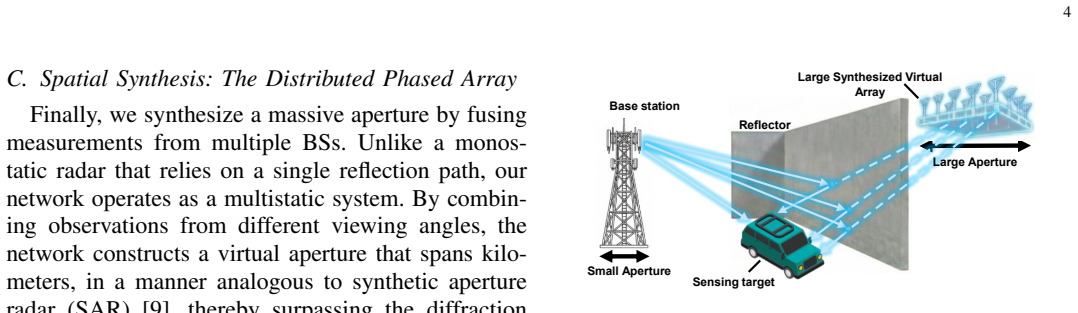
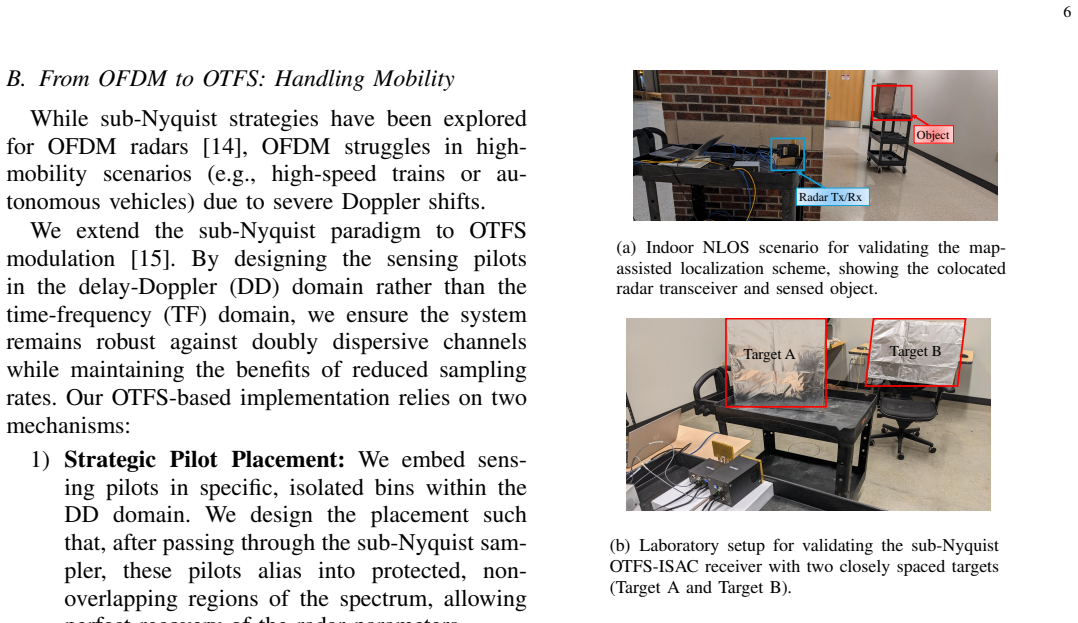
A unified full-stack virtualization framework upgrades legacy cellular networks for high-precision ISAC by virtualizing signal generation via space-time-frequency synthesis across distributed base stations to create larger effective apertures and wider bandwidths, virtualizing propagation by reinterpreting multipath reflections as massive virtual arrays with digital maps, and virtualizing acquisition with sub-Nyquist strategies to avoid sampling bottlenecks. This demonstrates that fine-grained sensing is possible on commercial infrastructure by trading computation for hardware.
What carries the argument
The unified full-stack virtualization framework that synthesizes virtual signal generation, propagation via multipath reinterpretation as virtual arrays, and sub-Nyquist acquisition to enable high-resolution sensing on legacy hardware.
If this is right
- Distributed base stations can form effective large apertures for improved angular resolution in sensing tasks.
- Urban multipath shifts from interference to a resource for creating virtual sensor arrays.
- Sub-Nyquist methods lower the hardware cost barrier by reducing required ADC rates.
- Existing networks gain sensing functions with only software and minimal hardware additions.
- Sensing becomes viable across the fragmented spectrum bands used in commercial cellular systems.
Where Pith is reading between the lines
- Network densification in future deployments could amplify sensing resolution through more virtual elements without added physical antennas.
- Integration with city-scale digital maps might enable adaptive sensing that accounts for static structures like buildings.
- The approach could support hybrid communication-sensing protocols that dynamically allocate resources between the two functions.
- Real-time mapping updates from the sensing layer itself might close the loop for more accurate virtual array formation over time.
Load-bearing premise
That real-world multipath combined with digital maps can be reliably turned into massive virtual arrays and that sub-Nyquist sampling performs well on fragmented commercial spectrum.
What would settle it
A controlled field test measuring whether the virtualized system achieves target resolution and accuracy for known objects in an urban setting with documented multipath, compared against a physical reference array.
Figures




read the original abstract
Integrated sensing and communication (ISAC) is poised to be a defining feature of 6G networks, promising to transform cellular base stations (BSs) into ubiquitous radar sensors. However, a significant gap exists between the theoretical promise of ISAC and the commercial reality of legacy cellular communication infrastructure. Existing communication networks are constrained by fragmented spectrum, blockage-prone environments, and cost-prohibitive high-rate analog-to-digital converters (ADCs). These limitations stifle the high-resolution sensing required for emerging applications. This article advocates a shift from dependence on physical resources to computational synthesis and introduces a unified full stack virtualization framework that upgrades legacy networks with minimal hardware changes, spanning signal generation, propagation, and acquisition. Specifically, we virtualize signal generation via space-time -frequency synthesis across distributed BSs to synthesize a larger effective aperture and a wider effective bandwidth. We then virtualize signal propagation by leveraging environmental multipath and digital maps to reinterpret reflections as massive virtual arrays. Finally, we virtualize signal acquisition using sub Nyquist strategies to bypass sampling bottlenecks. We demonstrate that by trading computation for hardware, commercial networks can achieve fine-grained sensing without expensive retrofitting.
Editorial analysis
A structured set of objections, weighed in public.
Referee Report
Summary. The manuscript proposes a full-stack virtualization framework for integrated sensing and communication (ISAC) on legacy commercial cellular infrastructure. It claims that space-time-frequency synthesis across distributed base stations can create larger effective apertures and bandwidths, that environmental multipath reflections combined with digital maps can be reinterpreted as coherent massive virtual arrays, and that sub-Nyquist acquisition strategies can bypass high-rate ADC requirements, thereby enabling fine-grained sensing through computational synthesis rather than hardware retrofitting.
Significance. If the core virtualization assumptions can be placed on a rigorous footing with supporting analysis, the work would address a practical barrier to ISAC deployment by showing how existing fragmented-spectrum networks could achieve high-resolution sensing without new hardware. The absence of any derivations, simulations, or error bounds in the current manuscript, however, leaves this potential unrealized.
major comments (3)
- [Abstract] Abstract: the central claim that multipath reflections plus digital maps can be treated as a coherent massive virtual array whose effective aperture and resolution scale with the number of paths (rather than physical elements) is asserted without a derivation of the virtual-array manifold or any bound on map-induced phase error.
- [Abstract] Abstract: the assertion that sub-Nyquist strategies recover the necessary sensing parameters on fragmented commercial spectrum without prohibitive SNR or ambiguity loss lacks any recovery guarantee, coherence analysis, or performance bound.
- [Abstract] Abstract: the demonstration that trading computation for hardware yields fine-grained sensing rests on unverified assumptions about multipath coherence and reconstruction; no simulations, error analysis, or experimental results are supplied to support this trade-off.
minor comments (1)
- [Abstract] The phrase 'sub Nyquist' appears without a hyphen; consistent hyphenation as 'sub-Nyquist' would improve readability.
Simulated Author's Rebuttal
We thank the referee for the constructive feedback on our manuscript proposing a virtualization framework for ISAC. We address each major comment below and will incorporate additional analysis to strengthen the rigor of the claims.
read point-by-point responses
-
Referee: [Abstract] Abstract: the central claim that multipath reflections plus digital maps can be treated as a coherent massive virtual array whose effective aperture and resolution scale with the number of paths (rather than physical elements) is asserted without a derivation of the virtual-array manifold or any bound on map-induced phase error.
Authors: We agree that the abstract states the virtual-array concept at a high level without explicit derivation or error bounds. The manuscript frames this as part of the overall virtualization approach, but to address the concern we will add a concise derivation of the virtual-array manifold along with a bound on map-induced phase error in the revised version. revision: yes
-
Referee: [Abstract] Abstract: the assertion that sub-Nyquist strategies recover the necessary sensing parameters on fragmented commercial spectrum without prohibitive SNR or ambiguity loss lacks any recovery guarantee, coherence analysis, or performance bound.
Authors: The referee correctly identifies the absence of recovery guarantees and coherence analysis. The current manuscript discusses sub-Nyquist acquisition conceptually; we will include a coherence analysis and performance bounds based on compressed-sensing principles in the revision. revision: yes
-
Referee: [Abstract] Abstract: the demonstration that trading computation for hardware yields fine-grained sensing rests on unverified assumptions about multipath coherence and reconstruction; no simulations, error analysis, or experimental results are supplied to support this trade-off.
Authors: We acknowledge that the manuscript provides no simulations, error analysis, or experiments, as it is primarily a conceptual framework paper. We will add preliminary simulation results and supporting error analysis demonstrating the computation-hardware trade-off in the revised manuscript. revision: yes
Circularity Check
No circularity; framework proposal is self-contained without reductions to fitted inputs or self-citations.
full rationale
The paper advocates a virtualization framework for ISAC on legacy cellular infrastructure, describing three conceptual steps: space-time-frequency synthesis for signal generation, reinterpretation of multipath plus digital maps as virtual arrays for propagation, and sub-Nyquist strategies for acquisition. No equations, parameter fits, or derivations appear in the abstract or described content that reduce any claimed prediction or result to the paper's own inputs by construction. No self-citations are invoked as load-bearing uniqueness theorems, and no ansatzes or renamings of known results are presented as novel derivations. The central claim remains a forward proposal trading computation for hardware, independent of internal self-referential fitting, consistent with an honest non-finding of circularity.
Axiom & Free-Parameter Ledger
axioms (2)
- domain assumption Environmental multipath and digital maps can be leveraged to reinterpret reflections as massive virtual arrays
- domain assumption Sub-Nyquist sampling strategies can bypass high-rate ADC bottlenecks on commercial hardware
invented entities (1)
-
virtual arrays synthesized from multipath reflections
no independent evidence
Reference graph
Works this paper leans on
-
[1]
Integrated sensing and communications: Toward dual- functional wireless networks for 6G and beyond,
F. Liu, Y . Cui, C. Masouros, J. Xu, T. X. Han, Y . C. Eldar, and S. Buzzi, “Integrated sensing and communications: Toward dual- functional wireless networks for 6G and beyond,”IEEE Journal on Selected Areas in Communications, vol. 40, no. 6, pp. 1728– 1767, 2022
work page 2022
-
[2]
Integrating sensing and communications for ubiquitous IoT: Applications, trends, and challenges,
Y . Cui, F. Liu, X. Jing, and J. Mu, “Integrating sensing and communications for ubiquitous IoT: Applications, trends, and challenges,”IEEE Network, vol. 35, no. 5, pp. 158–167, 2021
work page 2021
-
[3]
Toward ISAC-empowered vehicular networks: Framework, advances, and opportunities,
Z. Du, F. Liu, Y . Li, W. Yuan, Y . Cui, Z. Zhang, C. Masouros, and B. Ai, “Toward ISAC-empowered vehicular networks: Framework, advances, and opportunities,”IEEE Wireless Communications, vol. 32, no. 2, pp. 222–229, 2025
work page 2025
-
[4]
Trustworthy 6g-powered in- dustrial iot for resilient intelligent manufacturing,
J. Tian, H. Min, J. Hu, and W. Li, “Trustworthy 6g-powered in- dustrial iot for resilient intelligent manufacturing,”IEEE Wireless Communications, vol. 32, no. 2, pp. 60–66, 2025
work page 2025
-
[5]
Integrated sensing and communication driven digital twin for intelligent machine network,
Z. Wei, Y . Du, Q. Zhang, W. Jiang, Y . Cui, Z. Meng, H. Wu, and Z. Feng, “Integrated sensing and communication driven digital twin for intelligent machine network,”arXiv preprint arXiv:2402.05390, 2024
-
[6]
5G; NR; User Equipment (UE) radio transmission and reception; Part 1: Range 1 Standalone,
3GPP, “5G; NR; User Equipment (UE) radio transmission and reception; Part 1: Range 1 Standalone,” 3rd Generation Partnership Project (3GPP), Tech. Rep. TS 38.101-2, 2025, release
work page 2025
-
[7]
[Online]. Available: https://portal.3gpp.org/desktopmodules/ Specifications/SpecificationDetails.aspx?specificationId=3381
-
[8]
Communication in the presence of noise,
C. Shannon, “Communication in the presence of noise,”Proceed- ings of the IRE, vol. 37, no. 1, pp. 10–21, 1949
work page 1949
-
[9]
Orthogonal time frequency space modulation,
R. Hadani, S. Rakib, M. Tsatsanis, A. Monk, A. J. Goldsmith, A. F. Molisch, and R. Calderbank, “Orthogonal time frequency space modulation,” in2017 IEEE Wireless Communications and Networking Conference (WCNC), 2017, pp. 1–6
work page 2017
-
[10]
A tutorial on synthetic aperture radar,
A. Moreira, P. Prats-Iraola, M. Younis, G. Krieger, I. Hajnsek, and K. P. Papathanassiou, “A tutorial on synthetic aperture radar,” IEEE Geoscience and Remote Sensing Magazine, vol. 1, no. 1, pp. 6–43, 2013
work page 2013
-
[11]
Space-time-frequency synthetic integrated sensing and communication networks,
H. Pu, X. Wang, L. Su, and H. Li, “Space-time-frequency synthetic integrated sensing and communication networks,”IEEE Transac- tions on Wireless Communications, vol. 25, pp. 15 004–15 020, 2026
work page 2026
-
[12]
White rabbit: Sub-nanosecond timing distribution over ethernet,
P. Moreira, J. Serrano, T. Wlostowski, P. Loschmidt, and G. Gaderer, “White rabbit: Sub-nanosecond timing distribution over ethernet,” in2009 International Symposium on Precision Clock Synchronization for Measurement, Control and Communi- cation, 2009, pp. 1–5
work page 2009
-
[13]
Map-assisted millimeter wave and terahertz position location and sensing,
O. Kanhere and T. S. Rappaport, “Map-assisted millimeter wave and terahertz position location and sensing,”IEEE Transactions on Wireless Communications, vol. 24, no. 6, pp. 5323–5336, 2025
work page 2025
-
[14]
Enhanc- ing non-line-of-sight isac with position-aware beamforming,
H. Pu, X. Wang, K. Said, L. Liu, L. Su, and H. Li, “Enhanc- ing non-line-of-sight isac with position-aware beamforming,” in GLOBECOM 2025 - 2025 IEEE Global Communications Confer- ence, 2025, pp. 3777–3782
work page 2025
-
[15]
O. Lang, R. Feger, C. Hofbauer, and M. Huemer, “OFDM radar with subcarrier aliasing—reducing the ADC sampling frequency without losing range resolution,”IEEE Transactions on Vehicular Technology, vol. 71, no. 10, pp. 10 241–10 253, 2022
work page 2022
-
[16]
OTFS-ISAC system with sub-nyquist adc sampling rate,
H. Pu, X. Wang, A. Kumar, L. Su, and H. Li, “OTFS-ISAC system with sub-nyquist adc sampling rate,”IEEE Journal on Selected Areas in Communications, pp. 1–1, 2025
work page 2025
discussion (0)
Sign in with ORCID, Apple, or X to comment. Anyone can read and Pith papers without signing in.