Dynamic Coupling and Indirect Control of Jointed Robots Rolling Atop A Moving Platform
Pith reviewed 2026-05-09 20:49 UTC · model grok-4.3
The pith
Platform acceleration can steer an unactuated robot's heading to track any chosen function of time.
A machine-rendered reading of the paper's core claim, the machinery that carries it, and where it could break.
Core claim
With the acceleration of the platform as an input, the robot's heading can be made to track a chosen function of time. This is sufficient to guarantee that the robot can be induced to orbit a fixed point on the platform or to locomote persistently in a desired direction.
What carries the argument
The nonholonomic no-slip constraints on the wheels together with the free translational inertia of the shared platform, which transmit platform acceleration into changes in the robot's orientation.
If this is right
- Two robots on the same free platform exhibit coupled locomotion, each affecting the other's path through platform motion.
- A single robot with fixed joint can be made to orbit any chosen fixed point on the platform.
- The same input can produce sustained locomotion of the robot in any constant direction.
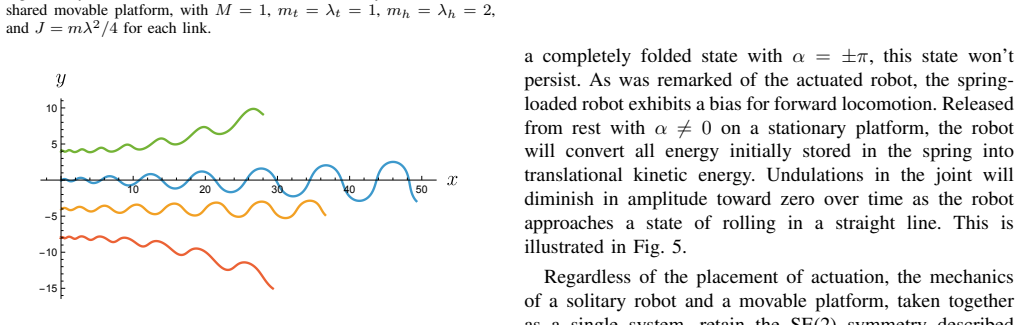
- Oscillatory joint actuation on one robot generates fish-like undulatory motion that persists under the platform coupling.
Where Pith is reading between the lines
- The result shows that orientation control can be transferred entirely to the base, removing the need for direct actuation at the robot joint.
- In a multi-robot setting the same platform actuator could coordinate several robots simultaneously without individual onboard control.
Load-bearing premise
The wheels must roll and pivot freely without lateral slip and the platform must translate freely according to its own inertial dynamics.
What would settle it
Apply a prescribed platform acceleration trajectory and measure whether the robot's heading angle follows the target time function within the model's no-slip assumption; repeat the test after forcing lateral slip or fixing the platform in place.
Figures


read the original abstract
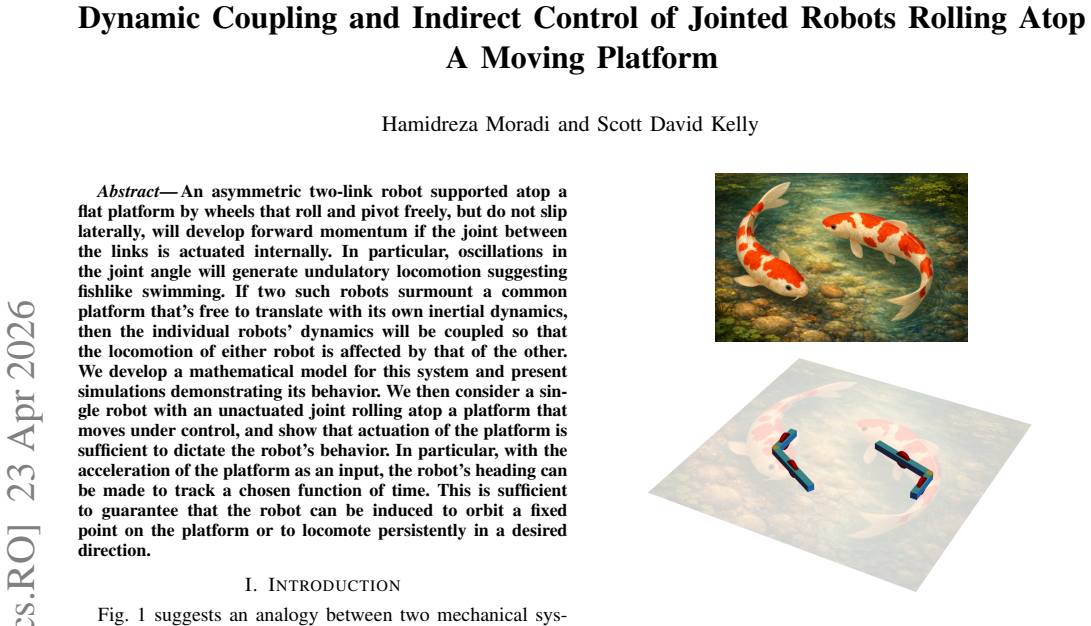
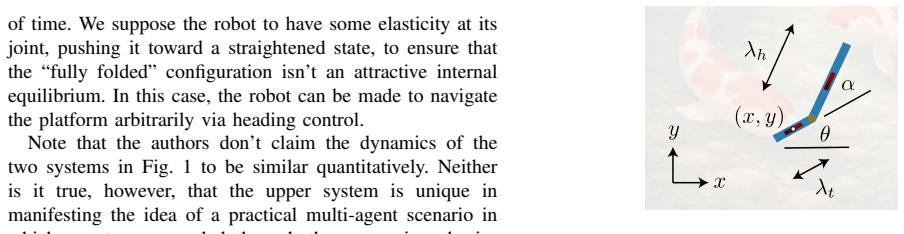
An asymmetric two-link robot supported atop a flat platform by wheels that roll and pivot freely, but do not slip laterally, will develop forward momentum if the joint between the links is actuated internally. In particular, oscillations in the joint angle will generate undulatory locomotion suggesting fishlike swimming. If two such robots surmount a common platform that's free to translate with its own inertial dynamics, then the individual robots' dynamics will be coupled so that the locomotion of either robot is affected by that of the other. We develop a mathematical model for this system and present simulations demonstrating its behavior. We then consider a single robot with an unactuated joint rolling atop a platform that moves under control, and show that actuation of the platform is sufficient to dictate the robot's behavior. In particular, with the acceleration of the platform as an input, the robot's heading can be made to track a chosen function of time. This is sufficient to guarantee that the robot can be induced to orbit a fixed point on the platform or to locomote persistently in a desired direction.
Editorial analysis
A structured set of objections, weighed in public.
Referee Report
Summary. The paper develops a mathematical model for an asymmetric two-link robot with freely rolling and pivoting but laterally non-slipping wheels atop a translating platform with its own inertial dynamics. It shows that internal joint actuation produces undulatory locomotion, that two such robots on a shared platform exhibit coupled dynamics, and that for a single robot with unactuated joint, treating platform acceleration as a control input allows the robot heading to track an arbitrary function of time, which in turn permits orbiting a fixed platform point or persistent directed locomotion. Simulations are presented to illustrate the behaviors.
Significance. If the tracking result holds, the work identifies a novel indirect control channel for nonholonomic systems that exploits platform dynamics rather than direct actuation, with possible relevance to mobile robotics on movable surfaces. The simulations provide concrete demonstration of the coupled locomotion and the claimed heading behavior under the stated assumptions.
major comments (1)
- Abstract: the central claim that 'with the acceleration of the platform as an input, the robot's heading can be made to track a chosen function of time' is load-bearing for the indirect-control result, yet the manuscript supplies no analysis of singular configurations of the unactuated joint angle where the nonholonomic rolling constraints may make heading rate identically zero for every platform acceleration; without such analysis or a proof that the unactuated dynamics avoid these singularities, the global tracking guarantee is not established and simulations may simply avoid the problematic regimes.
minor comments (1)
- The abstract and model description would be clearer if they explicitly listed the modeling assumptions (no lateral slip, platform free to translate, wheels roll and pivot freely) before stating the control result.
Simulated Author's Rebuttal
We thank the referee for the careful reading and constructive feedback on our manuscript. The concern regarding potential singularities in the heading tracking result is important, and we address it directly below with a commitment to revision.
read point-by-point responses
-
Referee: Abstract: the central claim that 'with the acceleration of the platform as an input, the robot's heading can be made to track a chosen function of time' is load-bearing for the indirect-control result, yet the manuscript supplies no analysis of singular configurations of the unactuated joint angle where the nonholonomic rolling constraints may make heading rate identically zero for every platform acceleration; without such analysis or a proof that the unactuated dynamics avoid these singularities, the global tracking guarantee is not established and simulations may simply avoid the problematic regimes.
Authors: We agree that an explicit analysis of singular configurations is required to rigorously support the global tracking claim. In the revised manuscript we will add a dedicated subsection deriving the heading-rate dynamics from the nonholonomic rolling constraints, explicitly identifying any joint-angle values at which the coefficient multiplying platform acceleration vanishes. We will then analyze the unactuated joint evolution to determine reachability of those configurations and, if necessary, restrict the tracking statement to the complement of the singular set or to initial conditions that avoid it. This will clarify the precise scope of the orbiting and persistent-locomotion guarantees while preserving the indirect-control contribution. revision: yes
Circularity Check
No significant circularity; derivation self-contained from nonholonomic model
full rationale
The paper constructs a mathematical model from nonholonomic rolling constraints (no lateral slip) and the inertial dynamics of the free platform, then treats platform acceleration as an exogenous input to analyze the resulting heading evolution for the unactuated two-link robot. The claim that heading can track an arbitrary function of time follows directly from this input-output structure without any fitted parameters, self-definitional loops, or load-bearing self-citations that reduce the result to its own assumptions. Simulations are presented as numerical illustrations rather than as the source of the controllability statement. No step in the provided abstract or described chain equates a prediction to a prior fit or renames an input as an output.
Axiom & Free-Parameter Ledger
axioms (1)
- domain assumption Wheels roll and pivot freely but do not slip laterally.
Reference graph
Works this paper leans on
-
[1]
Energy conservation by collective move- ment in schooling fish,
Y . Zhang and G. V . Lauder, “Energy conservation by collective move- ment in schooling fish,”eLife, vol. 12, p. RP90352, 2024
work page 2024
-
[2]
Self-propelling robotic hydrofoil arrays: Mechanics, ef- ficiency, and optimization,
R. Bhansali, “Self-propelling robotic hydrofoil arrays: Mechanics, ef- ficiency, and optimization,” Master’s thesis, The University of North Carolina at Charlotte, 2018
work page 2018
-
[3]
Passive propulsion in vortex wakes,
D. N. Beal, F. S. Hover, M. S. Triantafyllou, J. C. Liao, and G. V . Lauder, “Passive propulsion in vortex wakes,”Journal of Fluid Me- chanics, vol. 549, pp. 385–402, 2006
work page 2006
-
[4]
Nonholonomic mechanical systems with symmetry,
A. M. Bloch, P. S. Krishnaprasad, J. E. Marsden, and R. M. Murray, “Nonholonomic mechanical systems with symmetry,”Archive for Ra- tional Mechanics and Analysis, vol. 136, no. 1, pp. 21–99, 1996
work page 1996
-
[5]
Reduced-order modeling and analysis of a freely rolling two-link planar snakelike robot,
S. D. Kelly and H. Moradi, “Reduced-order modeling and analysis of a freely rolling two-link planar snakelike robot,” inAdvances in Nonlinear Dynamics, 2026
work page 2026
-
[6]
L. Bates and J. ´Sniatycki, “Nonholonomic reduction,”Reports on Mathematical Physics, vol. 32, no. 1, pp. 99–115, 1993
work page 1993
-
[7]
Non- holonomic dynamics and control of road vehicles: moving toward automation,
W. B. Qin, Y . Zhang, D. Tak ´acs, G. St ´ep´an, and G. Orosz, “Non- holonomic dynamics and control of road vehicles: moving toward automation,”Nonlinear Dynamics, vol. 110, no. 3, pp. 1959–2004, 2022
work page 1959
discussion (0)
Sign in with ORCID, Apple, or X to comment. Anyone can read and Pith papers without signing in.