Control of deterministic breakdown to turbulence of hypersonic boundary layer with spanwise non-uniform surface temperature
Pith reviewed 2026-05-08 10:06 UTC · model grok-4.3
The pith
Spanwise non-uniform wall temperature creates streaks that reduce second Mack mode stress and delay hypersonic transition.
A machine-rendered reading of the paper's core claim, the machinery that carries it, and where it could break.
Core claim
Spanwise non-uniform surface temperature distributions produce control streaks that stabilize the hypersonic boundary layer against deterministic breakdown. For second Mack mode dominated cases the streaks reduce high-frequency wall shear stress by about 30 percent and delay transition, while for first Mack mode cases they reduce peak heat flux without shifting transition. The mean and fluctuating heat transfer drop by 15 and 34 percent respectively, with the mechanisms traced to altered pressure work on turbulent kinetic energy and second-mode dilatation work.
What carries the argument
The spanwise non-uniform surface temperature distribution, which induces control streaks that modify the energy exchange between the second Mack mode and the mean flow.
Load-bearing premise
A practical surface temperature pattern can be maintained on a real vehicle without introducing new instabilities, heat transfer complications, or manufacturing difficulties.
What would settle it
Measuring the streamwise location of transition and the wall heat flux distribution in a Mach 6 wind-tunnel experiment using a flat plate with the same spanwise temperature variation as in the simulations would confirm or refute the reported delay and reductions.
Figures






read the original abstract
Direct Numerical Simulation (DNS) of a Mach 6 boundary layer over a flat plate is performed to assess the effect of spanwise non-uniform surface temperature on breakdown to turbulence under deterministic forcing. The streamwise location of laminar to turbulent transition in hypersonic boundary layers has a significant influence on viscous drag and aerodynamic heating of external surfaces of hypersonic vehicles. Previous work investigated the stabilization of hypersonic boundary layers by optimally growing streaks. More recently, DNS for a hypersonic boundary layer showed that it is possible to generate streaks through a spanwise non-uniform surface temperature distribution. The laminar computations showed the control method can stabilize the second Mack mode and it is robust across a range of Mach numbers and wall temperature ratios. In this work, two scenarios are investigated where two-dimensional (second Mack mode) and oblique (first Mack mode) disturbances dominate the initial linear stage of transition. It is found that weak control streaks with amplitude below 5% of the freestream velocity can reduce high-frequency shear-stress due to the second Mack mode by approximately 30% relative to the uncontrolled configuration, and delay transition. For first Mack mode dominated breakdown, the control streaks have no effect on transition location, but the peak amplitude of the spanwise-integrated wall heat flux is reduced. For the first and second Mack mode-dominated scenarios, the mean and high-frequency peak heat transfer are reduced approximately by 15% and 34%, respectively. The dominant mechanisms are identified and attributed to the pressure work contribution to turbulent kinetic energy and the second Mack mode dilatation work.
Editorial analysis
A structured set of objections, weighed in public.
Referee Report
Summary. The manuscript reports direct numerical simulations of a Mach 6 flat-plate hypersonic boundary layer under deterministic second-Mack-mode and first-Mack-mode forcing. Spanwise non-uniform surface temperature is used to generate weak control streaks (amplitude <5% of freestream velocity). For second-Mack-mode breakdown the streaks reduce high-frequency wall shear stress by ~30% and delay transition; for first-Mack-mode breakdown they leave transition location unchanged but reduce peak spanwise-integrated wall heat flux. Mean and high-frequency heat-transfer reductions of ~15% and ~34% are reported for both cases. The dominant mechanisms are identified via energy budgets as pressure-work contributions to turbulent kinetic energy and dilatation work.
Significance. If the quantitative reductions hold under rigorous numerical verification, the work supplies evidence for a passive, low-amplitude streak-based control strategy that can mitigate both skin-friction and heat-transfer penalties associated with hypersonic transition. The extension from prior linear-stabilization studies to nonlinear breakdown, together with the mechanistic energy-budget analysis, adds value beyond purely empirical observations.
major comments (1)
- [DNS Setup] DNS Setup section: the manuscript supplies no grid-resolution parameters, boundary-condition details, or convergence studies. Because the central claims rest on specific quantitative reductions (30% shear-stress, 15–34% heat-flux) obtained from the simulations, explicit demonstration that these percentages are free of numerical artifacts is required.
minor comments (2)
- [Abstract] Abstract: the phrases 'high-frequency shear-stress' and 'peak amplitude of the spanwise-integrated wall heat flux' would benefit from a parenthetical definition or reference to the precise diagnostic used.
- [Results] Results section: a compact table comparing the key metrics (transition location, peak shear stress, peak heat flux) for the controlled and uncontrolled cases would improve readability.
Simulated Author's Rebuttal
We thank the referee for the positive assessment of our work and the recommendation for minor revision. The single major comment is addressed below.
read point-by-point responses
-
Referee: [DNS Setup] DNS Setup section: the manuscript supplies no grid-resolution parameters, boundary-condition details, or convergence studies. Because the central claims rest on specific quantitative reductions (30% shear-stress, 15–34% heat-flux) obtained from the simulations, explicit demonstration that these percentages are free of numerical artifacts is required.
Authors: We agree that the DNS Setup section requires additional detail to support the quantitative claims. In the revised manuscript we will insert a new subsection that specifies the grid dimensions and spacings (including wall-unit resolutions in all directions), the complete set of boundary conditions (inflow, outflow, wall temperature distribution, and far-field), and the results of grid-convergence tests. These tests show that the reported reductions in high-frequency wall shear stress (~30 %) and in mean/high-frequency heat flux (15–34 %) change by less than 2 % when the grid is refined by a factor of two, confirming that the control effects are not numerical artifacts. revision: yes
Circularity Check
No significant circularity identified
full rationale
The paper reports results exclusively from direct numerical simulations (DNS) of a Mach 6 flat-plate boundary layer under deterministic modal forcing, with quantitative outputs such as ~30% reduction in high-frequency wall shear stress and ~15-34% reductions in heat transfer obtained directly from the computed fields and energy-budget decompositions. No equations, ansatzes, or predictions are presented that reduce by construction to fitted inputs, self-definitions, or prior self-citations; the central claims rest on the simulation data themselves rather than on any closed derivation loop. Prior-work references supply context for the temperature-streak generation method but are not load-bearing for the transition-control findings, which are independently falsifiable via the reported DNS setup, grid resolution, and forcing amplitudes.
Axiom & Free-Parameter Ledger
free parameters (1)
- streak amplitude
axioms (1)
- standard math The flow obeys the compressible Navier-Stokes equations with standard perfect-gas closure.
Reference graph
Works this paper leans on
-
[1]
showed that sufficiently closely spaced control-streaks are able to suppress oblique waves and delay transition to turbulence. Sharmaet al.[11] showed that most effective control-streaks had amplitudes approximately in the range of 10 to 20% of the freestream streamwise momentum ( ˜𝜌𝑢∞), and wavelength 1/5𝑡ℎ to 1/4𝑡ℎ of the fundamental oblique mode . For ...
-
[2]
Governing equations and numerical method The compressible, time-dependent formulation of the Navier-Stokes equations is numerically solved for a calorically perfect gas (air). The governing equations, specifically conservation of mass, balance of momentum and energy conservation are expressed in non-dimensional form as: 𝜕 𝜌 𝜕𝑡 + 𝜕 𝜕𝑥 𝑗 𝜌𝑢 𝑗 =0,(1) 𝜕 𝜌𝑢𝑖 𝜕...
-
[3]
Computational settings A schematic diagram of the computational domain for the DNS computations that capture transition to turbulence is depicted in Fig. 1. A self-similar, laminar solution is injected at domain inlet and it develops along a viscous, isothermal wall. Sponge regions are used at the inlet, outlet and upper boundary to damp the solution towa...
-
[4]
Disturbance forcing In this section, the wall boundary condition used to force transition to turbulence is described, and the mathematical definition, amplitude and frequency characteristics are largely based on Franko and Lele [3]. Two breakdown to turbulence scenarios via deterministic forcing are inves- tigated and referred to as second Mack mode funda...
-
[5]
The mathematical definition is largely based on our previous work [22, 23]
Wall temperature boundary condition This section provides a description of the wall temperature boundary condition that is used to generate the heated streaks to stabilize the boundary layer and delay transition to turbulence. The mathematical definition is largely based on our previous work [22, 23]. The wall temperature boundary condition is 𝑇𝑤 =𝑇 𝑤,𝑏𝑎𝑠...
-
[6]
Time-advancement and data analysis methods For the time-advancement, 1200 timesteps per second Mack mode fundamental period (𝜏 0 = 2𝜋/𝜔0 ≈2.4) are used. To achieve statistical convergence, the computations for the uncontrolled configurations are advanced in time for approximately 1.5 convective times ( ˜𝐿𝑥/˜𝑢∞). For the controlled configurations, the comp...
work page 2048
-
[7]
0 ζ Uncontrolled Controlled, A Tw = 0. 25 Laminar FIG. 6: Laminar and transitional DNS analysis for SMF case; effect of control method on streamwise distribution of the entropy function integrated on the cross-section. 𝜁= 1 𝐿 𝑦 𝐿𝑧 ∫ ∫ exp " − ( ˜𝑠−˜𝑠∞) ˜𝑅𝑔𝑎𝑠 # 𝑑𝑦𝑑𝑧 ,(19) where ˜𝑅𝑔𝑎𝑠 is the gas constant, ˜𝑠is the local entropy, and ˜𝑠∞ is evaluated based o...
-
[8]
7: DNS analysis of the SMF case; (a) effect of𝐴 𝑇𝑤 on the amplitude of the control streaks (𝑥 <500)
25 (b) FIG. 7: DNS analysis of the SMF case; (a) effect of𝐴 𝑇𝑤 on the amplitude of the control streaks (𝑥 <500). (b) Effect of control method on the streamwise distribution of the (time) envelope of the spanwise-averaged skin friction coefficient; grey dotted lines indicate the laminar and turbulent correlations. respectively. Based on the mid-point betwe...
- [9]
-
[10]
0 y/δ 99,in x = 250 ATw
-
[11]
002 |ˆu|00 − | ˆu|00 U ncontrolled x = 350
000 0 . 002 |ˆu|00 − | ˆu|00 U ncontrolled x = 350
-
[12]
002 |ˆu|00 − | ˆu|00 U ncontrolled x = 450 FIG
000 0 . 002 |ˆu|00 − | ˆu|00 U ncontrolled x = 450 FIG. 8: DNS analysis of the SMF case; effect of𝐴 𝑇𝑤 on wall-normal distribution of the streamwise velocity mean flow deformation relative to the uncontrolled case at three axial location ahead of the growth of the second Mack mode planar wave
-
[13]
Sensitivity of control method effectiveness to streak wavelength Previous work [22] showed that near-optimum second Mack mode stabilization can be achieved via control-streaks with a wavelength (𝜆𝑧,𝑠 =2𝜋/𝑘 𝑠) that is approximately 8-10 times the boundary layer thickness in the region of the second Mack mode maximum amplification. For this case study this ...
-
[14]
Sensitivity of the amplitude of the control-streaks to spanwise temperature variation The previous section showed that weak (𝐴𝑠 𝑢 <0.05) control-streaks are not sufficient to delay transition to turbulence dominated by triadic interaction of first Mack mode oblique waves. For this case study, the maximum reduction in the first Mack mode energy was achieve...
-
[15]
Mean heat transfer overshoot In the late stage of laminar to turbulence transition of hypersonic boundary layers, several experimental studies [41, 42] reported significant heat transfer (Stanton number,𝑆𝑡) peaks, which manifest as an overshoot when compared to the prediction based on the Reynolds analogy with skin friction coefficient, 2𝑆𝑡/𝐶 𝑓 =1. Franko...
-
[16]
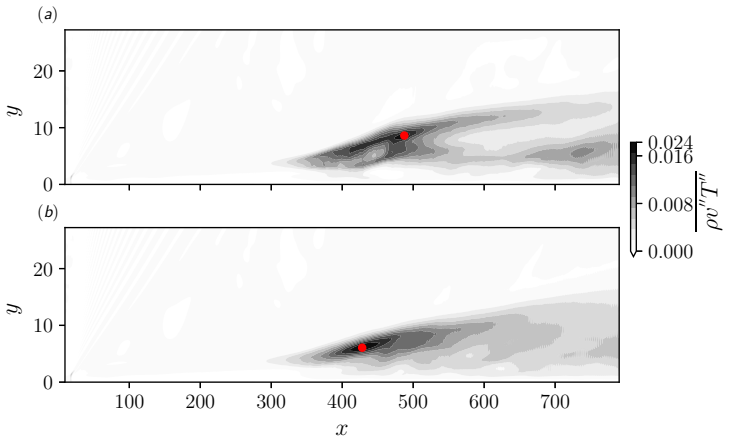
0160. 024 ρv ′′ T ′′ FIG. 18: DNS analysis of the FMO case; effect of control-streaks on spanwise averaged, wall-normal component of the turbulent heat transfer for the FMO case. (a) Uncontrolled and (b) controlled ([𝐴 𝑇𝑤 , 𝑘 𝑠]=[0.25,8]) configurations. The red marker indicates the location of the positive peak. For better visualization, the figure aspec...
-
[17]
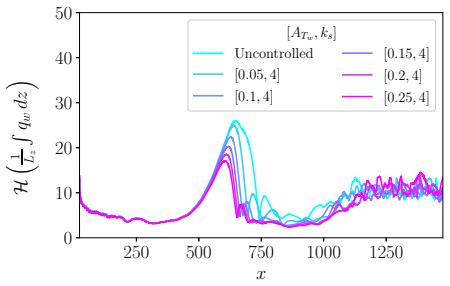
High-frequency heat transfer peak Zhuet al.[44] experimentally showed that a second peak in surface-temperature rise exists, which corresponds to the location of maximum amplification of the second Mack mode. The aerodynamic heating mechanism is attributed to high-frequency dilatation work due to the second Mack mode. The Hilbert-transform of the wall hea...
-
[18]
T. C. Lin, Influence of laminar boundary-layer transition on entry vehicle designs, J. Spacecraft Rockets 45, 165 (2008)
work page 2008
-
[19]
L. M. Mack, Linear stability theory and the problem of supersonic boundary-layer transition, AIAA J. 33 −20 −10 0 10 20 z
-
[20]
0 Tw θ 0 π/ 4 (a) 250 500 750 1000 1250 x
-
[21]
25 |ˆu|f k max θ 0 π/ 4 (b) 250 500 750 1000 1250 x 0.000 0.005 0.010 0.015 Ef k Chu 15 20 10−5 10−3 (f, k) (1,0) (1,1) (1,2) (c) 250 500 750 1000 1250 x 0 5 10 15 20H (⟨Cf⟩z) × 104 θ 0 π/ 4 (d) FIG. 24: Effect of spanwise phase (𝜃) between the control law and the disturbance actuator on (a) the spanwise wall temperature distributions, and on the streamwi...
work page 1975
-
[22]
K. J. Franko and S. K. Lele, Breakdown mechanisms and heat transfer overshoot in hypersonic zero pressure gradient boundary layers, J. Fluid Mech.730, 491 (2013)
work page 2013
-
[23]
J. H. M. Fransson, A. Talamelli, L. Brandt, and C. Cossu, Delaying transition to turbulence by a passive mechanism, Phys. Rev. Lett.96, 064501 (2006)
work page 2006
-
[24]
C. Cossu and L. Brandt, Stabilization of Tollmien–Schlichting waves by finite amplitude optimal streaks in the Blasius boundary layer, Phys. Fluids14, L57 (2002)
work page 2002
-
[25]
S. Bagheri and A. Hanifi, The stabilizing effect of streaks on Tollmien-Schlichting and oblique waves: 34 A parametric study, Phys. Fluids19, 078103 (2007)
work page 2007
-
[26]
P. Schlatter, E. Deusebio, R. de Lange, and L. Brandt, Numerical study of the stabilisation of boundary- layer disturbances by finite amplitude streaks, Int. J. Flow Contr. , 259 (2010)
work page 2010
-
[27]
S. Shahinfar, S. S. Sattarzadeh, J. H. M. Fransson, and A. Talamelli, Revival of classical vortex generators now for transition delay, Phys. Rev. Lett.109, 074501 (2012)
work page 2012
-
[28]
P. Paredes, M. M. Choudhari, and F. Li, Transition due to streamwise streaks in a supersonic flat plate boundary layer, Phys. Rev. Fluids1, 10.1103/PhysRevFluids.1.083601 (2016)
-
[29]
J. Ren, S. Fu, and A. Hanifi, Stabilization of the hypersonic boundary layer by finite-amplitude streaks, Phys. Fluids28, 10.1063/1.4941989 (2016)
- [30]
- [31]
- [32]
-
[33]
T. Zhou, Y. Lu, Z. Liu, and C. Yan, Controlling second-mode oblique breakdown in high-speed boundary layers using streak: A direct numerical simulation study, Phys. Fluids35, 084102 (2023)
work page 2023
- [34]
-
[35]
K. D. Fong, X. Wang, Y. Huang, X. Zhong, G. R. McKiernan, R. A. Fisher, and S. P. Schneider, Second mode suppression in hypersonic boundary layer by roughness: Design and experiments, AIAA J.53, 3138 (2015)
work page 2015
-
[36]
O. W. Taylor and P. J. Bruce, A parametric study into the effects of surface roughness spacing on the transition of hypersonic boundary layers (54th AIAA Aerospace Sciences Meeting, 2016)
work page 2016
-
[37]
P. Paredes, M. M. Choudhari, and F. Li, Instability wave-streak interactions in a high mach number boundary layer at flight conditions, J. Fluid Mech.858, 474 (2019)
work page 2019
- [38]
-
[39]
K. Ozawa and P. Bruce, Generation of streaks by non-uniform surface temperature distributions for hypersonic boundary layer transition control, inAIAA SciTech 2025 Forum(American Institute of 35 Aeronautics and Astronautics, Orlando, Florida, 2025) article number 2025-0262
work page 2025
-
[40]
K. Ozawa, L. Boscagli, G. Rigas, P. J. Bruce, M. T. Gurbuz, O. Ozer, and M. K. Quinn, Influence of non-uniform surface temperature distributions on hypersonic boundary layer, inAIAA SciTech 2026 Forum(American Institute of Aeronautics and Astronautics, Orlando, Florida, 2026) article number 2026-1147
work page 2026
-
[41]
L. Boscagli, O. Marxen, G. Rigas, and P. Bruce, Direct numerical simulations of hypersonic boundary layer transition control via non-uniform surface temperature distribution (AIAA SCITECH 2025 Forum, 2025)
work page 2025
-
[42]
L. Boscagli, G. Rigas, O. Marxen, and P. J. Bruce, Stabilisation of second Mack mode in hypersonic boundary layers through spanwise non-uniform surface temperature distribution, J. Fluid Mech.(Under journal review)(2026)
work page 2026
-
[43]
P. Wassermann and M. Kloker, Mechanisms and passive control of crossflow-vortex-induced transition in a three-dimensional boundary layer, J. Fluid Mech.456, 49–84 (2002)
work page 2002
-
[44]
P. Paredes, M. M. Choudhari, and F. Li, Instability wave-streak interactions in a supersonic boundary layer, J. Fluid Mech.831, 524 (2017)
work page 2017
-
[45]
J. D. Anderson,Hypersonic and high temperature gas dynamics(AIAA, 1989)
work page 1989
-
[46]
S. Nagarajan, S. K. Lele, and J. H. Ferziger, A robust high-order compact method for large eddy simulation, J. Comp. Phys.191, 392 (2003)
work page 2003
-
[47]
S. Nagarajan, S. K. Lele, and J. H. Ferziger, Leading-edge effects in bypass transition, J. Fluid Mech. 572, 471 (2007)
work page 2007
-
[48]
H. Song, A. S. Ghate, K. V. Matsuno, J. R. West, A. Subramaniam, and S. K. Lele, A robust compact finite difference framework for simulations of compressible turbulent flows, J. Comp. Phys.519, 113419 (2024)
work page 2024
- [49]
-
[50]
O. Marxen, T. Magin, G. Iaccarino, and E. S. Shaqfeh, A high-order numerical method to study hypersonic boundary-layer instability including high-temperature gas effects, Phys. Fluids23, 10.1063/1.3614526 (2011)
- [51]
-
[52]
K. J. Franko and S. Lele, Effect of adverse pressure gradient on high speed boundary layer transition, Phys. Fluids26, 024106 (2014)
work page 2014
-
[53]
M. Wang, S. K. Lele, and P. Moin, Sound radiation during local laminar breakdown in a low-mach- number boundary layer, J. Fluid Mech.319, 197–218 (1996)
work page 1996
-
[54]
Chu, On the energy transfer to small disturbances in fluid flow (part i), Acta Mech.1, 215 (1965)
B.-T. Chu, On the energy transfer to small disturbances in fluid flow (part i), Acta Mech.1, 215 (1965)
work page 1965
-
[55]
S. Unnikrishnan and D. V. Gaitonde, Linear, nonlinear and transitional regimes of second-mode instability, J. Fluid Mech.905, 10.1017/jfm.2020.781 (2020)
-
[56]
P. Guo, J. Hao, and C. Y. Wen, Interaction and breakdown induced by multiple optimal disturbances in hypersonic boundary layer, J. Fluid Mech.974, 10.1017/jfm.2023.814 (2023)
-
[57]
B. Bugeat, J. C. Chassaing, J. C. Robinet, and P. Sagaut, 3D global optimal forcing and response of the supersonic boundary layer, J. Comp. Phys.398, 10.1016/j.jcp.2019.108888 (2019)
-
[58]
P. Andersson, L. Brandt, A. Bottaro, and D. S. Henningson, On the breakdown of boundary layer streaks, J. Fluid Mech.428, 29 (2001)
work page 2001
-
[59]
D. C. Wilcox,Turbulence modeling for CFD, Vol. 2 (DCW industries La Canada, CA, 1998)
work page 1998
- [60]
-
[61]
T. Horvath, S. Berry, B. Hollis, B. Singer, and C.-L. Chang, Boundary layer transition on slender cones in conventional and low disturbance mach 6 wind tunnels (32nd AIAA Fluid Dynamics Conference and Exhibit, 2002)
work page 2002
-
[62]
D. Knight and M. Mortazavi, Hypersonic shock wave transitional boundary layer interactions - a review, Acta Astronaut.151, 296 (2018)
work page 2018
-
[63]
Y. Zhu, X. Chen, J. Wu, S. Chen, C. Lee, and M. Gad-El-Hak, Aerodynamic heating in transitional hypersonic boundary layers: Role of second-mode instability, Phys. Fluids30, 10.1063/1.5005529 (2018). 37
discussion (0)
Sign in with ORCID, Apple, or X to comment. Anyone can read and Pith papers without signing in.