Nonconforming virtual element method for the Monge-Amp\`ere equation
Pith reviewed 2026-05-08 10:26 UTC · model grok-4.3
The pith
A nonconforming virtual element method achieves optimal a priori error estimates for the Monge-Ampère equation approximation.
A machine-rendered reading of the paper's core claim, the machinery that carries it, and where it could break.
Core claim
We develop the C1-nonconforming C0-conforming virtual element method for the vanishing moment approximation of the Monge-Ampère equation in two dimensions. Optimal a priori error estimates in the H2-, H1- and L2-norms are derived for the virtual element method, and the existence and uniqueness of the virtual element solution are shown.
What carries the argument
The C¹-nonconforming C⁰-conforming virtual element discretization applied to the quasilinear fourth-order vanishing moment equation.
Load-bearing premise
The exact solution must possess sufficient regularity, probably at least H^4, to achieve the optimal error rates, and the vanishing moment parameter must be chosen small enough to maintain stability.
What would settle it
If numerical simulations on a smooth test case yield convergence rates lower than the predicted optimal ones, or if for some small regularization parameter the solver finds no solution or multiple solutions, the claims would be falsified.
Figures




read the original abstract
In this article, we develop the $C^1$-nonconforming $C^0$-conforming virtual element method (VEM) for the vanishing moment approximation of the second-order fully nonlinear Monge-Amp\`ere equation in two dimensions. In the vanishing moment equation an artificial biharmonic term is introduced which produces a quasilinear fourth order problem. We derive optimal a priori error estimates in the $H^2$-, $H^1$- and $L^2$-norms for the virtual element method, and show the existence and uniqueness of the virtual element solution. We perform several numerical experiments to validate the convergence rate of the error with respect to the mesh size.
Editorial analysis
A structured set of objections, weighed in public.
Referee Report
Summary. The manuscript develops a C¹-nonconforming C⁰-conforming virtual element method for the vanishing-moment regularization of the two-dimensional Monge-Ampère equation. An artificial biharmonic term with parameter ε produces a quasilinear fourth-order problem to which the VEM is applied. The paper derives optimal a priori error estimates in the broken H², H¹, and L² norms, establishes existence and uniqueness of the virtual element solution, and reports numerical experiments confirming the predicted convergence rates with respect to mesh size.
Significance. If the error estimates are optimal with constants controlled uniformly in the regularization parameter ε (or with explicit dependence that remains bounded for sufficiently small ε), the work would provide a useful extension of virtual element techniques to nonconforming discretizations of fourth-order fully nonlinear problems. The combination of nonconforming elements for the biharmonic term with standard VEM for lower-order terms, together with the existence/uniqueness result, could serve as a foundation for further analysis of MA-type equations on general polygonal meshes.
major comments (3)
- [§4, Theorem 4.2] §4 (a priori error analysis), Theorem 4.2 and the preceding approximation results: the optimal rates in the broken H²-norm (and the derived H¹ and L² rates) are obtained under the assumption that the regularized solution u_ε lies in H⁴(Ω). No bound on ||u_ε||_{H⁴} independent of ε (or with controlled growth as ε→0) is supplied. Because the constants in the Céa-type lemma and the interpolation estimates depend on this norm, the claimed optimality for the original Monge-Ampère problem is not yet justified when ε must be taken small enough that the regularization error is negligible.
- [§3.2 and §4.1] §3.2 (discrete problem) and §4.1 (stability): the existence and uniqueness proof relies on coercivity and continuity of the discrete form. It is not shown that the coercivity constant remains positive and bounded away from zero uniformly in both the mesh size h and the regularization parameter ε. This uniformity is load-bearing for the claim that the method remains well-posed and accurate in the limit ε→0.
- [§5] §5 (numerical experiments): all reported tests use a fixed value of ε (e.g., ε=0.01). No numerical study is presented that varies ε downward while monitoring both the discrete error and the difference between the computed solution and a reference solution of the original Monge-Ampère equation. Without such evidence, it remains unclear whether the observed optimal rates survive the regime required for practical approximation of the target problem.
minor comments (2)
- [§2 and §4] The notation for the broken H²-norm and the associated jump terms across element edges should be introduced once in §2 and used consistently; several places in §4 switch between ||·||_{H²,h} and the full broken norm without explicit reminder.
- [Abstract and §1] In the abstract and introduction the phrase “optimal a priori error estimates” is used without immediately stating the precise norms and the dependence on ε; a single clarifying sentence would improve readability.
Simulated Author's Rebuttal
We thank the referee for the careful reading of the manuscript and the constructive comments. We address each major comment point by point below, providing clarifications and indicating revisions where appropriate.
read point-by-point responses
-
Referee: [§4, Theorem 4.2] §4 (a priori error analysis), Theorem 4.2 and the preceding approximation results: the optimal rates in the broken H²-norm (and the derived H¹ and L² rates) are obtained under the assumption that the regularized solution u_ε lies in H⁴(Ω). No bound on ||u_ε||_{H⁴} independent of ε (or with controlled growth as ε→0) is supplied. Because the constants in the Céa-type lemma and the interpolation estimates depend on this norm, the claimed optimality for the original Monge-Ampère problem is not yet justified when ε must be taken small enough that the regularization error is negligible.
Authors: We thank the referee for this observation. The a priori estimates in Theorem 4.2 and the preceding results are derived for the regularized vanishing-moment problem with fixed ε > 0, under the standing assumption that u_ε ∈ H⁴(Ω). We do not supply a bound on ||u_ε||_{H⁴} independent of ε, nor do we claim such uniformity; the constants in the Céa lemma and interpolation estimates therefore carry an implicit ε-dependence. The paper focuses on the discretization error for the regularized equation, and the optimality statements are with respect to h for each fixed ε. Convergence to the original Monge-Ampère solution would additionally require control of the regularization error ||u − u_ε||, which is outside the present scope. In the revised manuscript we will explicitly state that the estimates apply to the regularized problem and add a remark clarifying the distinction from the original equation. revision: partial
-
Referee: [§3.2 and §4.1] §3.2 (discrete problem) and §4.1 (stability): the existence and uniqueness proof relies on coercivity and continuity of the discrete form. It is not shown that the coercivity constant remains positive and bounded away from zero uniformly in both the mesh size h and the regularization parameter ε. This uniformity is load-bearing for the claim that the method remains well-posed and accurate in the limit ε→0.
Authors: We agree that uniformity of the coercivity constant with respect to both h and ε is necessary to justify well-posedness in the vanishing-moment limit. The existence and uniqueness proof establishes well-posedness for each fixed pair (h, ε), but the coercivity and continuity constants inherit ε-dependence from the biharmonic term. We have not proved that these constants remain bounded away from zero independently of ε. In the revised version we will add a detailed remark on the ε-dependence of the stability constants and note that full uniformity requires further analysis of the regularized problem, possibly under additional assumptions on the data. revision: partial
-
Referee: [§5] §5 (numerical experiments): all reported tests use a fixed value of ε (e.g., ε=0.01). No numerical study is presented that varies ε downward while monitoring both the discrete error and the difference between the computed solution and a reference solution of the original Monge-Ampère equation. Without such evidence, it remains unclear whether the observed optimal rates survive the regime required for practical approximation of the target problem.
Authors: We appreciate the suggestion to strengthen the numerical validation. The experiments in Section 5 confirm the predicted rates for the regularized problem at a representative small value of ε. We will augment the numerical section with additional tests in which ε is successively reduced (e.g., ε = 0.1, 0.01, 0.001) and the discrete solutions are compared against a reference solution of the original Monge-Ampère equation obtained by a different method or with a much smaller regularization parameter. These results will be included in the revised manuscript. revision: yes
Circularity Check
No circularity: error estimates derived from standard VEM theory and approximation arguments
full rationale
The paper develops a C1-nonconforming VEM for the vanishing-moment regularization of the Monge-Ampère equation and derives optimal a priori estimates in broken H2, H1 and L2 norms together with existence/uniqueness. These steps rest on standard virtual-element approximation theory, consistency and stability arguments for fourth-order problems, and explicit regularity assumptions on the regularized solution u_ε (typically H4 or higher). No load-bearing self-citation chain, self-definitional reduction, or fitted parameter renamed as prediction appears; the numerical experiments serve only as validation, not as the source of the claimed rates. While uniform-in-ε control of constants is left open, that is an assumption-strength issue rather than a circularity in the derivation itself.
Axiom & Free-Parameter Ledger
Reference graph
Works this paper leans on
-
[1]
doi: 10.1016/j.camwa.2013.05.015. A. D. Aleksandrov. Certain estimates for the Dirichlet problem.Proc. USSR Acad. Sci., 134(5):1001–1004,
-
[2]
doi: 10.1137/15m1008117. P. F. Antonietti, L. B. da Veiga, G. Manzini, et al.The virtual element method and its applications, volume 31 ofSEMA SIMAI Springer Series. Springer,
-
[3]
doi: 10.1007/978-3-030-95319-5. G. Awanou. Standard finite elements for the numerical resolution of the elliptic Monge–Amp` ere equation: classical solutions.IMA J. Numer. Anal., 35(3):1150–1166,
-
[4]
doi: 10.1093/imanum/dru028. G. Barles and P. E. Souganidis. Convergence of approximation schemes for fully nonlinear second order equa- tions.Asymptot. Anal., 4(3):271–283,
-
[5]
doi: 10.3233/ASY-1991-43. P. Bastian, M. Blatt, A. Dedner, C. Engwer, R. Kl¨ ofkorn, R. Kornhuber, M. Ohlberger, and O. Sander. A generic grid interface for parallel and adaptive scientific computing. part ii: implementation and tests in dune. Computing, 82(2):121–138,
-
[6]
doi: 10.1007/s00607-008-0004-9. L. Beir˜ ao da Veiga, F. Brezzi, A. Cangiani, G. Manzini, L. D. Marini, and A. Russo. Basic principles of virtual element methods.Math. Models Methods Appl. Sci., 23(01):199–214,
-
[7]
doi: 10.1142/S0218202512500492. L. Beir˜ ao da Veiga, C. Lovadina, and A. Russo. Stability analysis for the virtual element method.Mathematical Models and Methods in Applied Sciences, 27(13):2557–2594,
-
[8]
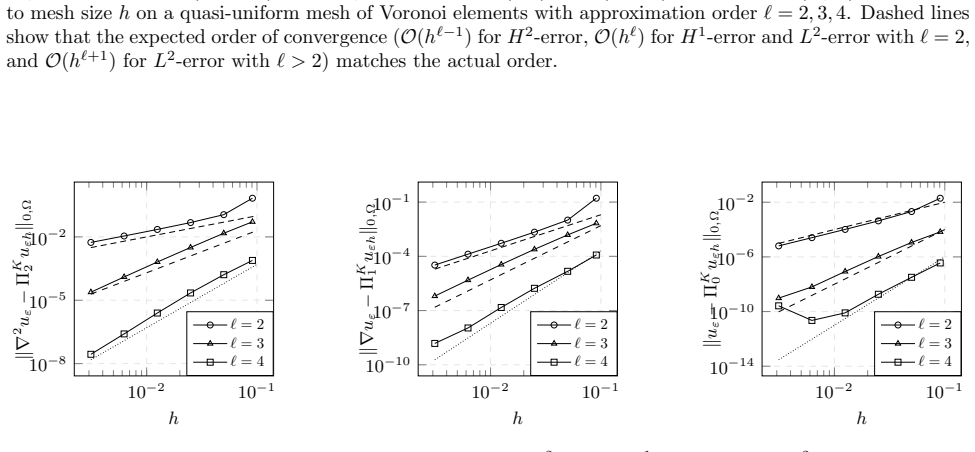
doi: 10.1142/S021820251750052X. 30 10−2 10−1 10−8 10−5 10−2 h ∥∇2uε −Π K 2 uεh∥0,Ω ℓ= 2 ℓ= 3 ℓ= 4 10−2 10−1 10−11 10−8 10−5 10−2 h ∥∇uε −Π K 1 uεh∥0,Ω ℓ= 2 ℓ= 3 ℓ= 4 10−2 10−1 10−15 10−10 10−5 h ∥uε −Π K 0 uεh∥0,Ω ℓ= 2 ℓ= 3 ℓ= 4 Figure 5: Problem 2 (Voronoi): Convergence of theH 2- (left),H 1- (centre), andL 2-error (right) with respect to mesh sizehon a ...
-
[9]
doi: 10.1051/m2an/2010017. K. B¨ ohmer. On finite element methods for fully nonlinear elliptic equations of second order.SIAM J. Numer. Anal., 46(3):1212–1249,
-
[10]
doi: 10.1137/040621740. G. Bonnet, A. Cangiani, and R. H. Nochetto. Conforming virtual element method for nondivergence form linear elliptic equations with Cordes coefficients.Math. Models Methods Appl. Sci., 35(01):75–112,
-
[11]
doi: 10.1142/S0218202525500034. M. Botti and L. Mascotto. Sobolev-Poincar´ e inequalities for piecewiseW 1,p functions over general polytopic meshes,
- [12]
-
[13]
S. C. Brenner, T. Gudi, M. Neilan, and L.-Y. Sung.C 0 penalty methods for the fully nonlinear Monge–Amp` ere equation.Math. Comput., 80(276):1979,
1979
-
[14]
doi: 10.1090/S0025-5718-2011-02487-7. S. C. Brenner, Q. Guan, and L.-Y. Sung. Some estimates for virtual element methods.Math. Models Methods Appl. Sci., 17(4):553–574,
-
[15]
doi: 10.1515/cmam-2017-0008. F. Brezzi and L. D. Marini. Virtual element methods for plate bending problems.Comput. Methods Appl. Mech. Eng., 253:455–462,
-
[16]
doi: 10.1016/j.cma.2012.09.012. J. Brusca and B. F. Hamfeldt. A convergent quadrature-based method for the Monge–Amp` ere equation.SIAM J. Sci. Comput., 45(3):A1097–A1124,
-
[17]
doi: 10.1137/22M1494658. A. Caboussat, R. Glowinski, and D. C. Sorensen. A least-squares method for the numerical solution of the Dirichlet problem for the elliptic Monge–Amp` ere equation in dimension two.ESAIM Control Optim. Calc. Var., 19(3):780–810,
-
[18]
doi: 10.1051/cocv/2012033. A. Caboussat, D. Gourzoulidis, and M. Picasso. An adaptive least-squares algorithm for the elliptic Monge– Amp` ere equation.Comptes Rendus M´ ecanique, 351(S1):277–292,
-
[19]
doi: 10.5802/crmeca.222. L. A. Caffarelli and C. E. Guti´ errez. Properties of the solutions of the linearized Monge–Amp` ere equation.Am. J. Math., 119(2):423–465,
-
[20]
doi: 10.1353/AJM.1997.0010. Y. Cai, H. Guo, and Z. Zhang. Virtual element methods for HJB equations with Cordes coefficients.Comput. Methods Appl. Mech. Eng., 447:118362,
-
[21]
doi: 10.1016/j.cma.2025.118362. A. Cangiani, G. Manzini, and O. J. Sutton. Conforming and nonconforming virtual element methods for elliptic problems.IMA J. Numer. Anal., 37(3):1317–1354,
-
[22]
doi: 10.1093/imanum/drw036. H. Chen, X. Feng, and Z. Zhang. A recovery-based linearC 0 finite element method for a fourth-order singularly perturbed Monge–Amp` ere equation.Adv. Comput. Math., 47(2):21,
-
[23]
doi: 10.1007/s10444-021-09847-w. C. Chinosi and L. D. Marini. Virtual element method for fourth order problems:L 2-estimates.Comput. Math. Appl., 72(8):1959–1967,
-
[24]
doi: 10.1016/j.camwa.2016.02.001. P. G. Ciarlet.The finite element method for elliptic problems. SIAM,
-
[25]
URLhttps://doi.org/10.5281/zenodo.19714059. A. Dedner and A. Hodson. Robust nonconforming virtual element methods for general fourth-order problems with varying coefficients.IMA J. Numer. Anal., 42(2):1364–1399,
-
[26]
doi: 10.1093/imanum/drab003. A. Dedner and A. Hodson. A framework for implementing general virtual element spaces.SIAM J. Sci. Comput., 46(3):B229–B253, 2024a. doi: 10.1137/23M1573653. A. Dedner and A. Hodson. A higher order nonconforming virtual element method for the Cahn–Hilliard equation. J. Sci. Comput., 101(3):81, 2024b. doi: 10.1007/s10915-024-0272...
-
[27]
X. Feng and M. Neilan. Mixed finite element methods for the fully nonlinear Monge–Amp` ere equation based on the vanishing moment method.SIAM J. Numer. Anal., 47(2):1226–1250, 2009a. doi: 10.1137/070710378. X. Feng and M. Neilan. Vanishing moment method and moment solutions for fully nonlinear second order partial differential equations.J. Sci. Comput., 3...
- [28]
-
[29]
doi: 10.1007/978-3-642-61798-0. C. E. Guti´ errez.The Monge–Amp` ere Equation, volume 89 ofProgress in Nonlinear Differential Equations and Their Applications. Birkh¨ auser, Cham,
-
[30]
doi: 10.1007/978-3-319-43374-5. J. Huang and Y. Yu. A medius error analysis for nonconforming virtual element methods for Poisson and biharmonic equations.J. Comput. Appl. Math., 386:113229,
-
[31]
doi: 10.1016/j.cam.2020.113229. J. Huang and Y. Yu. AC 0-continuous nonconforming virtual element method for linear strain gradient elasticity,
- [32]
- [33]
-
[34]
doi: 10.1051/m2an/2020085. M. Neilan.Numerical Methods for Fully Nonlinear Second Order Partial Differential Equations. PhD thesis, University of Tennessee, Knoxville,
-
[35]
doi: 10.1007/s00211-009-0283-x. M. Neilan, A. J. Salgado, and W. Zhang. The Monge–Amp` ere equation. In A. Bonito and R. H. Nochetto, editors,Geometric Partial Differential Equations - Part I, volume 21 ofHandbook of Numerical Analysis, pages 105–219. Elsevier, Amsterdam,
-
[36]
doi: 10.1016/bs.hna.2019.05.003. A. Pradhan.Error analysis and agglomerated polytopic mesh refinement for the virtual element method for fully nonlinear PDEs. PhD thesis, Charles University, Prague, Czech Republic, in preparation. D. Shylaja and S. Kumar. Morley type virtual element method for von K´ arm´ an equations.Adv. Comp. Math., 50(5):94,
-
[37]
doi: 10.1007/s10444-024-10158-z. B. Zhang, J. Zhao, and S. Chen. The nonconforming virtual element method for fourth-order singular pertur- bation problem.Adv. Comput. Math., 46(2):19,
-
[38]
doi: 10.1007/s10444-020-09743-9. J. Zhao, S. Chen, and B. Zhang. The nonconforming virtual element method for plate bending problems.Math. Models Methods Appl. Sci., 26(09):1671–1687,
-
[39]
doi: 10.1142/S021820251650041X. J. Zhao, B. Zhang, S. Chen, and S. Mao. The Morley-type virtual element for plate bending problems.J. Sci. Comput., 76(1):610–629,
-
[40]
doi: 10.1007/s10915-017-0632-3. 33
discussion (0)
Sign in with ORCID, Apple, or X to comment. Anyone can read and Pith papers without signing in.