A new framework of zero mean curvature surfaces in the isotropic 3-space
Pith reviewed 2026-05-08 09:32 UTC · model grok-4.3
The pith
Zero mean curvature surfaces with singularities in isotropic 3-space satisfy three Osserman-type inequalities when complete and of finite total curvature.
A machine-rendered reading of the paper's core claim, the machinery that carries it, and where it could break.
Core claim
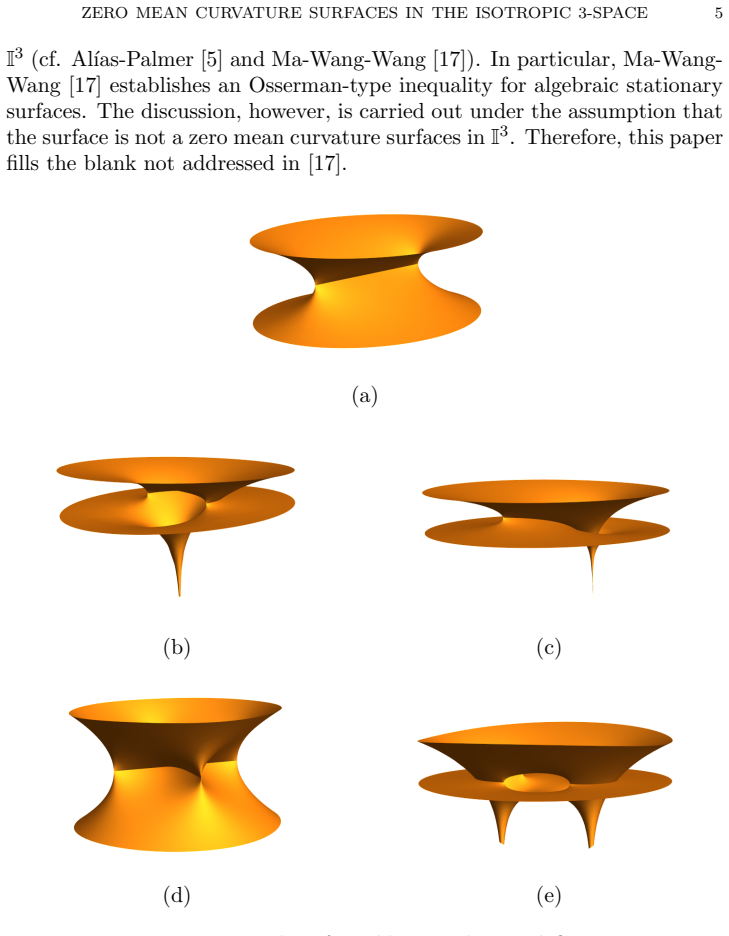
We introduce a class of zero mean curvature surfaces with singularities in the isotropic 3-space, called ZMC-faces. We establish three Osserman-type inequalities for a ZMC-face under certain assumptions on both completeness and finiteness of the total curvature. The equality conditions of these inequalities are related to the asymptotic behaviors of the ends. We present several examples of ZMC-faces attaining equalities in these inequalities.
What carries the argument
ZMC-faces, a class of zero mean curvature surfaces with singularities in isotropic 3-space, whose definition ensures consistency with the isotropic metric and permits analysis of singular points.
If this is right
- The three inequalities apply to all complete ZMC-faces of finite total curvature.
- Equality cases correspond to specific asymptotic behaviors at the ends of the surface.
- Examples exist that saturate all three inequalities simultaneously.
- The framework extends the study of zero mean curvature surfaces to include singular cases in isotropic geometry.
Where Pith is reading between the lines
- If these inequalities hold, they may help classify all such surfaces by their end behaviors similar to how Osserman inequalities work in other geometries.
- The approach to singularities could be adapted to other ambient spaces or curvature conditions.
- Computing the total curvature and checking the inequalities on the provided examples would confirm the sharpness of the bounds.
Load-bearing premise
The surfaces must be complete with finite total curvature and the new definition of ZMC-faces must handle singularities consistently within the isotropic metric.
What would settle it
Constructing or identifying a complete ZMC-face with finite total curvature for which one of the three inequalities fails to hold would disprove the main result.
Figures
read the original abstract
We introduce a class of zero mean curvature surfaces with singularities in the isotropic 3-space, called ZMC-faces. As a main result, we establish three Osserman-type inequalities for a ZMC-face under certain assumptions on both completeness and finiteness of the total curvature. The equality conditions of these inequalities are related to the asymptotic behaviors of the ends. Moreover, we present several examples of ZMC-faces attaining equalities in these inequalities.
Editorial analysis
A structured set of objections, weighed in public.
Referee Report
Summary. The paper introduces ZMC-faces, a class of zero mean curvature surfaces with singularities in isotropic 3-space, defined via a Weierstrass-type representation adapted to the degenerate metric. Under assumptions of completeness and finite total curvature, it establishes three Osserman-type inequalities, with equality cases determined by the asymptotic behavior of the ends, and verifies the results on several explicit examples.
Significance. If the derivations hold, the work provides a new framework for studying minimal surfaces in a degenerate geometric setting, extending Osserman-type inequalities to surfaces with isolated singularities. The explicit examples attaining equality cases and the integral formulas accounting for the isotropic metric are strengths that make the results potentially useful for further research in isotropic geometry and related minimal surface theory.
minor comments (3)
- §2: The definition of ZMC-face via the adapted Weierstrass representation would benefit from an explicit statement of how the degenerate isotropic metric is incorporated into the holomorphic data to ensure the mean curvature vanishes away from singularities.
- §4, Theorem 3.2: The integral formula for total curvature appears to omit a brief justification for why the contribution from isolated singularities integrates to zero; adding one sentence would clarify the passage from the local expression to the global inequality.
- The examples in §5 are helpful, but the asymptotic analysis for the ends in Example 5.3 could include a short table comparing the computed curvature integrals against the predicted equality bounds.
Simulated Author's Rebuttal
We thank the referee for the careful reading and positive assessment of our manuscript introducing ZMC-faces and establishing Osserman-type inequalities in isotropic 3-space. The report recommends minor revision but lists no specific major comments under that heading. Accordingly, we have no individual referee points to address point by point. We will make any minor editorial improvements to clarity or presentation as appropriate before resubmission.
Circularity Check
No significant circularity
full rationale
The paper introduces a new class of ZMC-faces via a Weierstrass-type representation adapted to the isotropic metric, states explicit hypotheses of completeness and finite total curvature, and derives three Osserman-type inequalities from integral formulas that incorporate isolated singularities. Equality cases are linked to end asymptotics and verified on explicit examples. No step reduces by construction to a fitted parameter, self-citation chain, or renamed input; the central claims remain independent of the paper's own definitions.
Axiom & Free-Parameter Ledger
invented entities (1)
-
ZMC-face
no independent evidence
Reference graph
Works this paper leans on
-
[1]
S. Akamine,Behavior of the Gaussian curvature of timelike minimal surfaces with singularities, Hokkaido Math. J.48(2019), 537–568
work page 2019
-
[2]
S. Akamine and H. Fujino,Extension of Krust theorem and deformations of minimal surfaces, Ann. Mat. Pura Appl.201(2022), 2583–2601
work page 2022
-
[3]
,Reflection Principles for Zero Mean Curvature Surfaces in the Simply Isotropic 3-space, Results Math.77(2022), 176
work page 2022
-
[4]
S. Akamine, W. Lee, and S.-D. Yang,Bernstein-type theorem for constant mean curvature surfaces in the isotropic 3-space, preprint, arXiv:2505.24109
-
[5]
L. J. Al´ as and B. Palmer,Curvature properties of zero mean curvature surfaces in four-dimensional Lorentzian space forms, Math. Proc. Cambridge Philos. Soc.124 (1998), 315–327
work page 1998
- [6]
-
[7]
J. Cho, D. Lee, W. Lee, and S.-D. Yang,Spinor Representation in Isotropic 3-space via Laguerre Geometry, Results Math.79(2023), 8
work page 2023
-
[8]
L. C. B. da Silva,Holomorphic representation of minimal surfaces in simply isotropic space, J. Geom.112(2021), 35. 30 ZERO MEAN CURVATURE SURFACES IN THE ISOTROPIC 3-SPACE
work page 2021
-
[9]
Fujimori,Spacelike CMC 1 surfaces with elliptic ends in de Sitter 3-space, Hokkaido Math
S. Fujimori,Spacelike CMC 1 surfaces with elliptic ends in de Sitter 3-space, Hokkaido Math. J.35(2006), 289–320
work page 2006
-
[10]
Huber,On subharmonic functions and differential geometry in the large, Comment
A. Huber,On subharmonic functions and differential geometry in the large, Comment. Math. Helv.32(1958), 13–72
work page 1958
-
[11]
L. P. Jorge and W. H. Meeks,The topology of complete minimal surfaces of finite total Gaussian curvature, Topology22(1983), 203–221
work page 1983
-
[12]
S. Kato,Classification of simple ends of minimal surfaces inI 3 and decompositions of minimal surfaces inR 3, preprint
- [13]
-
[14]
,On the maximal number of exceptional values of Gauss maps for various classes of surfaces, Math. Z.274(2013), 1249–1260
work page 2013
-
[15]
Y. Kawakami, R. Kobayashi, and R. Miyaoka,The gauss map of pseudo-algebraic minimal surfaces, Forum Math.20(2008), 1055–1069
work page 2008
- [16]
-
[17]
X. Ma, C. Wang, and P. Wang,Global geometry and topology of spacelike stationary surfaces in the 4-dimensional Lorentz space, Adv. Math.249(2013), 311–347
work page 2013
-
[18]
Osserman,A survey of Minimal Surfaces, Van Nostrand Reinhold Co., New York- London-Melbourne, 1969
R. Osserman,A survey of Minimal Surfaces, Van Nostrand Reinhold Co., New York- London-Melbourne, 1969
work page 1969
-
[19]
Pember,Weierstrass-type representations, Geom
M. Pember,Weierstrass-type representations, Geom. Dedicata204(2020), 299–309
work page 2020
-
[20]
H. Pottmann and Y. Liu,Discrete Surfaces in Isotropic Geometry, pp. 341–363, Springer Berlin Heidelberg, 2007
work page 2007
-
[21]
Sachs,Isotrope Geometrie des Raumes, Friedr
H. Sachs,Isotrope Geometrie des Raumes, Friedr. Vieweg & Sohn, Braunschweig, 1990
work page 1990
-
[22]
Sato,d-Minimal Surfaces in Three-Dimensional Singular Semi-Euclidean Space R0,2,1, Tamkang J
Y. Sato,d-Minimal Surfaces in Three-Dimensional Singular Semi-Euclidean Space R0,2,1, Tamkang J. Math.52(2021), 37–67
work page 2021
-
[23]
R. M. Schoen,Uniqueness, symmetry, and embeddedness of minimal surfaces, J. Differential Geom.18(1983), 791–809
work page 1983
-
[24]
J. J. Seo and S.-D. Yang,Zero mean curvature surfaces in isotropic three-space, Bull. Korean Math. Soc.58(2021), 1–20
work page 2021
-
[25]
Strubecker,Differentialgeometrie des isotropen Raumes
K. Strubecker,Differentialgeometrie des isotropen Raumes. III. Fl¨ achentheorie, Math. Z.48(1942), 369–427
work page 1942
-
[26]
,Duale Minimalfl¨ achen des isotropen Raumes, Rad Jugoslav. Akad. Znan. Umjet.382(1978), 91–107
work page 1978
-
[27]
H. Takahashi,Timelike minimal surfaces with singularities in three-dimensional spacetime (in Japanese), Master thesis, Osaka University, 2012
work page 2012
-
[28]
M. Umehara and K. Yamada,Maximal surfaces with singularities in Minkowski space, Hokkaido Math. J.35(2006), 13–40
work page 2006
-
[29]
Whitney,The singularities of a smooth n-manifold in(2n−1)-space, Ann
H. Whitney,The singularities of a smooth n-manifold in(2n−1)-space, Ann. of Math. 45(1944), 247–293. (Riku Kishida)Department of Mathematical and Computing Sciences, Insti- tute of Science Tokyo, Tokyo 152-8552, Japan Email address:kishida.r.1632@m.isct.ac.jp
work page 1944
discussion (0)
Sign in with ORCID, Apple, or X to comment. Anyone can read and Pith papers without signing in.