Recognition: unknown
Learning the Weather-Grid Nexus via Weather-to-Voltage (W2V) Predictive Modeling
Pith reviewed 2026-05-08 10:16 UTC · model grok-4.3
The pith
A compact neural network maps high-resolution weather data directly to bus voltages across a large power grid, enabling forecasts tuned to grid needs.
A machine-rendered reading of the paper's core claim, the machinery that carries it, and where it could break.
Core claim
The W2V model maps weather features at high spatial resolution directly to grid-wide bus voltages using a compact neural network with PCA-based initialization. This serves as a differentiable surrogate for weather-incorporated power flow analysis, enabling joint analysis of weather and grid states. The model supports grid-aware weather forecasting by using voltage prediction performance to guide forecast improvements, as demonstrated by its ability to prioritize critical conditions such as system-wide quick wind drops preceding ramp-ups on a 6717-bus Texas synthetic test system.
What carries the argument
The weather-to-voltage (W2V) model, a compact neural network with principal component analysis initialization that maps weather inputs to voltage outputs as a surrogate for power flow calculations.
Load-bearing premise
That a compact neural network with PCA-based initialization can serve as an accurate and numerically stable differentiable surrogate for weather-incorporated power flow analysis, and that its voltage outputs can meaningfully guide improvements in downstream weather forecasting.
What would settle it
If voltage predictions from the W2V model differ substantially from solutions obtained by standard power flow solvers on the 6717-bus system under various weather conditions, or if grid-aware forecasts guided by W2V do not outperform conventional forecasts on grid-relevant metrics such as ramp event prediction.
Figures



read the original abstract
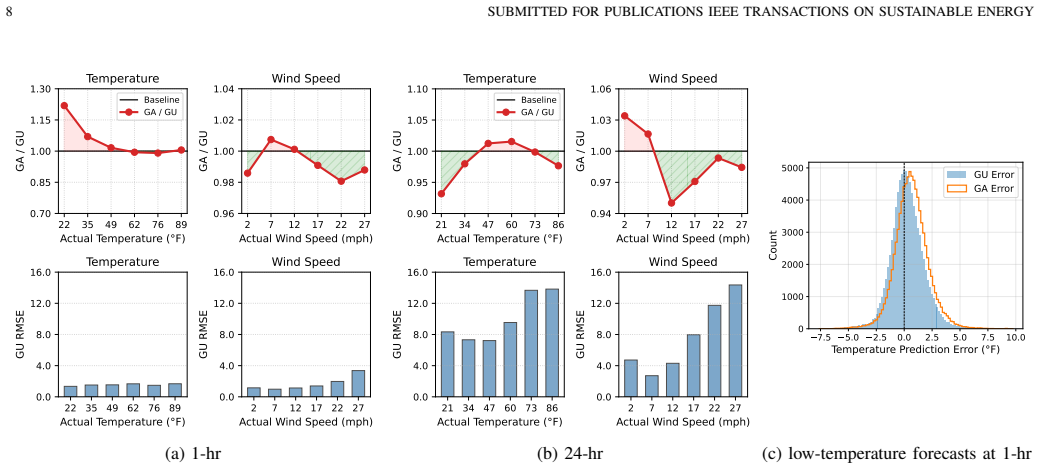
This paper proposes a weather-to-voltage (W2V) predictive modeling framework to learn the underlying weather-grid nexus. Unlike existing approaches on weather-informed grid operations, our proposed W2V model can achieve the joint analysis of weather and grid states, and further leverage this coupling to enhance grid-aware weather forecasting (GAWF) as a key application. To achieve this end-to-end learning, the W2V model acts as a differentiable surrogate for weather-incorporated power flow analysis by mapping weather features at high spatial resolution directly to grid-wide bus voltages. Thanks to a compact neural network design and principal component analysis based initialization, it achieves high voltage prediction accuracy and numerical stability during training. Building on this capability, W2V-based voltage signals are used to guide the development of GAWF that can account for its downstream voltage prediction performance. Using a 6717-bus Texas synthetic test system with meteorological inputs from 701 weather locations, our numerical tests have verified the excellent accuracy and generalizability of the proposed W2V model. More importantly, the W2V model has enabled the GAWF to effectively prioritize the weather features and conditions that are most critical to grid operations, such as system-wide quick wind drops preceding ramp-ups.
Editorial analysis
A structured set of objections, weighed in public.
Referee Report
Summary. The paper proposes a Weather-to-Voltage (W2V) predictive modeling framework that employs a compact neural network with PCA-based initialization to map high-resolution weather features directly to bus voltages across a 6717-bus Texas synthetic test system. This serves as a differentiable surrogate for weather-incorporated power flow analysis and is applied to enhance grid-aware weather forecasting (GAWF) by using voltage signals to prioritize critical weather features and conditions, such as system-wide wind drops.
Significance. If the accuracy claims hold and the GAWF application demonstrates measurable forecasting improvements, the work could meaningfully advance the integration of meteorological data into power system operations and control. The scale of the synthetic test case and the end-to-end differentiable modeling approach represent potential strengths for practical deployment in weather-grid nexus studies.
major comments (2)
- [Abstract] Abstract: The assertion of 'excellent accuracy and generalizability' for the W2V model on the 6717-bus system with 701 weather locations is unsupported by any reported quantitative metrics (e.g., voltage prediction RMSE/MAE, comparison to standard power flow solvers, or baseline neural network performance), preventing evaluation of the core surrogate modeling claim.
- [Abstract] Abstract (GAWF application): The statement that the W2V model 'has enabled the GAWF to effectively prioritize the weather features and conditions that are most critical to grid operations' lacks any supporting forecast-error metrics (RMSE, MAE, or skill scores) comparing GAWF performance with versus without W2V voltage guidance, leaving the key downstream application unverified despite being central to the paper's contribution.
minor comments (1)
- The abstract would benefit from a brief mention of the neural network architecture size, training dataset split, and any regularization techniques used to achieve the claimed numerical stability.
Simulated Author's Rebuttal
We thank the referee for the constructive comments on our manuscript. We address each major comment below and will revise the abstract to include key quantitative metrics from our numerical results, thereby strengthening the presentation without altering the underlying findings.
read point-by-point responses
-
Referee: [Abstract] Abstract: The assertion of 'excellent accuracy and generalizability' for the W2V model on the 6717-bus system with 701 weather locations is unsupported by any reported quantitative metrics (e.g., voltage prediction RMSE/MAE, comparison to standard power flow solvers, or baseline neural network performance), preventing evaluation of the core surrogate modeling claim.
Authors: The abstract provides a high-level summary of results whose details appear in Section IV (numerical tests). There we report voltage prediction RMSE and MAE on the 6717-bus Texas system, direct comparisons against standard power-flow solvers, and performance relative to baseline neural-network architectures, all confirming the claimed accuracy and generalizability. To make these claims immediately verifiable from the abstract, we will insert concise quantitative statements (e.g., achieved RMSE values and solver-comparison errors) in the revised version. revision: yes
-
Referee: [Abstract] Abstract (GAWF application): The statement that the W2V model 'has enabled the GAWF to effectively prioritize the weather features and conditions that are most critical to grid operations' lacks any supporting forecast-error metrics (RMSE, MAE, or skill scores) comparing GAWF performance with versus without W2V voltage guidance, leaving the key downstream application unverified despite being central to the paper's contribution.
Authors: Section V presents the GAWF experiments and shows that voltage signals from the W2V surrogate enable prioritization of operationally critical weather features (e.g., system-wide wind drops). While the body contains the supporting analysis, the abstract does not quote the comparative forecast-error metrics. We will add a brief statement of the observed improvement (e.g., reduction in GAWF RMSE or skill-score gain when W2V guidance is used) to the revised abstract. revision: yes
Circularity Check
No significant circularity; W2V is empirical NN training on synthetic weather-voltage pairs
full rationale
The paper trains a compact neural network (with PCA-based initialization) as a differentiable surrogate mapping high-resolution weather features directly to bus voltages on the 6717-bus Texas system. This is standard supervised learning: data is generated from the test system, the model is fitted, and accuracy/generalizability are verified on (presumably held-out) cases. The GAWF application then uses the trained W2V outputs to prioritize weather features critical to grid operations. No derivation, equation, or claim reduces by construction to its own inputs; no self-citation chain is load-bearing for the central result; no ansatz or uniqueness theorem is imported from prior author work; and no fitted parameter is relabeled as an independent prediction. The approach is self-contained data-driven modeling without tautological loops.
Axiom & Free-Parameter Ledger
free parameters (2)
- Neural network weights and biases
- PCA initialization settings
axioms (1)
- domain assumption A neural network can accurately and differentiably approximate weather-incorporated power flow analysis across a large grid.
Reference graph
Works this paper leans on
-
[1]
Electric power annual 2023,
U.S. Energy Information Administration, “Electric power annual 2023,” U.S. Dept. Energy, Oct. 2024, [Online]. Available: https://www.eia.gov/ electricity/annual/
2023
-
[2]
Electric power annual 2014,
U.S. Energy Information Administration, “Electric power annual 2014,” U.S. Dept. Energy, Feb. 2016, [Online]. Available: https://www.eia.gov/ electricity/annual/
2014
-
[3]
A steady-state voltage stability analysis of power systems with high penetrations of wind,
E. Vittal, M. O’Malley, and A. Keane, “A steady-state voltage stability analysis of power systems with high penetrations of wind,”IEEE Trans. Power Syst., vol. 25, no. 1, pp. 433–442, 2009
2009
-
[4]
Transmission, variable gen- eration, and power system flexibility,
E. Lannoye, D. Flynn, and M. O’Malley, “Transmission, variable gen- eration, and power system flexibility,”IEEE Trans. Power Syst., vol. 30, no. 1, pp. 57–66, 2014
2014
-
[5]
Frequency response assessment and enhancement of the US power grids toward extra-high photovoltaic generation penetrations—an industry perspective,
Y . Liu, S. You, J. Tan, Y . Zhang, and Y . Liu, “Frequency response assessment and enhancement of the US power grids toward extra-high photovoltaic generation penetrations—an industry perspective,”IEEE Trans. Power Syst., vol. 33, no. 3, pp. 3438–3449, 2018
2018
-
[6]
Risk assessment for power system operation planning with high wind power penetration,
M. Negnevitsky, D. H. Nguyen, and M. Piekutowski, “Risk assessment for power system operation planning with high wind power penetration,” IEEE Trans. Power Syst., vol. 30, no. 3, pp. 1359–1368, 2014
2014
-
[7]
Weather-informed probabilistic forecasting and scenario generation in power systems,
H. Zhang, R. Zandehshahvar, M. Tanneau, and P. Van Hentenryck, “Weather-informed probabilistic forecasting and scenario generation in power systems,”Appl. Energy, vol. 384, p. 125369, 2025
2025
-
[8]
Weather-informed forecasting for time series optimal power flow of transmission systems with large renewable share,
A. Unlu, S. A. Dorado-Rojas, M. Pe ˜na, and Z. Wang, “Weather-informed forecasting for time series optimal power flow of transmission systems with large renewable share,”IEEE Access, vol. 12, pp. 92 652–92 662, 2024
2024
-
[9]
The future of forecasting for renewable energy,
C. Sweeney, R. J. Bessa, J. Browell, and P. Pinson, “The future of forecasting for renewable energy,”Wiley Interdiscip. Rev. Energy Environ., vol. 9, no. 2, p. e365, 2020
2020
-
[10]
Stochastic look-ahead commitment: A case study in MISO,
B. Knuevenet al., “Stochastic look-ahead commitment: A case study in MISO,” inProc. IEEE Power Energy Soc. Gen. Meeting (PESGM). IEEE, 2023, pp. 1–5
2023
-
[11]
Solar uncertainty management and mitigation for exceptional reliability in grid operations (summer-go): Project final report,
S. Jascourt, K. Doubleday, J. Zhang, C. Feng, A. Florita, and B.-M. Hodge, “Solar uncertainty management and mitigation for exceptional reliability in grid operations (summer-go): Project final report,” National Renewable Energy Laboratory (NREL), Golden, CO (United States), Tech. Rep., 2023
2023
-
[12]
Quantifying the economic and grid reliability impacts of improved wind power forecasting,
Q. Wang, C. B. Martinez-Anido, H. Wu, A. R. Florita, and B.-M. Hodge, “Quantifying the economic and grid reliability impacts of improved wind power forecasting,”IEEE Trans. Sustain. Energy, vol. 7, no. 4, pp. 1525– 1537, 2016
2016
-
[13]
Short-term wind power prediction based on wind2vec-BERT model,
M. Yu, J. Han, H. Wu, J. Yan, and R. Zeng, “Short-term wind power prediction based on wind2vec-BERT model,”IEEE Trans. Sustain. Energy, vol. 16, no. 2, pp. 933–944, 2024
2024
-
[14]
An ultra-short-term distributed photovoltaic power forecasting method based on GPT,
H. Zhang, J. Yang, S. Fan, H. Geng, and C. Shao, “An ultra-short-term distributed photovoltaic power forecasting method based on GPT,”IEEE Trans. Sustain. Energy, 2025
2025
-
[15]
Task-based end-to-end model learning in stochastic optimization,
P. Donti, B. Amos, and J. Z. Kolter, “Task-based end-to-end model learning in stochastic optimization,”Adv. Neural Inf. Process. Syst. (NeurIPS), vol. 30, 2017
2017
-
[16]
More than accuracy: end- to-end wind power forecasting that optimises the energy system,
D. Wahdany, C. Schmitt, and J. L. Cremer, “More than accuracy: end- to-end wind power forecasting that optimises the energy system,”Electr . Power Syst. Res., vol. 221, p. 109384, 2023
2023
-
[17]
Price-aware deep learning for electricity markets,
V . Dvorkin and F. Fioretto, “Price-aware deep learning for electricity markets,” inNeurIPS Workshop Tackling Climate Change Mach. Learn., 2023, pp. 1–5
2023
-
[18]
Decision-focused re- training of forecast models for optimization problems in smart energy systems,
M. Beichter, D. Werling, B. Heidrich, K. Phipps, O. Neumann, N. Friederich, R. Mikut, and V . Hagenmeyer, “Decision-focused re- training of forecast models for optimization problems in smart energy systems,” inProc. 15th ACM Int. Conf. Future Sustain. Energy Syst. (e-Energy), 2024, pp. 170–181
2024
-
[19]
Decision-focused learning for power system decision- making under uncertainty,
H. Zhanget al., “Decision-focused learning for power system decision- making under uncertainty,”IEEE Trans. Power Syst., vol. 41, no. 1, pp. 307–323, 2026
2026
-
[20]
Weather-dependent power flow algorithm for accurate power system analysis under variable weather conditions,
A. Ahmed, F. J. S. McFadden, and R. Rayudu, “Weather-dependent power flow algorithm for accurate power system analysis under variable weather conditions,”IEEE Trans. Power Syst., vol. 34, no. 4, pp. 2719– 2729, 2019
2019
-
[21]
Dynamic thermal rating of transmission lines: A review,
S. Karimi, P. Musilek, and A. M. Knight, “Dynamic thermal rating of transmission lines: A review,”Renew. Sustain. Energy Rev., vol. 91, pp. 600–612, 2018
2018
-
[22]
An approach for the direct inclusion of weather information in the power flow,
T. Overbye, F. Safdarian, W. Trinh, Z. Mao, J. Snodgrass, and J. Yeo, “An approach for the direct inclusion of weather information in the power flow,” inProc. 56th Hawaii Int. Conf. Syst. Sci. (HICSS), 2023
2023
-
[23]
Calculation and validation of weather-informed renewable generation in the US based on ERA5 hourly weather measurements,
F. Safdarian, J. Cook, S. J. Lee, and T. J. Overbye, “Calculation and validation of weather-informed renewable generation in the US based on ERA5 hourly weather measurements,” inProc. IEEE Power Energy Conf. Illinois (PECI). IEEE, 2024, pp. 1–5
2024
-
[24]
Power flow modeling of the impacts of weather and other resiliency hazards with a focus on transmission planning,
F. Safdarian, J. Cook, K. Zhgun, T. J. Overbye, and J. Snodgrass, “Power flow modeling of the impacts of weather and other resiliency hazards with a focus on transmission planning,” inProc. 58th Hawaii Int. Conf. Syst. Sci. (HICSS), 2025
2025
-
[25]
ERA5 hourly data on single levels from 1940 to present,
H. Hersbachet al., “ERA5 hourly data on single levels from 1940 to present,” Copernicus Climate Change Service (C3S) Climate Data Store (CDS), 2023
1940
-
[26]
Reducing the dimensionality of data with neural networks,
G. E. Hinton and R. R. Salakhutdinov, “Reducing the dimensionality of data with neural networks,”Science, vol. 313, no. 5786, pp. 504–507, 2006
2006
-
[27]
Video compression with rate-distortion autoencoders,
A. Habibian, T. v. Rozendaal, J. M. Tomczak, and T. S. Cohen, “Video compression with rate-distortion autoencoders,” inProc. IEEE/CVF Int. Conf. Comput. Vis. (ICCV), 2019, pp. 7033–7042
2019
-
[28]
Machine learning empowering personalized medicine: A comprehensive review of medical image analysis methods,
I. Gali ´c, M. Habijan, H. Leventi ´c, and K. Romi ´c, “Machine learning empowering personalized medicine: A comprehensive review of medical image analysis methods,”Electronics, vol. 12, no. 21, p. 4411, 2023
2023
-
[29]
Identifying climate patterns using clustering autoencoder techniques,
T. Kurihana, I. Mastilovic, L. Wang, A. Meray, S. Praveen, Z. Xu, M. Memarzadeh, A. Lavin, and H. Wainwright, “Identifying climate patterns using clustering autoencoder techniques,”Artif. Intell. Earth Syst., vol. 3, no. 3, p. e230035, 2024
2024
-
[30]
An Overview of Multi-Task Learning in Deep Neural Networks
S. Ruder, “An overview of multi-task learning in deep neural networks,” arXiv preprint arXiv:1706.05098, 2017
work page internal anchor Pith review arXiv 2017
-
[31]
D. Mishkin and J. Matas, “All you need is a good init,”arXiv preprint arXiv:1511.06422, 2015
-
[32]
Feedforward error learning deep neural networks for multivariate deterministic power forecasting,
M.-S. Ko, K. Lee, and K. Hur, “Feedforward error learning deep neural networks for multivariate deterministic power forecasting,”IEEE Trans. Ind. Informat., vol. 18, no. 9, pp. 6214–6223, 2022
2022
-
[33]
A time series is worth 64 words: Long-term forecasting with transformers,
Y . Nie, N. H. Nguyen, P. Sinthong, and J. Kalagnanam, “A time series is worth 64 words: Long-term forecasting with transformers,” inProc. Int. Conf. Learn. Represent. (ICLR), 2023
2023
-
[34]
Multi-task spatial-temporal transformer for multi-variable meteorological forecasting,
T.-B. Li, A.-A. Liu, D. Song, W.-H. Li, J. Zhang, Z.-Q. Wei, and Y .-T. Su, “Multi-task spatial-temporal transformer for multi-variable meteorological forecasting,”IEEE Trans. Knowl. Data Eng., vol. 36, no. 12, pp. 8876–8888, 2024
2024
-
[35]
Attention is all you need,
A. Vaswani, N. Shazeer, N. Parmar, J. Uszkoreit, L. Jones, A. N. Gomez, Ł. Kaiser, and I. Polosukhin, “Attention is all you need,” inAdv. Neural Inf. Process. Syst. (NeurIPS), vol. 30, 2017
2017
-
[36]
Pytorch: An imperative style, high-performance deep learning library,
A. Paszkeet al., “Pytorch: An imperative style, high-performance deep learning library,” inAdv. Neural Inf. Process. Syst. (NeurIPS), vol. 32, 2019
2019
-
[37]
On the variance of the adaptive learning rate and beyond,
L. Liu, H. Jiang, P. He, W. Chen, X. Liu, J. Gao, and J. Han, “On the variance of the adaptive learning rate and beyond,” inProc. Int. Conf. Learn. Represent. (ICLR), 2020
2020
-
[38]
Online short-term solar power forecasting,
P. Bacher, H. Madsen, and H. A. Nielsen, “Online short-term solar power forecasting,”Sol. Energy, vol. 83, no. 10, pp. 1772–1783, 2009
2009
-
[39]
Deterministic and probabilistic fore- casting of wind power generation and ramp rate with expectation- implemented deep learning,
M.-S. Ko, H. Zhu, and K. Hur, “Deterministic and probabilistic fore- casting of wind power generation and ramp rate with expectation- implemented deep learning,”IEEE Trans. Sustain. Energy, vol. 17, no. 1, pp. 338–350, 2026
2026
discussion (0)
Sign in with ORCID, Apple, or X to comment. Anyone can read and Pith papers without signing in.